

Personal Agent Protocol Is Here. Is Your Site Ready for Agentic Commerce?


Agentic commerce is here, and people are already sinking their teeth into it! Earlier this month, Sierra announced Personal Agent Protocol, an open standard for how personal AI agents work with businesses, built with Meta and partners such as Shopify, Stripe, and Walmart.
Are you mentally stopping yourself and asking, “Wait, is my site even ready for a robot customer?” Don’t worry, I had the same thought, haha!
Here’s what I can tell you: Personal agents already book appointments and shop for people (of course, I use them myself!), yet most websites still treat them like any other anonymous visitor. Because of this, Bret Taylor, Sierra’s co-founder and OpenAI’s chairman, described the current state as “kind of chaos” in an interview with CNBC.
So, how do you navigate this ‘chaos’? Great question.
In this article, I’ll explain what the Personal Agent Protocol does, who is building it, and what it means for B2B sites like yours. After this, you’ll get my site-readiness checklist, so you can start preparing before agent visits pile up.
TL;DR
- Personal Agent Protocol is a new open standard. Sierra and Meta are building it with partners to define how personal AI agents find a business, identify themselves, sign in, and finish tasks.
- It runs on tools you already know. The draft builds on OAuth, JSON Web Tokens, HTTPS, OpenAPI, and MCP, and it starts with one file at a standard address on your site.
- The partner list is huge. OpenAI, PayPal, Visa, Zendesk, Cloudflare, and dozens of other companies joined as design partners within days of launch.
- Site readiness starts now. Clear facts, sensible bot rules, scoped sign-in, and agent-aware tracking will matter no matter how the final spec lands.
What Is Personal Agent Protocol?
Personal Agent Protocol is a shared set of rules for how a personal AI agent works with a company on a customer’s behalf. Think of it as a front door built for agents, complete with a guest list and a key system.
Today, most agents use websites the way people do. They load pages, click through forms, and sometimes call the support line when they get stuck. Sierra argues a direct connection could finish the same task securely in seconds.
Its core principle is simple. Customers decide how much access their agent gets, and companies set limits on what agents can do.
How a Personal AI Agent Uses the Protocol
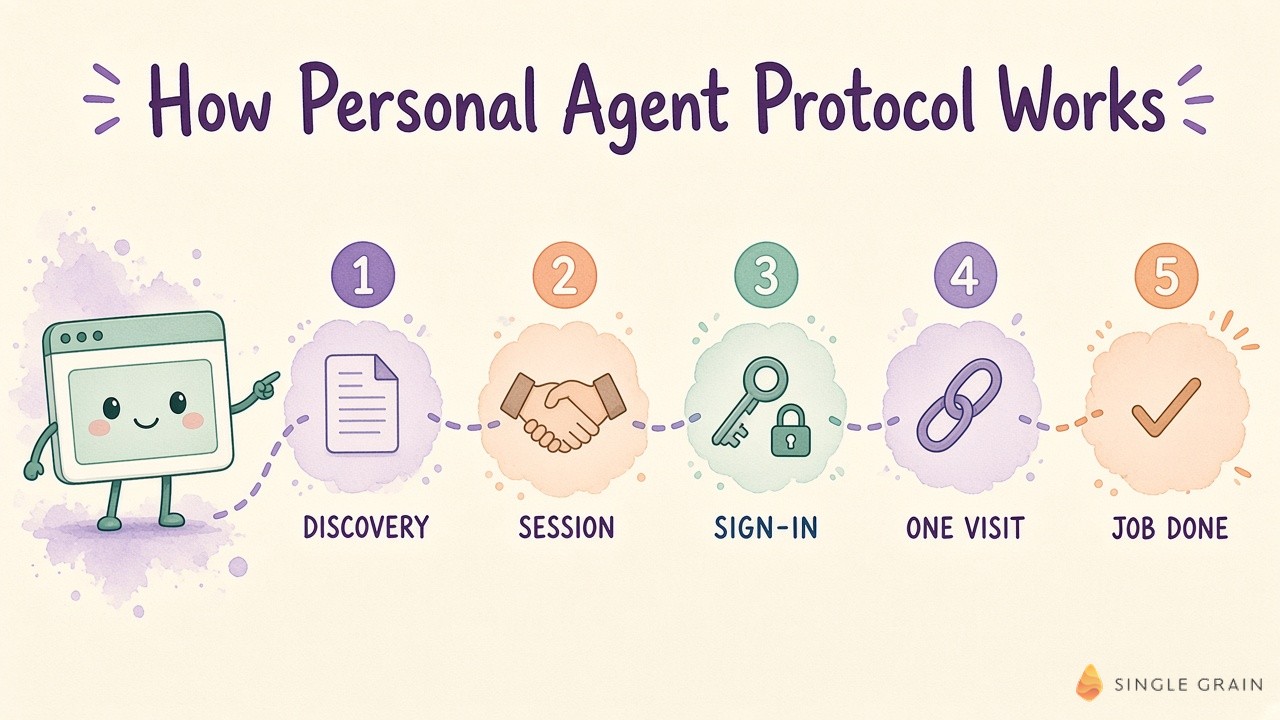
The draft spec, nicknamed Poppy, breaks every agent visit into five building blocks:
- Discovery. A company publishes one file at /.well-known/poppy.json. It tells agents how to interact with the business, how customers sign in, and what an agent may do.
- Session. The agent starts a session for its customer, often as a guest first. It identifies itself, so the company always knows an agent is acting.
- Sign-in. When a task needs the customer’s account, the person signs in through OAuth. If the company allows it, the agent can use a token limited to what the customer approved.
- One visit across channels. The same token works on the company’s website, its APIs, and its own agent. A question asked before sign-in and an order change made afterward count as one visit.
- Job done. The company picks the route. Agents can browse regular pages, connect through APIs built on OpenAPI and MCP, or talk to the company’s own agent for jobs like a warranty claim.
Need help visualizing this? Alex McGillis, VP of Product at Rocket, showed the protocol live at Sierra Summit using Meta’s Muse. Definitely take a look!
Muse found Rocket’s agent through the protocol, asked for his permission to connect, and worked through the numbers until a mortgage pre-approval letter was ready.
Who Is Building Personal Agent Protocol?
Sierra, the enterprise AI startup co-founded by Bret Taylor and Clay Bavor, is leading the effort with Meta. Launch partners included Genesys, Instinct, NiCE, Rocket, Shopify, Stripe, and Walmart.
Three days after the announcement, Sierra published the draft and named thirty-five more design partners. The new list includes:
- Bank of America
- Cloudflare
- Mastercard
- OpenAI
- PayPal
- Target
- United Airlines
- Visa
- Zapier
- Zendesk
For me, OpenAI’s spot caught my eye. In the CNBC interview, I noticed that Taylor said OpenAI and Anthropic weren’t on board yet and said he expected the big AI labs to join. Not to my surprise, OpenAI appeared on the design partner list just a few days later.
Meta has its own reasons to push. Its Muse agent climbed to the top of Apple’s App Store after launching in early September, and David Singleton, VP of engineering and consumer products at Meta Superintelligence Labs, told CNBC Muse already has millions of US users.
So why does any of this need a standard at all?
Why Agentic Commerce Needs a Standard
Right now, every company handles agent visits its own way. Some let agents browse, some break them by accident, and a few block them outright.
For example, Amazon has blocked Meta’s agents over scraping worries. It also sued Perplexity in November 2025, alleging the startup disguised its shopping agent to keep scraping Amazon’s site.
Each group wants something different from the connection, and Sierra lays out three needs.
- Consumers want speed and trust. They want the job done right the first time, by an agent acting in their best interest.
- Brands want visibility and control. They want to know when an agent acts for a customer and to decide what it can do.
- Agent builders want access. They want one consistent way to work with every participating company.
Taylor compared the fix to signing in with your Google or Facebook account, which he worked on as Facebook’s tech chief. Singleton compared it to email, a standard anyone can use to reach anyone else. Both point to one goal, shared rails for every agent and every business.
What Agentic Commerce Means for B2B Sites
Most launch examples are consumer jobs, such as returning a jacket or rebooking a canceled flight. So why should a B2B marketer care? Because the same pattern shows up when buyers research vendors.
Personal agents can already read pricing pages, compare features, and fill out forms. My team’s playbook for marketing to AI agents focuses on getting recommended in the first place. This protocol adds the plumbing underneath, so an agent can say who it works for and what it’s allowed to do.
Where B2B Buyers Will Feel It First
I expect four moments to change before anything else.
- Demo and meeting booking. An agent booking a sales call needs a clean form or calendar API, plus a way to say who it represents.
- Plan and pricing questions. Guest access may be enough to answer what does the team plan include? if your facts live on plain, readable pages.
- Account tasks. Renewals, seat changes, and invoice requests need sign-in with limited permissions, which the protocol’s OAuth flow is designed for.
- Support conversations. Warranty-style requests route to your own agent, so your support bot turns into a sales and retention channel.
In my view, companies with clean, structured facts will win these moments first. Search visibility still matters too, and answer engine optimization is how you stay visible when an agent does the searching.
Agentic Commerce Site-Readiness Checklist
Here’s the checklist my team uses to pressure-test a site for agent visitors. None of it depends on the final spec, and every item helps human visitors too.
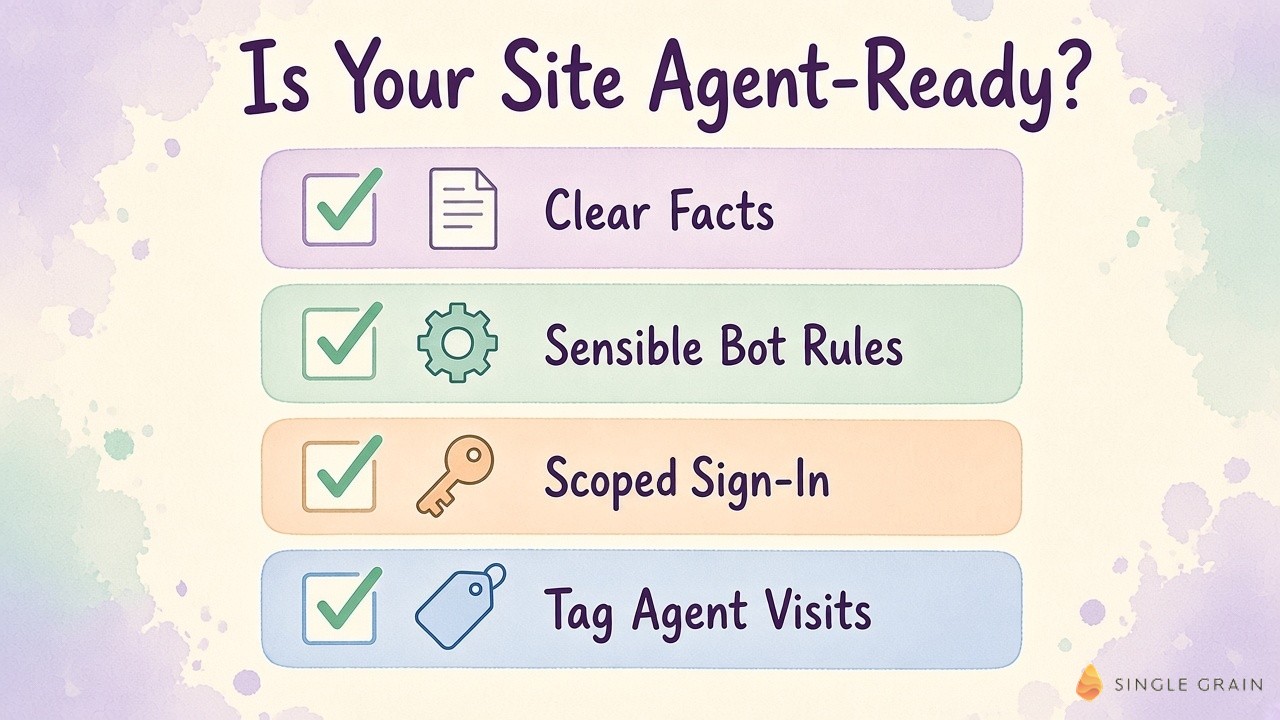
- Map guest tasks and signed-in tasks. List the jobs an agent might do on your site. Mark which ones are safe for a guest, such as pricing, availability, and policies, and which ones need an account.
- Put key facts in plain HTML. Your pricing, plan limits, integrations, and policies should live in readable text with clear headings. My team’s crawl and citation readiness checklist covers the technical side.
- Review your bot rules. Check robots.txt, your firewall, and any bot-management settings, so you know which agents you allow, challenge, or block. Cloudflare is a design partner, so I’d watch for agent-aware options in bot tools.
- Support scoped sign-in. The draft relies on OAuth, so confirm your login can grant read-only or limited access. Write access raises real AI agent security questions, so start small.
- Expose your top tasks through APIs. If you already have an OpenAPI spec or an MCP server, list which actions it covers, such as booking a demo or checking an order.
- Tag agent visits in analytics and your CRM. Record when an agent books a meeting or submits a form, so sales knows who is behind it. Clear lead source rules for agent-booked meetings keep the intent data intact.
- Name an owner for the spec. Someone on your team should read the draft at personalagentprotocol.org and track changes until a stable version ships.
If you only have time for four items this month, start with the ones in this sketch.
| Pay Attention |
|---|
| Poppy is still a draft. Sierra plans design workshops and a reference implementation over the coming month, so file formats and fields may change. Prepare your facts and permissions now, and wait for a stable spec before you publish a poppy.json file. |
Once these basics are in place, the bigger question is where the spec goes from here.
What to Watch as the Spec Evolves
Sierra has been upfront about what’s still missing. Its launch post lists three likely additions, and each one matters for marketers.
- More detailed permissions. Customers and companies could set limits on specific actions, such as allowing a quote request while blocking a purchase.
- Push notifications. A company could tell an agent the moment an order ships or a flight is delayed, which opens a brand-new channel for updates.
- Payments extensions. An agent could complete a purchase without sharing card details, which is where agentic commerce gets very real.
Poppy also sits next to other efforts. Sierra describes the Universal Commerce Protocol as focused on shopping, from finding products to checkout, and calls its own protocol complementary because it covers identity, permission, and any kind of task.
My advice is to watch both and build on the shared basics. Clean data and sensible permissions carry over to whichever standard wins.
| Pro-Tip |
|---|
| Ask a personal agent to complete one real task on your site this week, such as booking a demo or finding your pricing. Watch where it stalls, and fix the page first. |
One honest test like this usually teaches you more than any spec document.
Open the Front Door Before the Agents Knock
When it comes to Personal Agent Protocol, it’s obvious that agents need a trusted way to say who they work for, and companies want control over what those agents can do. Sites with clear facts, sensible permissions, and agent-aware tracking will be ready on day one.
My team at Single Grain helps B2B brands get found and chosen across search engines and AI answers. If you want help getting your site ready for agent visitors, explore our Search Everywhere Optimization services or see how our AEO services get brands cited in AI answers.
And, of course, if you have any questions about how Personal Agent Protocol might impact your site, don’t hesitate to reach out to me. Get in touch with my team here or message me on X!
Frequently Asked Questions About Personal Agent Protocol
-
What is Personal Agent Protocol?
Personal Agent Protocol is an open standard that Sierra and Meta are developing with industry partners. It defines how personal AI agents discover a business, identify themselves, get the customer’s permission, and complete tasks through a company’s website, APIs, or its own agent.
-
What is agentic commerce?
Agentic commerce is buying, booking, and account management where an AI agent acts on a person’s behalf. Standards such as Personal Agent Protocol aim to make those agent visits secure and visible to the business.
-
How does a personal AI agent sign in to a website?
Under the draft protocol, the customer signs in on the company’s own page through OAuth. If the company allows it, the agent then uses a session token that grants only the access the customer approved, such as read-only or write access.
-
Is Personal Agent Protocol available now?
Sierra has published a draft, nicknamed Poppy, and plans design workshops and a reference implementation over the coming month. Treat it as a working draft and expect changes before a stable version.
-
How can a B2B company prepare for agentic commerce?
Put pricing and policies in plain, crawlable pages, review your bot rules, support scoped sign-in, and tag agent visits in your analytics and CRM. This technical SEO checklist for LLM scrapers covers the crawl side.