

Technical SEO for LLM Scrapers: Crawl, Chunk, and Citation Readiness Checklist


Can LLM scrapers crawl, chunk, and cite this page?
LLM scraper readiness starts with access, extractable answers, and claims that retain their sources when separated from the page. The deliverable is a reusable checklist tied to URLs, evidence, and owners. It does not predict citations or assign an LLM visibility score. Buy implementation help when these controls cross SEO, engineering, and content responsibilities without a clear operator.
- Test the intended crawler’s access, not a generic “AI allowed” setting.
- Make the answer available in retrievable HTML with stable section boundaries.
- Keep qualifications and supporting sources beside the claims they support.
- Route failures through a repeatable job before buying expensive generation.
At a pre-release review, a technical SEO opens a money page’s robots rules beside its rendered preview. The preview contains the offer and its supporting evidence. The crawler-specific rule blocks the URL. This worked example starts with a concrete artifact: a page that looks ready to a buyer but is unavailable to the intended crawler.
In the same review, a content engineer compares the response HTML with the browser DOM. Navigation links arrive immediately; the answer block appears only after JavaScript runs. The checklist has no answer selector or chunk boundary. These are illustrative implementation failures, not Single Grain client results. Both require a page-level fix before another model purchase.
Job delta: Closest live technical SEO checklists target Googlebot. This page adds crawl→chunk→cite-ready controls for LLM scrapers, with pass/fail evidence per URL.
Kill rule: any Fail without owner+fix ticket → block “AI-ready” claim on that URL.
Operator artifact : LLM scraper readiness checklist (illustrative ACME row; not a client result). Eng+content blocks “AI-ready” claims until Pass/Fail is evidenced:
| URL | Crawl allow | Answer block | Cite-ready claim | Owner | Pass/Fail |
|---|---|---|---|---|---|
| /services/technical-seo | Intended crawler blocked by /services/ rule | #service-answer | Missing beside claim | Alex, eng (example) | Fail |
Open Future Forum (2026-09-06) puts 81% of 230 leaders past exploring agentic AI, so fix crawler access and extractable answer blocks before buying another model.

Eric’s Jev as the fast cheap middle layer: classify, apply criteria, route between models and ops changes where control sits before the next expensive write. The same review applies Reusable workflows beat custom premium work; build them, then hand them to the team, so uncertain rows route to a human instead of auto-publishing. Together with the embedded scene above, that is three on-angle Eric tape inputs for this job, not a link dump.
TABLE OF CONTENTS:
- Why a visibility scorecard is not crawl readiness
- Worked scene: the bot that fetches your nav chrome and misses the answer block
- Worked scene: checklist fields for crawl, chunk, and cite surfaces
- LLM scraper readiness checklist (crawl, chunk, cite, block, owner)
- Single Brain installs the system; Single Grain runs it when you need the team
Why a visibility scorecard is not crawl readiness
A visibility report records whether a sampled answer mentions your brand. Crawl readiness asks whether a particular agent can retrieve a particular URL and extract a useful, attributable passage. A mention cannot prove that your current pricing page is accessible. An accessible pricing page cannot guarantee a mention.
Single Grain’s LLMO best-practices guide covers the broader optimization program. This checklist addresses the implementation handoff underneath it: access rules, canonical targets, answer selectors, chunk boundaries, and source-bearing claims. It produces repair tickets, not another visibility dashboard.
Google’s guidance for AI features in Search points publishers toward existing SEO foundations rather than special AI markup. That supports the recommendation in Single Grain’s AI search optimization is SEO: repair the discovery and content layer before commissioning a parallel “GEO-only” stack. Google’s requirements apply to Google; other crawlers still need their own access tests.
The Open Future Forum September 2026 report reports that 81% of 230 marketing and growth leaders were past exploring agentic AI. Attribution was the leading named challenge, appearing in 20 of 96 open answers. Those are different denominators, and neither measures scraper readiness. They support an operational purchase decision: require evidence trails alongside automation.
Worked scene: the bot that fetches your nav chrome and misses the answer block
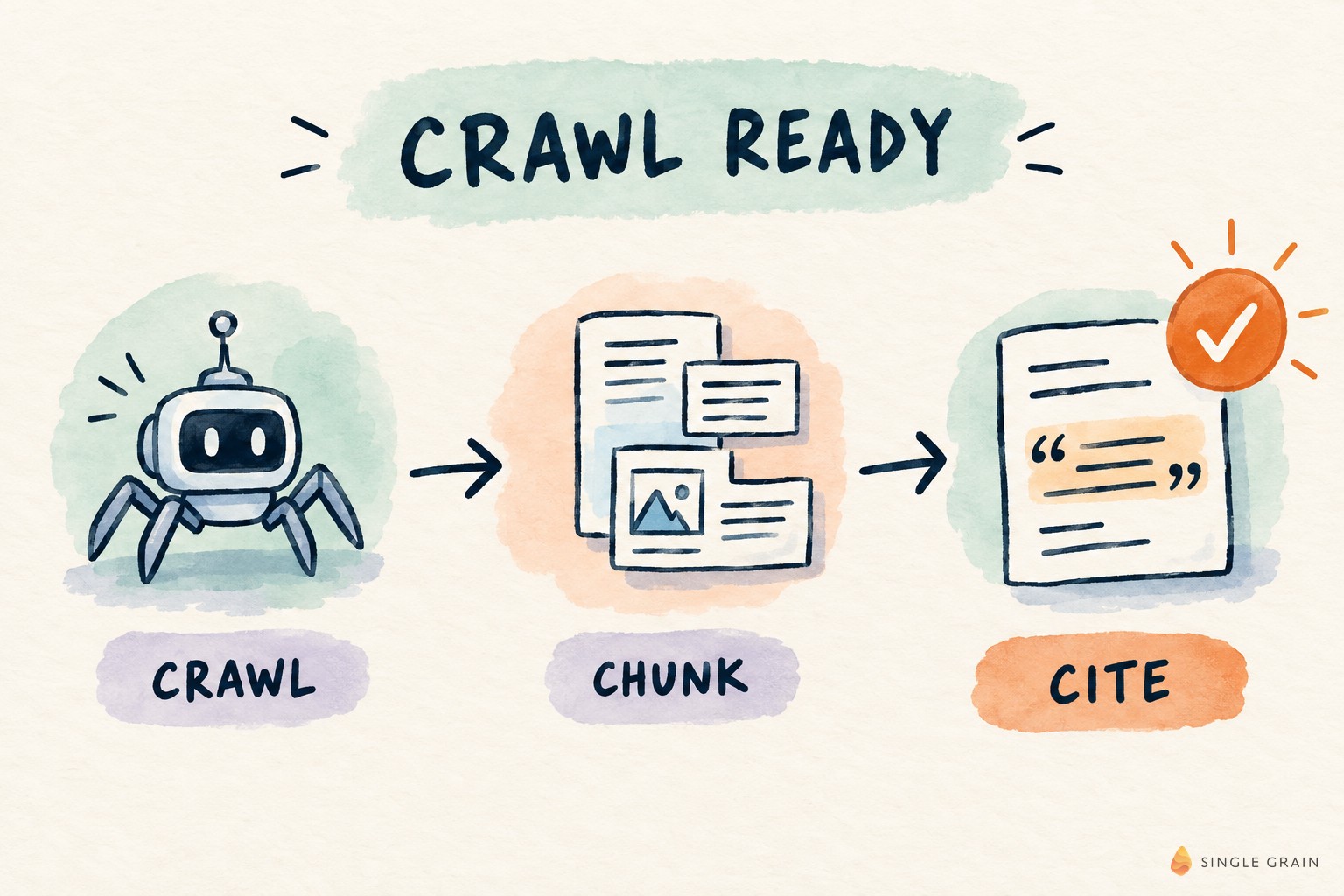
In Eric’s September video, “A better model still needs a better workflow,” the discussion moves from model improvement to the workflow that makes the model useful. Applied to this page review, the sequence is concrete: inspect the fetch, locate the answer block, then repair the extraction contract. The scraper-specific example is our application of that lesson, not a claimed demonstration from the video.
The engineer fetches the example service URL and finds a header, navigation menu, and application shell. The browser eventually displays the answer, but the tested non-rendering fetch does not. Asking a stronger model to summarize that response gives it more capability without supplying the missing text.
Assign the fix to content engineering: deliver the essential answer in server-rendered or static HTML, give it a stable selector such as the explicit input contracts used for reliable marketing bots, and separate sections with meaningful headings. A selector such as #service-answer is a local extraction contract, not a universal crawler standard. The acceptance test is whether the chosen fetch method returns the answer and its qualifications together.
Do not buy a stronger model to conceal missing schema or controls. First supply a stable content structure and an extraction test. Add relevant structured data only when it accurately describes visible content. No markup can substitute for an answer absent from the retrieved page.
Worked scene: checklist fields for crawl, chunk, and cite surfaces
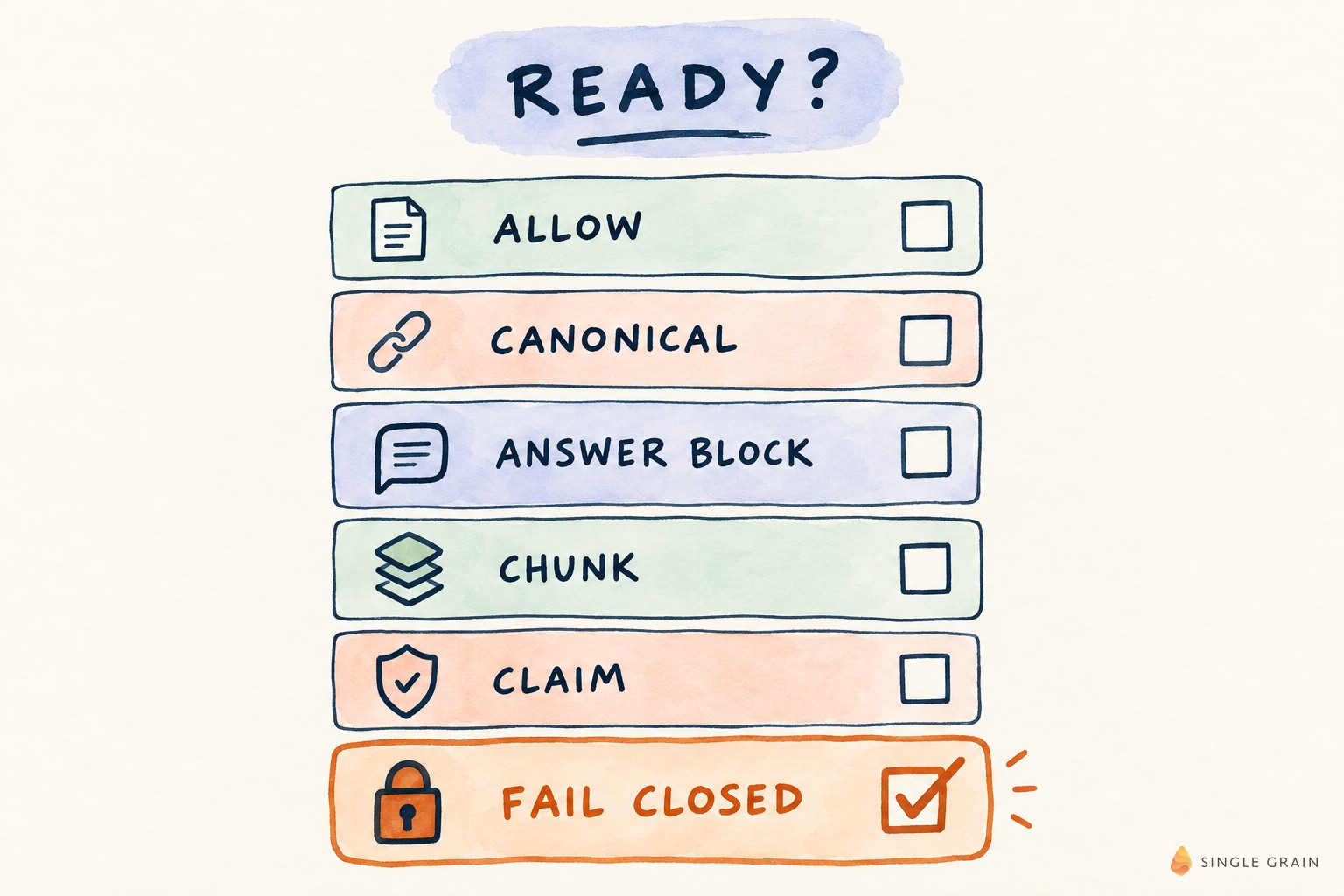
The technical SEO now checks the blocked money page from the opening review. The input bundle contains the URL, intended user agent, robots file, response headers, canonical element, and retrieved HTML. The checklist records which rule blocks access rather than collapsing every crawler into one permission.
Google’s robots.txt documentation describes crawler access controls and their limitations. Robots rules are not authentication, and blocking crawling does not reliably remove a URL from search results. Keep private content behind access controls. For public content, distinguish crawl permission from indexing and snippet directives, and check the relevant crawler’s documentation.
The filled artifact below uses illustrative URLs and proposed content. “Pass” means the stated local check succeeds, not that an LLM will cite the page. The proposed service claim must match the actual offer before it becomes production copy.
LLM Scraper Readiness Checklist
| URL | Crawl allow | Canonical | Answer block selector | Chunk boundary | Cite-ready claim | Owner | Pass/Fail |
|---|---|---|---|---|---|---|---|
| https://example.com/services/technical-seo | Intended crawler blocked by /services/ rule | Self-referencing | #service-answer absent from fetched HTML | No boundary in fetched HTML | Proposed: “The audit covers crawl directives and canonical targets.” Supporting scope absent. | Technical SEO lead + web engineering | Fail: access and extraction |
| https://example.com/docs/audit-scope | Intended crawler allowed | Self-referencing | #audit-scope present in HTML | H2 “Included checks” through next H2 | “The audit checks robots rules and canonical targets.” Adjacent list defines both checks. | Content engineering lead | Pass: local retrieval and scope check |
Canonicalization identifies the preferred URL; it does not compel a model’s citation choice. A useful chunk contains the claim, its scope, and supporting evidence without borrowing essential context from a distant accordion. For numerical claims, retain units, dates, denominators, and source links inside the same logical section.
LLM scraper readiness checklist (crawl, chunk, cite, block, owner)
Run the checklist as a bounded job with a defined URL set and saved fetch evidence. Eric’s Jev middle-layer discussion recommends inexpensive classification, criteria checks, and routing. Apply that before drafting: classify each failure as access, extraction, evidence, or ownership, then send it to the responsible owner.
- Crawl: record the target user agent, applicable rule, response status, and redirects. Separate intended blocks from defects.
- Chunk: test the answer selector against retrieved HTML and retain the heading hierarchy, qualifications, and adjacent evidence.
- Cite: verify that the claim is supported and its preferred source URL resolves. Use retrieval source allowlists to constrain acceptable evidence.
- Block: preserve explicit exclusions for private, licensed, or otherwise restricted material. Do not bulk-remove controls.
- Owner: attach the evidence, responsible role, repair instruction, and repeatable acceptance test to each ticket.
Keep the human ship gate here. Eric’s early Jev work tests support routing uncertain classifications to review rather than automatic action. Name the technical SEO lead as approver for crawl changes and the content engineering lead for extraction changes; do not auto-publish either from a classifier’s output.
Eric’s reusable-workflow recommendation changes the deliverable: build a job card the team can rerun after template changes, rather than commissioning a fresh premium audit each time. His decision-layer discussion adds a constraint: label thin evidence thin, and use misclassifications to improve checks before expanding automation.
Single Brain installs the system; Single Grain runs it when you need the team
Single Brain is the AI implementation OS for job-specific agents, evaluation, and kill switches. Scope this installation around the checklist: a URL queue, saved fetches, deterministic access checks, extraction tests, evidence routing, and a stop control for unexpected behavior. The operator view should expose the retrieved passage and failure reason, not just a green status.
Keep the work manual when permissions are unresolved, the page set changes rarely, or the business cannot define acceptable evidence. Automate repeatable checks once the inputs and acceptance criteria are stable. A stronger model remains the wrong purchase when the answer block, schema, or control layer is missing.
Hire Single Grain to install and run the system when you need SEO, engineering, and content operations without staffing that coordination internally. Bring your money-page URLs, crawler policy, and representative templates to a Single Grain consultation. Scope the engagement around repaired retrieval paths and reusable operating jobs, with citation outcomes evaluated separately.