

Gemini 4 Argon Splits Google AI Mode in Two. Is Your Brand in Both Answers?


Gemini 4 Argon just turned “what does Google say about my brand?” into a trick question. Google’s newest frontier model now answers in AI Mode, but only for people who pay for Google AI Pro or Ultra. Everyone else keeps the default model, so two people asking the same question can get answers from two different brains.
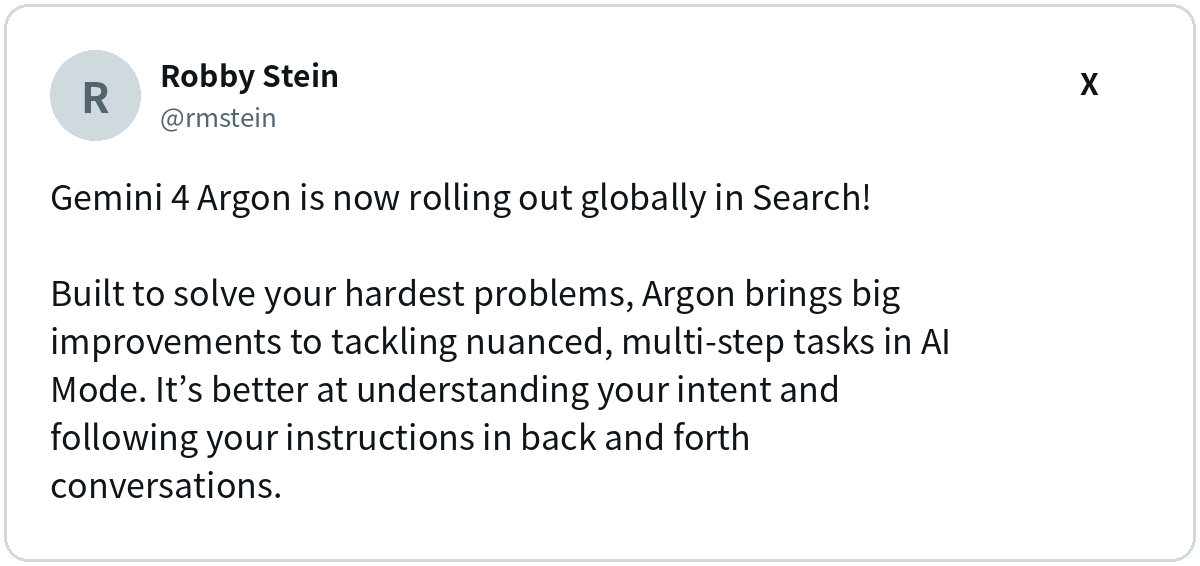
Robby Stein, VP of Product for Google Search, announced the global rollout on X, pitching Argon as better at nuanced, multi-step tasks.
My first thought jumped straight to reporting. If paid and free searchers can see different brands in their answers, which one is your AI visibility report describing?
In this guide, I’m going to break down what Gemini Argon 4 is, what Google claims about it, and the experiments I’d run first depending on your role.
TL;DR
- Argon is an opt-in model in AI Mode. Pro and Ultra subscribers can switch to it from the “+” menu in the search bar. Free users keep the default.
- Google pitches it for multi-step tasks. The claim is better handling of nuanced requests and follow-up instructions in back-and-forth chats.
- Paid and free searchers may see different answers. Test key queries on both lanes and compare which brands and sources show up.
- Don’t rewrite pages “for Argon” yet. Gather a few weeks of side-by-side data first.
TABLE OF CONTENTS:
- What Is Gemini 4 Argon?
- Who Gets Argon in AI Mode?
- Does a Paywalled Model Split Your Audience?
- Experiment 1: The Side-by-Side (for SEO Leads)
- Experiment 2: The Follow-Up Chain (for Content Teams)
- Experiment 3: The Ad Log (for Paid Search Managers)
- Experiment 4: The Shopping Trip (for E-commerce and Local)
- So, What Should Founders Actually Measure?
- Test Gemini 4 Argon Before You React to It
What Is Gemini 4 Argon?
Google’s Gemini 4 Argon announcement describes a model built for long, multi-step work across coding, enterprise knowledge work, and cyber defense. It first went to a set of trusted cyber defenders through Google’s Fairwind Program before opening up.
The spec sheet nerds will enjoy this one. Google raised the output limit to one million tokens, up from sixty-four thousand. For search, though, the multi-step part matters far more than raw length.
Argon now lives in several places:
- Developers through the paid tier of the Gemini application programming interface (API).
- Ultra subscribers in Google’s coding tool, Antigravity.
- Pro and Ultra subscribers in the Gemini app and in AI Mode.
Each of these doors serves a different crowd, and for marketers or businesses, AI Mode has by far the biggest reach. Access there comes with a catch, though.
Who Gets Argon in AI Mode?
Paid subscribers only, for now. Search Engine Journal reported the global rollout in Search, and because it’s rolling out, it may not appear on every account right away.
Will it become the default for everyone? Nobody outside Google knows. Gemini 3 Flash and 3.5 Flash both launched as defaults, while Gemini 3 Pro launched as an option and stayed one. Pick your favorite crystal ball.
| Quick Take |
|---|
| For most of your searchers, the default model is still doing the answering. Argon results are a preview of where AI Mode could go, so keep them next to your main tracking. |
This paid-only access is exactly what makes the next question so important for marketers.
Does a Paywalled Model Split Your Audience?
Here’s the part that made me put my coffee down. Google’s strongest model now lives behind a subscription, which means two people can type the exact same question into AI Mode and walk away with different answers.
One searcher pays for Google AI Pro or Ultra and gets Argon. The other uses the free default model. Same query, same moment, possibly a different set of brands recommended and a different set of sources linked.
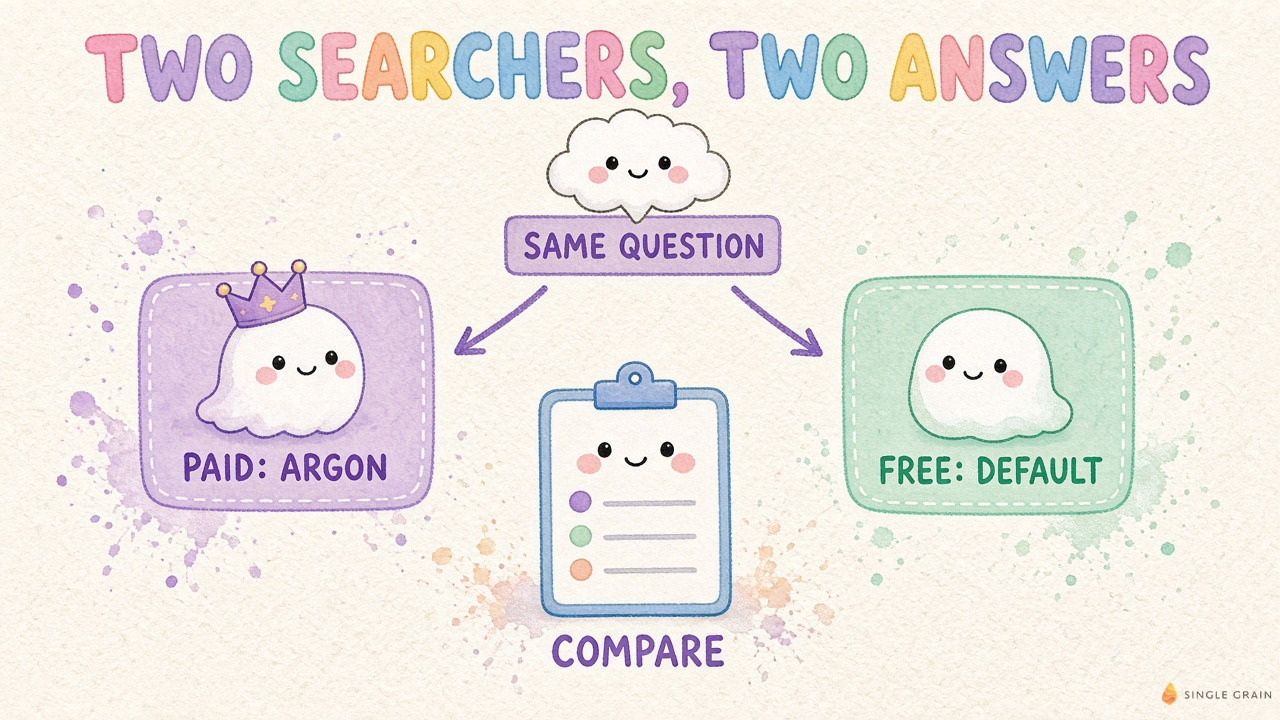
This split matters most for your reporting. If your team checks AI visibility from a free account, the snapshot you see may only describe part of your market.
Think About Who Actually Pays for AI Tools
Founders, marketers, developers and other heavy users are early adopters, and for a lot of B2B brands that overlaps nicely with the buyers who sign contracts. If these people sit in the paid lane, your free test account is showing you a different answer than the one your best prospects get.
I’m treating this as a gap to measure before anyone panics. The answers might match closely for your category, or they might differ a lot. You only find out by checking both lanes.
The only way to know how big that gap is for your brand is to test it, starting with a simple side-by-side.
Experiment 1: The Side-by-Side (for SEO Leads)
Hypothesis: Your brand shows up differently on Argon than on the default model.
Method: Pick ten buyer questions. Run each on Argon and on the default. Same wording, fresh chats, same day. For each answer, log whether your brand appears, which sources are linked, and which competitors show up. Google is giving links more room in AI Mode, so the sources column may matter as much as the brand column.
If you already track prompts with LLM tracking software for brand visibility, add a model column so the two lanes don’t blur together. Single prompts only tell part of the story, though, since Google’s pitch for Argon is about follow-ups.
| Pro-Tip |
|---|
| Test from two accounts, one paid and one free, rather than flipping models on one account. It’s closer to what real paid and free searchers see. |
Experiment 2: The Follow-Up Chain (for Content Teams)
Hypothesis: A model better at follow-ups will drop brands whose pages lack specifics.
Method: Test full chains of prompts, start to finish. For a project management tool, it might go like this:
- Broad: “What’s the best way to manage a remote design team?”
- Constraint: “We’re twelve people and need client approvals built in.”
- Shortlist: “Give me three tools and why.”
If you vanish at step two or three, your content probably lacks the details a constraint needs, like team size, use case, or integrations. Pages built for “best SaaS tools” queries in AI models spell those out.
Follow-up chains also give paid search teams a chance to watch where ads land.
Experiment 3: The Ad Log (for Paid Search Managers)
Hypothesis: Longer conversations change when commercial moments show up.
Method: During your follow-up tests, note when ads appear and at which step. Don’t touch budgets off a handful of searches. Just start the log, so you have a baseline if Argon ever becomes a default. Meanwhile, keep automated campaigns honest with the real controls and tradeoffs in Performance Max. Shopping and local tasks deserve a spot in the log too, since they lean on exact facts.
Experiment 4: The Shopping Trip (for E-commerce and Local)
Hypothesis: An instruction-following model leans harder on exact facts.
Method: Script a full buying task. “Find a waterproof hiking boot under my budget, then show the ones with free returns.” Or “Who does same-day AC repair near me, and which ones have weekend hours?” Then check two details. Does your brand make the final list, and are your prices, hours, and policies right?
The fix is mostly housekeeping. Put price ranges, service areas, hours, and return policies in plain text on your pages, and make them match your listings elsewhere.
| Watch Out |
|---|
| Neither Google’s post nor Stein’s announcement named which languages Argon supports in AI Mode, and an earlier Flash rollout was English only. If you market in several languages, test each market separately. |
All four experiments feed into one question for the person who signs off on the budget.
So, What Should Founders Actually Measure?
I recommend you start with the model your customers actually see. A new one shows up every few weeks, and chasing all of them is a great way to get nothing done.
Ask for one monthly check on your top buyer questions across the models your customers likely use. My team’s view at Single Grain is the fundamentals travel well between models, while the specifics are where answers differ.
These fundamentals are clear facts, strong third-party mentions, and pages AI systems can read, all covered in our answer engine optimization (AEO) framework. Google has also said optimizing for AI search is SEO, so the same work pays off in both lanes. Run that sheet for a month or two, and you’ll be reacting to real data instead of guesses.
| Action Step |
|---|
| Make one sheet with ten buyer questions as rows and two columns, Argon and default. Fill in brands mentioned and sources linked. Share it with your team and redo it next month. |
Test Gemini 4 Argon Before You React to It
Gemini 4 Argon adds a paid lane to AI Mode, and paying searchers may now see a different Google than everyone else. The smart move is a side-by-side test, a log of follow-up chains, and patience before you rewrite anything.
Want help tracking how AI Mode and other AI answers talk about your brand? See how my team at Single Grain approaches AEO, and let’s find out how you are performing across LLMs.
Frequently Asked Questions About Gemini 4 Argon
-
Who can use Gemini 4 Argon in AI Mode?
Google AI Pro and Ultra subscribers can choose Gemini 4 Argon in AI Mode from the plus icon in the search bar. Free AI Mode users keep the default model.
-
Is Gemini 4 Argon the default model in AI Mode?
No. It’s an option paid subscribers can switch to. Google hasn’t said whether it will ever become the default for everyone.
-
What is Gemini 4 Argon best at?
Google says Argon handles nuanced, multi-step tasks better and follows instructions more closely in back-and-forth conversations. Those are Google’s claims, so test them with your own queries.
-
Should I optimize my content for Gemini 4 in AI Mode?
Not yet. Track how answers differ between Argon and the default model first. The fundamentals, like clear facts and crawlable pages, help across every model.
-
How do I switch to Gemini 4 Argon in AI Mode?
If you have Google AI Pro or Ultra, open AI Mode and choose Argon from the plus menu in the search bar. The rollout is gradual, so it may not appear on every account right away.