

Is AI Content Bad for SEO? Google Finally Gave a Straight Answer


Is AI content bad for SEO? I’ve answered this question with a nervous “it depends” more times than I’d like to admit, mostly because Google’s own answer sounded like a shrug. That just changed, and the new wording is a lot less polite.
Google updated its guidance on helpful, people-first content, and two lines jumped out at me. Fake authors now get called deception by name, and large amounts of unreviewed AI text get labeled “little to no effort.”
So what’s the verdict? Mostly no. Google still doesn’t care which tool wrote your first draft. But the algorithm absolutely cares whether a real person stands behind the page and whether the page adds anything new (aka it provides real value to the reader).
I’ll walk through what Google changed, the myths it just knocked over, and a fast audit for the bylines and pages most likely to get you in trouble.
TL;DR
- AI content isn’t banned. Google’s guidance is about effort, originality, skill, and accuracy, not the tool.
- Fake authors are now named as deception. Google lists AI-generated headshots, made-up names, and false credentials.
- Unreviewed AI text counts as low effort. Mass AI text “without manual oversight or curation” is Google’s own example of little to no effort.
- The fix is a real human in the loop. Put a real expert’s name on each page, have them review it, and add something only you have.
TABLE OF CONTENTS:
- What Exactly Did Google Change?
- Does Google Penalize AI Content Automatically?
- Can a Made-Up Expert Still Add Authority?
- If You Cite Your Sources, Is a Rewrite Original?
- Does Publishing More AI Pages Mean More Traffic?
- Should You Hide It When You Use AI?
- How Do You Find Fake Authors on Your Site?
- AI Can Write the Draft, but a Human Has to Own the Page
What Exactly Did Google Change?
Google now explicitly aims its update right at bad AI content habits many sites picked up once AI writing got cheap.
The first is about authors. Google says to avoid deceptive authorship. For example, it directly names “AI-generated headshots, made-up names, or false credentials” as examples, and says deception “makes a page untrustworthy to both users and our automated quality systems.”
The second is about effort. In its section on how quality raters judge main content, Google lists effort, originality, talent or skill, and accuracy.
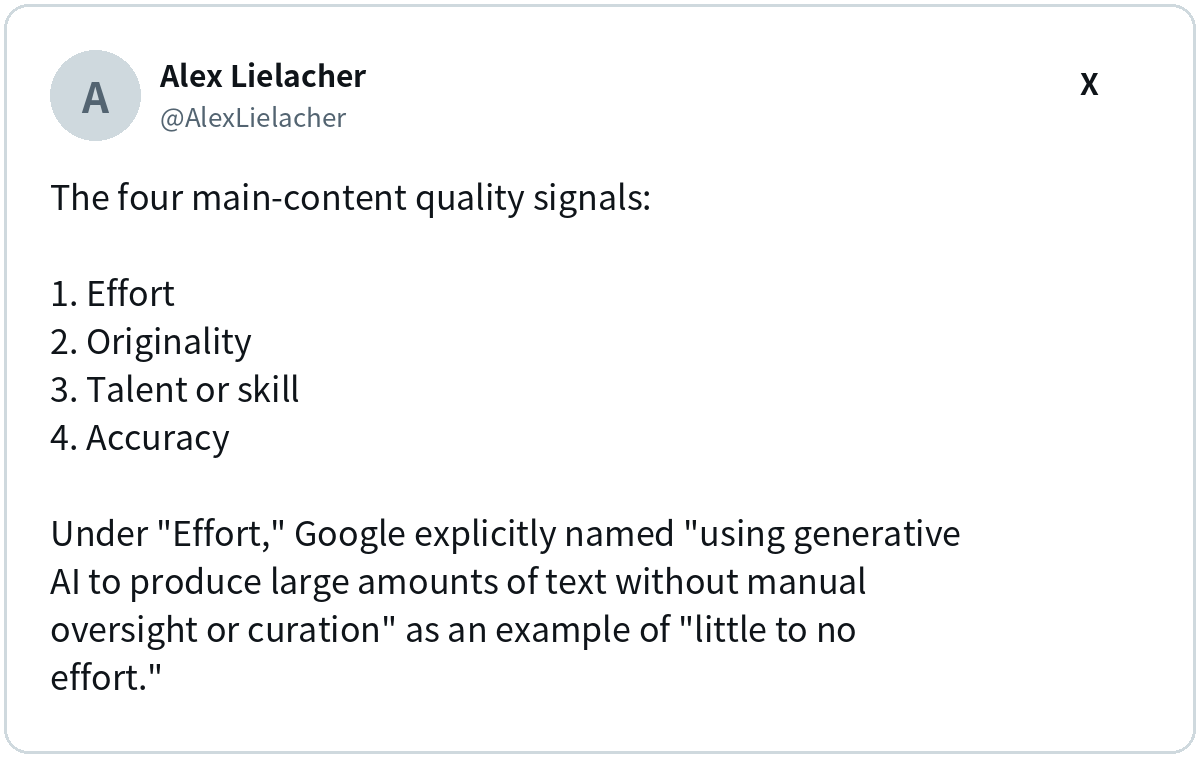
Google also states that credit to other sources “doesn’t replace the need for original effort.” This one quietly hits a lot of AI content workflows, and we’ll get to it.
| Quick Take |
|---|
| The new guidance doesn’t punish AI. It punishes pretending. Pretending a person exists, and pretending a summary is original. |
With those two lines in mind, the obvious next question is whether Google simply penalizes anything an AI touched.
Does Google Penalize AI Content Automatically?
No. Google hasn’t described any system that drops every page an AI touched. Google said back in 2023, in its post on how Google Search views AI-generated content, that it rewards quality however content is produced.
What breaks the rules is automation used to manipulate rankings, which its spam policies cover directly. So the line isn’t AI versus human. It’s help versus manipulation.
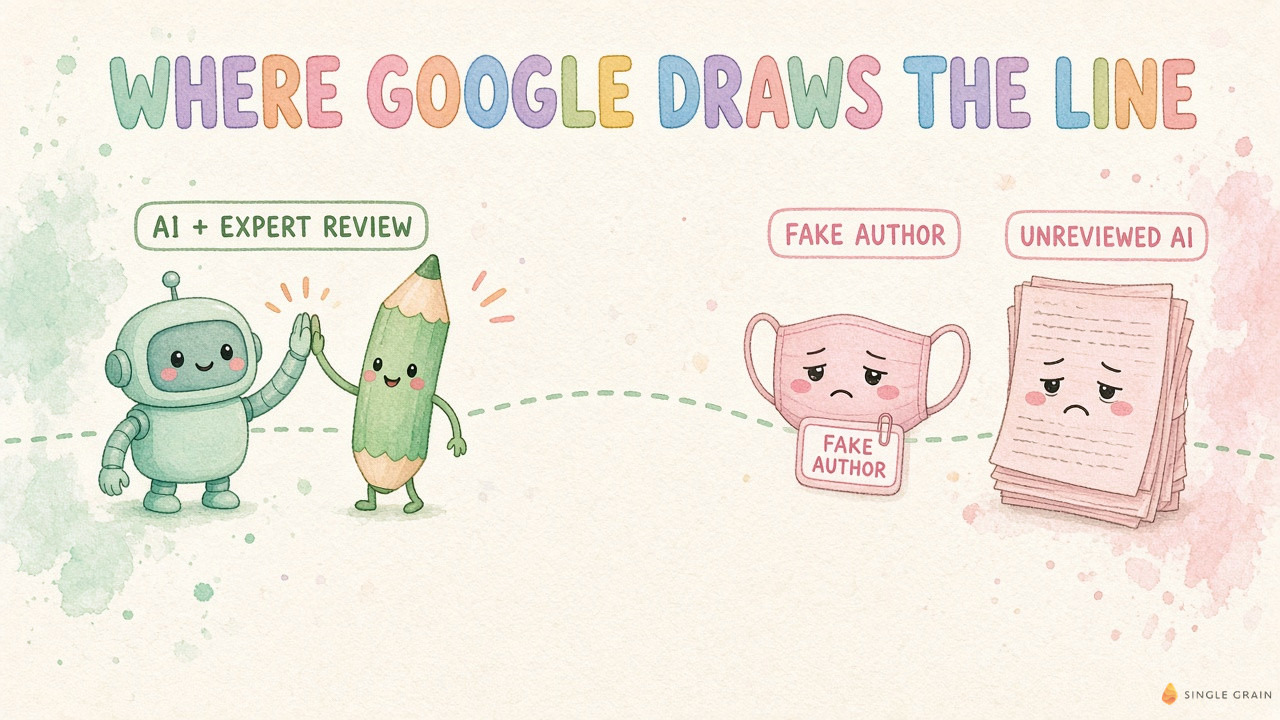
This brings us back to our original question: Is AI content bad for SEO? Truthfully, my team uses AI every day in content work. The test we apply is simple and effective. Would a reader trust this, and does it add something new? If the content is slop and adds no value, then it gets optimized or tossed.
You can absolutely use AI for SEO and pass both questions. Passing the trust question gets much harder, though, when the name on the page belongs to someone who doesn’t exist.
Can a Made-Up Expert Still Add Authority?
Not anymore, and honestly it never should have. A fake expert with an AI headshot doesn’t add trust. Once someone checks, it removes trust, from that page and from every page carrying the same byline.
If your site ever used placeholder or invented bylines, now is the time to fix them. Google’s guidance asks whether bylines lead to more information about the author, so make sure yours lead somewhere real. A real bio, real experience, and links to where the person works or writes elsewhere.
These E-E-A-T strategies show how to build it properly. To see why fake bylines do so much damage, it helps to look at how Google weighs trust.
Why This Hits Trust Hardest
E-E-A-T stands for experience, expertise, authoritativeness, and trustworthiness. Google says trust matters most of the four, and also says E-E-A-T isn’t a single ranking factor. Fake authors attack trust head-on, which is why one line in the guidance matters more than it looks.
Google also says its systems give even more weight to content with strong E-E-A-T on “Your Money or Your Life” topics, the ones that could significantly affect a person’s health, financial stability, or safety. A fake expert on a finance or health page is the worst possible place to cut corners.
Fake authors aren’t the only shortcut the guidance targets. Leaning on citations to make a rewrite look original is another.
If You Cite Your Sources, Is a Rewrite Original?
Sadly, no. A page summarizing three other articles with links at the bottom is still a summary, just a polite one.
Many AI workflows read the top results and blend them into a “new” article. Google asks whether content offers “substantial additional value and originality” over its sources. Blending isn’t value.
What counts instead? Add something only you have:
- Your own data from customers, campaigns, or tests.
- First-hand experience of what happened when your team tried it.
- A clear point of view a reader can agree or argue with.
- Real examples like screenshots, before-and-after results, or named use cases.
Originality is one problem. Volume is another, and it’s where many AI workflows go wrong.
| Pro-Tip |
|---|
| Before publishing, highlight every sentence a competitor’s page could also contain. If the highlighter runs out before the original stuff starts, the page isn’t ready. |
Does Publishing More AI Pages Mean More Traffic?
Yes and no. Let me explain.
Scale without review is exactly what Google flags. Its guidance also warns about “producing lots of content on many different topics in hopes that some of it might perform well.”
Single Grain has a case study on how AI-generated content boosted website traffic, and the lesson was never “publish more and walk away.” The wins came from AI speed plus human strategy and editing.
Watch the quiet damage too. Some AI agents rewrite pages already ranking well, so it pays to stop a content agent from killing posts that already rank.
Should You Hide It When You Use AI?
Google’s guidance points the other way. It suggests AI or automation disclosures where a reader might reasonably wonder how a piece was made, plus an explanation of how and why automation was used.
A blog post drafted with AI help and heavily edited by an expert doesn’t need a warning label. But product reviews, data roundups, or pages built mostly by automation can earn trust by explaining the process. And if your goal is readability, a few edits for making content authentically human help readers more than any label.
Disclosure only builds trust if the names on your pages are real, so the next step is checking them.
How Do You Find Fake Authors on Your Site?
This is the fun part, in a slightly grim way. One user on X shared a tidy starting point:
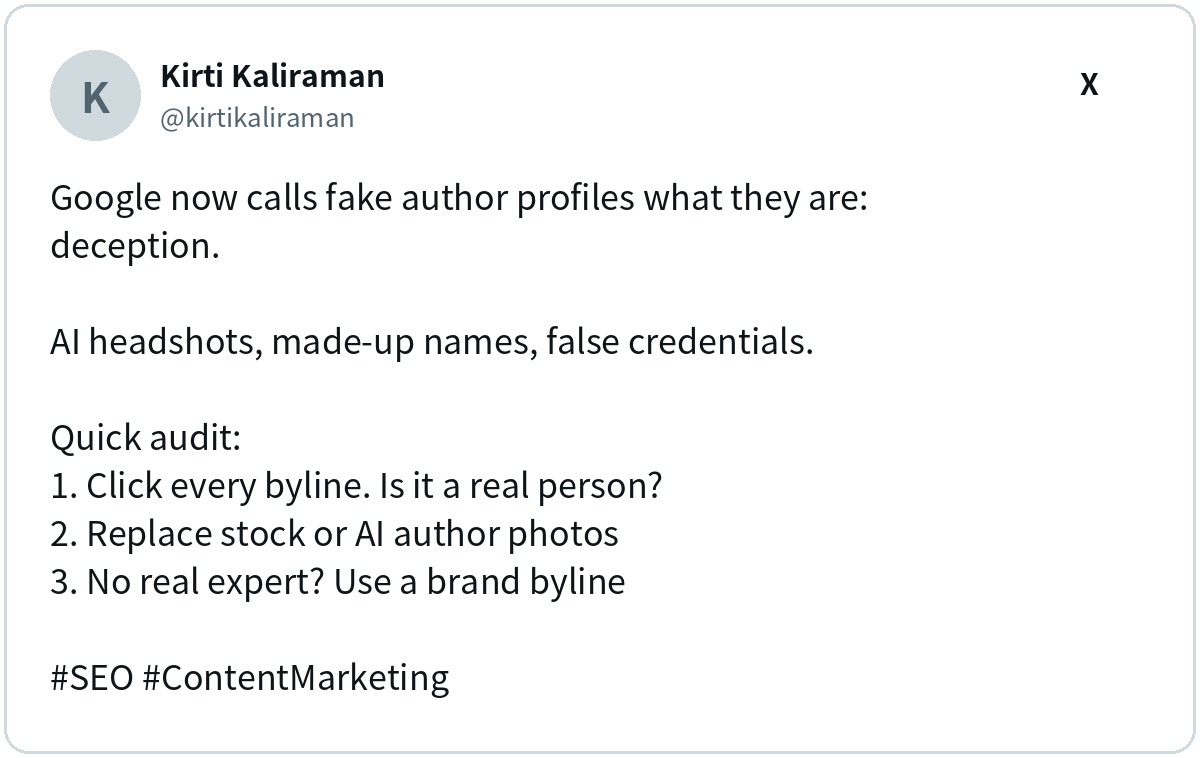
My team runs a slightly longer version:
- List every byline. Export all authors from your CMS, including old freelancers and placeholder names.
- Match each to a real person. If nobody on your team can vouch for an author, flag it.
- Fix bios and author pages. Real photos, real roles, links to profiles elsewhere.
- Retire made-up profiles. Reassign those posts to a real expert who has actually reviewed them.
Then do the content side. Sort pages by traffic loss and look for unreviewed AI text, summary-only articles, and pages with no original detail. Fix the ones worth saving and consolidate the rest. If traffic moved recently, check it the way we did after the unconfirmed Google update before changing anything.
| Starter Prompt for a Thin-Page Review |
|---|
| Here is the text of one of my blog posts and the three top-ranking pages for its main keyword. List every claim in my post that also appears in those pages. Then list anything in my post that is original, such as data, examples, or opinions. Tell me if the original part is strong enough to justify the page. |
AI Can Write the Draft, but a Human Has to Own the Page
So, is AI content bad for SEO? Not by itself. Fake authors, unreviewed text, and rewrites with nothing new are the problem, and Google has now written it down. Use AI for speed, then put a real expert’s name and judgment on every page.
If you’d like a content program built that way, with AI where it helps and real experts where it counts, check out my team’s content marketing services. Let’s make every page be one you’d proudly stand behind!
Frequently Asked Questions About AI Content and SEO
-
Does Google penalize AI content?
Not for being AI. Google’s guidance judges effort, originality, skill, and accuracy. Using automation mainly to manipulate rankings breaks its spam policies, though, so the purpose and quality of the page decide the outcome.
-
Is it okay to use a pen name or AI headshot for authors?
Google now says fabricated creator profiles, including AI-generated headshots, made-up names, and false credentials, are a form of deception. Use real authors with real bios instead.
-
Do I have to disclose AI use on my pages?
Not on every page. Google suggests disclosures where readers would reasonably wonder how content was created, such as pages built mostly by automation.
-
How can I make AI-assisted content safe for SEO?
Have a named expert review every line, add original data or experience, and avoid publishing pages that only summarize other sites. Fewer, better pages beat a high volume of thin ones.
-
Can I use AI to write first drafts and still rank?
Yes. Google says it rewards quality however content is produced. Have a real expert review and edit the draft, publish it under a real byline, and add something original like your own data or examples.