

How Top Marketers Run AI Agents Daily While Most Teams Fall Behind


Using AI agents for marketers’ grunt work is why I could record my latest Leveling Up video on a Sunday after a long, very hot day. I knew my agents could package it and get it scheduled for Tuesday without me waiting a week on anyone. That Sunday-to-Tuesday turnaround is how the top 1% of marketers use AI agents, and it’s widening the gap with everyone else.
Before, a video took about two weeks to get out. I waited on thumbnails, on topics, on edits and on posting. Now that work runs on AI, and videos that used to land somewhere between about 400 and 1,800 views are pulling 11,000, 15,000, even 21,000.
In this post, I’ll show you the content loop my bots run, how I work across several agents at once, and what changes in your job when you use AI agents for marketers the way the top 1% do.
TL;DR
- AI agents take on recurring marketing work. Finding topics, drafting, editing, posting and measuring all go to bots, while a person sets the gates and approves.
- Top marketers stopped waiting on other people. Agents now handle thumbnails, edits, drafts and scheduling.
- The best operators work T-shaped. They go deep in one skill and wide across channels, with agents doing the stretch.
- Find the task you still wait on. Build a bot for it this week.
Why the Top 1% of Marketers Stopped Waiting on Other People
Waiting kills momentum. When I had to wait on someone else for every step, I’d sometimes not want to record at all, because burnout comes from not seeing progress.
I walk through every system in this video, from the bots I run to how I hand them off to my team.

If your team is making you wait for things an agent could do in minutes, you might need a tough conversation. Somewhere, somebody hungrier is already working this way.
Robots should be focused on robot work, and humans should be focused on human work. The hard part is human inertia, and it doesn’t go away on its own.
The Content Loop My AI Agents Run Every Week
The clearest example of AI agents for marketers on my team is our content loop. It’s a chain of bots where each one hands its output to the next.
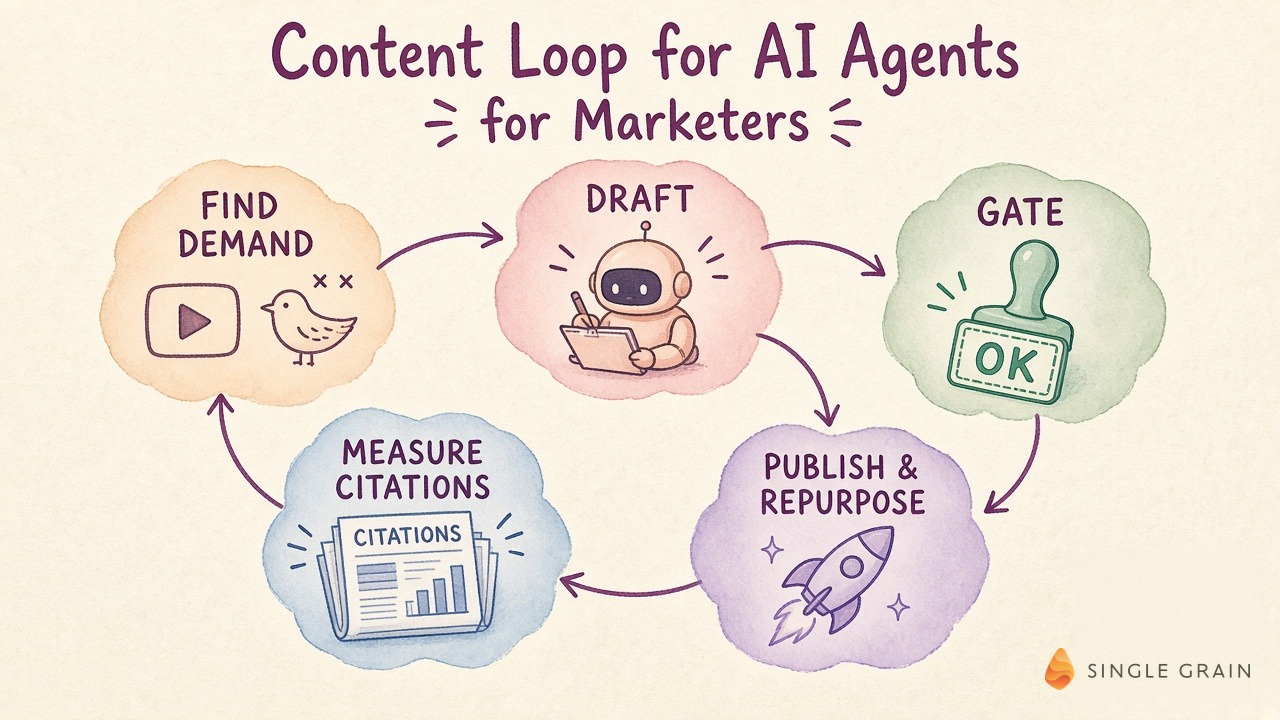
It starts with demand. Our YouTube demand radar scans channels in our space every week, suggests topics, tells me how many views the source videos got, and flags when attention on a topic has cooled.
How the AEO/SEO Bot Finds and Drafts Topics
Next, my AEO/SEO bot pulls ideas from three places: my team’s external content, like YouTube and the podcast, internal conversations, and the SEO and AEO tools connected to it. Your best content usually comes from internal conversations, so anything I’ve said that looks like a content spike can become a post.
The bot also checks for decaying content (older pages losing traffic) and for topics competitors cover that my team doesn’t. It drafts to my writer guidelines and pushes drafts into WordPress through an MCP (Model Context Protocol), a connector that lets an AI agent work inside another app.
Quality Gate and Citation Measurement
Before anything ships, Jev, the classifier my team uses as a quality gate, checks each draft. Does it invent statistics? Is this topic already live, so it would duplicate a page? Is each claim backed up, the way Google’s helpful content guidance expects?
Finally, a measurement bot and a GEO audit bot find citation gaps and tell the content bot what to ship next. This is the loop, and it works because each link is a single-job AI marketing bot rather than one agent trying to do everything.
| Pro-Tip |
|---|
| When you spot a post on X worth reacting to, hit share and send it to your bot with “should we do this?” It turns a passing idea into something the loop can score. |
How I Work Across Several AI Agents at Once
The top 1% work across several AI agents at once and give each one the job it’s best at. I covered how I compare OpenAI Dots, Grok Bot and Meta Muse in a separate post, so I’ll keep this to how the three split my week.
- Scheduled routines go to Grok Bot. It runs the tasks that fire on a schedule without me starting them, and teammates can talk to the bots directly in our workspace.
- Computer use goes to OpenAI Dots. It can control my computer and even direct my other agents.
- Instagram and ads go to Meta Muse. It picks the videos worth promoting and drafts the ads.
The reason this works is context. Each agent needs the same picture of your business, which is the idea behind the missing context layer most companies skip.
Become a T-Shaped Marketer
My background is SEO, and I also handle copywriting, paid ads, YouTube thumbnails and organic social. With agents, this range keeps getting wider.
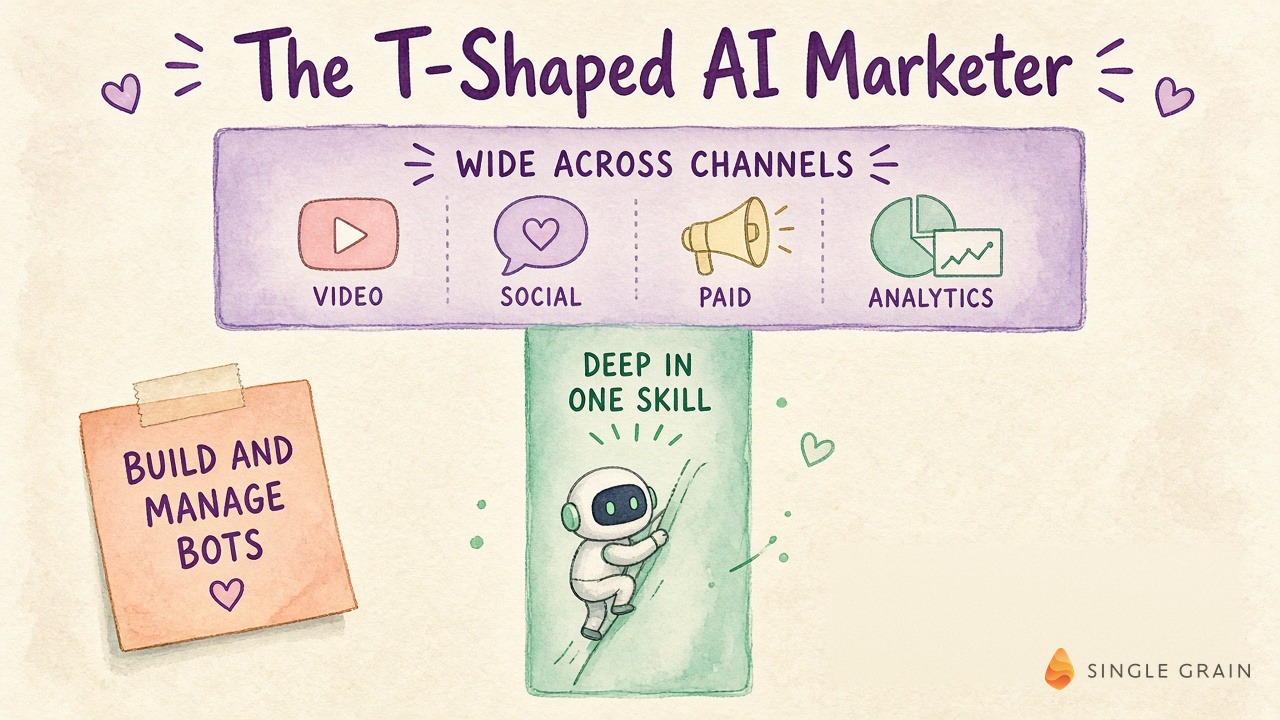
The vertical bar is your deep skill. The horizontal bar is everything agents now let you do well enough to ship, and the last box, building and managing bots, is what holds it together.
You can’t say you’re just an SEO anymore. Someone else who started as just an SEO has learned all these other things, and the labor market is competitive.
Does Going Wide Mean Doing Everything Badly?
The common worry is that going wide means doing everything badly. I don’t see it this way, because the agents carry the stretch work and your deep skill still sets the quality bar. My SEO background is what tells me whether a bot’s topic list is any good.
Your New Job: Build, Maintain and Retire Bots
The expectation on my team is that AI-native people are constantly building and managing bots. My team’s job is to create them, maintain them, optimize them, build new ones, and sunset the ones that don’t make sense.
We also make sure each bot gets what it needs from a compute and security standpoint, meaning enough processing power and only the access it should have. All the things you thought weren’t part of a marketer’s job are now part of it.
Measure Bots by Real Returns
Measure the results, too. I count actual returns and leave estimated time saved and estimated ROI out of the report.
Before you hand a bot to a teammate, run it through an AI agent readiness checklist to catch the access, data and approval gaps one prompt won’t fix.
| Starter prompt for a bot audit |
|---|
| “List every AI agent and routine our marketing team runs. For each one, give its single job, who owns it, what it can send, publish or spend without approval, and one result it drove last month with the source. Flag any bot with no owner, no measured result or more than one job, and recommend keep, fix or retire. Send it to me as a draft.” |
How to Start Using AI Agents Like the Top 1%
One bot is enough on day one. Find the single task you wait on someone else for, build a bot for it, and add your taste until the output is good.
Then hand it to someone on your team instead of gatekeeping it. When the whole team gets better, you become more valuable, and this is how AI agents for marketers turn into results you can measure.
If you’d rather have a team keep your content engine running, Single Grain is a content marketing agency, and my team works with AI agents every day.
Frequently Asked Questions About AI Agents for Marketers
-
What are AI agents for marketers?
They’re bots that take on recurring marketing work, such as finding topics, drafting content, editing video, scheduling posts and measuring results, while a person sets the rules and approves what goes out.
-
How do top marketers use AI agents?
They chain single-job bots into loops, for example demand research, drafting, a quality gate, publishing and measurement, and they work across several agents at once instead of waiting on other people.
-
Which AI agent is best for marketing?
It depends on the job. Eric Siu’s team uses Grok Bot for routines, OpenAI Dots for computer use and product work, and Meta Muse for Instagram and Meta ads.
-
Do AI agents replace marketers?
They replace waiting and repetitive tasks. Marketers still add taste, set the gates, approve output and decide which bots to build, fix or retire.
-
How do I start using AI agents in marketing?
Pick one task you regularly wait on someone else for, build a bot for that single job, refine the output, then hand it to a teammate and measure the result.