

How to Keep UTM and Meeting Intent Intact When an Agent Books the Call


At the post-booking CRM check, the RevOps owner opens an agent-created demo record. The calendar event exists, but utm_source is blank. In this worked example, the original booking request contained the campaign tag. The calendar adapter dropped it, and the CRM write accepted the incomplete payload. Upstream, an inbox triage agent for marketing ops should have labeled and routed the booking request before the adapter ran.
At the booking-payload check, the demand generation owner finds a different gap: the visitor asked about pricing, but the agent created a generic meeting. The source fields survived; the reason for booking did not. These two illustrative failures require the same artifact: a lead-source contract that travels with the meeting.
TABLE OF CONTENTS:
- Quick Overview
- Why a qualify-to-human handoff is not a source contract
- Worked scene: agent books a meeting and the UTM dies in the CRM
- Worked scene: source contract fields that must survive the calendar invite
- Lead-source contract checklist (UTM, referrer, intent, owner, stamp)
- Single Brain installs the system; Single Grain runs it when you need the team
Quick Overview
A booking agent needs a source contract before it can reliably write meeting records. That contract preserves observed UTM parameters, referrer, explicit meeting intent, ownership, and capture timestamps across the calendar and CRM. Put validation in the routing layer, where missing fields can stop an incomplete write. Success means the destination record matches the captured evidence, including explicitly labeled unknowns.
- Capture source evidence before the calendar adapter transforms the request.
- Require an explicit demo, pricing, or support intent.
- Separate first-touch attribution from the source of this booking.
- Check the saved CRM record, not just the outgoing payload.
Why a qualify-to-human handoff is not a source contract
A qualification handoff answers who should take over, what they need, and which action follows. A source contract answers where this meeting came from, what the visitor requested, and which evidence supports those answers. A sales representative can receive a complete brief while campaign attribution disappears.
That boundary distinguishes this page from Single Grain’s qualify-to-human handoff contracts. Keep operational transfer there. Here, treat source preservation as a separate acceptance condition for the booking integration.
The September 2026 Open Future Forum report reports that 81% of 230 marketing and growth leaders were past exploring agentic AI. Attribution was the leading named challenge, appearing in 20 of 96 open answers. Those are different denominators, not an attribution failure rate. The practical recommendation is narrower: test source integrity before expanding booking automation.
Worked scene: agent books a meeting and the UTM dies in the CRM
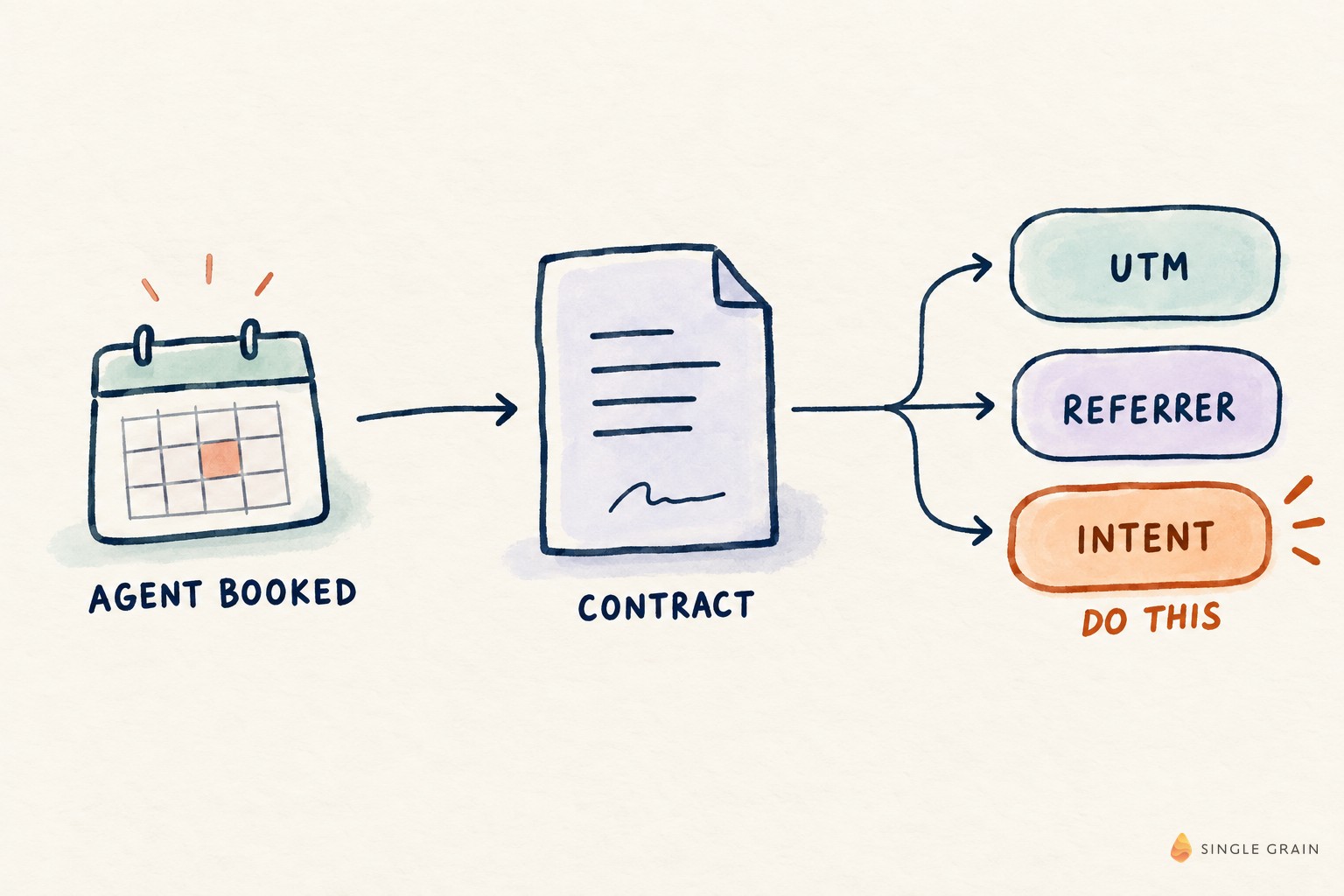
Eric’s Leveling Up discussion of Jev as an agency workflow middle layer provides the architecture: classify the request, apply criteria, then route between models and operations. The useful sequence puts a decision layer ahead of the downstream work. For booking, that means carrying evidence alongside the calendar slot.
Apply that sequence to the RevOps example. The intake request has utm_source, utm_medium, utm_campaign, a landing-page referrer, and demo intent. The calendar adapter creates an event using the email address and selected time. Its output omits the marketing fields. A CRM connector then treats that reduced output as the entire request.
The fix is to retain a canonical source envelope outside the calendar response. The middle layer checks required fields, allowed values, freshness rules, and the permitted write schedule before the writer model runs. The calendar adapter returns its event identifier; it does not replace the source envelope.
When the CRM-bound payload lacks utm_source, block that write until the captured value is restored. If the calendar event already exists, retain its identifier and repair the record without booking again. Completion requires a readback showing that the saved source fields match the envelope.
Eric’s point that a better model still needs a better workflow changes the purchase decision here. Buy or build a reliable mapping and validation step. A stronger model cannot recover a campaign parameter that the connector discarded.
Worked scene: source contract fields that must survive the calendar invite
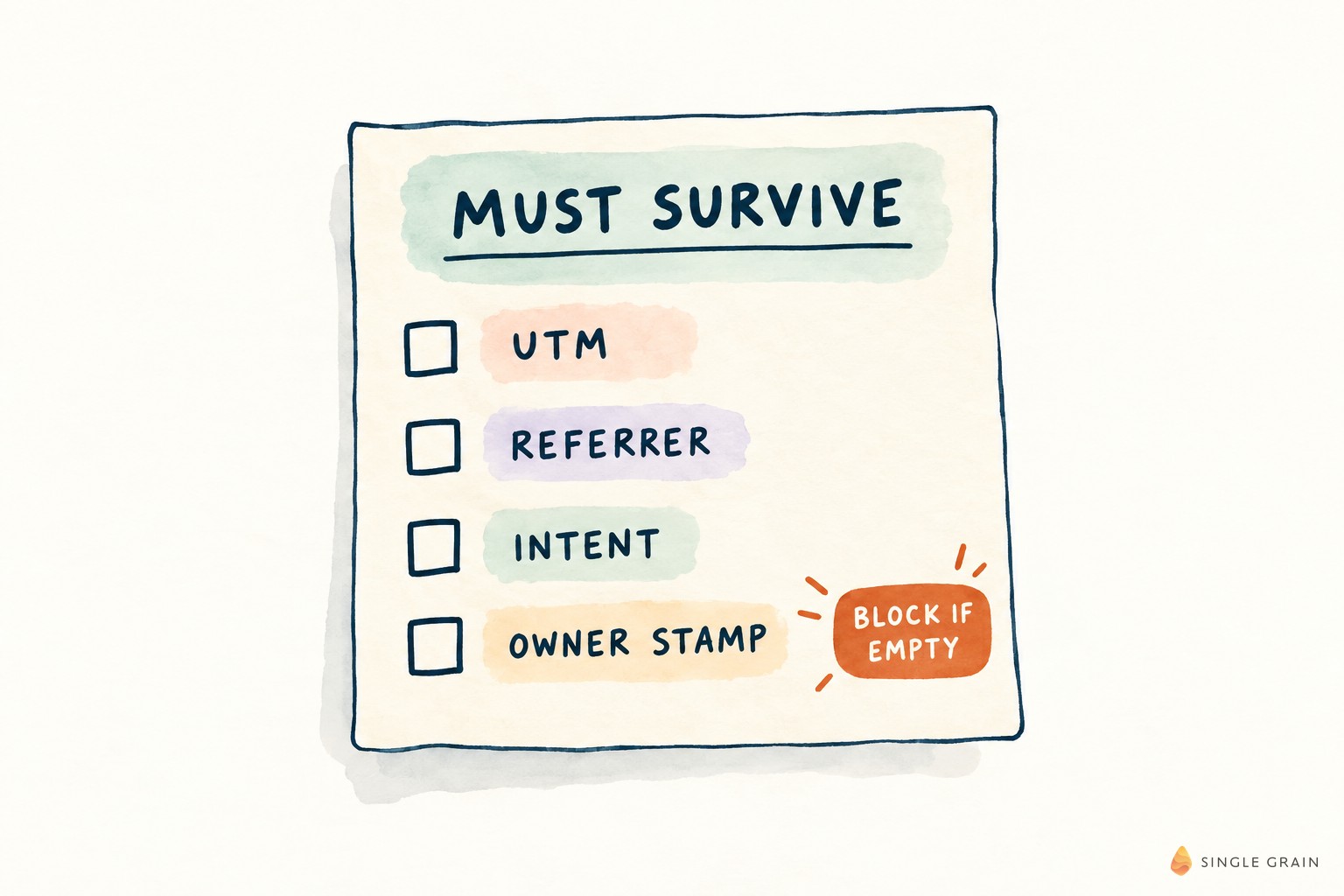
Return to the demand generation example. The visitor asks for pricing, selects a time, and receives an invitation. Before CRM creation, the contract requires meeting_intent to contain demo, pricing, or support. The explicit pricing request supplies the value; the agent must not default every booked call to demo.
Carry intent evidence separately from the enum: the relevant request text, its capture time, and whether the label was selected or inferred. That lets demand generation distinguish a pricing inquiry from a product demonstration without reading the invitation subject line as evidence.
Map these fields to actual CRM properties before implementation. HubSpot’s default deal-property documentation is an object-specific reference, not permission to assume every contact, deal, and meeting shares the same writable source fields. Verify property names, object scope, and write behavior. Do not assume a later enrichment step will backfill missing booking evidence.
Keep original contact source separate from meeting-level campaign source. An existing contact can return through a new campaign; overwriting first touch would destroy history while preserving the latest booking. Single Grain’s CRM field contracts provide the companion discipline for explicit destination mappings.
Lead-source contract checklist (UTM, referrer, intent, owner, stamp)
Name the RevOps owner as the human ship gate for the contract version. Following Eric’s Jev testing and criteria-routing discussion, route uncertain intent, conflicting source evidence, and untested mappings to human review rather than allowing automatic action.
- UTM: Preserve observed source, medium, campaign, term, and content. Distinguish absent values from values lost during processing. Never manufacture tags.
- Referrer: Store the observed referrer and landing URL within the permitted data policy.
- Intent: Require the approved enum and supporting evidence.
- Owner: Record the contract owner and the person responsible for resolving source exceptions.
- Stamp: Record capture time, booking time, contract version, and a stable correlation identifier.
- Destination: Specify object and property mappings, allowed writes, retry behavior, and readback comparisons.
Turn this checklist into a job card with the input envelope, adapter mappings, validation rules, exception queue, and completion evidence. Run the same tests whenever a form, calendar connector, or CRM property changes.
Single Brain installs the system; Single Grain runs it when you need the team
Single Brain is the AI implementation OS for agents, evaluation, and kill switches. For this job, its scope is the source envelope, booking adapters, CRM readback tests, and a kill switch that stops unsafe source writes without disabling unrelated workflows.
Eric’s decision-layer discussion emphasizes improving checks through feedback even when evidence is thin. Keep untested paths labeled thin. Use mismatches to strengthen the checks before claiming broader autonomy.
Do not automate attribution writes when the integration cannot retain source evidence or the CRM mapping remains undefined. Keep that work manual until the contract exists. Buying a premium model first leaves the same failure path intact.
Hire Single Grain to install and run this system when you need the operating team without staffing it internally. Bring your booking path, CRM property map, and an incomplete record to Single Grain. Start by locating the boundary where source evidence disappears.


