

Marketing to AI Agents: How I’m Getting My Brand on Their Shortlist


Your next customer might never visit your homepage. Their AI agent will do it for them. It will read your site, check who cites you, line you up against top competitors, and hand its human a shortlist. If you’re not on it, you never even get the chance to pitch.
I posted this prediction on X this week after reading a thread on agents in the economy from Patrick Collison, co-founder and CEO of Stripe. He argues personal agents will act as “a kind of structural subsidy for product quality.” I agree, and I’d add one thing. Agents reward proof, and most brands have far less of it online than they think.
So what does marketing to AI agents actually look like? Below are my six predictions for what changes, plus a simple weekly check you can start using this week.
TL;DR
- AI agents now narrow the options before a human looks. Marketing to them means making your brand easy for software buyers to read, verify and recommend.
- Agents reward proof. Self-ranked lists and invented stats hurt you more than they help.
- Trusted citations decide the shortlist. Mentions from sources agents rely on, plus readable docs, APIs and MCPs, determine which brands make the cut.
- Check what AI assistants say about you every week. When you find an error, fix it at the source page.
TABLE OF CONTENTS:
- What Changes When an AI Agent Does the Research
- 6 Predictions for Marketing to AI Agents
- 1. Self-Written "Best Agency" Lists Stop Working
- 2. Citations Become the New Backlinks
- 3. Invented Stats Get a Brand Penalty
- 4. Docs, APIs and MCPs Become Marketing Assets
- 5. SEO Doesn't Die
- 6. Marketing Teams Add a New Weekly Job
- How to Start Marketing to AI Agents This Week
- What This Means for Your Marketing Plan
What Changes When an AI Agent Does the Research
Think about how a buyer researches today. They skim a few pages, click the first result that looks good, and maybe ask a friend.
An agent doesn’t get tired after three tabs. Collison put the question well: “How would markets look different if individuals always spent at least 10 hours researching their purchases?”
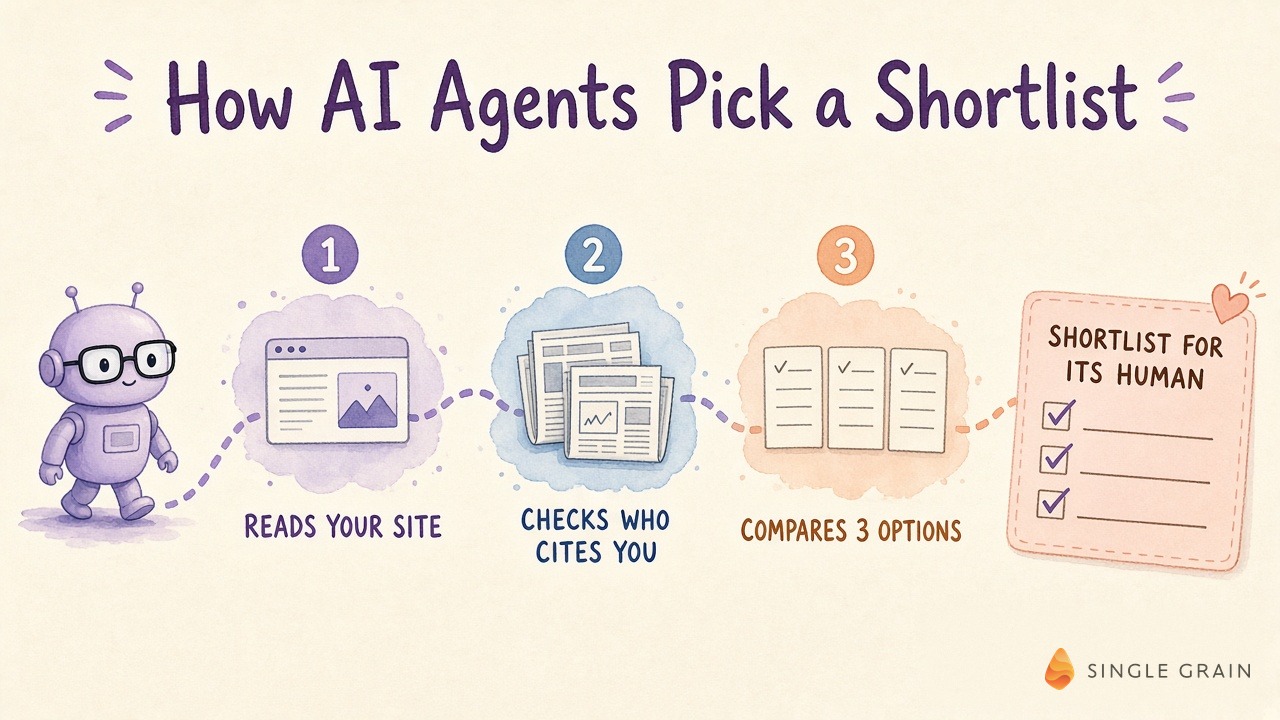
Each box in this flow is a checkpoint. The agent reads your site first, then looks for outside sources that mention you, then stacks you against competitors, and only the brands that survive all three reach a human.
This is why clever positioning alone won’t carry you. If your claims can’t be checked, the agent moves on to someone whose claims can.
6 Predictions for Marketing to AI Agents
Here’s what I expect the second-order effects to be, meaning the changes that follow once agents become the first reader of your marketing.
1. Self-Written “Best Agency” Lists Stop Working
“Best agency” lists you wrote about yourself stop working. LLMs (the large language models behind ChatGPT and Gemini) already spot the self-ranked list, and agents rarely cite it.
If your top-ranking page is a list where you put yourself at number one, treat it as a liability now. Rewrite it around the criteria a buyer would use, in line with Google’s guidance on helpful, people-first content, and let third-party proof decide where you land.
2. Citations Become the New Backlinks
A backlink is a link from another site to yours, and for years it was the main vote of trust in SEO. A citation is a mention of your brand in a source an agent trusts, whether or not it links.
Those mentions matter more than another post on your own blog. Think reviews, partner pages, industry roundups you didn’t write, and people quoting your data.
Objection: Fixing Citations on Pages You Don’t Own
The fair objection came from a reply on my X post: fixing it at the source often means fixing a page you don’t own, and no assistant publishes its full source list. This is true. My answer is to start with what you can control, keep every fact about you consistent on your own pages and listings, and earn the outside mentions over time with work people want to quote.
3. Invented Stats Get a Brand Penalty
An agent that catches one made-up number will trust the rest of your site less.
This is why every draft on my team’s site goes through a content gate, a check a draft must pass before it can publish. Jev, our classifier, scores it for duplicate pages, invented stats, weak evidence and AI tell (phrasing that reads as machine-written) before it moves forward.
4. Docs, APIs and MCPs Become Marketing Assets
The easier you are for an agent to read and use, the more often you make the shortlist. An API lets software pull your data directly, and an MCP (Model Context Protocol) server gives AI agents a standard way to connect to your product and use it.
Clean documentation, public pricing and an MCP server are now part of your marketing. My team is acting on this. I’m turning some of our product repos into websites, MCPs and plugins so agents can discover them, because being early here is a first-mover advantage.
5. SEO Doesn’t Die
Gemini and AI Overviews are grounded in Google. This means they pull from Google’s search results when they answer. The teams that kept doing SEO well get a head start.
If you’ve built strong pages, you’re already halfway to being agent-readable. The remaining work is making facts like pricing, specs and proof easy to find as plain text on those pages.
6. Marketing Teams Add a New Weekly Job
Someone has to check what agents say about the brand every week and fix what’s wrong at the source. On my team this job belongs to a bot plus one person who approves the fixes, and the next section shows how the check works.
| Pro-Tip |
|---|
| Audit any page where you rank yourself against competitors. Replace self-awarded rankings with criteria, sourced numbers and links to third parties that back you up. |
How to Start Marketing to AI Agents This Week
Your current team can start with a repeatable check and the discipline to fix problems at the source page.
- Write down ten questions your buyers actually ask before they buy.
- Ask each question in ChatGPT, Gemini and one other assistant your buyers use, and note who gets named.
- Flag every claim about your brand that’s wrong, outdated or missing.
- Trace each error to the page or source it came from, then fix that page first.
- Make product facts easy to read: pricing, specs, integrations and proof all on crawlable pages.
- Repeat the check every week and track whether you’re named more often.
I picture those six steps as one loop that my team runs every week.
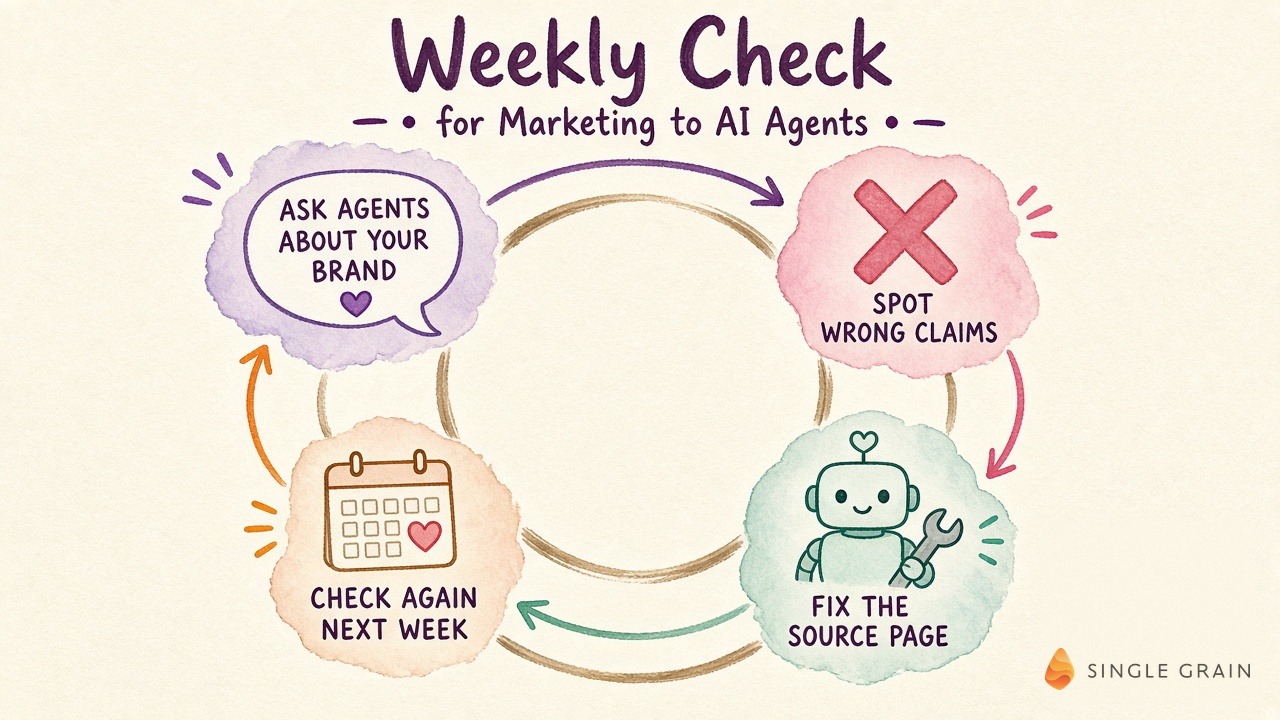
The loop matters more than any single fix. Agents keep re-reading the web, so a fix may take a while to show up in answers, and you’ll only know it landed if you keep checking.
How I Automate the AI Visibility Check With Grok Bot
A Grok Bot routine handles the first half of this. My AI Search Visibility bot on Grok Bot checks whether AI assistants recommend us and who they name instead, and our GEO (generative engine optimization) audit shows where we’re missing citations. Before you hand this routine to a bot, run through an AI agent readiness checklist so it has the access and guardrails it needs.
| Starter prompt for an AI visibility check |
|---|
| “Every Monday, ask ChatGPT, Gemini and Perplexity these 10 buyer questions: [questions]. For each answer, list every brand named, in order, and quote what was said about [your brand]. Flag anything inaccurate or missing and name the source page it likely came from. Send me the results in Slack as a draft. Do not edit or publish anything.” |
What This Means for Your Marketing Plan
Most marketing plans were built for people who skim. Agents read everything, compare it, and remember what didn’t check out.
So put your energy into evidence. Earn mentions from sources you don’t control, keep every number traceable, and make your product easy for software to understand.
Do that, and marketing to AI agents stops being a guessing game. You’ll know what the agents say about you, and you’ll know how to change it.
If you want your brand to show up when AI agents and assistants build a shortlist, my team at Single Grain helps brands get found on Google and in AI answers through Search Everywhere Optimization. Get in contact with my team to see how our SEO and AEO services can help you!
Frequently Asked Questions About Marketing to AI Agents
-
What is marketing to AI agents?
Marketing to AI agents means making your brand easy for AI buyers and assistants to read, verify and recommend. Agents research sites, check citations and compare competitors before a person sees a shortlist.
-
How do AI agents decide which brands to recommend?
They read your site, look at who cites you, and compare you against competitors. Brands with verifiable proof and mentions from trusted sources are more likely to make the shortlist.
-
Does SEO still matter when AI agents do the research?
Yes. Gemini and Google’s AI Overviews are grounded in Google Search, so strong SEO still gives you a head start with agents.
-
Do self-ranked best-of lists hurt you with AI agents?
They can. LLMs already recognize lists where a brand ranks itself first, and agents are unlikely to cite them as proof.
-
How often should you check what AI assistants say about your brand?
Weekly is a good rhythm. Assistants keep re-reading the web, so a regular check shows whether your fixes are changing the answers.