What Is a Good Sales Win Rate?


Is your team celebrating a sales win rate above 50% while revenue barely moves? It feels like proof the pitch works, but it also often means you’re leaving money on the table because most of the deals you close are the easy, cheap ones.
A sales win rate is the share of qualified opportunities your team turns into customers over a set period. Neil Patel, co-founder of NP Digital, and I broke down a list of startup sales lessons from Jen Abel, co-founder of the sales consultancy Jjellyfish, on a recent Marketing School episode. Her ninth point stopped both of us cold. A 50%+ win rate is usually a warning light, and I love how blunt it is.
So what does a healthy number look like, and how do you know if yours is too high? Keep reading for the benchmarks, the formula, and the fixes I’d make if my own close rate looked too good to be true.
TL;DR
- Most B2B teams win about one in five new deals. Ebsta and Pavilion’s 2025 benchmark put the new-logo average at 19%, while expansion deals closed at 45%.
- A very high win rate often points to underpricing. When almost everyone says yes, your offer may be too cheap, too vague, or aimed only at safe deals.
- Calculate win rate the same way every quarter. Divide won deals by won plus lost deals from the same stage, and keep open deals out of the math.
- Judge win rate next to deal size and pipeline volume. A lower rate on bigger, better-fit deals usually beats a high rate on tiny ones.
What Is a Good Sales Win Rate?
A good sales win rate depends on what you sell, who you sell to, and where you start counting. Still, broad benchmarks give you a useful baseline before you compare against your own history.
What the Benchmarks Say
Ebsta and Pavilion’s 2025 GTM Benchmarks analyzed about 655,000 opportunities and $48 billion in pipeline. New-logo deals closed at roughly 19%, and expansion deals with existing customers closed at 45%. The same research found highly qualified deals won about 50% of the time, against 8% for poorly qualified ones.
Proposal close rates run a bit higher. Proposify’s benchmark of 742,137 proposals put the average proposal close rate at 20%, because weaker opportunities drop out before a proposal ever goes out.
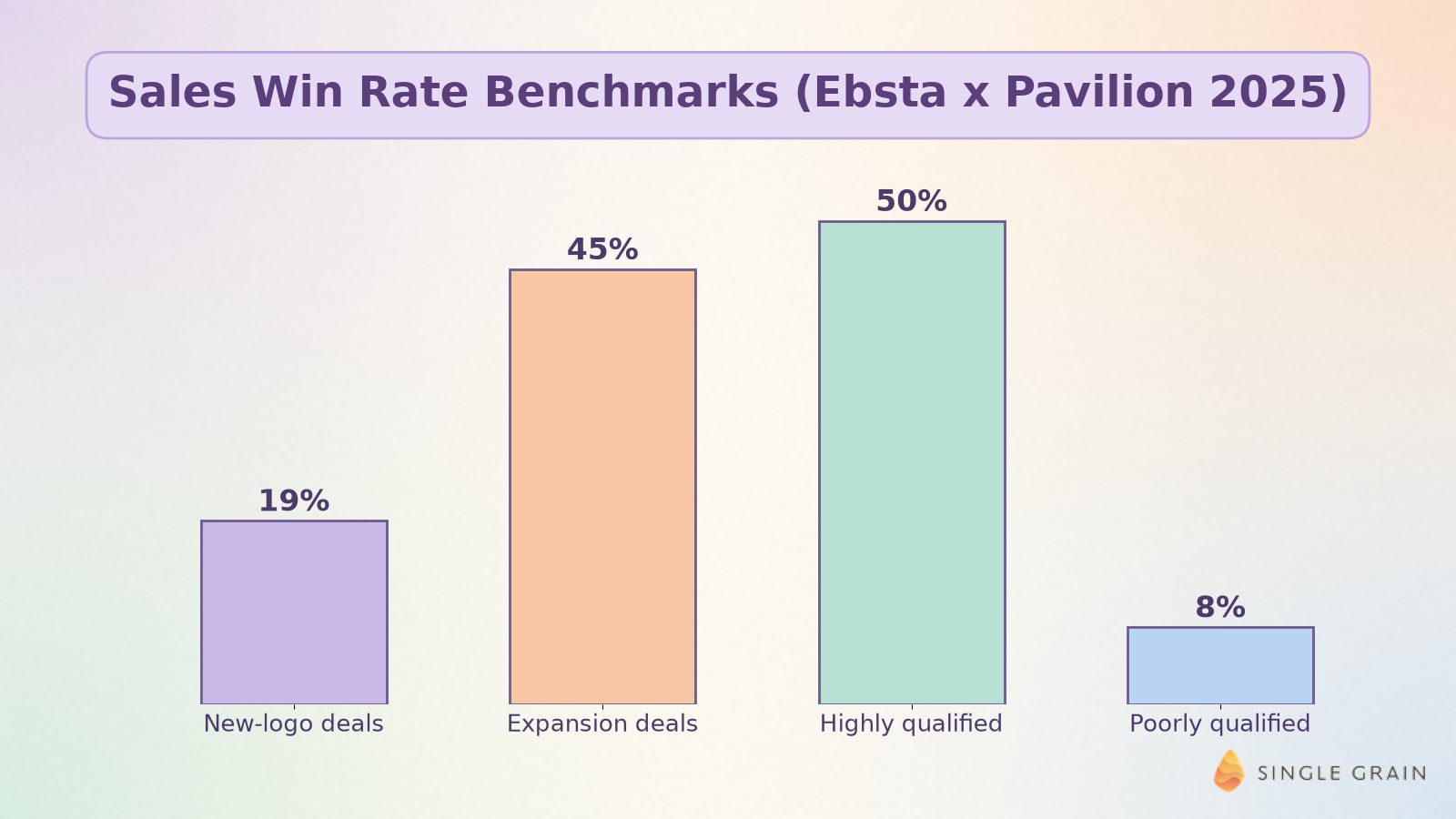
So a new-business win rate in the high teens to mid-20s is normal for many B2B teams. Expansion deals should close far more often, so never blend the two into one number.
What Is a Good Win Rate in Sales for Your Team?
Your own trend matters more than any industry average. Compare this quarter to the last four, split by deal source, segment, and rep.
- Outbound deals often close at a lower rate but can carry the highest contract values.
- Inbound and referral deals usually close faster because the buyer already trusts you.
- Expansion deals should beat new-logo deals by a wide margin.
If one segment suddenly jumps or drops, look at pricing, qualification, and deal size before you celebrate or panic.
Once you know what “normal” looks like, the bigger question is what happens when your number climbs well past it.
When a High Win Rate Is a Warning Sign
Jen’s point is simple. If your team closes more than half its deals, something is usually off. Neil brought it up on the show, and I agreed right away.
Your Price Is Too Low
Neil told a story from the early days of NP Digital. A salesperson on his team sold a client SEO for $250 a month. At that price, the team had no way to deliver a return. The client got angry about results, so Neil refunded her and coached her himself on a handful of calls.
That deal had a near-perfect close rate attached to it. Of course people say yes at $250 a month. The problem shows up later, in churn, refunds, and unhappy customers.
Buyers Don’t Know What They’re Buying
A high close rate can also mean expectations are fuzzy. If a buyer signs without understanding the scope, the timeline, or the effort on their side, you’ve only moved the “no” to month three. Watch for deals where the buyer never asks about deliverables, never pushes on price, and never brings a second stakeholder to the call.
Clear proposals fix most of this. Spell out what’s included, what isn’t, and what the buyer must do in the first thirty days. Some buyers will walk away, and the ones who stay will stick around much longer.
You Only Chase Safe Deals
Some teams protect their win rate by skipping hard, high-value opportunities. The rate looks amazing. Pipeline stays small, deal sizes stay flat, and growth stalls.
| Pay Attention |
|---|
| If your win rate rises while average deal size falls, treat it as a pricing problem first. Pull your last twenty wins and check how many came in at a discount or below your standard package. |
None of these problems show up in the win rate itself, which is why you need a consistent way to calculate it.
How to Calculate Win Rate the Right Way
The formula is simple. The definition behind it is where most teams go wrong.
The Basic Formula
Win rate = deals won ÷ (deals won + deals lost) × 100, for the same period.
Say your team closed thirty deals last quarter and lost ninety. Your win rate is thirty divided by 120, or 25%. Open deals stay out of the math until they resolve.
Pick One Starting Stage and Stick to It
Teams count from different starting points, and each gives a different answer:
- Opportunity win rate. Won deals divided by all qualified opportunities. This matches most benchmarks.
- Proposal close rate. Won deals divided by proposals sent. This runs higher.
- Lead-to-customer rate. Customers divided by all leads. This runs far lower, often in single digits.
Write down your definition and use it every quarter. A number with a moving definition can’t tell you whether anything improved.
Split the Number Before You Judge It
One blended rate hides the story. Break it out by new logo vs. expansion, by channel, by deal size band, and by rep. A rep at 60% on tiny deals and a rep at 20% on enterprise deals may both be doing fine.
With a clean number in hand, you can decide which levers to pull.
How to Improve Your Sales Win Rate Without Underpricing
You want more wins at the right price, from the right buyers. These are the levers I’d test first.
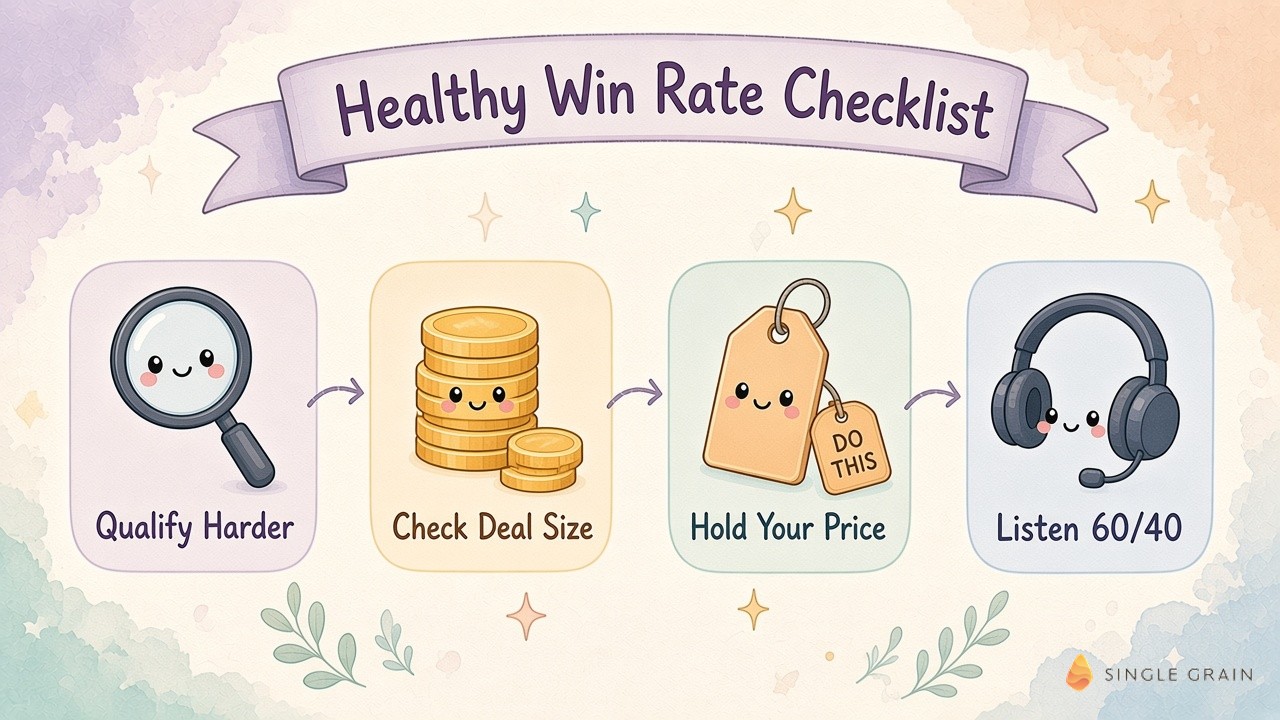
Qualify Harder at the Top
Ebsta’s data shows qualification is the biggest swing factor, with highly qualified deals winning about six times as often as poorly qualified ones. Tighten your fit criteria and route the best leads fast. Intent-based lead routing and lead scoring tied to revenue help your reps spend time where it pays off.
Sell Money Made Over Money Saved
In demos, focus on the problems you solve and the revenue a buyer can gain. Savings matter, but growth usually moves a decision faster.
Make the Offer a No-Brainer
A great offer makes the yes easy without dropping the price. Add a clear scope, a fast first result, or a guarantee you can actually keep. Our guide to pricing strategies covers how to package value so the price holds.
Listen More on Discovery Calls
At Single Grain, our discovery talk ratio sits around 50/50. I want it closer to 60/40, with reps listening more than they talk. An AI sales assistant that preps every call frees reps to ask better questions instead of scrambling for context.
These levers work best when you track them alongside the win rate, so the number tells you the full picture.
What to Track Alongside Win Rate
Win rate never works alone. Pair it with a few other numbers and you’ll spot problems early.
- Average deal size. A rising win rate with a falling deal size is a red flag.
- Pipeline volume. More qualified opportunities at a steady win rate beats a high rate on a thin pipeline.
- Sales cycle length. Deals that drag usually close less often.
- Churn and refunds in the first ninety days. These reveal deals that should never have closed.
A simple weekly view is enough. Sales call analysis can also show you which objections keep killing deals, so you fix the pitch before the number drops.
| Pro-Tip |
|---|
| Review your lost deals as closely as your wins. Tag each loss with one reason, such as price, timing, fit, or competitor, and look at the pattern every month. If price is never the reason, you may be charging too little. |
Put all of this together and the win rate becomes a health check for your entire sales motion.
Build a Win Rate You Can Trust
A good sales win rate for new business usually sits around one in five, and expansion deals should close far more often. If your team wins more than half its deals, check your pricing, your expectations, and your deal mix before you celebrate. Judge every rate next to deal size and pipeline volume.
Want help building a pipeline with better-fit buyers and pricing that holds? Single Grain’s go-to-market strategy team can audit your funnel and sales motion. Contact Single Grain to get started.
Frequently Asked Questions About Sales Win Rate
-
What is a good sales win rate for B2B?
Many B2B teams win about one in five new-business opportunities. Ebsta and Pavilion’s 2025 benchmark put the new-logo average at 19% and expansion deals at 45%. Compare against your own last four quarters first.
-
How do you calculate win rate?
Divide deals won by deals won plus deals lost in the same period, then multiply by 100. Leave open deals out until they close, and keep the same starting stage every quarter.
-
Is a 50% win rate good?
Not always. A rate above 50% on new business often means pricing is too low, expectations are unclear, or the team only chases safe deals. Check deal size and early churn before you celebrate.
-
What is the difference between win rate and close rate?
Teams use the terms loosely. Win rate usually counts qualified opportunities, while close rate often counts proposals or all leads. Pick one definition and use it consistently.
-
How can I improve my sales win rate?
Qualify harder, route the best leads fast, sell revenue gained over money saved, and build a clear offer. Our guide to lead scoring shows how to focus reps on better-fit deals.