Hermes Agent vs OpenClaw: How I Use Both to Run My Agency


Your choice of Hermes Agent vs OpenClaw gets expensive when the wrong agent goes quiet in the middle of a client week. Both can research leads, build decks, and run jobs on a schedule. The real difference shows up after a few months, when you’ve piled more work onto them and need them to answer every time.
I’ve used OpenClaw since its early days and Hermes since it arrived, and I run ten to fifteen agents across both at any given time. In my breakdown of how I turned Hermes into a chief of staff, I listed twelve jobs it handles for my agency. People kept replying with the same question about which one they should run.
My answer comes down to four criteria, a clear winner on the one I care about most, and a setup where both agents work together.
TL;DR
- OpenClaw wins on features, community, and security tooling. It has been around longer, has more integrations, and NVIDIA built an enterprise security stack for it.
- Hermes wins on reliability. It responds almost every time and learns from your work by creating and improving skills.
- For a business owner, reliability usually decides it. An agent your team depends on can’t go silent for hours.
- The best setup uses both. Hermes acts as the brain and holds an OpenClaw fleet accountable inside Slack.
What Are Hermes Agent and OpenClaw?
Both are open-source autonomous agents you run yourself and talk to from the chat apps you already use. Neither is a chat window you open and close. They hold memory, follow playbooks, and run scheduled jobs in the background.
OpenClaw at a Glance
OpenClaw describes itself as an open-source AI assistant that runs on your own devices and meets you in channels like Slack, Teams, Telegram, and WhatsApp. Its tools, skills, and plugins extend what an assistant can do, and a community hub distributes plugins. An independent foundation stewards the project.
Hermes Agent at a Glance
Hermes Agent comes from Nous Research and calls itself a self-improving agent with a built-in learning loop. It creates skills from experience, improves them during use, and searches its own past conversations. It can even import settings, memories, and skills from an existing OpenClaw install.
With the basics covered, here’s how they compare on the criteria a business actually feels.
Hermes vs OpenClaw on 4 Business Criteria
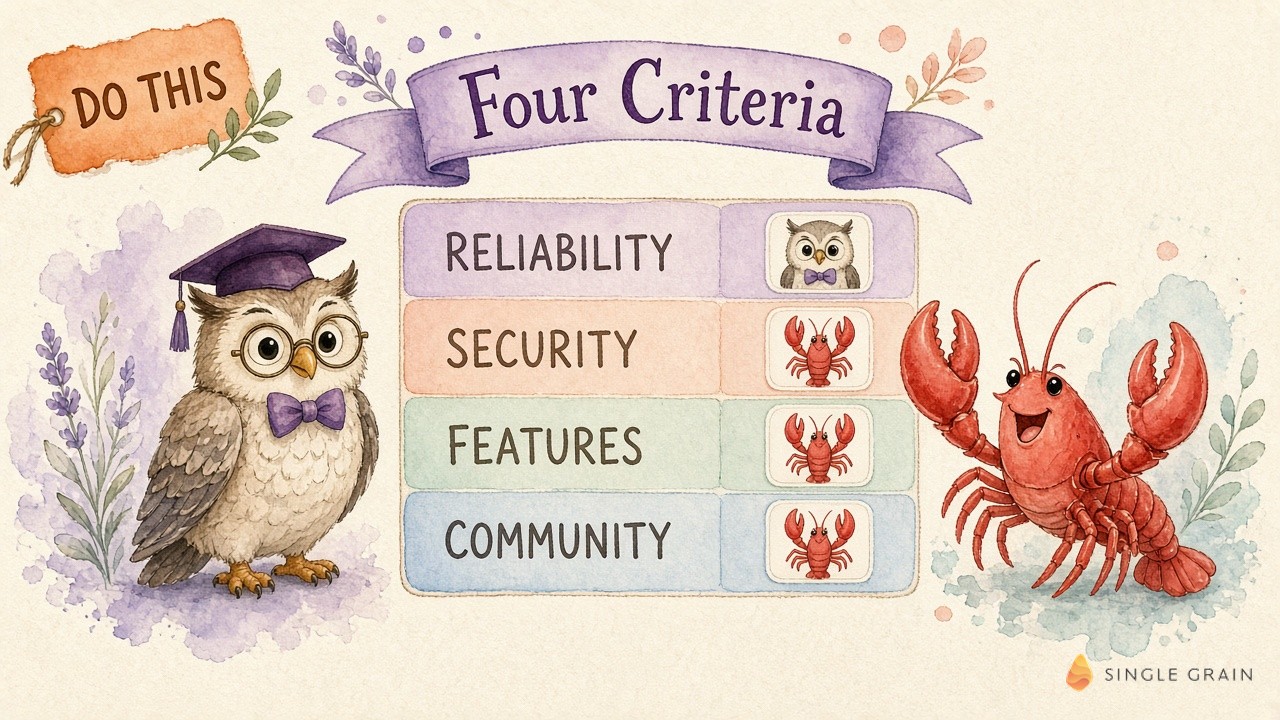
I judge agents on reliability, security, features, and community. In my Leveling Up video comparing the two, I scored each category based on daily use.

| Criteria | Winner | Why |
|---|---|---|
| Reliability | Hermes | Responds almost every time, even under heavy use |
| Security | OpenClaw | Longer hardening history plus NVIDIA’s NemoClaw stack |
| Features | OpenClaw | More integrations and community-built skills |
| Community | OpenClaw | Older project with more builders sharing setups |
On paper, OpenClaw wins three categories to one. The details explain why I still lean on Hermes for the work my business depends on.
Reliability
My team relies on OpenClaw agents inside Slack for data pulls, lead research, and cold email infrastructure. They’ve told me work feels slower without the agents.
Over time, though, my main OpenClaw agent started ignoring messages, and the gateway would get overwhelmed and need a reset. I restructured and isolated the agents, had both tools audit the setup, and still saw issues. Hermes, by contrast, has almost never left me without a reply.
Security
OpenClaw had serious security gaps early on, and any autonomous agent with broad access carries risk. The more it can do, such as sending email on your behalf, the bigger the blast radius. OpenClaw has had more time to add hardening, and NVIDIA announced NemoClaw in March 2026 to add sandboxing and privacy controls for OpenClaw agents.
Features
OpenClaw connects to more tools, and more people have built skills for it. I think of it like a utility belt with a gadget for almost everything. Hermes still can’t connect to everything I want, and when I asked it to score itself against OpenClaw, it agreed.
Community
OpenClaw has a bigger community sharing setups on X, plus engineering support from large companies. The Hermes community is strong and growing fast, but more community usually means faster fixes for security and features.
Scores only tell part of the story, so the next question is how each agent behaves on real work.
Hermes Agent Use Cases in My Business
Hermes earned its place by handling jobs that need a fast, dependable response. These come from the twelve jobs in my original post.
Branded Artifacts on Demand
Hermes reads a design.md file and produces on-brand one-pagers, carousels, case studies, and landing pages. One morning at the gym, I asked it to build new landing pages from my team’s design file, and it delivered usable versions before I finished my workout.
Memory, Tickets, and Goals
My team pairs Hermes with Obsidian for memory and Linear for tickets. It logs decisions daily, opens tickets as work happens, and routes them back to me for review. A /goal command gives it a definition of done, and it keeps working until it gets there. I compared memory options in this look at giving every AI agent one shared brain.
Specialists Underneath
Hermes sits on top of narrow specialist agents, one for cold outbound infrastructure and another for ad creative at scale. You brief one agent, and it coordinates the rest. That structure mirrors how an AI chief of staff works.
Those jobs show where Hermes shines, while OpenClaw still carries plenty of the load.
Where OpenClaw Still Wins
OpenClaw runs a large share of my agency’s day-to-day agent work, and the reasons go beyond its integrations.
Breadth of Integrations
When a job needs a specific tool, OpenClaw usually has a skill or plugin for it already. That breadth saves setup time for research, outreach, and reporting workflows.
Enterprise Paths
For client deployments, NemoClaw gives teams a more governed way to run agents with sandboxing and policy controls. My clients running NemoClaw have been able to communicate with their agents reliably and securely. NVIDIA describes the stack as still in active development, so test it before rolling it out widely.
Team-Wide Adoption
OpenClaw agents in Slack became part of how my team works. Teammates query them, strategize with them, and execute through them. When an agent reaches that point, structure decides whether it stays reliable as you add more jobs.
| Pro-Tip |
|---|
| Split agents by job before they get overloaded. One agent per domain, with its own memory and its own channel, prevents the slowdown that comes from piling every task onto a single bot. |
Job separation solves part of the reliability problem, and the rest comes from pairing the two agents.
How I Run Both Together
The answer for my business has been both, with clear roles. Hermes acts as the brain. OpenClaw provides more of the muscle.
Hermes Holds the Fleet Accountable
I run an OpenClaw chief of staff with a fleet of agents under it, and Hermes sits in the same Slack channel. When an OpenClaw agent stalls or forgets a task, Hermes gives it a kick and gets the work moving again. The two hold each other accountable, which covers the reliability gap.
Separate Profiles by Job
In a July post on Hermes as an operating layer, I recommended separate profiles by job, such as a thinking profile with a stronger model for strategy and planning. The same idea applies across both tools. My guide to Slack AI agents covers how to set channels and permissions.
Stop the Work From Leaking
Ten to fifteen agents create a new problem. Threads pile up, jobs overlap, and work gets lost. A simple resolver that summarizes each thread and routes work to one place prevents that, and a weekly agent monitoring report catches anything that slips.

That combined setup works for my agency, but your starting point depends on your team.
Which Should Run Your Business?
Pick based on what your team will depend on most.
Choose Hermes First If Reliability Comes First
If you’re a founder or operator who needs fast answers and an agent that learns your workflows, start with Hermes. Keep email in draft mode until it earns trust, and set guardrails on which bots can hit send.
Choose OpenClaw First If You Need Breadth
If your team needs many integrations or a governed enterprise path, start with OpenClaw and plan your agent structure early. Separate agents by job from day one.
Plan to Use Both
Most growing teams end up running both. Give each a clear role, put them in the same channel, and let them check each other’s work. If you’re also weighing team assistants, this comparison of OpenAI Dots, Grok Bot, and Meta Muse covers the hosted options.
Whichever agent you choose, the value comes from the structure around it: memory, permissions, and clear jobs. Single Grain’s AI transformation services team builds and manages agent fleets on Hermes and OpenClaw for growth-stage companies. Contact Single Grain to plan which agent should own which job in your business.
Frequently Asked Questions About Hermes Agent vs OpenClaw
-
What is the difference between Hermes Agent and OpenClaw?
Both are open-source autonomous agents you run yourself. OpenClaw has more integrations, a bigger community, and NVIDIA’s NemoClaw security stack, while Hermes Agent from Nous Research focuses on a built-in learning loop and has been more reliable in my daily use.
-
Which is more secure, Hermes or OpenClaw?
OpenClaw currently has more security hardening and an enterprise path through NVIDIA NemoClaw. Any autonomous agent with broad access is risky, so limit permissions and keep send actions behind approval with either tool.
-
Can Hermes and OpenClaw work together?
Yes. I run an OpenClaw fleet with Hermes in the same Slack channel, and Hermes nudges OpenClaw agents when they stall or forget a task.
-
How do I keep agent knowledge from going stale?
Store decisions in an external memory such as Obsidian, log work in a ticketing tool, and review a weekly monitoring report so outdated facts get corrected before agents act on them.
-
Can I move from OpenClaw to Hermes?
Hermes can import settings, memories, and skills from an existing OpenClaw install, which makes testing it alongside OpenClaw easier.