

AI Agent Guardrails: Which Bots Should Read, Draft, or Send


AI agent guardrails decide whether a bot can only read your CRM or can email your biggest customer at midnight. Get them wrong, and one bad output turns into a public mistake with your company’s name on it.
Only one of my Grok Bots is allowed to send anything without a person approving it first. Every bot I build starts on the bottom rung of a permission ladder with three rungs (Read, Draft and Send) and it climbs only when it earns it.
If you are scratching your head and wondering, “Which of my bots should be allowed to hit send?” then you’ve come to the right place. Discover the best permission ladder, real AI agent guardrails examples from my own bots, and the rules you can use to decide when a bot earns more access.
TL;DR
- AI agent guardrails limit what an agent can access, do and say. Technical controls stop bad inputs and outputs, and permission rules decide which actions need a person.
- Put every bot on one rung of a permission ladder. Read bots see everything and change nothing, Draft bots need approval, and Send bots act only inside written rules.
- Most bots should live on Read or Draft. Only one of my bots can send without a person approving first, and anything outside its rules still lands with a human.
- Bots earn the next rung with a track record. Promote a bot only after its rules are written down and its exceptions have a named human owner.
What Are AI Agent Guardrails?
AI agent guardrails are the rules and controls that limit what an autonomous agent can access, including which actions it can take and what it can say. These guardrails exist because agents like to act fast, and an action like sending an email or spending money is much harder to undo than a bad paragraph.
Guardrails come in two flavors, and you need both.
- Technical guardrails. Filters on inputs and outputs, protection against prompt injection, and limits on which tools and data an agent can reach.
- Operational guardrails. Business rules about which actions need a person’s approval, what volume or spend is allowed, and who owns the exceptions.
Security researchers group the root causes of agent damage into excessive functionality, excessive permissions, and excessive autonomy. Engineers usually own the first two. The third is a leadership decision, and it’s where my permission ladder comes in.
Here’s how the ladder works.
How the Read, Draft, Send Ladder Works
As I mentioned earlier, three rungs make up this permission ladder. Read comes first, then Draft, and finally Send. Each bot sits on exactly one of them.
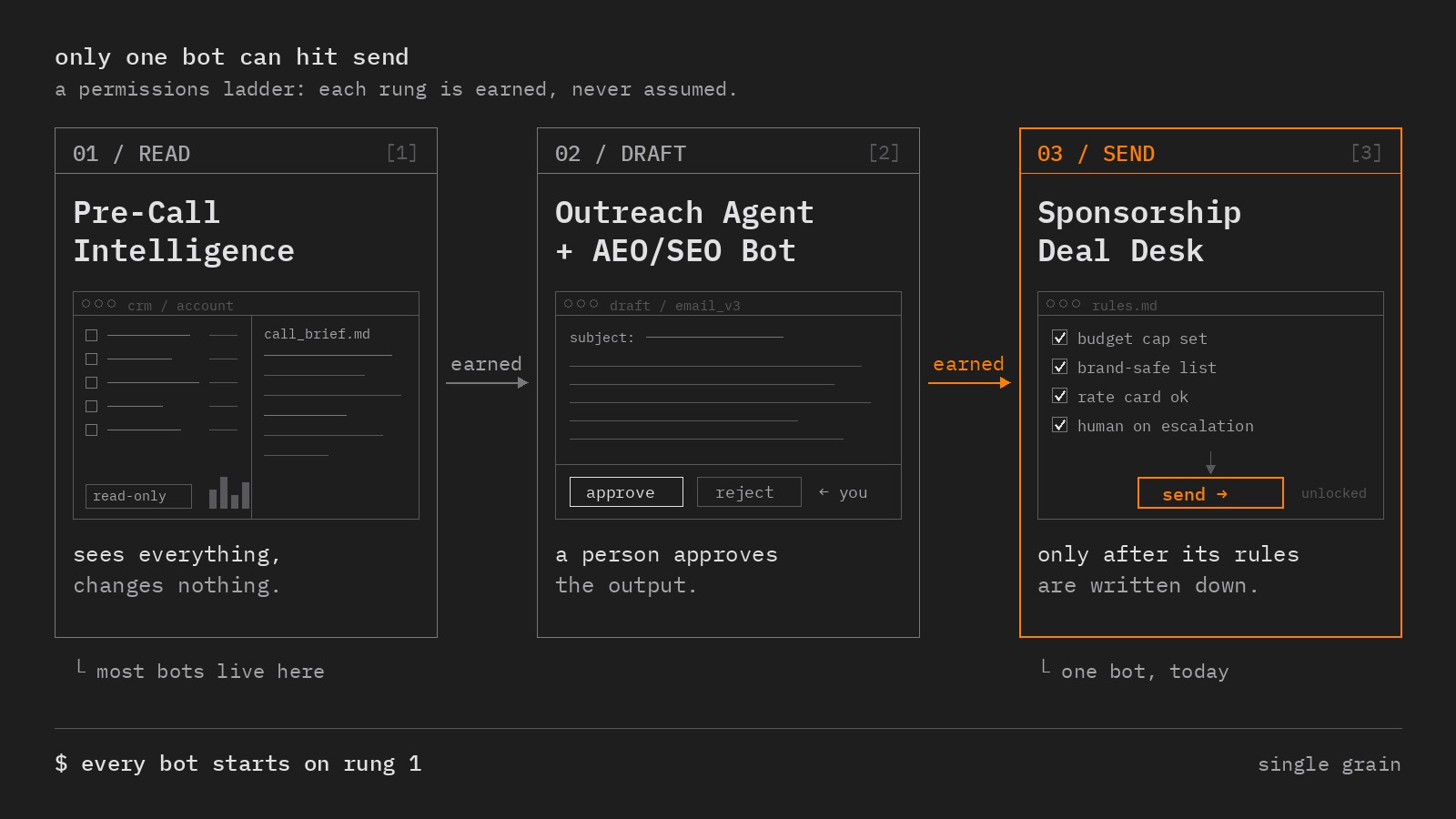
Every new bot starts on the bottom rung. Each move up requires proof.
1. Read
A Read bot can look at everything and change nothing. My Pre-Call Intelligence bot lives here, pulling from the CRM, inbox, Slack and call notes to prep a decision card before big meetings.
Most of my bots live on this rung. Because the bot can’t change anything, connecting it to sensitive systems is an easy call.
2. Draft
A Draft bot prepares the work, and a person approves the exact output. My Outreach Agent and AEO/SEO Bot sit here, so no email goes out and no page goes live without a yes.
The approval covers the exact output. Edits after the yes would break the whole point of the gate.
3. Send
A Send bot can act without a fresh approval, but only inside rules written down ahead of time. My Sponsorship Deal Desk is the only bot up here, because its first reply, its price floor, and its authority were all spelled out first.
Anything outside these rules still lands with a human. The bot has freedom inside a fence, and nothing beyond it.
So where do people fit into all of this?
Where Human in the Loop AI Agents Fit
Human in the loop AI agents pause at defined points so a person can approve, edit, or reject the work before it continues. On my ladder, the loop lives at the Draft rung for every action and at the Send rung for every exception.
The risk with human review is that it turns into rubber-stamping. A reviewer who sees a hundred items with no context starts clicking approve on autopilot.
My team keeps review meaningful with a few habits.
- Small batches. The approver sees a short queue, which keeps attention high.
- Evidence attached. Each item shows the facts behind it, so checking takes seconds.
- A named owner. Exceptions go to a specific person through an exception queue, never a shared channel nobody watches.
- A clear definition of done. Every bot works from agent job cards so the reviewer knows what good output looks like.
Human review works best when the bot does the heavy lifting and the person makes the call. Real examples make this clearer. Let’s take a quick look!
AI Guardrails Examples From My Own Bots
These AI guardrails examples come straight from bots I run. Each one pairs a job with a hard limit.
- Pre-Call Intelligence. Read-only access to calendar, CRM, email, Slack and call notes, with follow-ups saved as drafts.
- Outreach Agent. A daily cap on how many people it can queue, and when it can’t find enough qualified prospects, it sends fewer emails instead of loosening the criteria.
- AEO/SEO Bot. It works on unpublished pages and never publishes without an exact yes.
- Talent Bot. It scores applicants against a frozen role pack, so the bar stays put from the first candidate to the last, and it never auto-sends.
- Sponsorship Deal Desk. A locked first reply and a minimum price on new rate asks, with exceptions held for a human.
Each time, a person decided once, and the bot repeats that decision every day without drifting. This idea sits at the heart of how I protect the bar with AI.
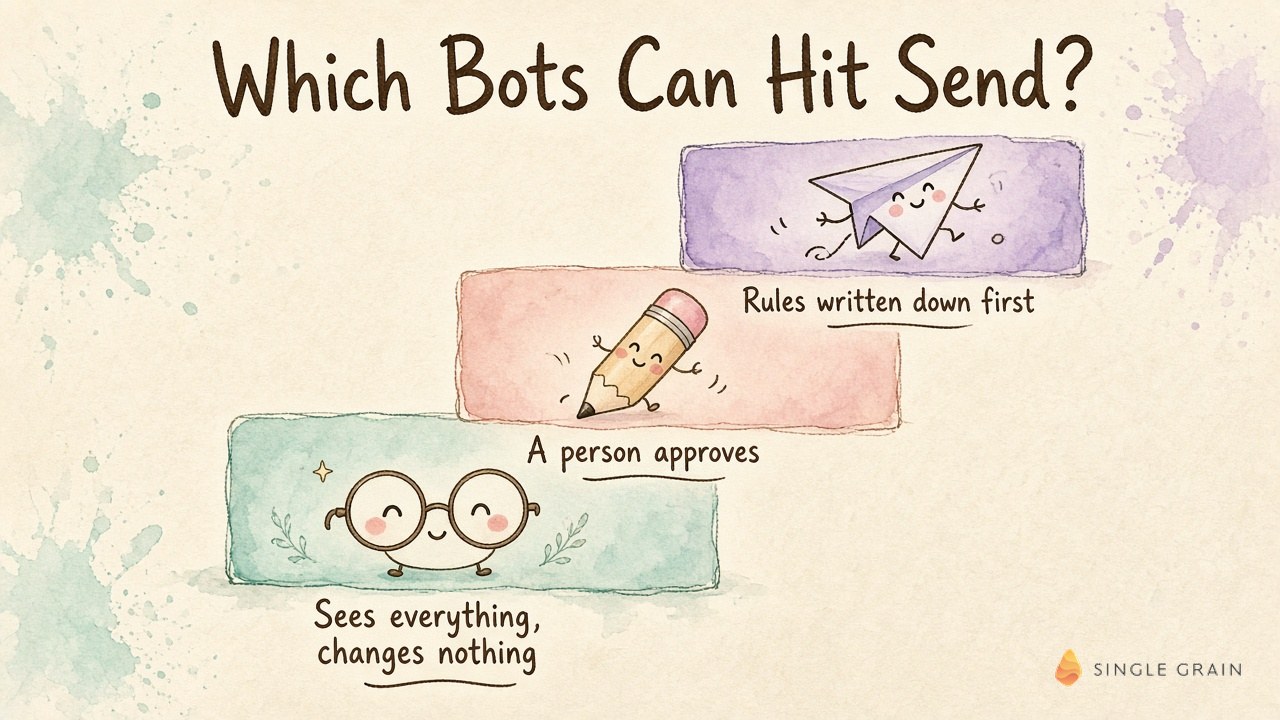
Look closely and you’ll see the guardrail is rarely technical. It’s a business decision written down clearly enough for a bot to follow.
| Pro-Tip |
|---|
| Write each guardrail as one sentence a new hire could follow, such as “Never quote below the minimum price.” If you can’t write it that plainly, the bot isn’t ready to enforce it. |
The technical layer still matters, though, especially once agents touch tools and money.
Agentic AI Guardrails for Tools, Data, and Spend
Agentic AI guardrails at the system level make sure a bot physically can’t exceed its rung. Prompts can be ignored or manipulated, so the limits should live in the tools and permissions themselves.
My team checks for these controls on any agent connected to real systems.
- Least-privilege access. A Read bot gets read-only credentials, with no write scope hiding in the connection.
- Separate credentials per bot. One compromised bot can’t borrow another bot’s access.
- Rate limits and caps. Volume and spend have hard ceilings outside the model.
- Logs for every action. You can see what the bot read, drafted and sent, and who approved it.
- A fast stop. Clear kill switches for managed marketing agents let a person pause everything in one move.
Authorization belongs in the downstream system rather than in the model’s judgment. If the CRM itself rejects a write from a Read bot, a clever prompt can’t talk its way around it.
With the fence built, the remaining question is how a bot climbs.
How a Bot Earns the Next Rung
A bot moves up only when three conditions hold. It has a track record on its current rung, its rules for the higher rung are written down, and a named human owns its exceptions.
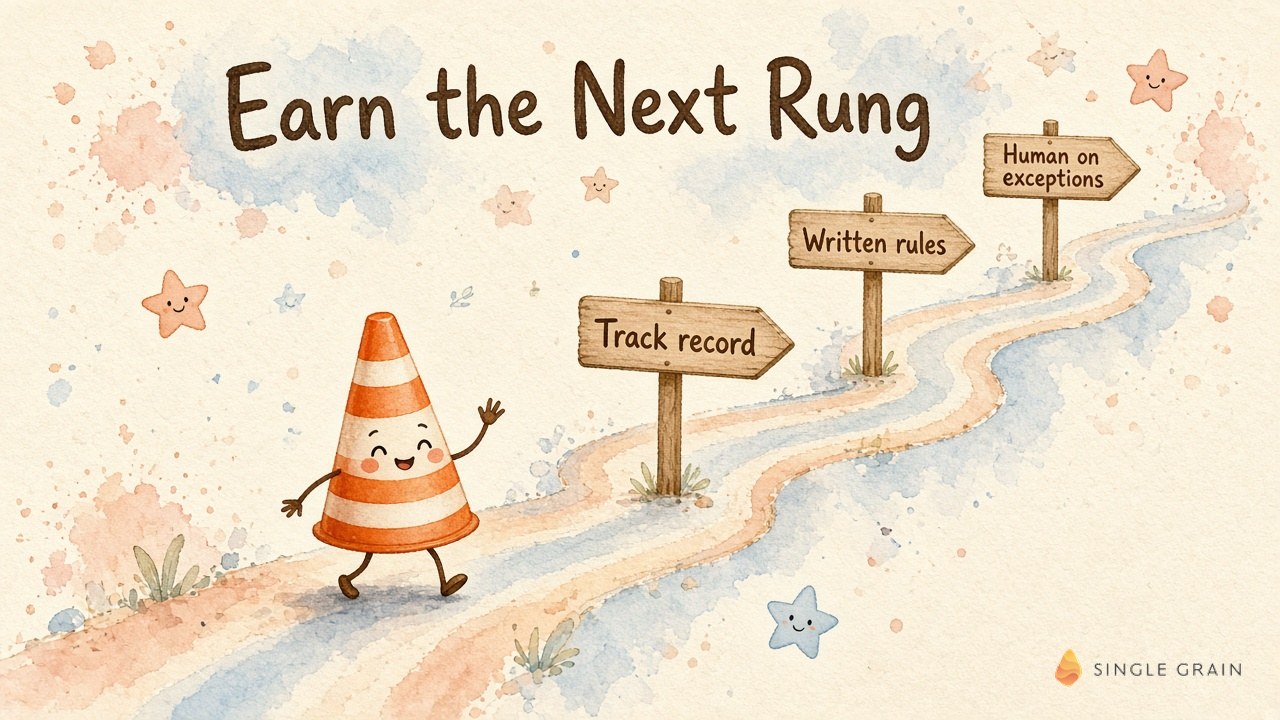
Here’s how I apply each condition.
- Track record. The bot’s drafts get approved with few or no edits for a sustained stretch, and the misses it does make are small.
- Written rules. The higher rung’s limits exist in writing, such as a first reply, a price floor or a volume cap.
- Human on exceptions. Anything outside the rules routes to a specific person with the evidence attached.
Some actions should stay at Draft no matter how good the bot gets. Contracts, refunds, pricing changes outside a set floor and anything public that can’t be pulled back are good examples.
| Action Step |
|---|
| List every bot your team runs, write its current rung next to its name, and flag any bot that can send without written rules. Move those bots down to Draft until the rules exist. |
Running this ladder across a whole company takes more than one person’s judgment.
How Guardrails Connect to AI Agent Governance
AI agent governance is the ownership layer above the guardrails. It answers who decides each bot’s rung, who reviews the rules and how often, and who is accountable when a bot gets something wrong.
Frameworks like the NIST AI Risk Management Framework give leadership teams a shared vocabulary for this. For businesses, my advice is to keep it practical with a clear pipeline RACI for agent-run jobs and a regular review of every bot’s rung.
My Grok Bot use cases show how this looks across a real company, with each job’s stopping point spelled out. The lesson from my team’s AI SDR experiment points the same way, since a bot with too much freedom and too little ownership breaks quietly.
| Pay Attention |
|---|
| A guardrail with no owner decays. Put a monthly review on the calendar, and treat any change to a bot’s rung like a change to someone’s job description. |
Governance can sound heavy, but in practice it’s a short list and a monthly meeting.
Put Every Bot on a Rung This Week
AI agent guardrails work best as a simple ladder everyone understands. Read bots see everything and change nothing, Draft bots wait for a yes, and Send bots act only inside rules a person wrote down first.
If you want help building AI agents with guardrails like these across SEO, content, and growth, my team at Single Grain can help. A forward deployed marketer can work with your team, and you can explore Single Grain’s AI transformation services and AI-powered SEO services to see where to start.
AI Agent Guardrails FAQs
-
What are AI agent guardrails?
AI agent guardrails are the rules and controls that limit what an agent can access, which actions it can take and what it can say. They include technical filters plus business rules about approvals, caps and exceptions.
-
How do guardrails relate to human in the loop AI agents?
Human in the loop is one kind of guardrail. On my permission ladder, a person approves every action at the Draft rung and handles every exception at the Send rung.
-
What are some examples of AI agent guardrails?
Read-only access for a call-prep bot, a daily cap for an outreach bot, a no-publish-without-yes rule for a content bot, and a locked first reply with a minimum price for a deal desk bot are all examples from my own bots.
-
When should an AI agent be allowed to send without approval?
Only after it has a track record, its rules are written down and a named person owns its exceptions. Only one of my bots meets that bar today.
-
Who should own AI agent guardrails?
A named leader should own each bot’s rung and review it on a set schedule. A simple pipeline RACI for agent-run jobs makes that ownership clear.