What Is a Forward Deployed Engineer, and Why Is Every AI Company Hiring One?


Time and time again, I’ve heard founders ask, “what is a forward deployed engineer?” right after an AI rollout stalls. This is a clear pain point I’ve identified with many rollouts over the past year. Licenses get bought, a few people use them, and six months later nothing in the business runs differently. The missing piece usually turns out to be a person who sits inside the work and builds the system there. Enter the forward deployed engineer.
Recently, I wrote about why the next wave of companies will run on forward-deployed humans plus AI agents. Palantir proved the model with software for governments and large enterprises. My agency is now applying it to revenue, and the role has become the hardest one for me to hire.
So what exactly is a forward deployed engineer? How do they differ from traditional software engineers? And most importantly, why do YOU need to have them on YOUR team?
In this guide, I’ll explain what the role is, how it differs from consultants and solutions engineers, why AI companies want these people first, and how to hire or become one.
TL;DR
- A forward deployed engineer embeds with one customer to ship working systems. The focus is many capabilities for one customer instead of one capability for many.
- Palantir created the role. Its engineers called Deltas deploy and customize platforms inside customer organizations.
- AI made the role urgent. Models are cheap and easy to buy, while the context needed to make them useful lives inside each business.
- The same model now applies to marketing. Forward deployed marketers own a revenue loop and use agents to compress the work.
TABLE OF CONTENTS:
- What Is a Forward Deployed Engineer?
- Forward Deployed Engineer vs Consultant vs Solutions Engineer
- Why AI Firms Hire Forward Deployed Engineers First
- From Forward Deployed Engineers to Forward Deployed Marketers
- How to Hire a Forward Deployed Engineer
- How to Become a Forward Deployed Engineer
- Where the Role Is Heading
What Is a Forward Deployed Engineer?
A forward deployed engineer, often shortened to FDE, is a software engineer who works directly inside a customer’s organization and is often AI native. Instead of building one product feature for thousands of users, the FDE configures, extends, and ships systems to solve one customer’s hardest problems.
Where the Role Came From
Palantir calls its forward deployed software engineers Deltas, according to its own engineering blog. Its product engineers, called Devs, focus on one capability for many customers. Deltas focus on one customer and many capabilities, and they measure success by impact on the customer’s goal.
Gergely Orosz, author of The Pragmatic Engineer newsletter, reports Palantir had more forward deployed engineers than standard software engineers until around 2016. OpenAI and Ramp have since built their own versions of the role.
What an FDE Does Day to Day
An FDE sits in operations meetings, learns the data pipelines, and figures out why a process breaks. Then they build applications or agent workflows on a shared platform to encode what they learned. When the platform is missing a capability, they often contribute it back to the core product.
With the definition settled, the next question is how the role compares to the jobs people confuse it with.
Forward Deployed Engineer vs Consultant vs Solutions Engineer
The FDE role overlaps with several others, which is why job posts can look vague. The differences come down to ownership and code.
FDE vs Consultant
Palantir addresses this directly. Consultants generally create a one-time analysis or recommendation, while Deltas work with customers to build long-term solutions which keep improving. An FDE ships working software and stays responsible for whether it gets used.
FDE vs Solutions Engineer
A solutions engineer usually supports the sale with demos, technical answers, and proofs of concept. The Pragmatic Engineer adds FDEs are expected to contribute more to the core product. Their work continues long after the contract is signed.
A Simple Way to Compare the Roles
| Role | Main Output | Time Horizon |
|---|---|---|
| Forward deployed engineer | Working systems inside one customer | Ongoing |
| Consultant | Analysis and recommendations | Project-based |
| Solutions engineer | Demos and proofs of concept | Pre-sale and onboarding |
| Product engineer | Features for many customers | Roadmap-based |
Those boundaries blur in practice, but ownership of the outcome is the clearest test. That ownership explains why AI companies want FDEs before almost anyone else.
Why AI Firms Hire Forward Deployed Engineers First
Most B2B companies I talk to pay for several AI tools. Marketing uses one model for copy, sales uses another for email drafts, and operations uses a third for spreadsheets. None of it compounds, because each tool starts from zero with no memory of the business.
Context Is the Bottleneck
Models are easy to buy. What a company can’t buy off the shelf is an understanding of its own pipeline, objections, and data. An FDE gathers that context and turns it into systems. My breakdown of the context layer most companies are missing covers the same idea.
Embedded Systems Are Hard to Replace
When engineers build systems inside a customer’s operations, ripping them out means losing everything the system learned. That switching cost is why the model produces long relationships. Andreessen Horowitz calls this trading margin for moat, with AI startups accepting heavier implementation work in exchange for deeper, stickier customer relationships. It also raises the bar on AI agent security, since embedded agents touch CRMs, call recordings, and financial data.
What It Looks Like in Revenue
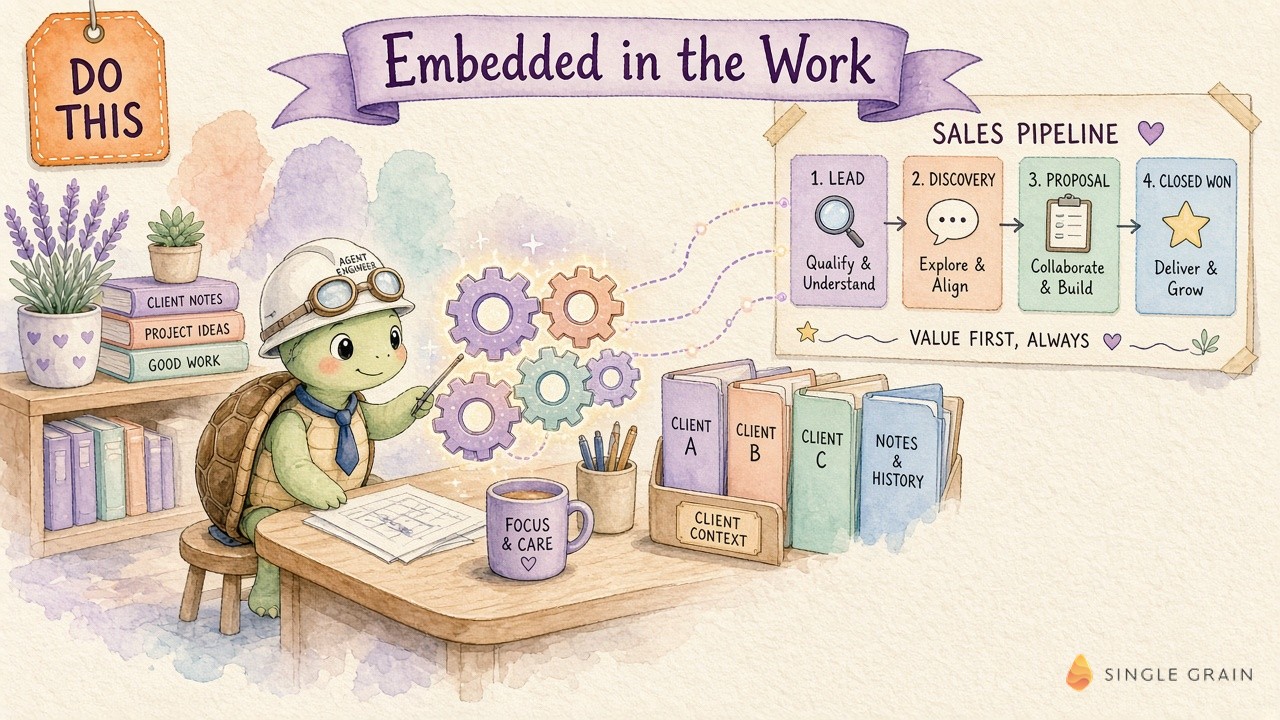
In my original post, I described a forward-deployed revenue architect who spends four to eight weeks inside a company to get started. They sit in pipeline reviews, read call recordings, and map the funnel from first touch to closed-won. Then they build agents to encode what they learned.
After a month, the system knows more about the revenue engine than any single employee does. It has read every call transcript and connected closed deals to the content behind them.
That shift from engineering to revenue is where the role gets interesting for marketing teams.
From Forward Deployed Engineers to Forward Deployed Marketers
The same pattern works for marketing, with a different skill mix. A forward deployed marketer owns a client’s growth loop and uses agents to handle research, drafts, reporting, and setup.
Why the Old Agency Org Chart Breaks
In a June post on rebuilding the agency org chart around forward deployed marketers, I described a simple landing page request moving through a strategist, a copywriter, an SEO specialist, and an account manager. Four people touched one page, and nobody had built anything yet. When agents can draft the brief, pull keywords, and build the page in minutes, context becomes the constraint.
Constraint Ownership Over Task Ownership
Task ownership sounds like “I own the report.” Constraint ownership sounds like “I own moving this client from weak lead quality to better pipeline.” The operator owns the loop, agents compress the work, and specialists plug in when craft depth is needed. The full playbook for embedding a forward deployed marketer who ships agents covers hiring, scope, and metrics.
The Operator Still Catches What Agents Miss
My team saw this with an SEO decay workflow. The agent flagged pages which looked like they were declining, but the operator noticed several dropped in the same window every year and recovered on their own. The fix was a seasonality check comparing the same month in prior years, which became a permanent rule in the workflow.
| Pro-Tip |
|---|
| When an embedded operator corrects an agent, turn the correction into a written rule inside the workflow the same day. One fix should prevent the same mistake for every future client. |
That habit of turning fixes into rules is also the best signal when you’re hiring for the role.
How to Hire a Forward Deployed Engineer
Strong FDEs are rare because the job combines engineering, business judgment, and client trust. My team has been hiring forward deployed engineers from around the world, and a practical challenge filters candidates better than a resume.
Skills to Look For
- Production experience. They’ve shipped systems touching real revenue or operations, beyond demos and prototypes.
- Business curiosity. They ask why a process exists before automating it.
- Communication. They can explain a tradeoff to an executive and a bug to an engineer in the same afternoon.
- Judgment under ambiguity. They pick a path when requirements are fuzzy and adjust fast.
Resumes rarely show these traits clearly, so test for them directly.
Interview With Real Work
Give candidates a messy, realistic problem and watch how they scope it. The questions in this post on what my team sends every AI-native hire are a good starting point for screening.
The same traits apply if you’re trying to become an FDE yourself.
How to Become a Forward Deployed Engineer
Most FDEs grow into the role from software engineering, data work, or technical consulting. There’s no single certification for it.
A portfolio of real builds carries more weight than credentials, so start there.
Build in Public on Real Problems
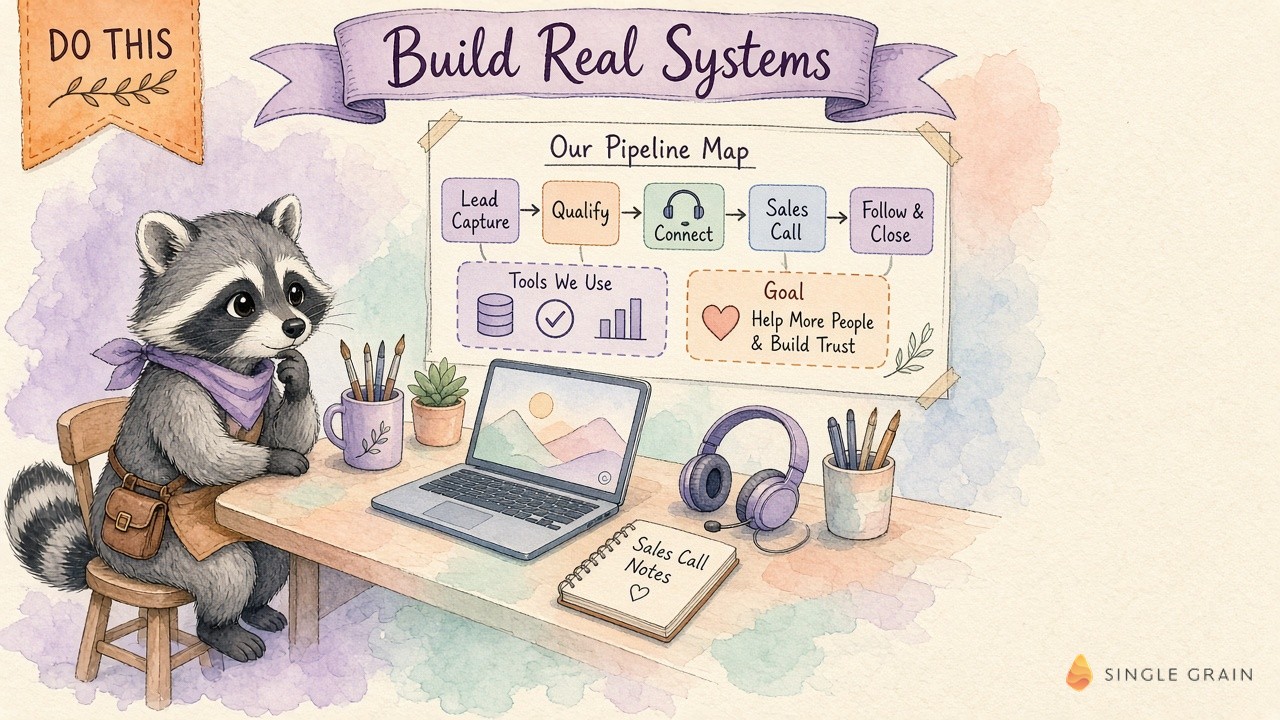
Pick a real business process, such as lead routing or reporting, and build an agent workflow for it end to end. Document what broke and how you fixed it. A finished system with a clear before and after beats any course certificate.
Learn the Business Side
Spend time with sales calls, pipeline reviews, and customer support tickets. The best FDEs understand why a metric moved, which makes their systems far more useful. This explainer on who owns the pipeline when agents run the jobs makes a good primer on how ownership works in agent-heavy teams.
Where the Role Is Heading
Forward deployed engineering started as a Palantir quirk and became a standard role at AI companies. It now spreads into revenue and marketing teams, wherever AI value depends on knowing one business deeply.
The same pattern shows up in AI native companies, where small teams embed agents in every workflow. Companies wanting AI to change outcomes need someone embedded in the work, whether they hire that person or bring in a partner. Single Grain’s AI transformation services team embeds forward deployed marketers and engineers who build agent workflows inside your stack. Contact Single Grain to talk through where an embedded operator would move your numbers first.
Frequently Asked Questions About Forward Deployed Engineers
-
What is a forward deployed engineer?
A forward deployed engineer is a software engineer who embeds with a customer to build and customize systems for that customer’s problems. Palantir, which created the role, describes it as one customer and many capabilities.
-
How is a forward deployed engineer different from a consultant?
Consultants usually deliver a one-time analysis or recommendation. Forward deployed engineers build working systems with the customer and stay responsible for whether those systems keep improving.
-
Why are AI companies hiring forward deployed engineers?
Models are easy to buy, but making them useful requires deep context about each business. Forward deployed engineers gather that context and turn it into working systems.
-
What is a forward deployed marketer?
It’s the marketing version of the role. A forward deployed marketer owns a client’s growth loop, uses agents to handle research and production, and brings in specialists when craft depth is needed.
-
How do embedded engineers handle security and permissions?
Embedded systems often touch CRMs, call recordings, and financial data, so they need per-client data separation, role-based access, audit logs, and human approval before agents send or publish anything.