What Is Service as Software? How Agencies Sell Outcomes Instead of Hours


You’ve all heard about software as a service… but have you ever heard of service as software? Simply put, service as software is the model agencies need right now, because bolting AI onto an hourly model only races toward cheaper work and thinner margins. Under this modern model, the firm sells finished outcomes delivered by reusable workflows instead of billing for time.
Recently, I wrote about the $1 software to $6 services idea, the framing that for every dollar companies spend on software, several more go to services. Everyone was talking about capturing the whole budget with AI, but almost nobody explained how to do it. My answer was to stop selling labor and start selling managed growth loops.
Below, you’ll find the definition, the economics, the seven loops worth building an agency around, and a simple framework for deciding what to productize first.
TL;DR
- Service as software means selling the outcome, with software doing most of the delivery. The customer buys a finished result instead of a tool they have to run.
- The unit of value is the loop. A loop is an end-to-end process that turns inputs into outcomes and gets smarter from feedback.
- Skills turn expertise into infrastructure. Codified workflows let agents repeat your best process while people own judgment and taste.
- Usefulness and ongoing effort decide what to productize. Keep helping the customer while you reduce the repeat work behind each delivery.
What Is Service as Software?
Leaders in the industry describe the shift as moving from software as a service to service as software. Traditionally, in a software business, the customer buys access to a tool and remains responsible for the result. As you probably already know, the services business puts responsibility for the result on the seller.
Service as software flips this narrative using AI agent.
AI agents close the gap between the two. They can read messy inputs, generate output, and handle multi-step tasks, so a firm can deliver a service with far less manual labor. Foundation Capital sizes the opportunity at $4.6 trillion across salaries and outsourced services.
Service as Software vs SaaS
The difference comes down to who does the work. A SaaS tool gives your team a dashboard for paid media. A service-as-software firm runs the paid media program and reports the outcome, using agents and workflows behind the scenes.
Outcome pricing follows the same logic. Foundation Capital points out that outcome-based pricing aligns cost with the value delivered, which removes the incentive to limit usage.
Why Investors Care
Julien Bek, a partner at Sequoia Capital, put the ratio plainly in his essay on services as the new software. For every dollar spent on software, six are spent on services, so the work budget dwarfs the tool budget.
In a June post, I pointed out that AI service firms were commanding valuation multiples as high as 30x, well above what a typical agency earns. That gap is why venture firms have started chasing services. Treat that multiple as the high end of the market, since most service firms still trade far lower.
With the definition in place, the next question is what an agency actually sells under this model.
Why Selling Hours Is the Wrong Bet
Most agencies use AI to make labor cheaper. Faster decks, cheaper reports, more blog posts, and more ad variants all sit on top of the same fragile business. If execution gets ten times cheaper, an hourly model loses revenue on every efficiency gain.

Hours, Deliverables, Expertise, Loops
The unit of value in agencies has moved from hours to deliverables to expertise. The next unit is the loop. A loop is an end-to-end business process that repeatedly turns inputs into outcomes and improves from feedback.
Agents Work Inside the Loop
An agent is a worker inside the loop. A paid creative loop might include a research agent mining reviews and sales calls, a creative agent drafting hooks, a QA agent checking claims, and an analytics agent reading performance. The loop is the business model, and the agents are staff.
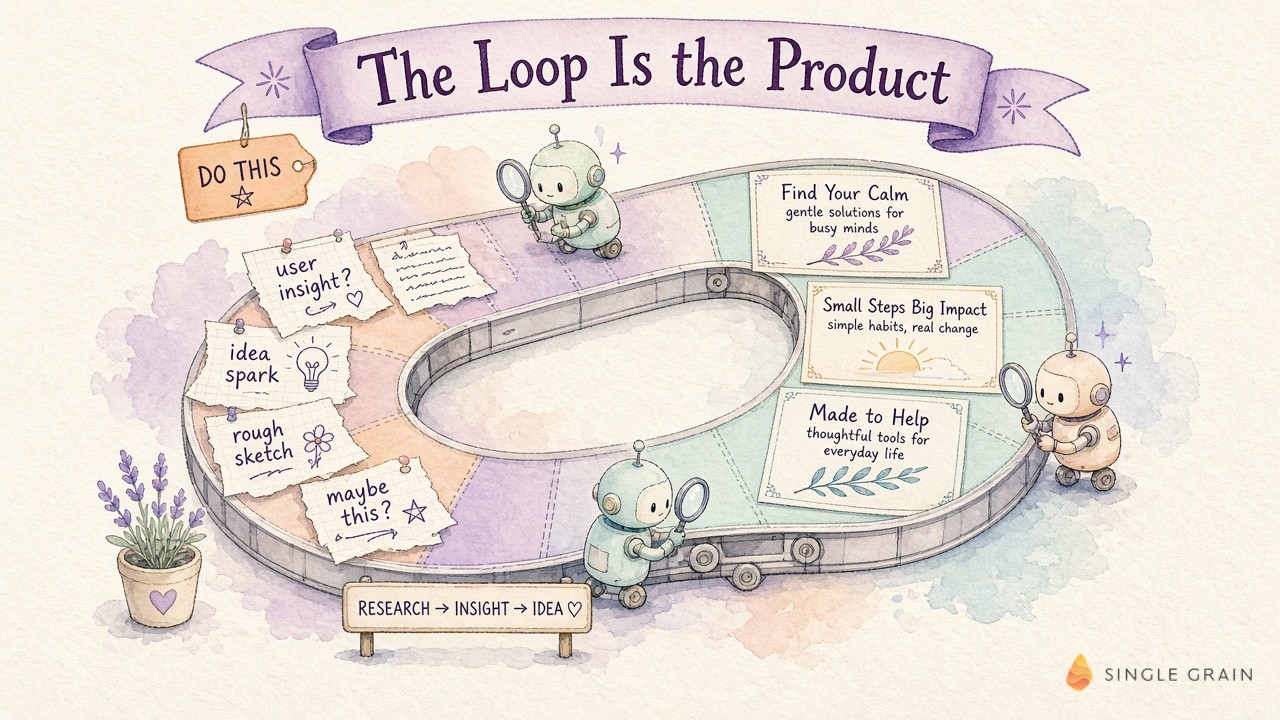
That distinction keeps teams from buying a zoo of agents with no operating system. The next section lays out the loops worth building.
7 Loops Every Services as Software Agency Should Own
These are the loops I described in my original post. Each one runs continuously across the client relationship.
- Raw materials loop. It keeps collecting customer research, sales calls, reviews, and offer details, because stale inputs produce stale marketing.
- Creative testing loop. It produces many useful variants, kills most of them fast, and learns from the winners.
- Demand capture loop. It turns search, AI answers, social discovery, and community signals into briefs, page updates, and sales assets.
- Conversion loop. It watches every step between attention and action to find where momentum dies.
- Client narrative loop. It turns performance data into what changed, why, and what decision needs approval.
- Sales enablement loop. It reads sales calls and creates the proof, objection handling, and follow-up assets reps need.
- Learning loop. It captures winning hooks, losing angles, and workflow fixes, then feeds them back into every account.
The learning loop is the moat. If an agency serves a hundred clients and every account still starts from scratch, it’s a staffing company with better positioning.
Where Skills Fit
Codified skills hold the loops together. A SKILL.md file tells the system how a task should be done, what good looks like, and where a person needs to review. I explained the difference between skills and one-off prompts in an earlier piece.
Where People Fit
People move up the stack. They direct agents, judge output, read weak signals, and earn client trust. Slide formatting and rebuilding the same onboarding checklist should belong to the system.
Those roles change hiring as much as delivery, which brings up the harder question of what to standardize.
The Usefulness vs Effort Framework
In my September framework post, I shared the matrix my team uses to decide what to productize. Put customer usefulness on one axis and ongoing delivery effort on the other.
The Four Quadrants
- High usefulness, high effort is premium custom work. Price it for what it takes.
- High usefulness, low effort is where a proven reusable workflow belongs.
- Low usefulness, high effort should stop or get rethought, since difficulty alone doesn’t justify a build.
- Low usefulness, low effort usually loses priority, because cheap activity still eats attention.
The goal is to move work down the high-usefulness side. Keep helping the customer while you reduce the repeat effort.
Watch for Dashboarditis
I call one failure mode dashboarditis. A team builds an impressive dashboard, but nobody checks whether people use it or whether useful work actually gets delivered. A demo answers neither question.
Count the Ongoing Cost
A workflow can be expensive to build and still become cheap to run. Count the recurring work in full. If an engineer has to rescue every run or the manual task moved into a review queue, the workflow isn’t scalable yet. My team uses a similar lens for deciding what work to productize, deprioritize, or stop.
| Pro-Tip |
|---|
| Before calling any workflow productized, run it three times against the same acceptance standard and record total effort, including corrections. If speed improves while rework climbs, the workflow still needs work. |
Once you know what to productize, the remaining question is how customers pay for it.
Three Ways to Sell Service as Software
The same capability can support different buying relationships. My team designs around three.
Managed Services
The customer wants you to run it. They pay for ongoing delivery, judgment, and an accountable owner. Reusable workflows make the service efficient, but the customer never has to operate them. For pricing guidance, see how to price managed marketing agents without guessing margin.
Workflow Access
The customer wants to run it in-house. They get access to the workflows and connections and operate them with their own team or agents.
Outputs or Outcomes
The customer wants a defined deliverable. An accepted creative asset is an output with a clear brief and review process. Incremental sales count as outcomes, which raise attribution questions. Charge for outcomes only where you can support the measurement.
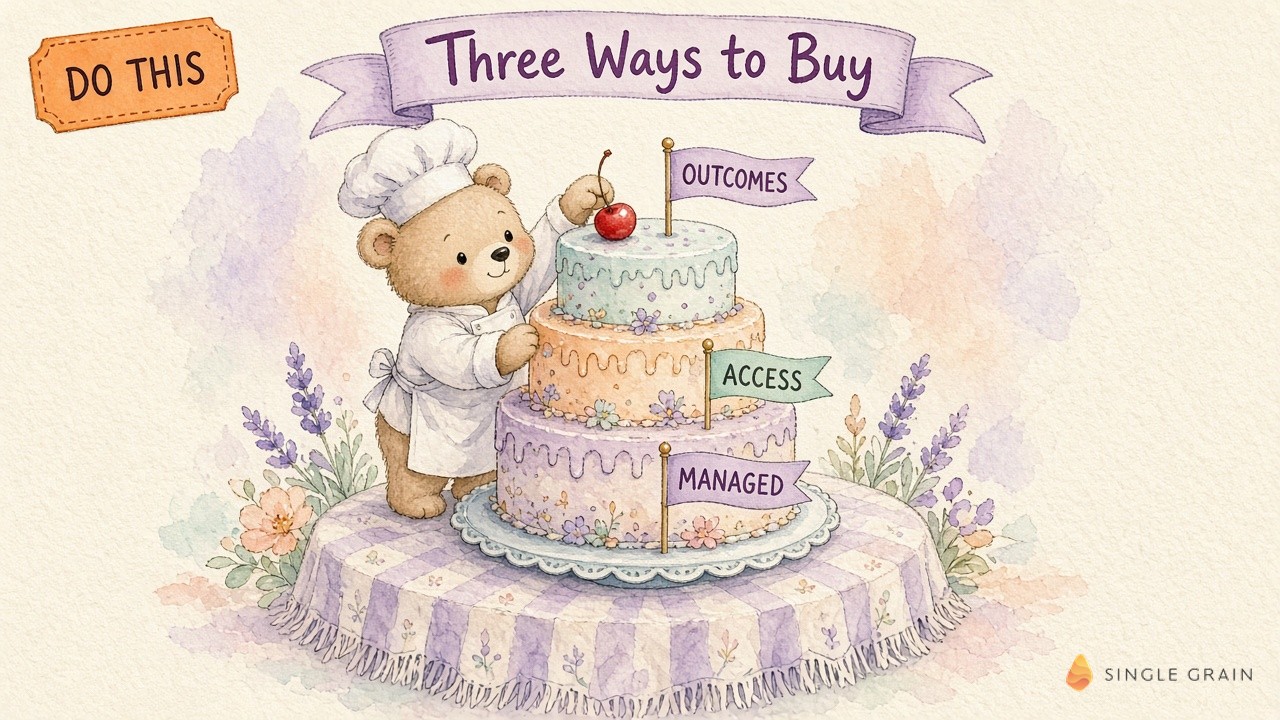
Those three layers explain how customers buy, while the matrix explains what to build.
How to Start a Service as Software Model
You can apply this without building a platform first.
Pick One Recurring Job
Choose a service your team already delivers. Write down the customer’s desired result and what makes the work acceptable. Place it on the usefulness and effort matrix using real delivery experience.
Standardize the Most Wasteful Step
Find the repeated step with the most avoidable effort and turn it into a workflow with defined inputs and a review point. Keep customer-specific context visible. This walkthrough on starting an AI services firm for local businesses shows the same idea applied to a smaller market.
Measure the Next Run
Record total effort on the next delivery, including corrections, and check the output against the original standard. Then decide whether to improve the workflow, keep the job custom, or stop investing in it.
What This Means for Hiring
The most valuable people in a services-as-software firm can direct agents, judge output, and turn messy input into clean action. My team now recruits forward-deployed engineers and forward-deployed marketers who sit close to the client and ship workflows.
Companies building this way often look like the model described in what an AI native company is. Fewer people handle more accounts, and each delivery leaves behind a better method.
If your marketing still depends on an agency billing hours, ask what you’re actually paying for. Single Grain’s AI transformation services team builds and runs managed growth loops for growth-stage companies. Contact Single Grain to see which loop fits your business first.
Frequently Asked Questions About Service as Software
-
What is service as software?
It’s a business model where a company sells a finished outcome, such as a managed ad program or tax filing, and delivers most of it with AI agents and reusable workflows instead of manual labor.
-
How is service as software different from SaaS?
SaaS sells access to a tool, and the customer stays responsible for the result. Service as software sells the result itself, with software doing most of the delivery behind the scenes.
-
Do AI service firms really get 30x multiples?
Some AI service firms have been valued at multiples as high as 30x, but that’s the top of the market. Most service businesses still trade at much lower multiples, so treat it as a ceiling, not a baseline.
-
Should agencies charge for outcomes?
Only where they can support the measurement. Outputs like accepted creative assets are easy to define, while outcomes like incremental sales raise attribution questions that need clear terms.
-
How do I start moving my agency to service as software?
Pick one recurring job, place it on a usefulness and ongoing effort matrix, standardize the most wasteful step, and measure total effort on the next run before productizing more.