Who Owns AI Generated Images? Check Rights Before Ads Run


A lot of clients want exclusive creative. But when asked about it, suddenly nobody on your ad team can answer who owns AI generated images. Can anyone own them at all?
In short, ownership comes down to two separate questions:
- Whether a human authored enough of the image for protection
- What your generator’s terms let you do commercially
Personally, I’ve already had a creative review go wrong, which is why I want an editor on every client ad.
So, can you run the image, promise exclusivity, or neither? If you’re the paid media lead signing off, you’ll want the answer before the ad goes live. First comes the copyright decision and the creative reviews behind my advice, followed by what I’d put beside an ad awaiting approval. Let’s dive into it.
TL;DR
- Purely AI-generated material lacks U.S. copyright protection under Copyright Office guidance. Human-authored elements require their own assessment.
- A provider’s commercial permission addresses your contract. Record the applicable terms and the account used for production.
- Human creative work needs a visible record. Preserve source files and explain which final elements a person authored.
- Give every approved ad a traceable rights record. Connect its inputs, permissions, and final version to a named approver.
TABLE OF CONTENTS:
- Who Owns AI Generated Images?
- What a Real AI Copyright Decision Shows
- Why I Keep a Human in Creative Review
- Check Tool Terms for AI Ad Creative
- Use Competitor Ad Research Without Assuming Permission
- Build an Asset Rights Record Someone Can Review
- Decide Whether to Approve, Revise, or Hold
- Give Your Next Ad a Clear Approval Owner
Who Owns AI Generated Images?
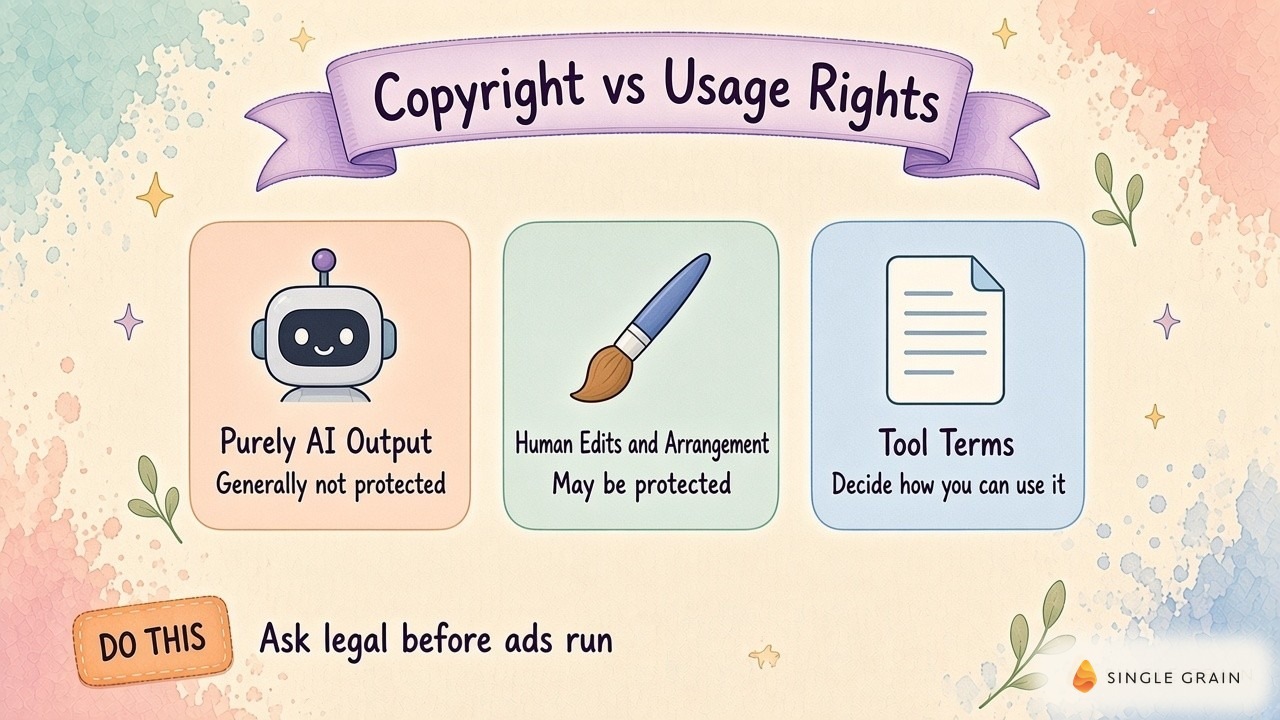
Let’s start with the facts. The Copyright Office’s copyrightability report excludes purely AI-generated material from protection. Therefore, you should always begin with human authorship. For the generally available technology the report examined, prompts alone didn’t give a person sufficient control over expressive elements.
Your generator’s agreement answers a separate question about commercial use. Open the terms covering the actual production account. Check which permissions the provider grants and which conditions apply. A contractual assignment can only transfer available rights; it can’t create human authorship.
Separate Permission From Exclusivity
Can you run the image in the campaign? Could you challenge someone else’s copying? I’d reserve separate fields for these answers in the approval record. A client asking for exclusive ownership needs more than permission from a tool provider.
In the commercial-use field, I’d identify the relevant contract clause. In the authorship field, I’d describe the human-created elements for counsel to assess. If either answer is missing, I’d hold the ownership promise until someone resolves it.
My team’s guide to AI images covers the broader production workflow. Here I’m concerned with the file reaching your approval queue. The comic review below shows why its finished appearance can’t settle every rights question.
What a Real AI Copyright Decision Shows
In February 2023, the Copyright Office reviewed comic author Kristina Kashtanova’s Zarya of the Dawn registration. The review covered the comic and its original application. The Office also examined correspondence explaining how the images were produced.
Its letter recognized the author’s text and the selection, coordination, and arrangement of written and visual material. It excluded the individual Midjourney-generated images from protected authorship. The Office said it would replace the original certificate with a narrower registration covering the author’s expression. The finished comic therefore contained elements with different copyright status.
Read the Final Ad in Layers
I’d bring this habit into an ad review by opening the editable design file beside the export. Then I’d identify the source of each visible element. Generated backgrounds need their production history, licensed photographs need a permission record, and original copy needs its authorship documented.
Ask the designer to point to the work they contributed. Original illustration, handwritten lettering, or a particular creative arrangement gives counsel a contribution to examine. “Edited by a human” leaves the reviewer guessing about what changed.
I wouldn’t treat the comic decision as a guarantee for an ad. I’d use it to check whether an ownership claim covers more than the documented authorship supports. Keep the source file open during this conversation; the export hides too much of the production history.
Why I Keep a Human in Creative Review
I learned this with my own YouTube channel. I let an automated skill produce the videos without putting enough of my taste into the process, and when I reviewed them, I wasn’t happy with the result.
At Single Grain, the lesson carried straight into client ad creative: keep someone responsible for judging the final creative. I would add an inputs-and-permissions review before approving an ad for use.
Quality approval doesn’t settle copyright ownership. I can judge whether creative matches the intended direction, while counsel assesses the rights questions. Passing my taste check would still leave the permission record to complete.
I keep human judgment involved across creative channels. For a paid media lead, I’d turn this into an explicit handoff: specify where AI design agents stop and human approval begins. Save the generated draft before the designer changes it, so the reviewer can compare the files.
Check Tool Terms for AI Ad Creative
Save the agreement for the product, plan, and account used to make the image. Date the copy and attach it to the production records. A colleague’s memory of another subscription leaves you without the clause covering this file.
I’d have the reviewer write the answers beside the relevant clauses:
- Commercial use. Which clause permits the intended advertising use, and what conditions apply?
- Inputs. Does the business have permission to upload each reference file, and how may the provider handle it?
- Output rights. What does the agreement assign or license, and what does it say about similar outputs?
- Claim handling. Does any indemnity apply to this account and use, and which exclusions or notice requirements matter?
Keep the explanation attached to the saved agreement. Otherwise, the next reviewer has to reconstruct your decision from the contract. If production switches accounts or providers, reopen the review before approving the resulting asset.
When a Client Needs Exclusive Rights
What if the client contract already promises exclusive ownership? Flag the clause before generation begins. Ask counsel whether the proposed production method supports the deliverable. Include the photographer, designer, or contractor agreements in the same review.
For a recurring mascot or signature illustration, I’d choose a production route with a clear authorship history. Ask the designer to retain drafts and explain original creative decisions. Counsel still needs to assess the contribution; a person’s presence in the workflow doesn’t settle the question.
Put the decision in the creative brief. My team’s creative testing framework organizes performance experiments. I’d attach the rights record to each asset entering a test, so variations retain a path back to the approved inputs.
Use Competitor Ad Research Without Assuming Permission
Competitor research is useful up to a point. A Jev Images competitor analysis report, for example, reviews advertising and makes recommendations about pages, which helps decide what deserves further investigation.
A recommendation in a report supplies no permission to reuse the advertiser’s image. I’d ask the ad lead to turn an observation into a written creative objective. Then I’d develop an original execution from approved inputs and keep the research reference separate from production files. Any proposed use of someone else’s actual work would go to counsel.
Reference Files Need Their Own Record
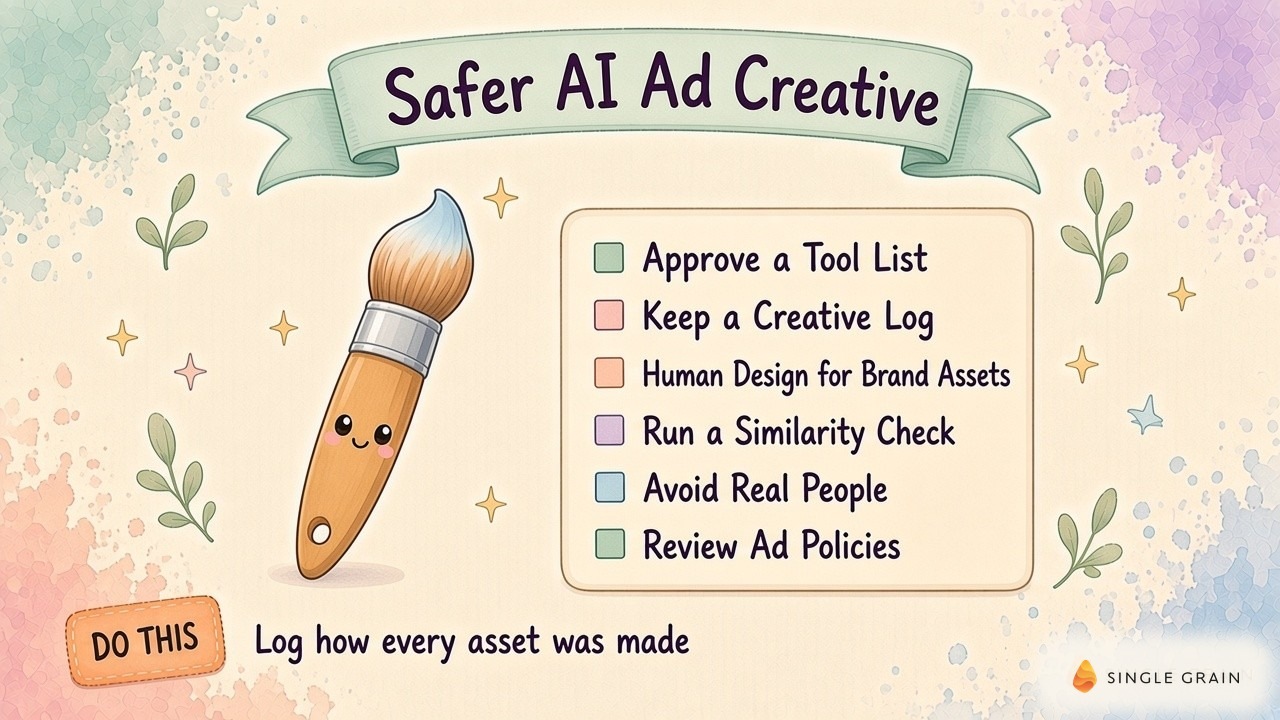
Pause before uploading a reference image to a generator. Record where the file came from and which permission supports the upload. Having a copy doesn’t give you permission to modify it or include its elements in an ad.
At final review, check for recognizable logos, characters, or real people. If a resemblance raises a concern, route the output to the appropriate reviewer with the source reference attached. The comparison can flag a problem. It can’t certify legal clearance.
My team’s posts on scaling creative with Seedance and Meta ads and Seedance AI video ads cover production at scale. Each variation still needs a traceable source. Before increasing output, I’d check whether the next reviewer can follow an asset back to approved material.
Build an Asset Rights Record Someone Can Review
I’d start with the spreadsheet row for the ad awaiting approval. Give the asset a stable ID and link the row to the actual export. Store the editable design file in the same project folder. The person receiving the handoff should be able to open both files.
Log the Tool, Inputs, and Terms
Next, I’d fill in the tool, account, generation date, prompt file, and uploaded references. Link each input to its source or permission document. Save the applicable terms beside the production files. A future reviewer shouldn’t have to hunt for old contract language online.
For the human contribution column, I’d ask the designer to describe the visible work and identify the relevant layers or drafts. Then I’d add the reviewer and approval scope. Name the campaign and intended use in the scope field, so a later reuse prompts another decision.
| Pro-Tip |
|---|
| Keep the unedited generated output beside the final layered file. The designer can point to a visible change while counsel evaluates the claimed contribution. |
The Copyright Office’s registration guidance requires disclosure of AI-generated content and a description of human contributions. Applicants must exclude AI-generated content exceeding a minimal amount from the claim. Accurate production notes give a registration reviewer material to examine if the business pursues protection.
Assign Review Roles for the Asset Rights Record
I’d assign the paid media lead to check the record for missing answers. Counsel handles legal questions, and the designer explains creative authorship. The lead then reconciles the approved file with the campaign scheduled to launch.
My team’s guide to which AI agents can hit send covers approval boundaries. Here I’d let an automated check flag an empty field, with a named person responsible for the release decision. A filled spreadsheet row still needs a reviewer who can explain its contents.
Decide Whether to Approve, Revise, or Hold
I’d approve an asset after the responsible reviewers document its intended use, input permissions, and applicable terms. Record any limits in the approval scope. Permission for a temporary campaign shouldn’t silently become permission for permanent brand use.
If a component has unclear provenance, I’d return the file for revision. Ask the designer to replace the component using an approved source, preserve the revised file, and submit it for review again. A changed prompt leaves the unidentified source unresolved.
If a key permission remains unanswered, I’d hold the asset. I’d also hold an ownership promise exceeding the available evidence. Write the missing answer into the record and assign someone to resolve it. Production can act on a specific missing permission more easily than an unexplained rejection.
Recheck Policies Before Release and Reuse
Check the destination platform’s current advertising policies before release. For legal developments, consult the Copyright Office’s AI resource page. Keep dated guidance beside the campaign-specific advice from your reviewer, so you can see the basis for the decision.
After approval, retain the review history with the performance results. A campaign earning a larger budget can bring the file back into discussion. I’d want the original permission record available when someone proposes expanding its use.
Give Your Next Ad a Clear Approval Owner
I want AI to help my team at Single Grain explore creative ideas faster. Before an ad launches, I want the paid media lead to identify the approved file and open its permission record. Start with the asset already awaiting review. Complete its record before expanding the process.
Need help connecting creative production to campaign execution? Single Grain’s creative strategy team and paid advertising team can help build your workflow. Contact Single Grain to discuss your campaign.
Frequently Asked Questions About Who Owns AI Generated Images
-
Can AI-generated images be copyrighted?
In the U.S., the Copyright Office says purely AI-generated material isn’t protected. Human contributions like creative selection, arrangement, or edits may be.
-
Are prompts enough to own an AI image?
According to the Copyright Office, prompts alone don’t currently provide enough human control to create copyright protection.
-
Can I use AI images in ads?
Often yes, depending on the tool’s terms and your plan. Check output rights, restrictions, and content policies with your legal team first.
-
What's the biggest risk with AI ad creative?
Outputs that resemble copyrighted works, trademarks, or real people. Avoid these prompts and run similarity checks.
-
How do I protect AI-assisted brand assets?
Add meaningful human design work, document the process, and have legal review before registering or relying on the asset.