How to Measure AI ROI and Where the Real Returns Come From


Have you noticed that your AI tool bill is exact to the cent, but your revenue story is still a complete guess? You’ve poured in buckets of your own cash into AI tools, but you’re not entirely sure if you’re actually seeing real returns. AI ROI gets awkward fast in a budget review, because finance wants proof of what actually improved… and you don’t have the numbers.
I’ve faced this issue myself, and I decided that I want my own numbers to survive these awkward conversations. For example, in a recent Media OS walkthrough I posted on my YouTube channel, I described a new Meta campaign connected to HubSpot. My paid media bot produced a sales-qualified lead in its first week! I was excited about the result, but a qualified lead still needs to become revenue before I can claim a financial return.
So how do you separate a useful early signal from a return finance can recognize? In the sections ahead, I’ll build a workflow-level AI ROI report for a marketing budget decision, walk through the cost sheet, use my campaign and editorial workflows as examples, and show how I’d decide whether to keep funding a pilot.
TL;DR
- Choose a workflow with an accountable owner. Define its accepted output and the business result before counting AI activity.
- Separate capacity from cash. Recovered hours need a documented use before you assign them a financial benefit.
- Include review and repair costs. Setup, rejected drafts, and ongoing maintenance belong beside subscriptions in your calculation.
- Keep early signals labeled. A qualified lead or an approved article can justify further testing while revenue remains unproven.
TABLE OF CONTENTS:
- What AI ROI Measures in a Marketing Workflow
- Build a Baseline You Can Recheck
- My Media OS Campaign Shows Where Measurement Starts
- Our Gap Card Makes Review Work Visible
- Count AI Costs After the First Draft
- Measure Revenue From AI Recommendations Separately
- Check Quality Before Claiming Payroll Savings
- Give Finance a Funding Decision It Can Inspect
- Choose a Workflow Worth Funding
What AI ROI Measures in a Marketing Workflow
AI ROI (return on investment) measures the financial benefit attributable to a workflow against its full cost.
Here’s how you calculate it: Subtract the incremental cost from the attributable benefit, then divide by the incremental cost. Use the same measurement period on both sides of the calculation.
I would start with a campaign or editorial process small enough for its owner to inspect. For example, a subscription dashboard shows spending, while a campaign record or an editorial queue shows whether the spending produced usable work.
Separate Capacity From Financial Benefit
Keep capacity, financial benefit, and customer outcomes separate in the report. Capacity means a person has time available for another task. A financial benefit requires evidence of additional contribution or an expense actually avoided.
For additional sales, finance can supply the appropriate margin and treatment of fulfillment costs. Counting all incremental revenue as profit overstates the return. For savings, confirm whether an invoice fell or spending was avoided before entering cash in the benefit column.
My team’s guide to AI spend per employee can help frame the budget discussion. The decision in this post happens at the workflow level, where you can inspect the output and its cost together. Start by giving the report a specific boundary.
Build a Baseline You Can Recheck
A useful baseline describes the work before the pilot changes it. Save a sample of completed work with its review history and the elapsed time from request to acceptance. Choose a period representative of the workload you intend to test.
Define an Accepted Output
For an editorial workflow, a generated draft remains work in progress until an editor approves it. Define acceptance using the editorial requirements already in use. Keep rejected drafts in the record because they consumed time and money.
For a paid campaign, define the handoff sales will accept. A form submission can contain incomplete or unsuitable details. Record the qualification decision so a change in lead volume doesn’t hide a change in lead quality.
Record Human Effort Across the Handoff
Ask the workflow owner to capture active work time separately from waiting time. An article waiting for approval may have a long cycle with little editing effort. A draft approved quickly can still require substantial repair.
Use a spreadsheet with columns named Request, Owner, Accepted Output, Active Minutes, Review Minutes, and Rework Reason. Keep links to the source artifacts so someone else can recheck the entries.
Keep the Comparison Fair
Compare work with similar scope and acceptance criteria. A short announcement and a researched buying guide create different workloads. Separate them in the sheet instead of averaging away the difference.
When practical, run comparable work through the prior process during the pilot. Record changes in campaign offers or audience targeting alongside the AI change. Otherwise, the report may give AI credit for an improvement caused elsewhere.
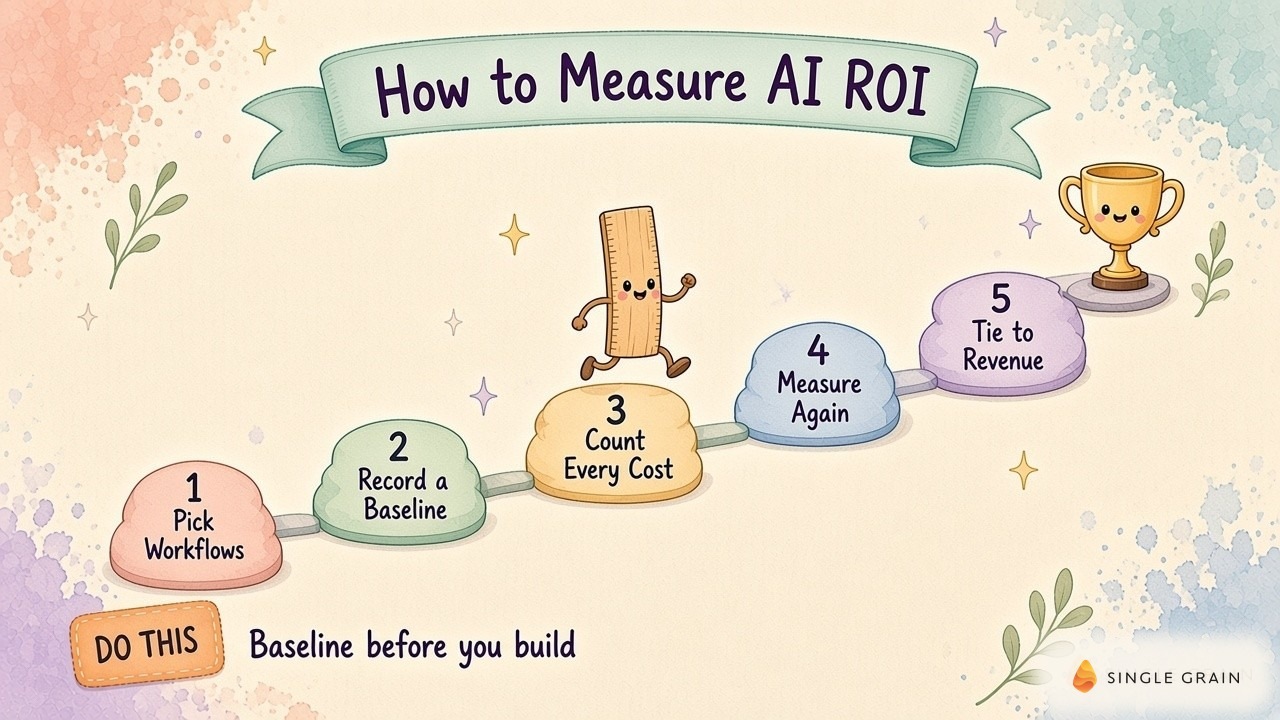
A baseline makes later questions easier to answer. My own campaign example shows why the distinction between an early result and a financial return matters.
My Media OS Campaign Shows Where Measurement Starts
In the walkthrough, I was reviewing a new acquisition funnel at Single Grain: a Meta campaign assembled by Media OS with HubSpot connected. I reported a sales-qualified lead during the first week, with the funnel directing prospects toward AI visibility and citation maps.
A qualified lead is a promising start, and a closed sale, a margin improvement, and the campaign’s full cost are still missing from the picture. I wouldn’t turn the prospect’s company revenue into a claim about revenue earned by Single Grain.

Trace the Campaign Through the CRM
To evaluate a campaign like this, I would retain the campaign identifier and the associated CRM records. Check which leads sales accepted, whether opportunities progressed, and which deals eventually closed. Capture the ad spend and human review effort during the same period.
My team’s guide to using AI for paid ads covers the campaign work around this decision. For the ROI report, the additional question is how much of the observed result came from the AI-assisted process. Compare it with a credible baseline before attributing the improvement.
Report a Qualified Lead as an Early Signal
If a sale hasn’t closed, report the qualified lead as an early signal. Keep the revenue field pending. I can choose to fund more learning with this evidence while acknowledging how much remains uncertain.
Campaign revenue may take time to mature. Editorial operations provide a different place to inspect the cost of getting usable work out of a bot.
Our Gap Card Makes Review Work Visible
In my workflow walkthrough, I described how an editor on my team received an editorial gap card. Jev screened ideas against live posts, and the workflow sent a decision table to the team. My editor’s main editorial decision sat between the proposed idea and drafting it into WordPress.
The gap card is worth following through the process. It lets you inspect whether a proposed article adds useful coverage and whether the editor accepts the recommendation. A WordPress draft alone leaves unanswered how much review was required to get it there.
Measure Review Time per Accepted Idea
For this workflow, I would measure review time per accepted idea alongside rejected duplicates. I would also retain the reason for each rejection and the revisions needed after drafting.
A duplicate caught before drafting can avoid downstream work. To value the benefit, use the actual effort previously required to draft and review comparable articles. Don’t count the same avoided work again as additional publishing capacity.
My team’s AI content cost-benefit guide expands on editorial economics. Here, the gap card gives the reviewer a place to trace the decision. Keep the approved idea connected to the final article so later performance has a clear origin.
Neither the campaign nor the gap card proves an ROI percentage by itself. Each gives you a starting point for collecting the missing evidence, including costs people can easily overlook.
Count AI Costs After the First Draft
Your cost sheet needs the full expense of operating the pilot. Include subscriptions and usage charges, then add the time spent connecting systems and checking outputs. If an employee repairs a faulty result, record the repair against the workflow responsible.
Separate Setup Costs From Recurring AI Costs
Separate initial setup from recurring operation. A connector built during the pilot may support future work, so show its initial cost explicitly and explain any allocation across workflows. Keep the allocation method consistent when comparing pilots.
Access controls and checks can require work too. The NIST AI Risk Management Framework remains a reference for planning risk management. Include the cost of the controls you actually implement, with the owner responsible for maintaining them.
| Pro-Tip |
|---|
| Add a Rework Reason field before you launch. Repeated corrections to unsupported claims or broken source links can reveal where the workflow needs repair. A clean subscription total won’t expose this labor. |
I would also record the task receiving any recovered time. If an editor uses available hours to improve existing articles, link to the revisions. Until the work produces a measured benefit, report the hours as capacity recovered.
Once the cost sheet covers the actual work, you can evaluate growth opportunities without letting enthusiasm inflate the result.
Measure Revenue From AI Recommendations Separately
In the Marketing School discussion of AI recommendations, the conversation emphasized getting assistants to recommend a company’s products or services. I treat this as a growth opportunity to test. Treat any return from it as something to measure in your own business.
My approach to marketing to AI agents belongs in a separate measurement track from internal automation. A visibility project aims to influence discovery and demand. An editorial bot may aim to reduce the effort required for an accepted article.
Track AI Visibility Pilots Through Qualified Demand
For a visibility pilot, retain the questions tested and the answers observed, including the date. Pair this record with identifiable referral traffic and what buyers say about discovery. Keep buyer-reported discovery separate from directly observed referral sessions.
Neither an assistant mention nor a referral visit is a sale. Follow qualified demand through your normal sales process and label attribution gaps. If several channels influenced a buyer, explain the attribution method before assigning a financial benefit.
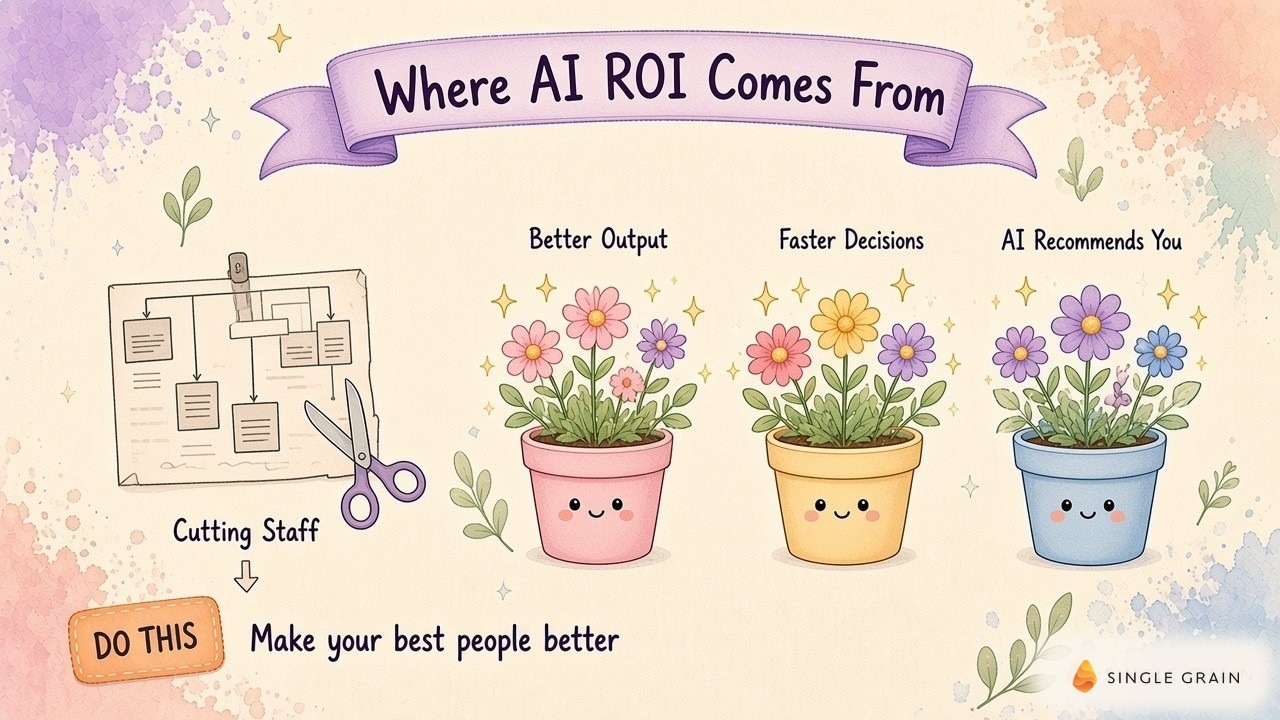
My team’s guide to AI marketing analytics addresses the wider reporting work. Keep each pilot’s evidence attached to its own outcome so a visibility gain doesn’t mask an expensive production process. This separation also helps when a staffing claim enters the budget conversation.
Check Quality Before Claiming Payroll Savings
A payroll reduction changes the cost base. To evaluate its return, inspect the work left behind and any effect on customers. Include replacement contractors, escalations, and additional oversight in the comparison.
I would ask whether the remaining team can maintain the promised service at the actual workload. An automation demo doesn’t answer this question. Retain examples of completed customer work and the quality checks used to approve it.
If acceptance rates fall or clients require more corrections, the saving needs another review. Keep any customer loss visible beside the cost reduction. Avoid claiming AI caused a staffing or revenue change without evidence linking the events.
This is why I prefer a report built around accepted work and attributable benefits. It gives finance enough detail to challenge the assumptions before expanding the budget.
Give Finance a Funding Decision It Can Inspect
Present the workflow owner, baseline, and pilot result together. Attach the cost calculation and evidence behind the benefit. Label each figure as observed, estimated, or still pending.
State the decision you recommend and the evidence supporting it. A pilot with acceptable quality and promising qualified demand may deserve continued testing. A workflow spending more on review than it recovers needs a repair plan before expansion.
Set the Next Review Around the Workflow Cycle
Define the next review around the workflow’s actual cycle. A campaign may need time for opportunities to close, while an editorial process can reveal rejected drafts much sooner. Explain what evidence would change your recommendation, including a deterioration in quality.
Keep projected returns separate from measured results in the final report. A forecast can guide a budget decision if its assumptions are visible. It becomes misleading when the report presents expected revenue as earned revenue.
With this record, your next review can begin with the campaign or approved article and follow the costs through to the outcome. The recommendation becomes easier to revisit when new evidence arrives.
Choose a Workflow Worth Funding
I want an AI ROI report to answer a practical question about the next dollar of marketing budget. Use the campaign record or editorial decision to show what happened, and keep the unproven benefit visible. Fund the next test with a clear owner and a result you can inspect.
If you need help evaluating a marketing workflow, my team at Single Grain offers AI transformation services. Contact Single Grain to discuss your goals and current process.
Frequently Asked Questions About AI ROI
-
What is AI ROI?
AI ROI is the return a business gets from AI compared with the full cost of using it, including tools, setup, training, and human review time.
-
How do you calculate AI ROI?
Subtract total AI costs from total gains, then divide by total costs. Measure specific workflows against a baseline so the gains are real, not estimated.
-
Are AI layoffs a good measure of AI ROI?
Not on their own. Cuts can hurt recruiting and client results, and the bigger returns usually come from better output, faster decisions, and AI visibility.
-
How long does it take to see AI ROI?
Run each AI-assisted workflow for at least a month before comparing it with your baseline. Revenue effects can take longer to show up.
-
Where do companies get the most AI ROI?
Often from giving skilled people more leverage, automating classification decisions, and getting AI assistants to recommend their brand.