How to Build a Crisis Communication Plan: Create Brand Narrative Before the Internet Does


Does your company have a crisis communication plan ready before the worst headline of the year breaks? Most teams don’t. They write the response after the story is already trending, and by then the memes have written it for them.
NVIDIA just gave every marketer a live case study. Over a few weeks, reports about Jensen Huang’s personal life turned into a confirmed story, a second report, and his resignation on November 12. On my Marketing School podcast, Neil and I talked about how the stock dropped about 26% and how the company’s slow, thin response cost it roughly a trillion dollars in market value, at least temporarily.
The business didn’t change overnight. The narrative did. This guide shows how to build a crisis communication plan that lets you set the story first, with a template you can copy today.
TL;DR
- The first response sets the narrative. If you stay quiet, the internet fills the gap with memes and conspiracy theories.
- Speed matters more than polish. In a Crisp survey of 2,000 consumers, 53% expected a brand to respond within 60 minutes of a crisis.
- Build the plan before you need it. Pre-approved message templates, named spokespeople, and contact lists save hours when every minute counts.
- Use the template below. It covers the team, audiences, holding statements, channels, and the review cycle.
Why Crisis PR Is About the First Response
A crisis isn’t only the event. It’s the story people tell about it, and that story forms fast. Customers, employees, and investors all start forming opinions in the first hour, often from whatever shows up in their feed.

The Internet Fills Silence With Memes
During the NVIDIA story, social feeds filled with jokes comparing tech CEOs and their stock prices. Conspiracy theories followed about who wanted Jensen out and why. As I said on the show, people fill the space with memes when you don’t control your own narrative.
None of that content came from the company. It came from the gap the company left open.
Narrative Moves Markets in Both Directions
The same week, HubSpot co-founder Brian Halligan came back as CEO and called it day one of a refounding. Neil checked the stock during our recording, and it was up about 6.7%. A founder returning with a clear story got rewarded. A founder leaving without one got punished.
| Pay Attention |
|---|
| Markets, customers, and candidates all react to the story before the facts are settled. A clear first statement buys you time to gather the rest. |
That contrast is the whole case for crisis communication. You can’t control every event, but you can control how quickly you show up with your version.
What Your Audience Expects in a Crisis
Before you write a plan, know the clock you’re working against. The Crisp 2019 Crisis Impact Report, which surveyed 2,000 US and UK consumers, found clear expectations.
- 53% expect a response within 60 minutes.
- 34% expect a response within 30 minutes.
- 59% want the response to come from the CEO.
- 55% would warn friends and family after a poorly handled crisis.
These numbers come from before AI feeds and short video sped everything up, so treat them as a floor. The window to respond has only gotten shorter.
How to Build a Crisis Communication Plan
A useful plan fits on a few pages and lives somewhere your team can reach from a phone. Ready.gov’s crisis communications guidance recommends naming audiences, preparing contact lists, and pre-writing messages in advance. Here’s how to turn that into a working plan.
Step One: Name the Crisis Team
Pick a small group of four to six people with clear roles: a lead decision maker, a spokesperson, a legal reviewer, and someone who owns social channels. Add backups for each role, because crises rarely wait for business hours.
Step Two: Map Your Audiences
List every group that will want answers. That usually includes employees, customers, investors, partners, regulators, and the media. Each one needs a slightly different message and channel. Assign an owner to each group so nobody assumes someone else already sent the update.
Step Three: Write Holding Statements Now
A holding statement says you know about the issue, you’re looking into it, and when you’ll share more. Draft three or four versions for likely scenarios, such as a data breach, a product failure, or a leadership change. Get them approved ahead of time so you can post within the first hour.
Step Four: Choose Channels and Owners
Decide where each update goes first: your website, email, LinkedIn, X, or a press release. If you expect AI tools to summarize the story, publish a clear statement on your own site so assistants have an official source to cite. Our guide to press release SEO for AI citations covers how to format these.
Step Five: Monitor and Update
Set up alerts for your brand, executive names, and product names across news, social, and forums. If you need outside help, compare these online reputation management companies before a crisis hits. Reddit threads can shape the story quickly, so review how to handle crisis management on Reddit before you need it.
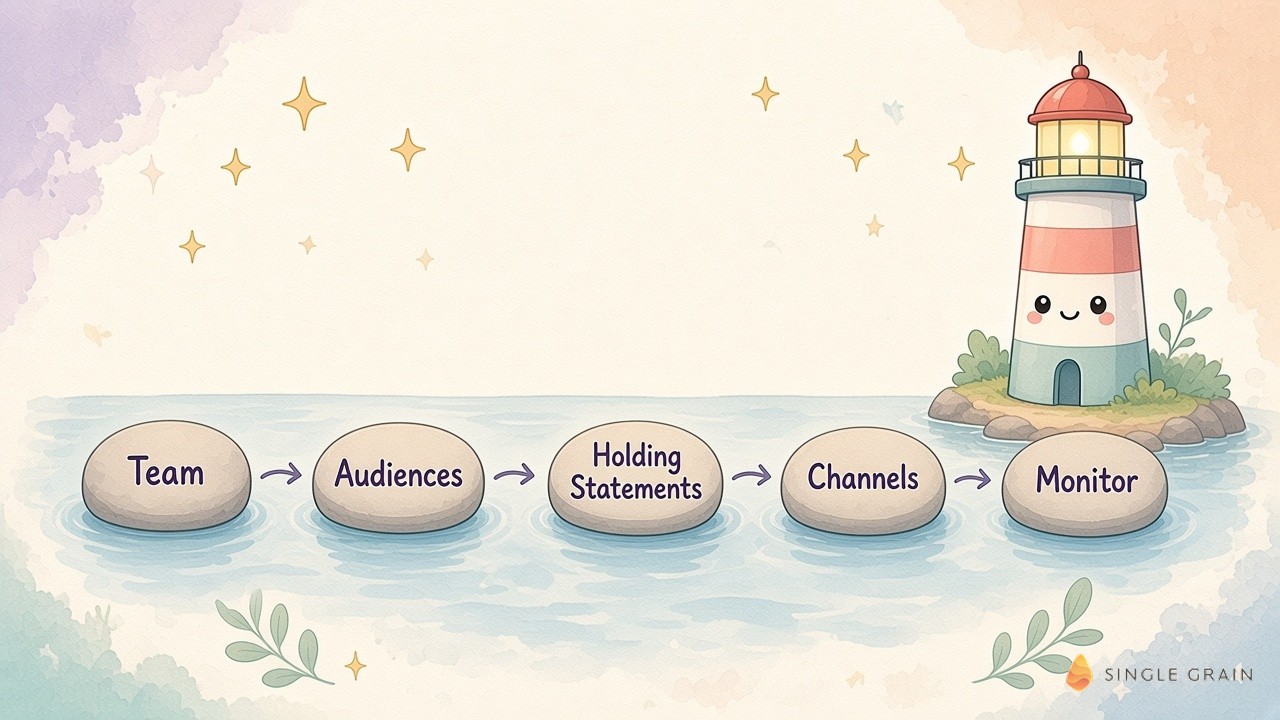
With the steps in place, the template below gives you a single page to fill in.
Crisis Communication Plan Template
Copy this table into a shared doc and fill it in this week. Review it every quarter.
| Section | What to fill in | Example |
|---|---|---|
| Crisis team | Names, roles, backups, phone numbers | CEO (decision), VP Comms (spokesperson), General Counsel (review) |
| Severity levels | What counts as minor, major, and critical | Critical: safety issue, leadership change, data breach |
| Audiences | Each group and its owner | Employees (HR), customers (CS lead), investors (CFO) |
| Holding statements | Pre-approved text for each scenario | “We’re aware of reports about X and are reviewing them. We’ll share an update by 3 p.m. ET.” |
| Channels | Where each update goes first | Website newsroom, then email, then social |
| Approval path | Who signs off and how fast | Spokesperson plus legal within 30 minutes |
| Monitoring | Tools, keywords, and who watches | Brand and executive name alerts across news, social, and Reddit |
| Review cycle | When to update the plan | Quarterly, plus after every incident |
Keep the finished template short enough to read in five minutes. A long binder nobody opens won’t help when the story is moving.
Store a copy outside your main systems too. If the crisis is a data breach or an outage, your usual drive or intranet may be the first thing to go down.
How to Shape Your Brand Narrative Before the Internet Does
A plan covers the bad day. Your brand narrative covers every other day, and it decides how much credit people give you when something goes wrong.
Build Trust Before You Need It
Brands with a clear story and a visible leader get more patience. Share how decisions get made, show the people behind the company, and keep a steady cadence of honest updates. Stories told in your own voice, including on community platforms, build the goodwill you’ll draw on later. These examples of storytelling on Reddit show what that looks like in practice.
Turn Criticism Into Signal
Not every negative comment hurts.
On the same episode, I shared something new from hiring. Engineers we’re recruiting tell me they like our one-star Glassdoor reviews that complain we push AI too hard. To an AI-native candidate, that “negative” review is proof we’re serious. When your narrative is clear, some criticism actually reinforces it.
Keep Your Story Consistent Across Channels
Search results, AI answers, and social posts should all tell the same story. Coverage on trusted sites helps, and our guide on digital PR for ChatGPT citations explains how.
| Pro-Tip |
|---|
| Run a 30-minute crisis drill once a quarter. Pick a scenario, start a timer, and see how long it takes to post an approved holding statement. If it takes more than an hour, fix the approval path first. |
Each drill also shows you which contacts, logins, or approvals are out of date before a real crisis exposes them.
Common Crisis PR Mistakes to Avoid
Even teams with a plan slip under pressure. Watch for these:
- Holding out for every fact. A short, honest holding statement beats silence.
- Too many voices. One spokesperson keeps the message consistent.
- Scrubbed criticism. Pulled posts usually create a second story.
- Forgotten employees. Staff often hear the news from social media first, so tell them early.
- An early victory lap. Keep updating until the questions stop.
- Ads on autopilot. Pause scheduled promotions that could look tone-deaf. Our guide to handling ad failures and recovery covers this for paid channels.
These mistakes matter as much as the template itself, because the response is what people remember.
Build Your Crisis Communication Plan This Week
A crisis communication plan is cheap insurance. Name the team, map audiences, pre-write holding statements, pick channels, and set up monitoring. Then run a drill so the plan works under pressure.
If you want help building a brand narrative strong enough to carry you through a bad news cycle, Single Grain’s content marketing team can help you plan it. Contact Single Grain to get started.
Frequently Asked Questions About Crisis Communication Plans
-
What is a crisis communication plan?
It’s a written playbook that names your crisis team, audiences, pre-approved messages, channels, and approval steps so you can respond quickly and consistently when something goes wrong.
-
What should a crisis communication plan include?
Include the crisis team and backups, severity levels, audience lists, holding statements, channels, an approval path, monitoring tools, and a review schedule.
-
How fast should a company respond to a crisis?
As fast as possible. In Crisp’s 2019 survey, 53% of consumers expected a response within 60 minutes, and 34% expected one within 30 minutes.
-
What is a holding statement?
A short message acknowledging the issue, saying you’re reviewing it, and stating when you’ll share more. It buys time while you gather facts.
-
How often should you update a crisis communication plan?
Review it every quarter and after every incident. Run a short drill to test how quickly your team can post an approved statement.