Press Release SEO: Format Releases So AI Tools Cite Them


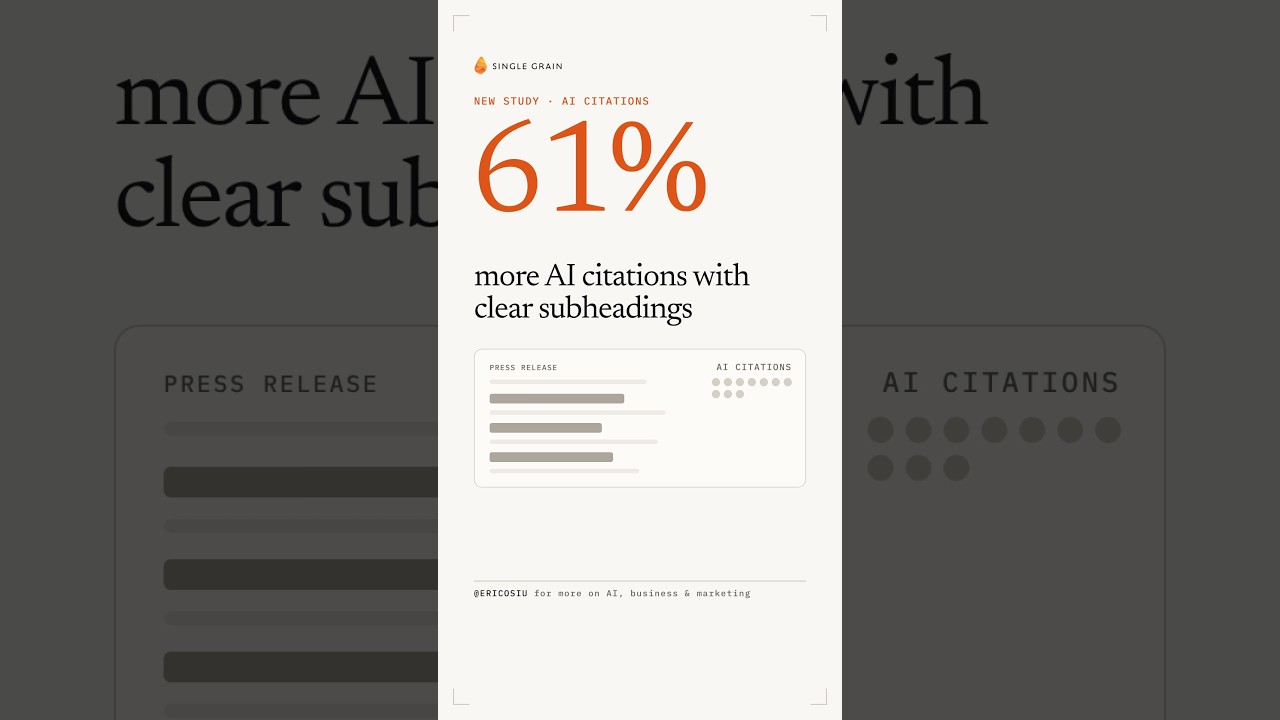
Press release SEO just got a new scoreboard, and it lives inside AI answers. A press release with clear, topical subheadings picked up 61% more AI citations than the average release in a new dataset. This is a huge lift for a formatting choice most PR teams make in about ten seconds.
The data comes from Notified, the company behind GlobeNewswire, which looked at roughly 26,670 releases and more than 850,000 citation events from ChatGPT and Claude. Here’s what I’ve deduced: AI reads like a skimmer, so the releases that win are the ones a skimmer can understand in one pass.
If you’ve been asking, “Should my next announcement still go out on a wire at all?”, the answer starts with the data. After the numbers, I’ll show you how to write a press release AI tools can cite and how long to wait before you judge the results.
TL;DR
- Press release SEO now includes AI citations. Releases still rarely move rankings through links, but they can get quoted by ChatGPT and Claude when they’re easy to parse.
- Three formatting choices lined up with more citations. Topical subheadings (+61%), a link back to your own site (+57%), and a clear “first of its kind” claim (+60%) all beat the average release.
- Citations show up late. More than half of AI citations (56.4%) landed over a week after the release went out, so a one-day report misses most of the value.
- Treat the numbers as signals. This is vendor data showing correlations, so use it to shape your format and then measure your own releases for a month.
TABLE OF CONTENTS:
- What Is Press Release SEO Today?
- What the New Citation Data Shows
- Why AI Citations Show Up Weeks Later
- How to Write a Press Release That AI Can Cite
- Common Press Release Mistakes AI Tools Skip
- Where Press Releases Fit in Your AEO Plan
- How to Measure Press Release SEO Results
- Make Your Next Release Easy to Cite
What Is Press Release SEO Today?
Press release SEO is the practice of writing and distributing announcements so they get found in search and, now, cited in AI answers. For years, the conversation centered on backlinks. Teams stuffed releases with keyword-rich anchor text and hoped the syndicated copies would boost rankings.
This approach stopped working a long time ago. Google’s spam policies list links with optimized anchor text in press releases as an example of link spam. Most wire services also mark outbound links so they pass no ranking credit, which matches Google’s guidance on qualifying outbound links.
So why care nowadays? Because AI assistants read news to answer questions, and a release is often the cleanest, most direct source of a company fact. If your release is the clearest statement of what you launched, AI tools have a reason to quote it.
What the New Citation Data Shows
Notified compared releases that earned AI citations against the average release in its dataset. Three patterns stood out, and each one maps to how a model scans a page.
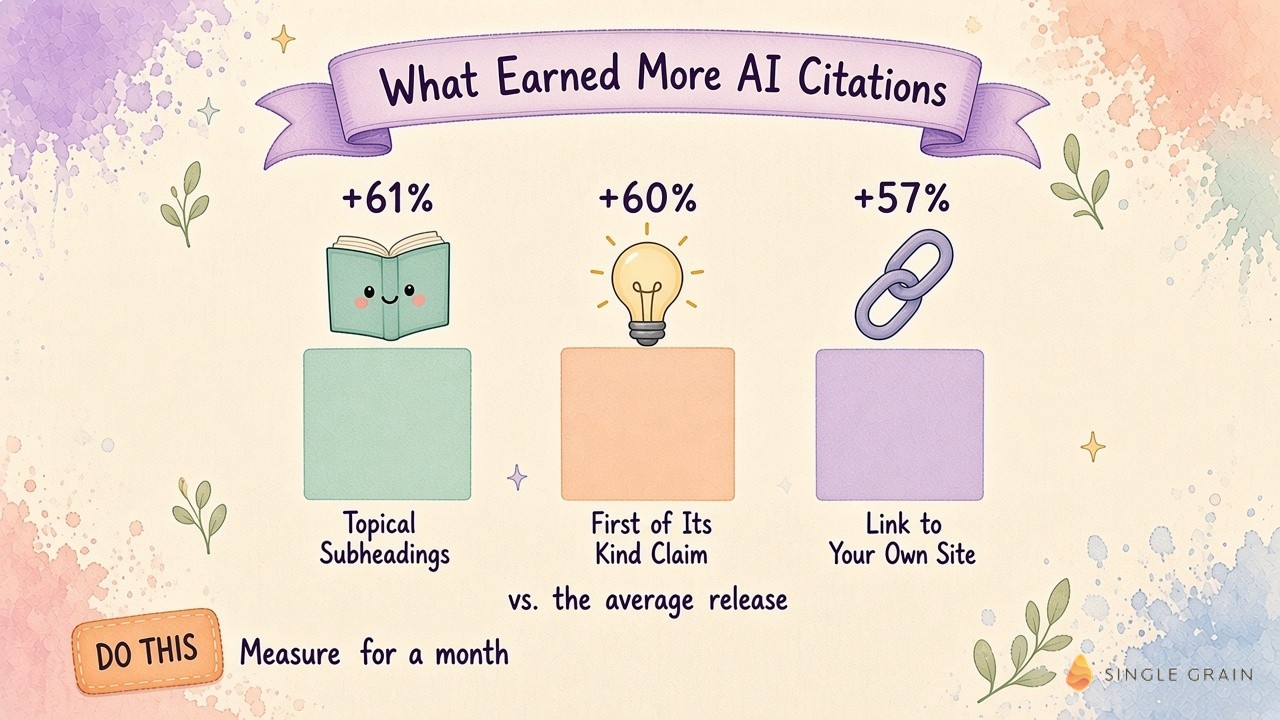
Topical Subheadings (+61%)
Releases with subheadings that stated the point of each section earned the biggest lift. A subhead like “New Tool Cuts Onboarding Time for Finance Teams” tells a model exactly what the paragraph below covers. A subhead like “Overview” tells it nothing.
A Link to Your Own Site (+57%)
Releases that linked back to the company’s site also did better. The link gives a model a clear path to the source of truth, such as a product page, a pricing page, or a full report.
A Clear “First of Its Kind” Claim (+60%)
Releases that plainly said what was new also earned more citations. Models answering “what’s the first tool that does X” look for direct statements, so a specific, defensible claim gives them one to quote. Only make the claim if it’s true and you can back it up.
These three patterns explain the lift, but the timing data might matter even more for how you report on PR.
Why AI Citations Show Up Weeks Later
Here’s the twist I didn’t expect. In the latest data, 56.4% of AI citations landed more than a week after the release went out, up from 48.4% in April. More than half the value now arrives after most teams have already moved on to the next announcement.
This delay makes sense. AI assistants keep answering questions long after the news cycle ends, and each new answer can pull from your release again. A release is closer to a reference page than a one-day news spike.
| Pay Attention |
|---|
| If your PR report only covers the first forty-eight hours, it’s missing most of the AI citation value. Set a thirty-day check for every major release. |
So the measurement window has to stretch. I broke down the full dataset in a post on X, and my advice there still stands. Measure for a month, never a day.
How to Write a Press Release That AI Can Cite
You don’t need a new template. You need a few deliberate edits to the one you already use. Here’s the format I’d hand to any PR or content team.
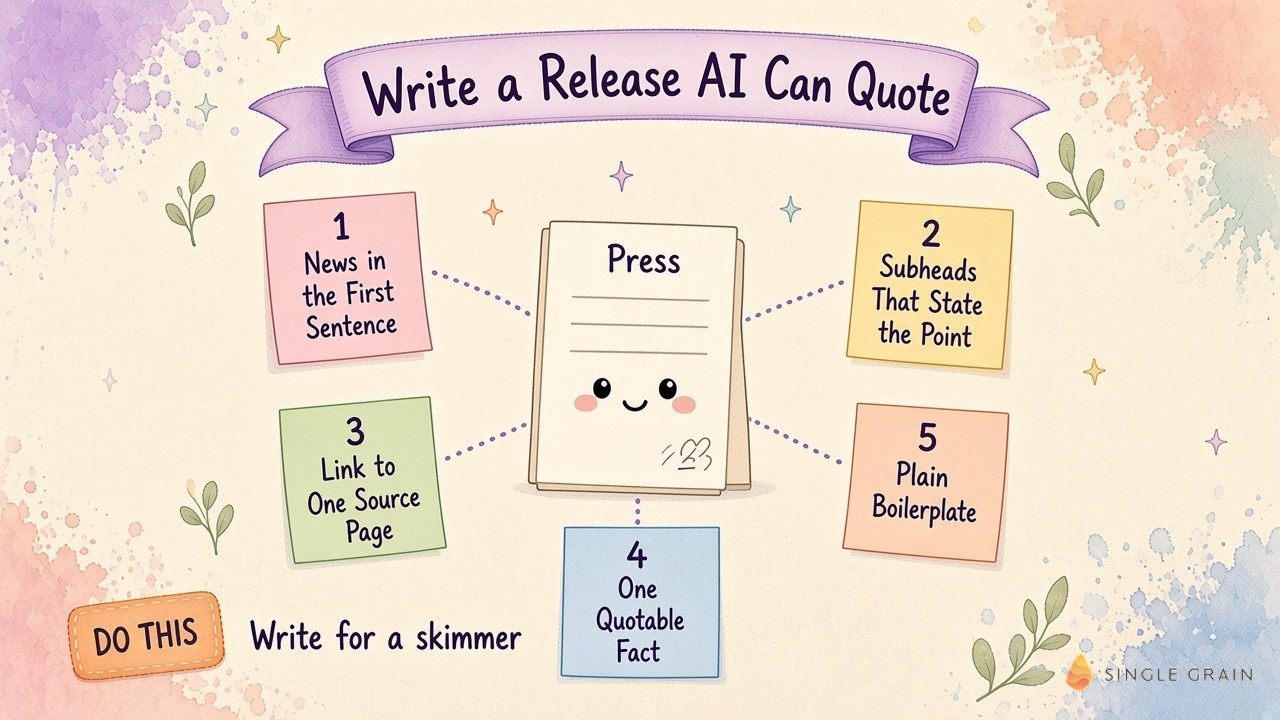
1. Lead With the News in One Sentence
Put the who, what, and why in the first sentence. A model often pulls the opening line, so make it a complete answer on its own.
2. Write Subheadings That State the Point
Turn every section header into a short claim. Swap “Background” for “Why Mid-Market Retailers Asked for Faster Returns.” Each subhead should still make sense if someone reads only the subheads.
3. Link to One Clear Source Page
Link your company name or product name to the page with the full details. Keep it to one or two links, and point them at pages you’d want an AI tool to cite.
4. Include One Quotable Fact
Add a specific number, date, or comparison a model can repeat, like a launch date, a customer count, or a test result. Make sure every number is accurate and sourced.
5. Keep the Boilerplate Plain
Your “About” section is often where a model learns what your company does. Write it in plain words, with your category and main service in the first sentence.
These five edits take minutes, and they work for traditional search readers as well as AI tools.
Common Press Release Mistakes AI Tools Skip
Most releases that earn zero citations fail for the same few reasons. Each one is easy to fix once you know to look for it.
- The first is a vague headline. “Acme Announces Exciting New Partnership” gives a model nothing to answer with. Name the partner, the product, and the result instead, so the headline works as a standalone fact.
- The second is a buried lead. Many releases spend two paragraphs on context before saying what happened. A model scanning for the answer may never reach it, so the news belongs in the first sentence.
- The third is quote filler. Executive quotes like “We’re thrilled to bring this to market” add length without adding facts. Use the quote to explain why the launch matters to customers, in plain words a model could reasonably repeat.
- The fourth is a missing source page. If the release links to your homepage, a model has to hunt for the details. Link straight to the page with the specifics, and make sure this page is live before the release goes out.
Fix these four and your release becomes far easier to cite. From there, releases can slot into the rest of your AI search work.
Where Press Releases Fit in Your AEO Plan
Press releases are one piece of answer engine optimization (AEO), the work of getting your brand cited in AI answers. They work best alongside earned coverage and strong owned pages. My team’s guide to earning ChatGPT citations with digital PR covers the earned media side in depth.
Your own site still does the heavy lifting. A release can point a model to your product page, but this page needs to be clear and easy to crawl, which is where technical SEO for LLM scrapers comes in. If AI tools already describe your brand incorrectly, start with citation hygiene before you send another announcement.
Google has also been clear that optimizing for AI search is still SEO, so the same fundamentals apply. Clear structure, accurate facts, and a page worth citing win across both.
How to Measure Press Release SEO Results
Give every release a thirty-day scorecard. Track AI citations, referral visits from AI tools, branded search lift, and any pickup by real publications. Compare each release against your own average instead of an industry benchmark.
A free check is a good first step. My team’s free AI visibility report shows how often AI tools mention your brand in buyer answers, which gives you a baseline before your next launch. You can also track AI search exposure more broadly with the lessons from our look at AI Overview statistics for buying searches.
After a few releases, you’ll see which formats earn citations for your brand. Keep those, drop the rest, and update your template.
Make Your Next Release Easy to Cite
Right now, press release SEO comes down to clarity. Write subheadings that state the point, link to one strong source page, include a quotable fact, and measure for a month. The data is vendor-reported and correlational, so treat it as a strong hint and let your own results confirm it.
If you’d like help turning announcements and content into AI citations, my team at Single Grain offers content marketing and SEO services built for AI search. Contact Single Grain and we’ll review your next release before it goes out.
Frequently Asked Questions About Press Release SEO
-
Are press releases good for SEO?
Press releases rarely help rankings through links, because wire links usually pass no ranking credit. They can still help visibility by earning AI citations, coverage, and branded searches.
-
How do I get my press release cited by ChatGPT?
Lead with the news in one sentence, use subheadings that state the point, link to one clear source page, and include a specific, accurate fact a model can repeat.
-
How long does it take for AI tools to cite a press release?
In recent vendor data, more than half of AI citations arrived over a week after release, so measure each release for at least thirty days.
-
Should press releases include links?
Yes, one or two links to your own source pages can help readers and AI tools find the full details. Avoid keyword-stuffed anchor text, which Google treats as link spam.
-
Do press releases still matter for AEO?
Yes. They’re one input alongside earned media and strong owned pages, and my team’s guide to earning ChatGPT citations with digital PR covers the rest.