All About B2A: AI Bot Traffic vs Real Revenue


AI bot traffic is climbing faster than almost anyone predicted. At the same time, a lot of business owners are realizing that the revenue story has NOT caught up yet. This Business-to-Agent (B2A) gap is what I find most interesting right now. Recent conversations revolve around how AI agents are becoming the main users of the web (just look at the recent developments with agentic checkout in ChatGPT!), while businesses like Airbnb have found that agents are barely sending bookings.
Let’s face it: If you run growth or analytics, you’re stuck between these two headlines.
One says you need to court AI agents now or lose the next wave of customers. The other says agent traffic is noise that rarely turns into money. Fun if you love new channels. Less fun if you have to defend the budget for it.
Here’s what B2A means, what the traffic data actually shows, why bookings and orders are lagging, and how to measure agent traffic so you can make the call for your own business.
TL;DR
- B2A means business-to-agent. Andreessen Horowitz partners argue companies will have to sell to AI agents the way they once sold to searchers and app users.
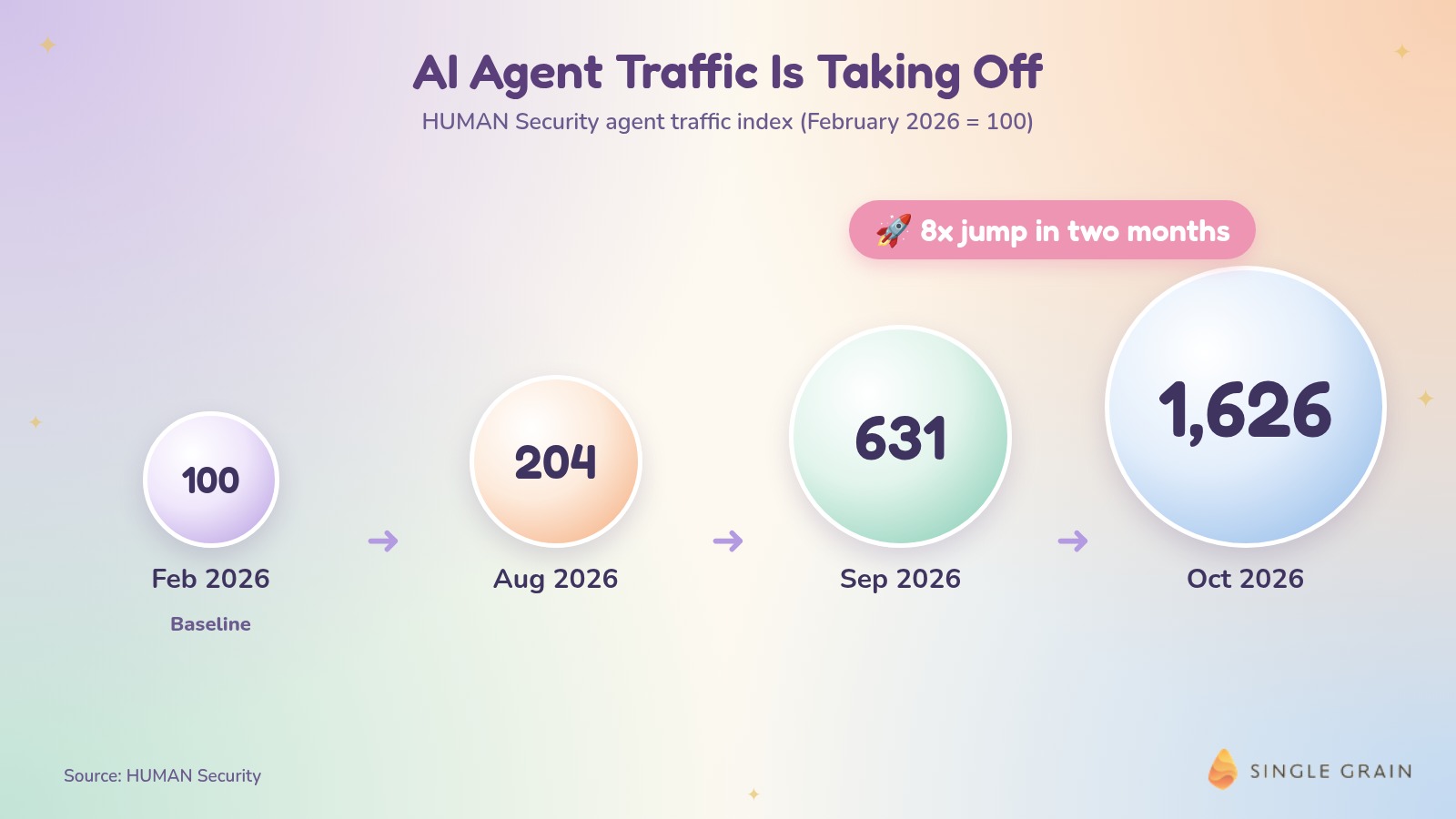
- Agent traffic is surging. HUMAN Security data cited by a16z shows agentic browser traffic grew 8x between August and October.
- Revenue is lagging. Airbnb’s CEO said a “very non-material” number of its nearly half a million daily bookings come from agents like Muse.
- Measure before you invest. Separate agent visits from human visits, then track what each actually converts into.
What Is B2A?
B2A stands for business-to-agent. In an essay titled “Welcome to the B2A Economy,” a16z partners Olivia Moore and Justine Moore argue that agents are becoming the primary users of the internet. As agents move from answering questions to completing tasks, they expect agents to decide which products to use, which services to subscribe to, and where to spend money.
From Walls to Storefronts
The essay’s sharpest line sums up the shift. For years, retailers and platforms built walls to keep bots out. Now, the authors say, they’ll have to fight for bots’ business.
For many teams, that’s a full reversal. The same security rules built to stop scrapers can now block a customer’s agent at checkout.
How B2A Differs From AI Search
An appearance in an AI answer is one thing. A purchase completed by the agent itself is another. B2A treats agent selection as its own distribution channel.
The agent compares options, picks one, and acts. Your product has to win that comparison without a person ever seeing your homepage, your ads, or your brand story.
What the AI Bot Traffic Data Shows
The numbers are big, but they need careful reading. PPC Land’s analysis points out that several of the essay’s headline claims run ahead of its own charts.
Bot Traffic Overall
The essay’s chart shows bots rising from 42% of web traffic in 2021 to 51% in 2024 and 2025, with 54% forecast for 2026. The chart counts all bots, including scrapers and crawlers, so it doesn’t isolate AI agents.
Agentic Traffic From AI Browsers
The stronger evidence comes from HUMAN Security. Its index of agent traffic, set to 100 in February 2026, reached 204 in August, 631 in September, and 1,626 in October. That’s the 8x jump in two months.
Who Drives the Traffic
HUMAN’s October data shows Meta’s Muse driving about 60% of agent activity and OpenAI products a combined 30%. Together, that’s roughly 90% of agent traffic on HUMAN customer sites.
The mix has changed quickly. In May, HUMAN’s data showed Perplexity’s Comet leading with 47% of agentic traffic. A few months later, Muse had taken over, so expect the leaders to keep shifting.
| Pay Attention |
|---|
| “Bot traffic” and “AI agent traffic” aren’t the same thing. Check which one a report measures before you compare it with your own analytics. |
The distinction matters even more once you look at revenue.
Why Bookings and Revenue Are Lagging
Traffic is growing fast. Purchases from that traffic aren’t, at least not yet.
Airbnb’s View
On Airbnb’s third-quarter earnings call, CEO Brian Chesky said the company isn’t seeing much traffic, and even fewer bookings, from Muse and Instinct. Business Insider reported that of nearly half a million daily bookings, a “very non-material” number come from those agents. He added that agent traffic peaked in early October and hadn’t increased since.
Other Companies Say the Same
Business Insider also noted that Booking.com and Expedia executives reported very little agent traffic on their calls. DoorDash’s CEO said third-party agents had generated “several hundred orders in total.” For a company that size, that’s a rounding error, though it’s also a real starting point.
That gap raises a fair question, and one account on X asked it directly:
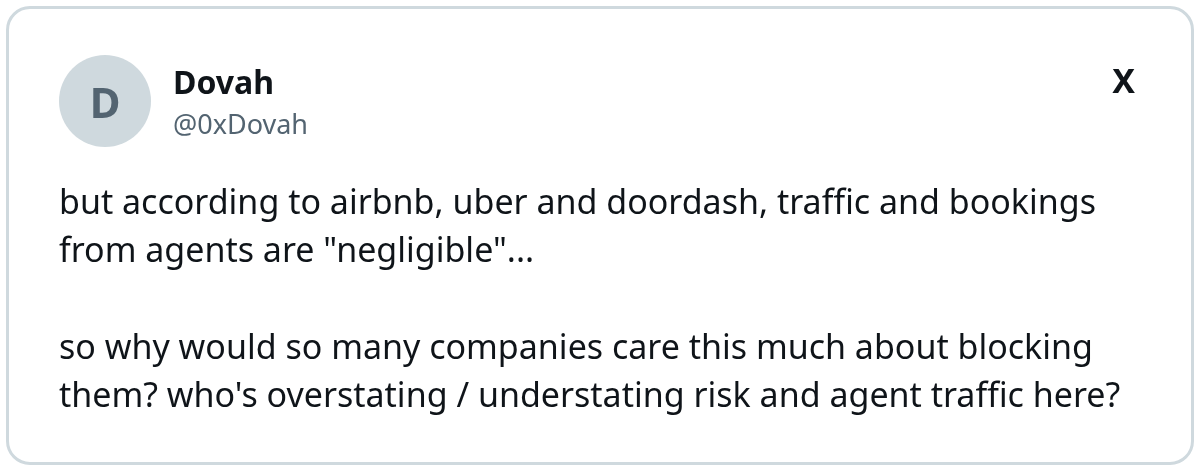
My read is that both can be true. Bookings from agents are tiny today, but companies are setting the rules now for when the volume shows up.
Why Travel May Be Different
Chesky argued that trip planning is aspirational. People enjoy browsing photos, comparing homes, and deciding with travel companions. He sees general agents as better for simple tasks like restaurant reservations, and Airbnb plans to roll out its own travel agent.
Where AI Traffic Does Convert
Referral traffic from AI tools is a different story. The a16z essay cites Shopify data showing AI-driven traffic to stores grew eightfold year over year in Q1 2026, while orders from AI-powered searches grew nearly thirteenfold. Shopify’s third-quarter update showed AI-referred orders up 3.3 times year over year.

The pattern so far is clear. AI referrals sending people to your site can convert well, while autonomous agents completing purchases are still early.
How to Measure AI Bot Traffic on Your Site
You can’t decide whether B2A matters for you without your own data.
1. Separate the Traffic Types
Split visits into three groups: crawlers that read content, AI referrals where a person clicks from an AI tool, and agents browsing or buying on a person’s behalf. Each has different value for your business. Server logs and bot management tools can identify signed agents and common user agents.
2. Track Outcomes Beyond Visits
For each group, track conversions, revenue, and assisted conversions. Agent visits ending in a human purchase later are easy to miss. Aligning CRO testing with AI traffic attribution helps keep tests honest.
3. Set a Crawler and Agent Policy
Decide which bots you allow, rate-limit, or block. Write the rules down and share them with security, marketing, and ecommerce, so each team knows why an agent got through or got stopped. Review them every quarter, since new agents appear often and old user agents change. A clear AI crawler policy that protects content lets helpful agents in without giving away everything.
4. Make Your Site Easy for Agents to Read
Clean structure and internal links help agents and retrieval systems find the pages you care about most. Our notes on internal linking for AI crawlers cover the basics.
| Pro-Tip |
|---|
| Review your bot management rules before you celebrate or panic. If your firewall blocks agents by default, low agent revenue may be a symptom of your own settings. |
Once you have a baseline, you can decide how much to invest and which teams should own the work.
Who Offers AI Agent Traffic Detection?
You’ll need a tool that can tell agents from people. The sources behind this story point to a few categories.
Bot Management and Security Vendors
Companies like HUMAN Security, Cloudflare, and Arkose Labs track bot and agent traffic across many sites. Their dashboards can flag signed agents, separate them from scrapers, and let you set rules for each.
Analytics and Server Logs
Your web analytics platform shows AI referrals when a person clicks through from a chatbot. Server logs go further, capturing user agents and request patterns that analytics scripts may never see.
Commerce Platforms
Platforms like Shopify now report AI-driven traffic and orders for merchants. If you sell through one, check its reports before you buy anything new. Compare the platform’s AI order counts with your own analytics each month to see whether the two tell the same story.
My team’s view at Single Grain is to start with the data you already have, then add a dedicated tool only when agent traffic is large enough to matter.
Should You Invest in B2A Now?
My view is to prepare without overspending. The traffic trend is real, but the revenue is still early for most businesses.
- Do now: measure agent traffic, allow signed agents, and keep product data accurate.
- Test next: soft conversion paths for agent visitors, such as saved carts or follow-up offers. These ideas on soft conversion paths for early-stage AI traffic are a good starting point.
- Wait on: large custom agent integrations until your data shows real orders.
A longtime performance marketer made the same point on X after Airbnb’s call, from watching past channels grow:
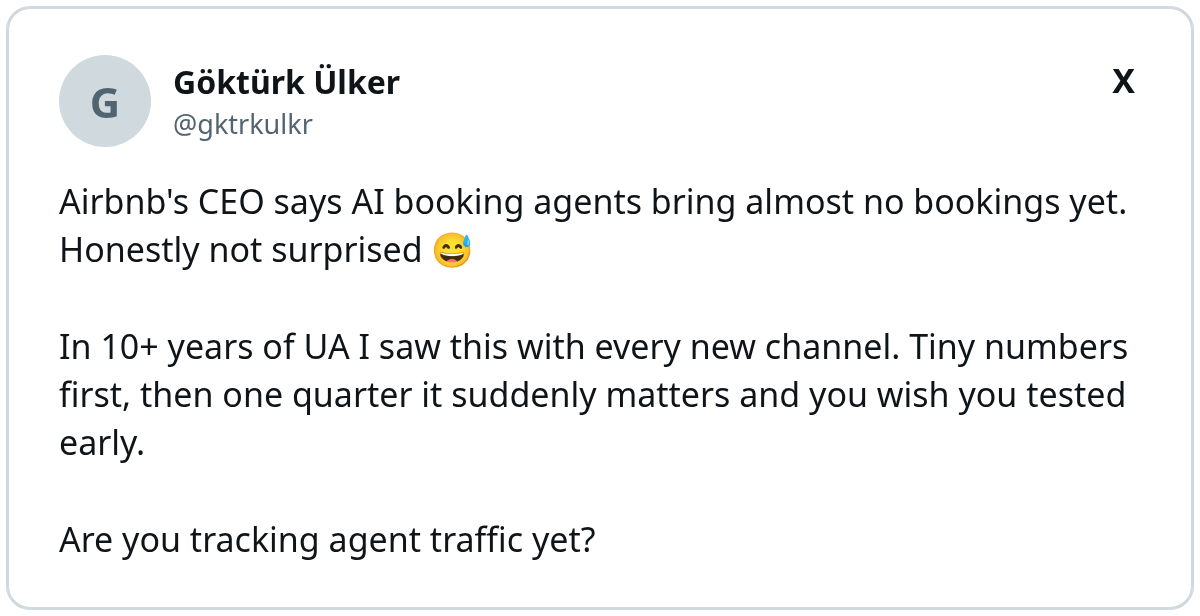
Small tests now cost far less than catching up later.
Businesses selling simple, repeatable purchases will likely see agent revenue first. Think replenishment orders, subscriptions, and standard products with clear specs. Complex, emotional purchases like travel may take longer.
Get Ready for B2A Without Betting the Budget
AI bot traffic is surging, led by agents like Muse and OpenAI’s products, but bookings and orders from autonomous agents are still small. Measure each traffic type, open the door to signed agents, and invest in deeper integrations once your own data shows a return.
If you want help measuring AI traffic and building a plan for agent-driven growth, Single Grain’s AI transformation team can help. Contact Single Grain to get started.
Frequently Asked Questions About AI Bot Traffic and B2A
-
What is B2A?
B2A means business-to-agent. It describes companies selling to AI agents that choose products and services on a person’s behalf, much like they once sold to searchers and app users.
-
How fast is AI agent traffic growing?
HUMAN Security data cited by a16z shows agentic browser traffic grew 8x between August and October 2026, with Meta’s Muse and OpenAI products driving about 90% of it.
-
Do AI agents drive real bookings or sales?
Not much yet for autonomous agents. Airbnb’s CEO said a very non-material share of its daily bookings come from agents like Muse. AI referrals that send people to sites tend to convert better.
-
Is bot traffic the same as AI agent traffic?
No. Bot traffic includes crawlers and scrapers. AI agent traffic is a narrower group of agents browsing or acting for a person.
-
How do I measure AI bot traffic?
Separate crawlers, AI referrals, and agents using server logs and bot management tools, then track conversions and revenue for each group.