Fable 5.2 for Marketing Teams: What is Claude Fable 5.2?


Is Fable 5.2 worth switching to for your marketing team, or is it built for engineers? Anthropic released Claude Fable 5.2 on November 9, 2026, and most early reviews focus on coding benchmarks and science demos. Marketers need a different test.
I spent a day pushing it on creative marketing and business jobs with almost no spec. I asked for a 3D product page, a funnel simulator, an ad studio, and a revenue war room. Then I looked at how fast it worked and whether a team could actually use what it made.
This review covers what Claude Fable 5.2 is, what it built for me, what it costs, and when a marketing team should use it instead of a cheaper everyday model.
TL;DR
- Fable 5.2 is Anthropic’s model for the hardest, most open-ended work. It launched November 9, 2026, at $8 per million input tokens and $40 per million output tokens.
- It turns loose ideas into working marketing assets. With almost no spec, it built a 3D product page, an interactive funnel simulator, ad concepts, and a pipeline dashboard.
- Anthropic itself says most tasks should start on Opus 5.5. Use Fable 5.2 when the job is complex, creative, or open-ended.
- Test models on real marketing jobs. Benchmarks won’t tell you whether a model helps your team ship campaigns faster.
What Is Claude Fable 5.2?
Claude Fable 5.2 is Anthropic’s upgraded model for demanding reasoning and long, agentic work. Anthropic’s launch post explains that Fable and Mythos share the same underlying model. Fable includes stronger cyber and biology safeguards, so it’s available to all users.
What Changed From Fable 5.1
Anthropic says Fable 5.2 communicates more clearly than earlier versions, generates output up to 30% faster than Fable 5.1, and costs less. An optional fast mode speeds up generation by up to 2.5 times at a higher price.
Where You Can Use It
Fable 5.2 is available on the Claude Platform and on Amazon Web Services, Google Cloud, and Microsoft Azure. Developers can find model details in the Claude Fable 5.2 docs.
With the basics covered, here’s what it did on real marketing work.
What Fable 5.2 Built for Marketing
I gave it creative, open-ended prompts instead of tightly scoped specs. Creative work is where marketing lives, so that’s the right stress test. Here are five functions that Fable 5.2 built for marketing.

1. A 3D Product Page
It built a landing page for a spritz drink brand with a real-time 3D can. Visitors could switch flavors and add a pack to their cart. Setup took very little time, and the result felt like something a brand team would actually test.
2. A Funnel Simulator
This was my favorite. It made an interactive funnel where you can adjust each stage and watch revenue move. In one scenario, if 80% of visitors read past the hero section, 10,000 visitors produced 779 orders and about $50,000 in revenue. Higher checkout starts and a bigger average order value pushed the number up.
A tool like this makes conversion rate optimization easy to explain to a team or a client.
3. An Ad Studio and Design Reel
It produced an ad studio where you can swap copy and creative, plus a set of ad designs, a conference promo page, and SaaS landing page concepts. The quality was solid for drafts I never specified in detail. It reminded me of Carrot, our internal tool for LinkedIn account-based marketing, which swaps copy and creative by account. For teams running AI-driven LinkedIn ABM, this kind of quick concept work can speed up testing.
4. A Revenue War Room
Using dummy CRM data, it built a dashboard showing $3.53 million in open pipeline, with $3.4 million at risk and $682,000 likely to close. Its headline was blunt: your pipeline is a mirage. A deal radar flagged which deals were going cold. For a sales leader, that view answers the first question in every forecast meeting: which deals need attention this week?
5. Pipeline Leaks and Lost Deals
A leak view showed where revenue slipped, such as 12% of lost value tied to price and deals going quiet after the proposal. That data already lives in most CRMs. Fable 5.2 makes it far more engaging to present. For a deeper process, see how to score closed-lost deals worth reopening.

Each build took minutes instead of days. The value is speed from idea to something you can show.
Fable 5.2 Pricing and Benchmarks for Marketers
Cost and performance matter when you run models across a team every day.
| Item | Fable 5.2 |
|---|---|
| Input price | $8 per million tokens |
| Output price | $40 per million tokens |
| Fast mode price | $16 input and $80 output per million tokens |
| Speed vs Fable 5.1 | Up to 30% faster |
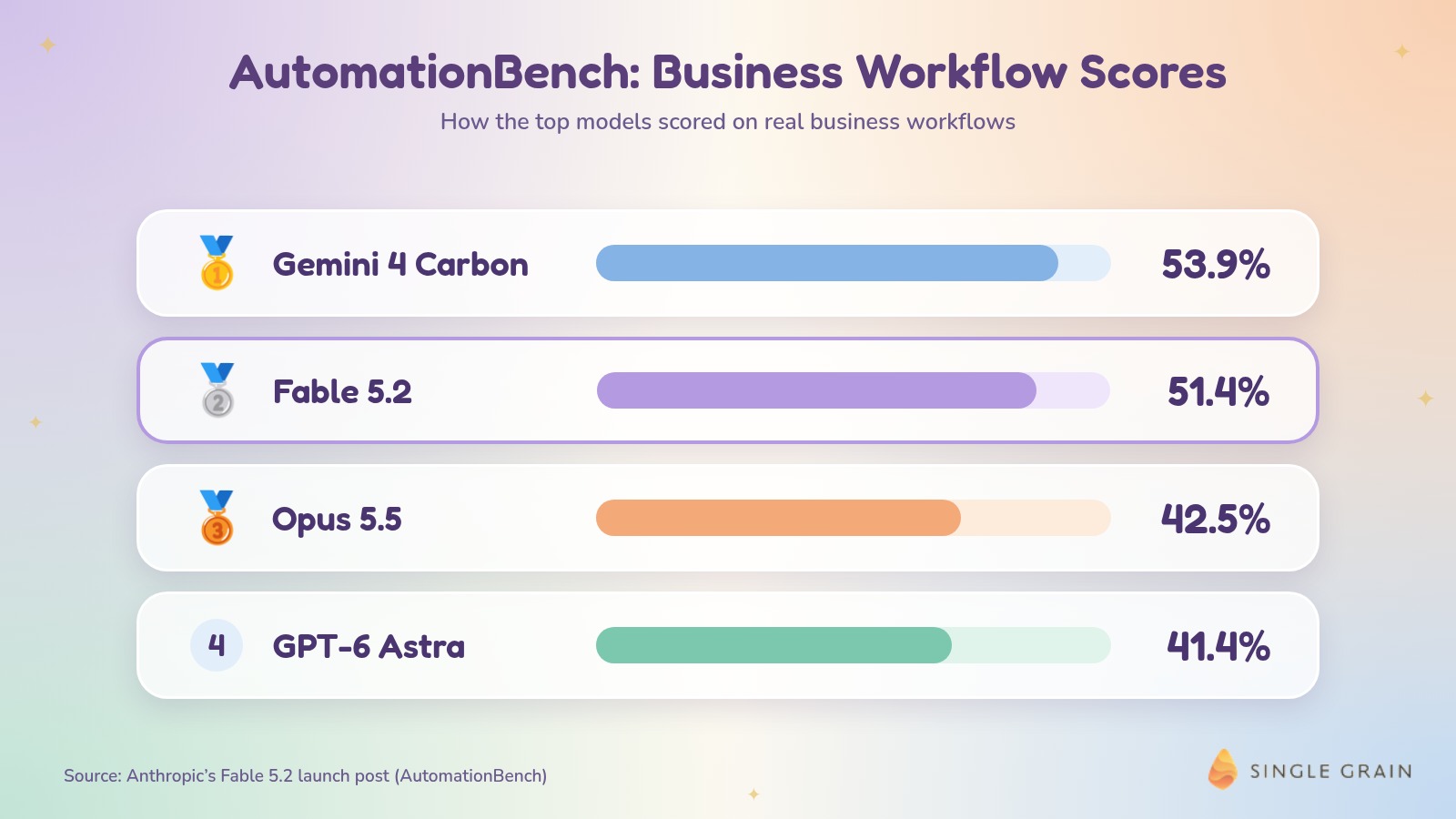
| AutomationBench (business workflows) | 51.4%, vs 42.5% for Opus 5.5 and 53.9% for Gemini 4 Carbon |
Source: Anthropic’s launch post. Note the business workflow result. Fable 5.2 beat Opus 5.5 but trailed Gemini 4 Carbon, so it isn’t the automatic winner for every marketing operations task.
Benchmarks are a starting point. Your own tests decide the rest.
To put the pricing in practical terms, a working session with 200,000 input tokens and 50,000 output tokens costs about $1.60 for input and $2.00 for output, or $3.60 total. That’s cheap for a funnel model a client will see, but it adds up fast if a whole team runs every small task through Fable 5.2. Track spend by use case for the first month so you know where it pays off.
Is Claude Fable Worth Switching To?
For most marketing teams, the answer is to use it selectively.
When Fable 5.2 Makes Sense
Use it for complex, open-ended work: interactive tools, multi-step analysis, strategy simulations, and large document reviews. Anthropic also positions it as an advisor that smaller models can consult, or an orchestrator that hands simple tasks to cheaper models.
When to Stay on a Daily Driver
Anthropic recommends starting most coding and knowledge tasks on Opus 5.5, then moving up to Fable or down to Sonnet or Haiku as needed. Routine copy edits, social captions, and simple summaries rarely need the most expensive model.
How to Test It Yourself
Pick three real jobs from your backlog, such as a landing page, a funnel model, and a pipeline report. Run each on your current model and on Fable 5.2.
Compare time to a usable draft, edits needed, and total cost. Ask the people who’ll actually use the output to score each version blind. Their preference is a better signal than any benchmark, and it tells you quickly whether the upgrade is worth paying for.
| Pro-Tip |
|---|
| Retest your saved prompts and skills whenever you switch models. Instructions tuned for one model can perform worse on another until you adjust them. |
That retest matters, because we’ve seen AI skills get worse after a model update until the prompts were fixed.
How to Use Fable 5.2 in a Marketing Workflow
A powerful model only helps if it fits how your team works. These habits keep results useful and costs under control.
Start With a Loose Brief, Then Tighten
My best results came from short, open prompts that described the goal and audience. Once the first version exists, give specific feedback on layout, copy, or data. Fable 5.2 handles iteration well, and you’ll often get further in three rounds than with one long spec.
Keep a Human Reviewer on Every Asset
Fast output still needs a check. Review numbers, claims, and brand voice before anything reaches a client or goes live. Interactive tools need extra care, since a formula error in a funnel simulator can mislead a whole meeting.
Control Spend With Model Routing
At $40 per million output tokens, long sessions add up. Route routine tasks to a cheaper model, and save Fable 5.2 for the parts that need deep reasoning. Anthropic’s advisor setup, where a smaller model consults Fable only on hard questions, is one way to do this.
Turn Wins Into Reusable Skills
When a prompt produces a great funnel model or dashboard, save it as a template or skill. Your team can rerun it with new data, and you’ll get consistent results without starting from scratch every time.
How Fable 5.2 Compares to Other Models Marketers Use
Every major lab now has a top-tier model. We’ve covered how GPT-6 Astra handles marketing work with a 70/30 human split, and how Codex and Claude Code compare for marketing ops. The pattern holds across all of them. The model matters less than the workflow, the review process, and the human who owns the result.
Test Fable 5.2 on Real Marketing Jobs
Claude Fable 5.2 is a strong pick for creative, complex marketing work, and it turns rough ideas into working tools fast. It’s also expensive, so save it for jobs that need it and keep a cheaper model for daily tasks.
If you want help building AI agents that handle AEO, SEO, ad creative, and outbound inside Slack or Teams, Single Grain’s AI transformation team builds managed marketing agents for clients. Contact Single Grain to get started.
Frequently Asked Questions About Fable 5.2
-
What is Claude Fable 5.2?
It’s Anthropic’s upgraded model for demanding reasoning and long agentic work, released November 9, 2026. It shares an underlying model with Mythos 5.2 but adds stronger safeguards so all users can access it.
-
How much does Fable 5.2 cost?
Anthropic lists it at $8 per million input tokens and $40 per million output tokens. Fast mode costs $16 per million input tokens and $80 per million output tokens.
-
Is Fable 5.2 good for marketing?
It’s strong for creative, complex jobs such as interactive funnel models, landing page concepts, and pipeline dashboards. Routine copy tasks usually don’t need it.
-
Should I use Fable 5.2 or Opus 5.5?
Anthropic recommends starting most tasks on Opus 5.5 and moving up to Fable 5.2 for the most complex, open-ended work.
-
How fast is Fable 5.2?
Anthropic says it generates output up to 30% faster than Fable 5.1, and an optional fast mode speeds generation by up to 2.5 times.