Agentic Checkout in ChatGPT: Are You Ready for Agentic Payments?


Agentic checkout just took a real step forward with ChatGPT Wallet, and this one feels different from the last try. OpenAI’s new wallet lets its dots agents pay on your behalf with a stand-in card number. You approve each purchase with a check like Face ID, and the agent finishes checkout on the store’s own website.
If you run an online store, the question is whether your site will let those agents in or quietly turn them away. OpenAI was direct about who does the work here.
Its new Commerce Partner Playbook puts most of the setup on merchants, their security tools, and their fraud vendors. Fine if your stack is ready. Painful if your bot protection treats every agent like a scraper.
So if you’re wondering, “Do I need to rebuild checkout for AI agents, or just stop blocking them?” then you’ve come to the right place. Below you’ll find what ChatGPT Wallet does, why it matters for agentic payments, and a readiness checklist for your store.
TL;DR
- ChatGPT Wallet lets agents pay without your real card details. Card networks issue a payment token after you approve each purchase with a biometric check.
- The sale happens on the merchant’s site. Agents use your existing checkout, so you keep the customer relationship, pricing, fulfillment, and returns.
- Access is the first hurdle. In one PPC Land-reported test, bot protection refused a shopping agent at 14.5% of 200 retailers.
- Launch scope is narrow. Only US ChatGPT Pro subscribers aged 18 and older with eligible US cards can use it for now.
What Is ChatGPT Wallet?
ChatGPT Wallet launched this month, built with American Express, Mastercard, and Visa. PPC Land’s coverage explains how it works. When a user approves a purchase, the card network issues a token, a stand-in card number, security code, and expiry date that fit the card form already on the merchant’s site.
Who Can Use It Today
Availability is limited to adult ChatGPT Pro subscribers in the United States and hold eligible US-issued cards. It runs only inside dots, OpenAI’s always-on agents. OpenAI says it’s starting small to learn from real-world use.
How It Differs From Instant Checkout
This is OpenAI’s second attempt at payments. Instant Checkout kept the transaction inside ChatGPT, and OpenAI shut it down in March 2026. PPC Land notes that Walmart had said conversion for products sold inside ChatGPT was three times lower than click-outs to its own site. Wallet flips the model by sending the agent to the merchant’s website.
| Pay Attention |
|---|
| OpenAI describes fuller delegation, where agents buy within spending limits you set in advance, as a future step with no date. Today, every purchase still needs the user’s approval. |
Some people on X read that approval step as a sign Wallet isn’t truly agentic yet:
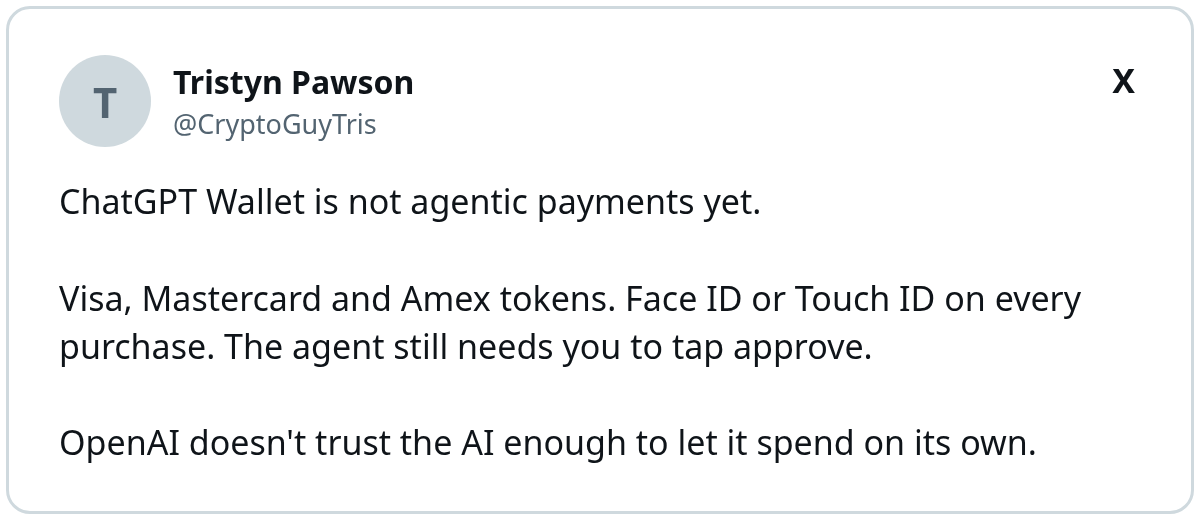
He’s right that the agent can’t spend on its own today. For merchants, I’d call that a feature. A real person signs off on every order before it reaches your checkout.
That approval step keeps volumes modest for now, which gives merchants time to prepare. I’d use that window well. Security and fraud changes often need sign-off from several teams, and they rarely ship in a week. Starting the conversation now means you’re ready when OpenAI opens Wallet to more users.
3 Reasons Why Agentic Payments Matter for Your Store
OpenAI says 1.2 billion people use ChatGPT each week, and many research products there. Wallet is the bridge from research to a completed purchase. Here are three solid reasons why you should pay attention to agentic payments right now.
1. Agents Arrive Ready to Buy
An agent that reaches your checkout usually carries a purchase decision already made in a conversation you can’t see. Turning it away loses a sale that was nearly done. The shopper may never know your site blocked the agent. They’ll just see that the purchase failed and try another store.
2. Blocked Agents Are a Real Risk
PPC Land reported that when Blend ran a shopping agent against 200 UK and US retailers, bot protection refused it at 29 of them on both attempts, a 14.5% rate. Among large retailers, the refusal rate was 20%.
3. Fraud Systems Can Decline Good Orders
OpenAI admits that risk systems may still flag legitimate agent purchases, leading to declines or cancellations. It says it’s working with fraud prevention partners Forter, Riskified, Sardine, and Signifyd, plus payment providers Adyen, Checkout.com, and Stripe.

Each of those failure points can be fixed before agent volume grows.
Agentic Checkout Readiness Checklist
OpenAI’s playbook covers four areas. Here’s how I’d turn them into a checklist for my own team.
1. Let Signed Agents Through
Configure your CDN or firewall to recognize signed requests using Web Bot Auth, and make sure general security rules aren’t blocking ChatGPT agents. PPC Land cites Arkose Labs data showing ChatGPT agent signed 78.4% of its sessions with Web Bot Auth, so signed traffic is already common.
2. Keep Product Information Current
Claim your business in ChatGPT and upload product feeds with current pricing and availability through Business Hub. OpenAI notes that browser access doesn’t require a feed, but accurate data helps agents pick your products. Out-of-stock items listed as available are especially costly, because the agent wastes a trip and the shopper loses trust in your store.
3. Talk to Your Risk and Payment Providers
Ask your fraud vendor and payment processor how they recognize legitimate agent purchases. If they can’t answer clearly, expect declines. Get the answer in writing, and ask what data they need from you to tell a real agent order apart from fraud.
4. Consider Plugins or WebMCP Tools
For more control, you can build a plugin that lets agents check availability or manage carts, or add WebMCP tools to your site. Both take more work than browser access. My view is that most stores should get browser access right first, then consider a plugin once agent orders show up in meaningful numbers.
| Area | Quick check | Owner |
|---|---|---|
| Agent access | Web Bot Auth signed requests allowed through CDN and firewall | Engineering or security |
| Product data | Business Hub claimed and feeds current | Ecommerce or marketing |
| Payments and risk | Fraud and payment providers confirm agent handling | Finance or payments |
| Deeper integration | Plugin or WebMCP tools evaluated | Product |
Work through the table one row at a time, starting with access. Access problems block every other improvement, so they’re worth fixing before you polish feeds or build a plugin.
Agentic Commerce Beyond ChatGPT
ChatGPT isn’t the only agent shopping online. PPC Land notes that Meta’s Muse agent checks out inside WhatsApp with one-time cards and approval for each purchase, and Visa and Mastercard are building on Web Bot Auth for their own agent programs. If you’re preparing for the wider shift, our post on the Personal Agent Protocol and agentic commerce covers more ways to get your site ready.

How AI Agents Read Your Store
Agents don’t browse like people. Instead, they read structured information, follow your checkout steps literally, and stop when something is unclear. With that being said, it is super important that your online storefront is set up properly on the backend, not just on the front!
For example, we’re working with a business right now who has clear shipping and return data on the front end of their product pages. But the backend is left blank, so agents (and the algorithm in general) can’t scrape it! We discovered this through a simple technical audit, which we set up for all of our clients the moment they choose to partner with us.
Here are ways an AI agent reads your digital store.
Clear Prices and Policies Win
An agent comparing options needs exact prices, shipping costs, and return terms. Hidden fees or vague policies give it a reason to pick another store. The same issues that cause cart abandonment with human shoppers, such as surprise costs and trust gaps, can stop an agent too.
Simple Checkout Flows Finish More Often
Every extra step is another chance for an agent to fail. Pop-ups, forced account creation, and unusual form fields can all break an automated checkout. Test your own flow with a fresh browser and count the steps.
Structured Pricing Pages Help Agents Choose
For SaaS and subscription businesses, agents also read pricing pages before recommending a plan. These notes on how AI agents evaluate SaaS pricing pages apply to ecommerce plans and bundles as well.
Give AI Visitors a Soft Path Too
Not every agent visit ends in a purchase. Some agents gather options for a person to review later. Soft conversion paths for early-stage AI traffic, like saved carts or back-in-stock alerts, keep that visit from going to waste.
What This Means for Measurement
Agent purchases come from conversations you can’t observe. Expect more orders with thin referral data. Tag your checkout so agent-driven orders can be separated, and compare them with ChatGPT referral traffic in analytics. Our guide to setting up ChatGPT Ads conversion tracking covers related tracking steps.
Watch Decline Rates Closely
Track declines and cancellations on orders that look agent-driven. A spike usually points to a fraud rule that needs tuning. Share examples with your fraud vendor, since they can only adjust models when they see real cases from your store.
Review Your Robots and Bot Rules
Many stores added aggressive bot rules during scraping waves. Revisit them so signed agents get through while bad bots stay out. Rate limits, CAPTCHA triggers, and country blocks are the usual suspects. Test each change in a staging environment first so you don’t open the door to scrapers by accident.
Get Your Store Ready Before Volume Arrives
Agentic checkout through ChatGPT Wallet is small today, but it runs on your existing checkout and puts the setup on you. Let signed agents in, keep product data current, confirm your risk providers can recognize agent purchases, and decide whether a plugin is worth it.
If you want help preparing your store for agentic payments and AI shopping, Single Grain’s ecommerce and AI teams can audit your setup. Our technical SEO agency is one step away from helping you optimize your website for AI agents. Contact Single Grain to get started.
Frequently Asked Questions About Agentic Checkout
-
What is agentic checkout?
It’s when an AI agent completes a purchase on a shopper’s behalf. With ChatGPT Wallet, the agent pays on the merchant’s own website using a card-network token after the user approves the purchase.
-
What is ChatGPT Wallet?
It’s OpenAI’s payment tool, built with American Express, Mastercard, and Visa, that lets dots agents pay with a stand-in card number after a biometric approval for each purchase.
-
Who can use ChatGPT Wallet?
At launch, US ChatGPT Pro subscribers aged 18 and older with eligible US-issued cards, inside dots agents.
-
How do I prepare my store for agentic payments?
Allow signed agent requests through your CDN and firewall using Web Bot Auth, keep product feeds current, confirm your fraud and payment providers recognize agent purchases, and consider plugins or WebMCP tools.
-
Do I need a plugin to accept ChatGPT Wallet payments?
No. OpenAI says browser access works with existing checkout flows and doesn’t require a plugin or product feed, though both can give you more control.