The Elon Musk Algorithm for Automation: 5 Step Process


Have you looked at the Elon Musk algorithm before handing your next workflow to an AI bot? Most teams skip straight to automation. They take a slow, messy process, wire it to an agent, and end up with the same mess… just running faster. Whoops! Luckily, the Elon Musk algorithm is a five-step framework that seeks to improve the process and reduce the mess.
I put our article process through all five steps before a bot touched it, and automation was the last one. My bet is that 95% of our processes are pretty stupid. Probably yours too.
This guide explains the five-step process, how we applied it to content production, the results from the first week, and the rollout ladder we use before any bot reaches clients.
TL;DR
- The Elon Musk algorithm is a five-step process. Question every requirement, delete steps, simplify, speed up, and automate last.
- Automation comes last for a reason. Tesla learned this when over-automating the Model 3 line caused production delays.
- Evals pass human taste to the bot. We turned an editor’s edits into scoring rules so the AI knows what good looks like.
- Results came fast. In its first seven days, our bot produced 19 articles that scored 58/100 alone and 86/100 after a human edit.
What Is the Elon Musk Algorithm?
The Elon Musk algorithm is a five-step framework for improving any process. It was developed at Tesla and popularized by Musk. Jon McNeill, Tesla’s president of sales from 2015 to 2018, laid it out in his book The Algorithm. I call it QDESSA for short.
The Elon Musk 5 Step Process
- Question every requirement. Ask who asked for it and why.
- Delete any step you can. If you don’t add back at least some of what you removed, you didn’t delete enough.
- Simplify and optimize. Only after the waste is gone.
- Speed up cycle time. Make the remaining steps move faster.
- Automate. Last, once the process is lean and proven.
The order matters more than any single step. Most teams jump to step five because automation feels like progress, while the first four steps feel like admin work.
Why Automation Goes Last
In a Business Insider interview, McNeill explained that the team decided automation had to be last after over-automating the Model 3 line caused production delays. Automate a broken process and you lock the waste in.
That lesson applies directly to AI agents in marketing.
How I Applied the Elon Musk Algorithm to Content
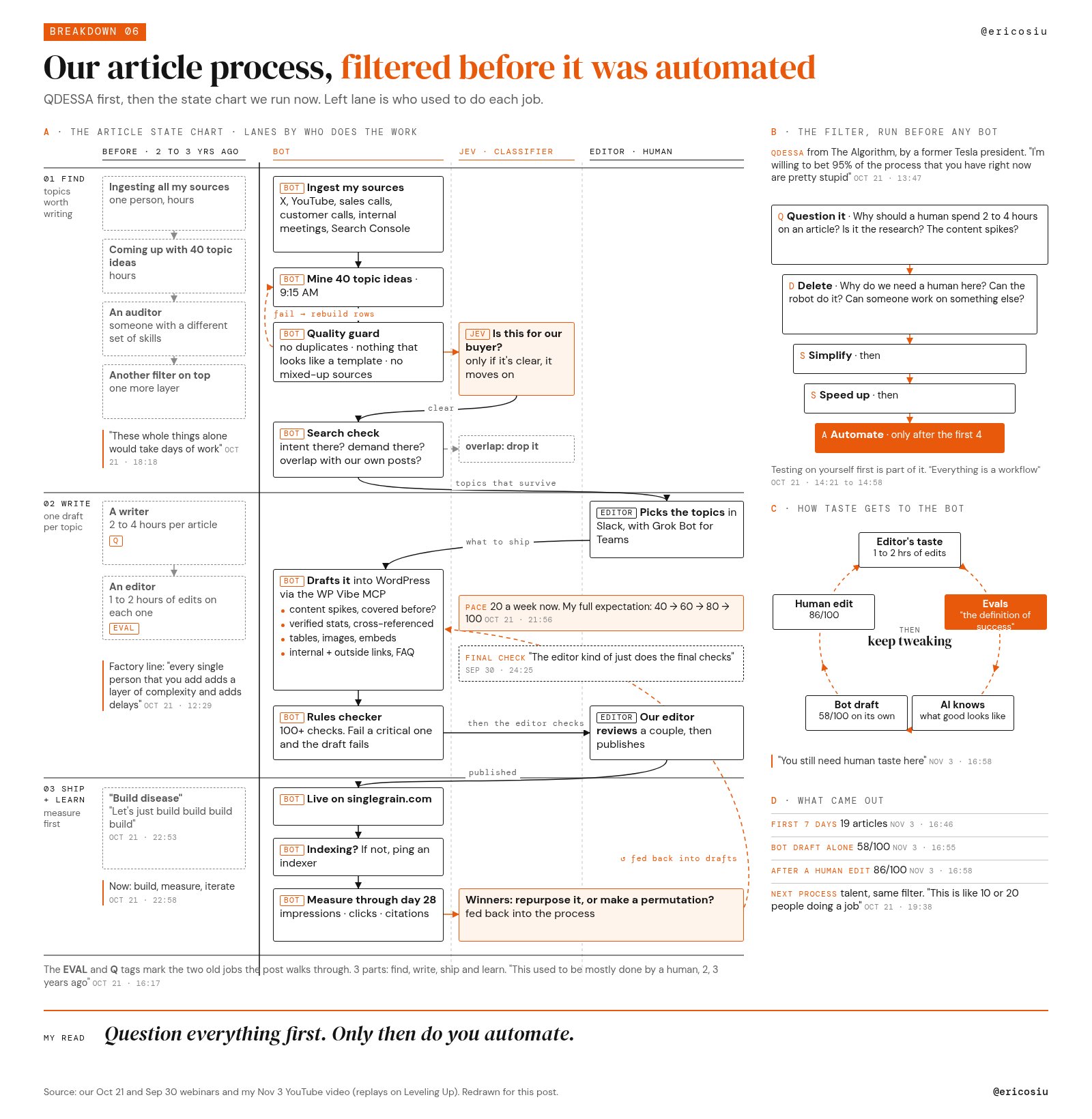
I’ll be honest… our article process used to take a writer two to four hours per post, plus one to two hours of editing. We live in a day and age where we clearly want to speed up the process through AI, but also avoid publishing AI slop grenades.
Through the Elon Musk Algorithm, here’s how each step changed it (to speed up but also produce quality!):
Step 1: Question the Process
We started by asking why a writer should spend two to four hours on one article. The honest answer was that most of the time went into research, finding content spikes, and formatting.
None of that needed a writer’s judgment. The writing itself, and the editor’s taste, were the parts worth protecting.
Step 2: Delete What Doesn’t Need a Human
We handed the bot the research: content spikes, whether we’d already covered the topic, verified stats, tables, images, and outside links. No one person can do all of that well. On an old factory line, every person you add brings more complexity and delay.
Step 3: Simplify With Evals
The editor’s one to two hours of edits became evals, a set of scoring rules the AI checks against. The editor still owns taste. Evals are how that taste gets passed to the bot. If you want the details on building review rules, see how to build an editorial review process for AI accuracy.
Step 4: Speed Up the Cycle
With research automated and evals in place, drafts move from idea to review in a fraction of the time. A human still does the final check before anything goes live.
Step 5: Automate Last
Only then did we let the bot run the full draft workflow. In its first seven days, it produced nineteen articles. The drafts scored 58/100 on their own and 86/100 after a human edit.
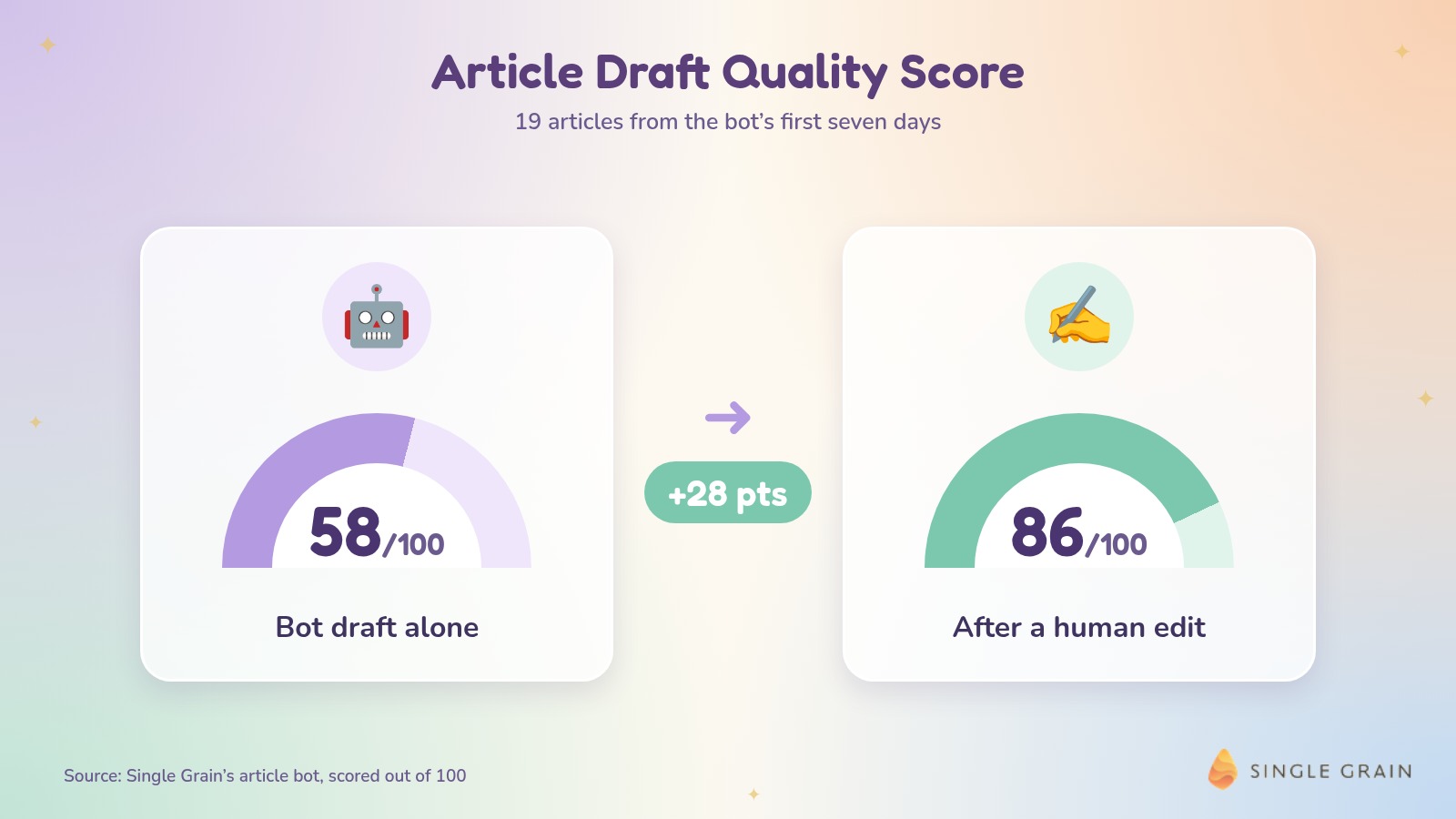
That gap is the point. The bot handles volume, and the human closes the quality gap.
The Bot Rollout Ladder
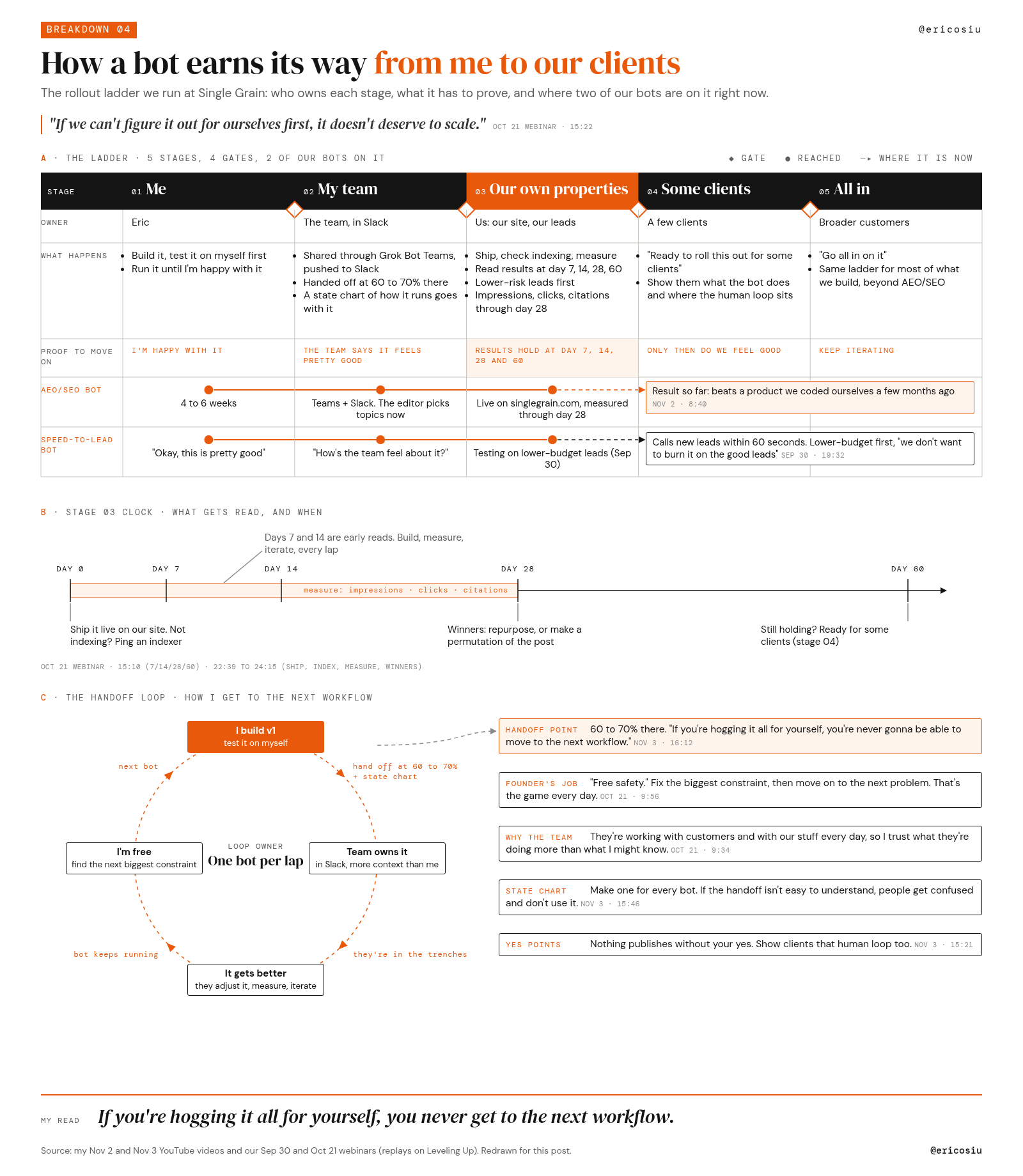
The algorithm decides what to automate. The rollout ladder decides who gets the bot and when. Nothing at Single Grain goes to everyone on day one. My rule is simple: if we can’t make it work for ourselves first, it doesn’t deserve to scale.
The Five Rungs
- Me first, until I’m happy with it.
- My team, once it’s 60% to 70% of the way there.
- Our own sites, with results checked at 7, 14, 28, and 60 days.
- Some clients.
- All clients.
I tested our AEO and SEO bot on myself for four to six weeks before the team got it. Clients only get a bot once it works on us.
Why Hand Off at 60% to 70%
The team is in the work every day. They end up with more context than I have. If I hold on to a bot too long, I never get to the next workflow.
The handoff also spreads ownership. When the team shapes the last 30% of a bot, they trust it more and use it more. Our AEO and SEO bot went to the team in Slack, and it now beats a product we coded ourselves a few months earlier.
A Real Example: Speed-to-Lead
Our speed-to-lead bot calls new leads within 60 seconds. I tested it first, then asked the team how it felt. Next, we tried it on lower-budget leads so it couldn’t burn the best ones. Only after that did it move up the ladder.
| Pro-Tip |
|---|
| Start every new bot on low-risk work, such as lower-budget leads or internal drafts. You learn the failure modes without putting your best accounts or your brand at risk. |
The ladder keeps mistakes small while the bot improves.
How to Run the Musk Algorithm on Your Own Workflows
You can apply this to almost any marketing process. Here’s a quick way to start.
Pick One Slow Process
Choose a workflow eating hours every week, such as reporting, content briefs, or lead routing. Start with one process at a time. A single clean win builds the habit and gives your team proof the method works.
Map Every Step
Write down each step, who does it, and how long it takes. Mark which ones need human judgment and which are just moving information around. A shared doc or whiteboard is enough. Many teams find their process has a few approval steps nobody remembers adding, and those are often the easiest to delete.
Delete Before You Build
Cut any step that doesn’t change the outcome. Our earlier lesson on simplifying before you automate shows how one workflow went from sixty-four clicks to three.
Turn Judgment Into Evals
Capture what your best person checks for and write it down as rules. Those rules let a bot match their standard. Start with the edits they make most often, such as tone, structure, or missing sources, and add new rules each time they catch something the bot missed.
Watch for Automation Bias
Once a bot runs, people tend to trust it too much. Keep humans reviewing outputs, and read up on automation bias in AI before you scale.
Each of these steps keeps the human in charge of quality while the bot takes on the repetitive work.
Where the Musk Algorithm Has Limits
The framework is simple, but it isn’t easy. McNeill notes that it depends on commitment from the top, and he’s candid that the pace can be exhausting for some people. A team asked to question and delete its own work every week needs leaders who back those calls.
It also won’t fix a bad strategy. The algorithm makes a process faster and leaner, but it can’t tell you whether you’re producing the right content or targeting the right buyers. Pair it with clear goals and real performance data.
3 Common Mistakes When You Apply the Algorithm
Even teams who like the framework slip in predictable ways.
1. Skipping Straight to Automation
The most common mistake is treating step five as step one. When a new AI tool shows up, it’s tempting to plug it into the current workflow. Run the first four steps first, even if it takes a week.
2. Deleting Too Little
Most teams delete one or two steps and stop. Musk’s rule of thumb is simple: if you never have to add a step back, you probably didn’t cut deep enough.
3. Losing the Human Check
Once the bot looks good, the human review often gets dropped. Our scores show why that’s risky. The gap between 58 and 86 is the work an editor still adds.
Automate the Process You Actually Want
The Elon Musk algorithm works because it forces you to fix a process before you scale it. Question, delete, simplify, and speed up first. Then automate, test the bot on yourself, and climb the rollout ladder.
If you want help redesigning your marketing workflows for AI, Single Grain’s AI transformation team can work through it with you. Contact Single Grain to get started.
Frequently Asked Questions About the Elon Musk Algorithm
-
What is the Elon Musk algorithm?
It’s a five-step process developed at Tesla: question every requirement, delete steps, simplify, accelerate cycle time, and automate last.
-
Who wrote The Algorithm book?
Jon McNeill, Tesla’s former president of sales, wrote The Algorithm, which explains how to apply the five-step framework in any organization.
-
Why should automation come last?
Automating a broken process locks in its waste. Tesla learned this when over-automating the Model 3 line caused production delays.
-
How do you apply the Musk algorithm to marketing?
Pick a slow workflow, map every step, delete what doesn’t change the outcome, turn expert judgment into evals, and only then automate with human review.
-
What is a bot rollout ladder?
It’s a staged rollout where a bot is tested on its builder first, then the team, then your own sites, then some clients, and finally all clients.