

Spin Up a Lead-Capture Site in an Afternoon With GPT Sites



OpenAI shipped GPT Sites, and it changes what one person can stand up before dinner. If you run marketing, you know the old drill for a single lead-capture page. It meant a designer, a developer, a form tool, and a week spent waiting on all three. Now you describe the page you want and GPT Sites builds working pages with forms, sign-in, storage, and a database behind them, with no separate stack to wire up. A lead-capture page went from a week of other people’s time to an afternoon of your own.
The catch is that speed does not write your offer for you. GPT Sites removes the build, not the thinking behind a page that converts.
By the end of this you will know exactly how I would use GPT Sites to put a real lead-capture page live this week, and where I would still keep a human in the loop.
TABLE OF CONTENTS:
TL;DR
- GPT Sites builds a working website from one prompt, with pages, a form, sign-in, storage, and a database, so a lead-capture page is now an afternoon of your own time instead of a week of waiting on other people.
- Build the narrowest thing first: one offer, three form fields, native storage, and a follow-up, then publish and read the result in 48 hours by counting submissions.
- The tool removes the build, not the judgment. Keep a person on the offer, on data handling and privacy, and on moving leads into a real CRM.
What Is GPT Sites?
GPT Sites is OpenAI’s tool that builds a working website from a plain description. You tell it what you want and it returns pages, a form, built-in sign-in, storage, and a database, all in one place. There is no separate host to buy, no form plugin to install, and no backend to connect to a frontend.
Everything a lead-capture page needs ships from one prompt. The form, the data store, and the published URL arrive together, and you can edit, re-prompt, and publish without leaving the conversation.
Why a Lead-Capture Page Is the Right First Build
Every new tool tempts you to build the biggest thing you can picture. Do the opposite. Pick the narrowest job that pays you back fast.
A lead-capture page has one job. It collects a name, an email, and one qualifying detail. You can read the result in 48 hours by counting form submissions, which tells you whether GPT Sites earns a bigger bet before you point a product launch at it.
Most teams I talk to lose weeks waiting on a page that a form and a clear offer could have replaced. A lead-capture page also owns its data from the first submission, because entries land in the tool’s database instead of a form service you do not control. If the offer works, submissions come in. If it does not, you rewrite the headline and publish again in minutes.
How I Would Spin One Up in an Afternoon
You can build a working lead-capture page with GPT Sites in a single afternoon. The tool hands you pages, a form, sign-in, storage, and a database from one prompt, so the only work left is the offer, the three fields worth asking for, and the follow-up.
I run the same five steps every time.
Write the Offer Before You Open the Tool
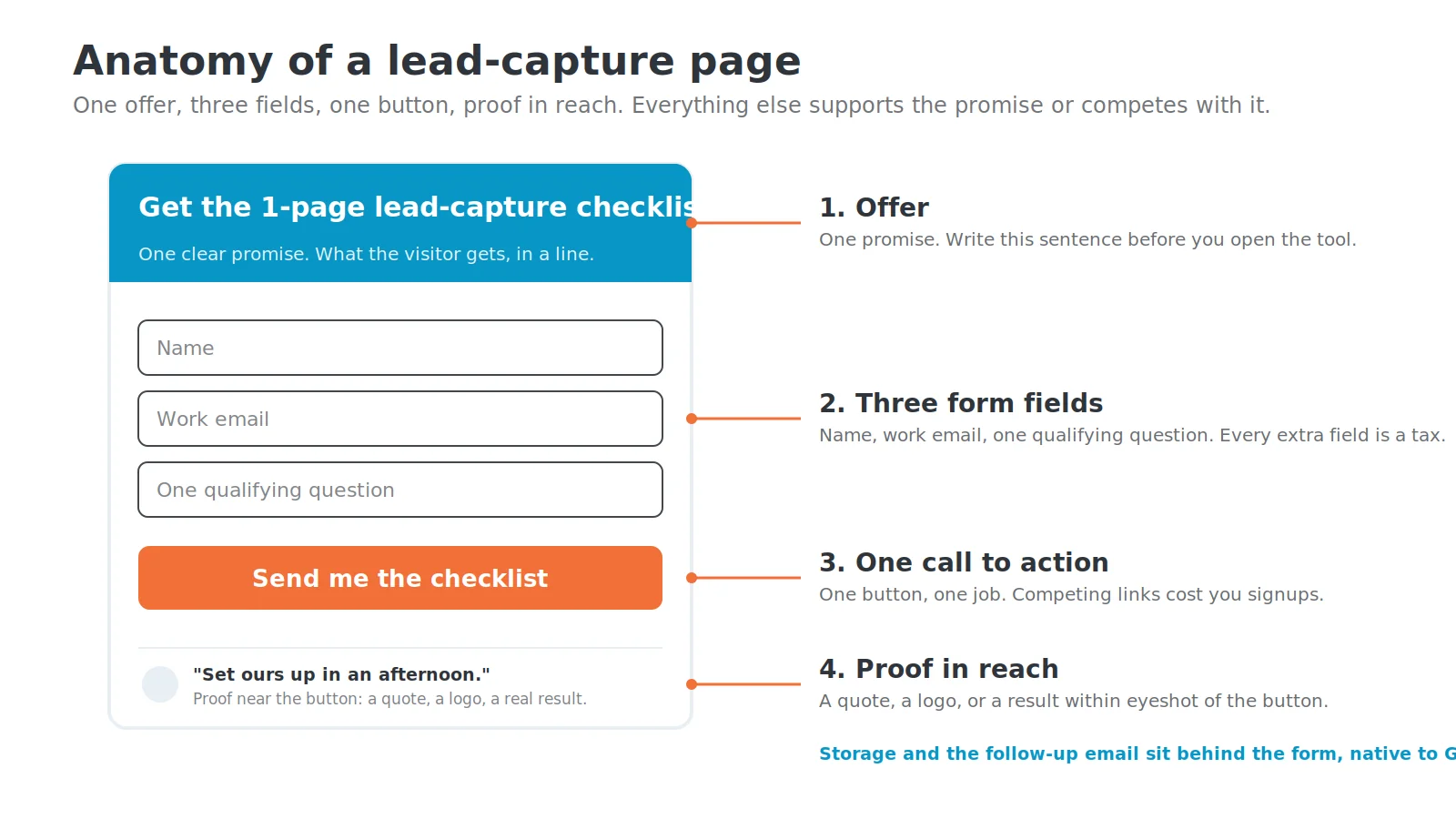
Write one sentence that answers what the visitor gets. A checklist, a teardown video, early access to a beta. If you cannot finish that sentence, you are not ready to build a page, you are ready to brainstorm one.
I would ship the page first and pretty it up second. The offer earns the signup, the font does not.
Pick Three Form Fields, No More
Keep the form to three fields:
- Name
- Work email
- One qualifying question that tells you whether the lead is worth a call
Every extra field is a tax on the visitor’s patience, and you can ask for more in the follow-up email.
Connect Storage, Then Set the Follow-Up
GPT Sites stores entries natively, so submissions land in a database with no Zapier hop or webhook to maintain. Once that works, add a confirmation email or a redirect to a thank-you page that names the next step.
Publish, Then Verify
Submit a test entry yourself. Confirm it shows up in storage, then open the page on your phone. Three checks pass and you are live. The whole run, from offer to published URL, fits inside one afternoon if you resist redesigning the button three times.


What Makes the Page Actually Convert
A published page is not a converting page. Launch speed is what GPT Sites gives you. Conversion is still your job.
A landing page is a promise and a form. Treat it as a design project and you will stall for a week you did not need to spend. One headline states what the visitor gets, one button tells them how to get it, and everything else either supports that promise or competes with it. The fundamentals of a page that converts are well documented, and a single, focused call to action beats a page full of competing links every time.
Put Proof Next to the Button
Place a short testimonial, a client logo, or one concrete result within eyeshot of the submit button. The cursor is already there. Give the visitor one reason to click instead of one reason to scroll away. Social proof set near the point of action is one of the steadier ways to raise trust at the moment it matters.
If you want the page to earn more per visitor, the same thinking behind personalized landing pages for ABM works here. Swap the headline by audience segment and track which version pulls more leads. When you are testing several variants and want a system instead of guesses, a conversion rate optimization partner can run the experiments and read the results.
Keep the Page Fast
GPT Sites ships lightweight pages by default, which helps. Check that no heavy image or stray script crept in. A slow page loses the visitor before your headline gets read.
Where GPT Sites Fits, and Where It Does Not
GPT Sites is strong at one thing: standing up a functional page fast. Campaign landing pages, event registrations, early-access waitlists, and quick split tests all fit, because each has a short life and a clear conversion goal.
Where does it stop? It is not your system of record. Do not treat its database as your CRM. Export leads into a tool built for pipeline and nurture, and keep a person on data handling and privacy. Who sees the entries, where they live, and whether your privacy policy covers this collection are questions the tool will not answer for you.
Plenty of AI tools now handle marketing work that used to need a full team, and GPT Sites fits that pattern. It removes the build bottleneck, not the judgment. If you want a partner to map where these tools fit across content, SEO, and paid media, our AI marketing agency work starts with the jobs your team repeats every week.
Here is my flat take. If you are still waiting two weeks for a developer to ship a landing page, you are paying for a delay, not a page. GPT Sites removes the delay. It will not write your offer, pick your fields, or follow up for you, and the teams that win with it are the ones that already know what they want to say.
When you are ready to move past gut-feel testing and run structured experiments on your pages, the conversion rate optimization team at Single Grain can set up the framework. You bring the pages. We bring the data.