

How to Earn ChatGPT Citations With Digital PR (Not Another SEO Page)


How to Earn ChatGPT Citations With Digital PR (Not Another SEO Page)
Your company has published another useful article, but ChatGPT still recommends competitors and cites other sources. Before commissioning the next SEO page, run a legacy content helping competitors audit, then pick one claim you can substantiate and build a digital PR campaign around it. Give credible publications a reason to mention your work, then check whether relevant AI answers cite the coverage or your original evidence.
Eric Siu makes that connection in his discussion of digital PR and ChatGPT citations: digital PR is a route to getting cited. That changes where the next dollar goes. If your existing page explains the subject well, fund evidence development and targeted outreach before another interchangeable article.
Keep the operating scope small. In Eric’s discussion of marketing agents, he cites 17 of 100 companies using AI agents in marketing, with those agents covering 3.5% of marketing staff. Those figures argue against selling an “AI-first organization” overhaul. Give Single Grain one owned workflow to improve: evidence, outreach, and citation measurement. Track staff hours alongside the outputs.
Why another SEO page does not get you cited
A useful page helps engines discover and understand your business. It cannot guarantee that an AI answer will select your company or cite your URL. Repeating widely available advice gives reporters little reason to cover you and answer systems little distinctive evidence to reference.
Eric’s engine-optimization framing expands the assignment beyond blue links. Keep technical SEO for LLM scrapers and useful pages. Add external corroboration and answer-level measurement. Single Grain’s framework for integrating AEO with SEO supports that combined brief: discoverable evidence, credible mentions, and checks against buyer questions.
The supporting click data explains why visibility deserves its own measurement. Pew Research Center’s analysis of March 2025 browsing activity found fewer traditional-result clicks when Google displayed an AI summary. Users also rarely clicked the sources inside those summaries. Prioritize prompts with an AI Overview query capture playbook when an owned citation brief is worth the work.
| Observed Google search behavior | Share of visits |
|---|---|
| Traditional-result click without an AI summary | 15% |
| Traditional-result click with an AI summary | 8% |
| Click on a source inside an AI summary | About 1% |
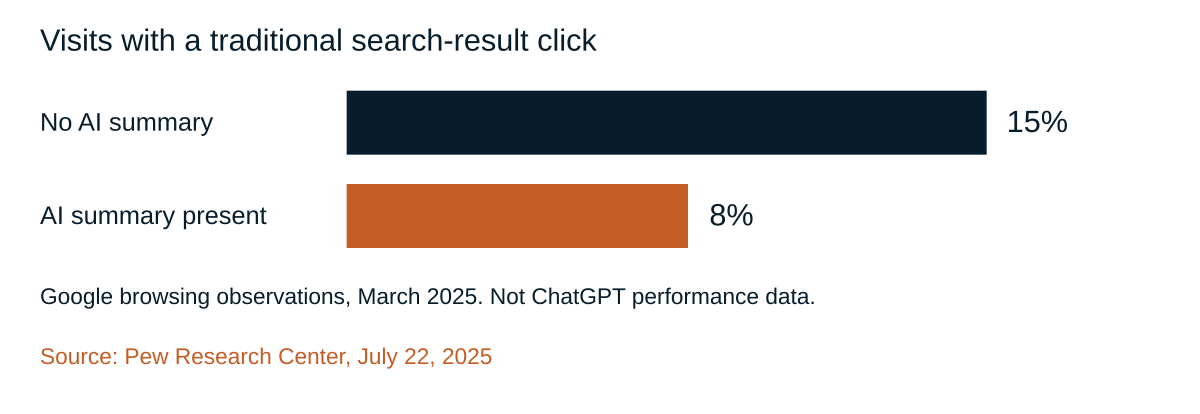
These are Google observations, not ChatGPT citation rates or proof of causation. Use them to justify measuring inclusion before a visit occurs, while retaining conversion tracking. The Generative Engine Optimization research paper provides additional experimental support for testing citations, quotations, and statistics in source content. Its findings do not guarantee performance in live ChatGPT answers. Buy a testable process, not a promised citation lift.
Worked scene: digital PR → earned mention → AI citation check
In Eric’s digital PR video, he connects earned mentions with getting cited by ChatGPT. The practical takeaway is a change in sequence: develop something worth referencing, seek coverage, then inspect AI answers. Assign the editor a claim a reporter can investigate rather than another keyword variation. The execution below illustrates that recommendation; it is not a reported Single Grain client result.
A software company has permission to analyze anonymized onboarding records. Its analyst finds that one implementation step repeatedly delays activation. The team limits its claim to the observed records and documents the sample, exclusions, and definition of activation. Its source page includes the method and an attributable expert explanation. Nothing in the pitch claims an industry-wide benchmark.
The PR lead approaches a reporter who covers that implementation problem. The pitch contains the finding, its limitations, the source URL, and an offer to discuss the analysis. The reporter publishes coverage attributing the finding to the company. The team saves the article URL and exact attributed statement. That establishes an earned-media outcome. An AI citation remains a separate outcome to test.
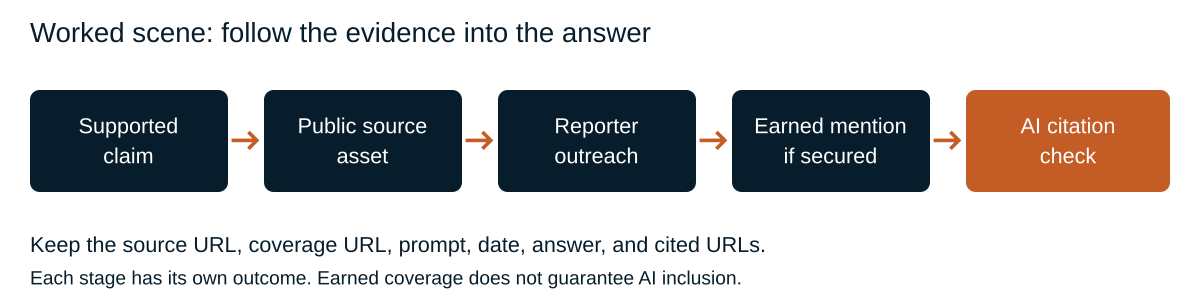
Before outreach, the analyst saves answers to a fixed set of buyer questions about onboarding delays. After coverage, the analyst repeats those questions, recording the date, product, available model information, search settings, answer text, and cited URLs. Explicit citations, uncited brand mentions, and absent mentions receive separate labels. A similar phrase without attribution is not enough to claim credit. When models credit the wrong brand, apply brand equity citation hygiene for LLMs.
The analyst also checks whether the answer cites the company’s evidence or the reporter’s article. Both can matter, but they represent different paths to visibility. Repeated observations are more useful than a favorable screenshot. Search results and generated answers change, so a before-and-after difference alone cannot establish that PR caused it.
Evaluate Single Grain’s AI SEO services against this complete measurement scope. Keep a relevant PR campaign when coverage is valuable but citation checks remain negative. Revise the angle when reporters cannot use the evidence. Do not commission extra pages merely to make the activity report look busy.
Worked scene: gated AEO asset feeding PR
The second illustrative execution starts with an AEO diagnostic workbook. A bot drafts the introduction, question checklist, and outreach summary from a bounded research packet. Its inputs include source URLs, permitted claims, definitions, and limitations. The workbook helps a marketing team record its appearances in AI answers and compare those observations with referral traffic.
The team puts the useful explanation outside the gate: methodology, a preview, source references, and the core finding. It gates the editable workbook. A reporter needs accessible proof, and a form-only landing page offers little public substance to reference. The campaign’s only evidence should not sit inside an emailed PDF.
Following the release review described below, PR uses the public asset as proof in outreach. The pitch identifies the question the diagnostic answers and links directly to supporting material. The download serves a separate job: capturing demand from readers who want to run the diagnostic themselves. The same research supports both paths without making a form submission the price of verification.
Pew’s click findings sharpen the reporting decision. A reader may encounter the finding without visiting the website; an interested operator may still download the workbook. Record citations and mentions as visibility outcomes. Record downloads and qualified inquiries as demand outcomes. Do not combine them into an unsupported “AEO ROI” number.
Use Single Grain’s AEO services to define the questions, asset structure, and reporting requirements before production. Buy specialist PR capacity if your team lacks relevant media relationships. Keep the evidence ledger and prompt log in company-controlled systems so the learning survives a vendor change. Measure drafting, verification, and outreach hours separately to see whether automation actually reduces work.
What you do not automate or fake
Eric’s safe-publish discipline sets the release rule for both scenes: bots draft; a human exact-approves anything that ships externally. In the Single Grain brief, name the individual account lead as the release owner and the client-side subject expert responsible for factual signoff. A role labeled “marketing” is not an accountable ship gate.
That gate covers the page, download, pitch, and externally shared report. The approver checks the actual text, links, figures, permissions, and attachments. Approval of an outline does not authorize a later generated version. Publishing and email tools should attach approval to the final artifact. Any material revision returns to review.
Refuse fabricated surveys, synthetic customer quotes, inflated sample claims, and paid placements presented as independent coverage. Keep confidential records out of source assets. If the evidence cannot support the pitch, narrow the claim or stop. Neither a bot nor a PR vendor gets to turn a plausible observation into a documented result.
What to do next + CTA
Start with one claim and one buyer question. Inventory evidence you can disclose, identify publications that cover the issue, and save baseline AI answers. Choose the source asset only after establishing what a reporter and prospective customer can learn from it.
Give the first campaign separate success definitions: relevant earned coverage, observed AI inclusion, qualified demand, and staff time required. Review each without disguising weak results in a composite score. Coverage without citations may still be worthwhile. A citation unrelated to a buying question should not become the headline result.
Talk to Single Grain about building that first evidence-led digital PR and AEO campaign. Bring existing content, usable research, and priority buyer questions. The next investment should make your expertise easier to verify, cover, and cite.