Legacy Content Helping Competitors: An AEO+SEO Cannibalization Audit


Is your legacy content helping competitors win the query?
An AEO+SEO cannibalization audit checks whether legacy pages compete with your intended buying pages or supply evidence that favors a competitor. It separates observed rankings and citations from assumptions about attribution. If you publish at scale, pair the audit with a programmatic SEO and AI search visibility playbook. The deliverable is a URL-level decision sheet with supporting evidence, an action, an owner, and a due date. Start there before commissioning replacement articles.
- Prioritize buying queries supported by account and buyer evidence.
- Separate internal ranking competition from competitor-favoring recommendations.
- Choose consolidate, redirect, rebuild, or kill based on intent and evidence.
- Automate classification only after the decision rules are explicit.
At a Monday search review, an SEO lead opens a legacy comparison page sitting above the product page for a buying query. The comparison names a competitor as the winner. In this illustrative audit, the ranking report looks healthy until the lead reads the recommendation a buyer actually sees.
In the same review, the lead captures an AI Overview citing an outdated roundup that lists that rival first. The artifact is a screenshot, a query, and a source URL, not proof of a lost sale. Together, these two findings give the audit a sharper question: whose case is our content making?
Job delta: Closest live SEO audits rank pages by traffic. This page ranks legacy URLs by who they help in AI answers : us or a competitor : then picks consolidate/redirect/rebuild/kill with an owner and due date.
Operator artifact : cannibalization audit sheet (illustrative ACME rows; not a client result). Ops blocks the next step until required fields are filled:
| URL | Query cluster | Who benefits | Action | Owner | Due |
|---|---|---|---|---|---|
| /blog/best-workflow-tools | Best workflow tools with audit logs | Competitor: Rival A | Rebuild using current buyer criteria | Maya, content lead (example) | Audit week 2 |
| /compare/workflow-tools | Workflow platform for audit logs | Competitor: Rival A | Consolidate unique evaluation material; redirect after intent check | Jordan, SEO lead (example) | Audit week 3 |
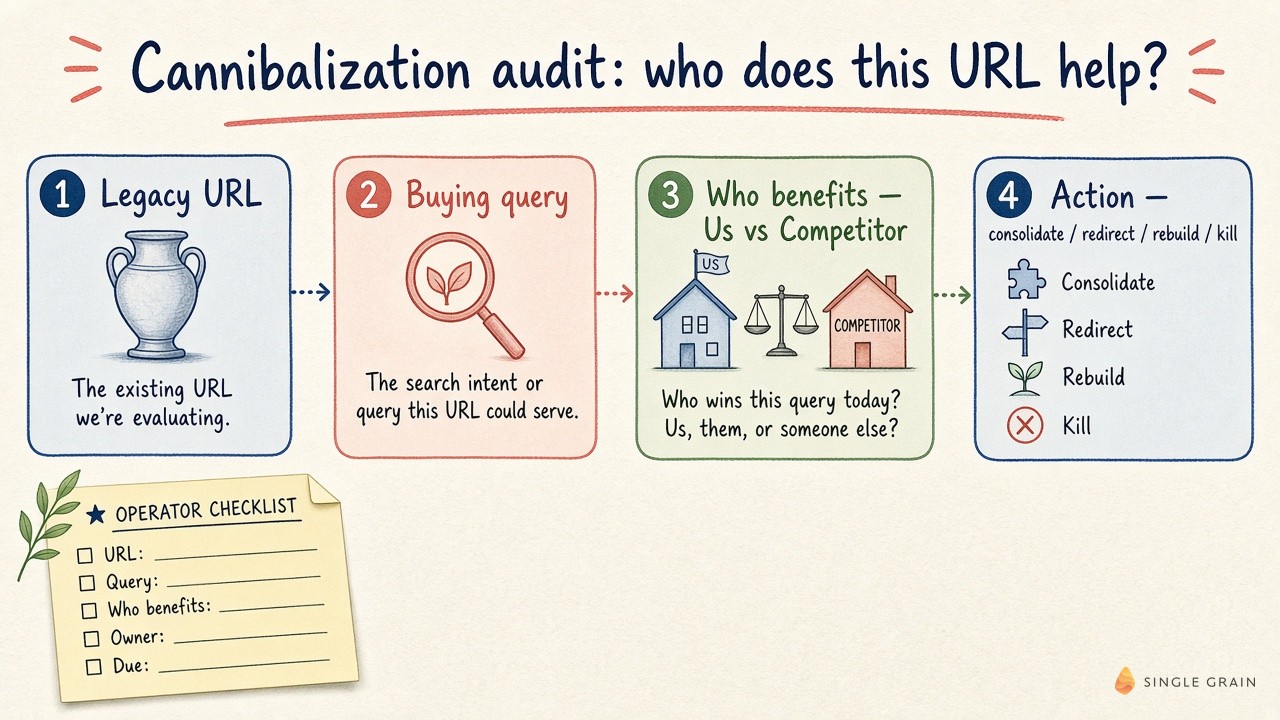
With Open Future Forum CMO AI Leverage Report (2026-09-06) at 81% of 230 marketing/growth leaders past exploring agentic AI, the audit decision is to freeze legacy URLs that currently recommend a competitor before commissioning net-new comparison copy. Forrester (2026-09-08) shows 83% of B2C marketing decision-makers implementing agentic AI, so citation and ranking evidence feed a kill/keep sheet rather than proving the competitor won the category.

TABLE OF CONTENTS:
- Why a rewrite spree is not a cannibalization audit
- Worked scene: the legacy guide that cites your competitor as the authority
- Worked scene: audit fields that decide consolidate, redirect, or rebuild
- AEO+SEO cannibalization audit sheet (URL, query cluster, who benefits, action, owner)
- Single Brain installs the system; Single Grain runs it when you need the team
Why a rewrite spree is not a cannibalization audit
A refresh queue starts with age, declining clicks, or stale screenshots. This audit starts with query ownership and beneficiary. Two pages mentioning the same topic do not establish cannibalization. You need evidence that they serve the same intent, that the wrong destination appears, or that an outdated recommendation creates a commercial conflict.
Likewise, an AI citation to your domain does not automatically help you. A cited roundup can accurately report a rival’s advantage. That may be useful editorial work worth retaining. Flag a problem when the recommendation is unsupported, obsolete, or inconsistent with the buying job the page now serves. Do not delete credible competitor references merely because competitors benefit.
Eric’s choose-before-create recommendation changes the queue: rank proposed work by pipeline evidence before drafting volume. A comparison appearing in active buyer questions gets investigated before a broad informational post with no demonstrated buying relevance. Pipeline evidence establishes priority, not a fabricated revenue attribution.
Single Grain’s guide to pages that drive AI visibility without organic traffic addresses the visibility gap. This audit adds a different decision: who benefits from the visible page, and which URL should own the intent?
Google’s AI features documentation grounds the implementation in existing Search requirements and helpful-content practices. Keep crawlability, indexability, internal links, and page usefulness in the same backlog. Single Grain’s argument that AI search optimization is SEO is the right operating constraint here: do not purchase a separate GEO-only stack to avoid fixing your site.
Worked scene: the legacy guide that cites your competitor as the authority
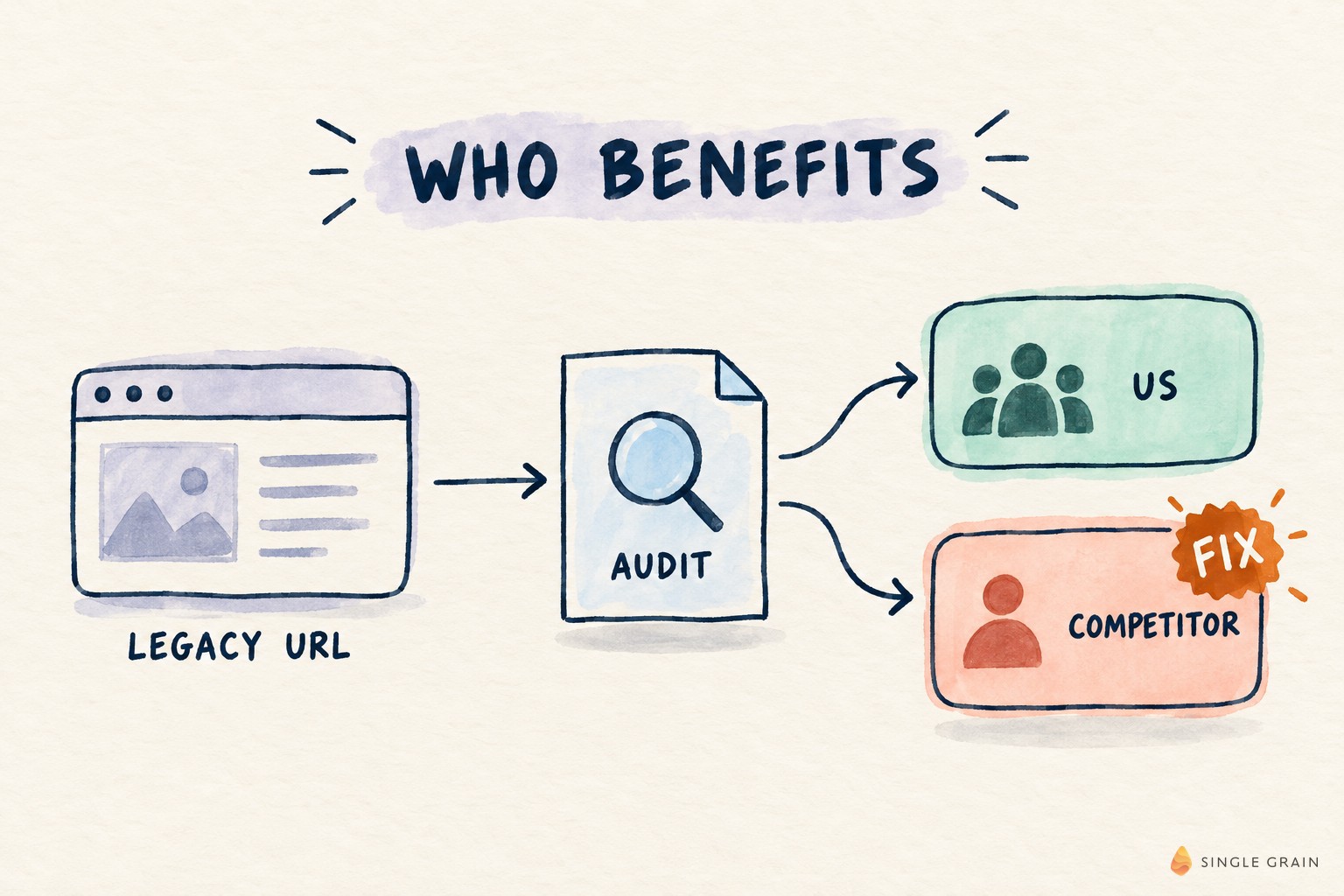
In Eric’s Leveling Up discussion of a company brain built from customer calls, the sequence starts with existing company content and internal conversations. Agents surface candidate ideas; the selection step determines what deserves to be made. The lesson for this audit is concrete: consult the call evidence before turning an old roundup into another writing assignment.
Apply that sequence to our illustrative legacy workflow-tools roundup. The captured AI Overview cites the page, which lists Rival A first. The operator records the exact query, capture date, cited passage, and destination. Listing order alone does not establish why the answer chose a vendor. The finding remains “our cited source recommends Rival A,” not “our page caused Rival A’s ranking.”
Next, the operator checks approved buyer-call excerpts and current product documentation. Buyers are asking about audit logs, but the roundup compares vendors using an outdated feature checklist. That mismatch supports a rebuild around the current buying criteria. If the old checklist remains accurate and serves a distinct audience, the page should stay.
C6 changes the input policy: the company brain supplies governed evidence, not an unlimited transcript dump. Use permissioned excerpts, account or buyer labels, source dates, and links back to approved records. Exclude client names and dollar amounts. Missing evidence creates a research task, not permission to invent a replacement recommendation.
Worked scene: audit fields that decide consolidate, redirect, or rebuild
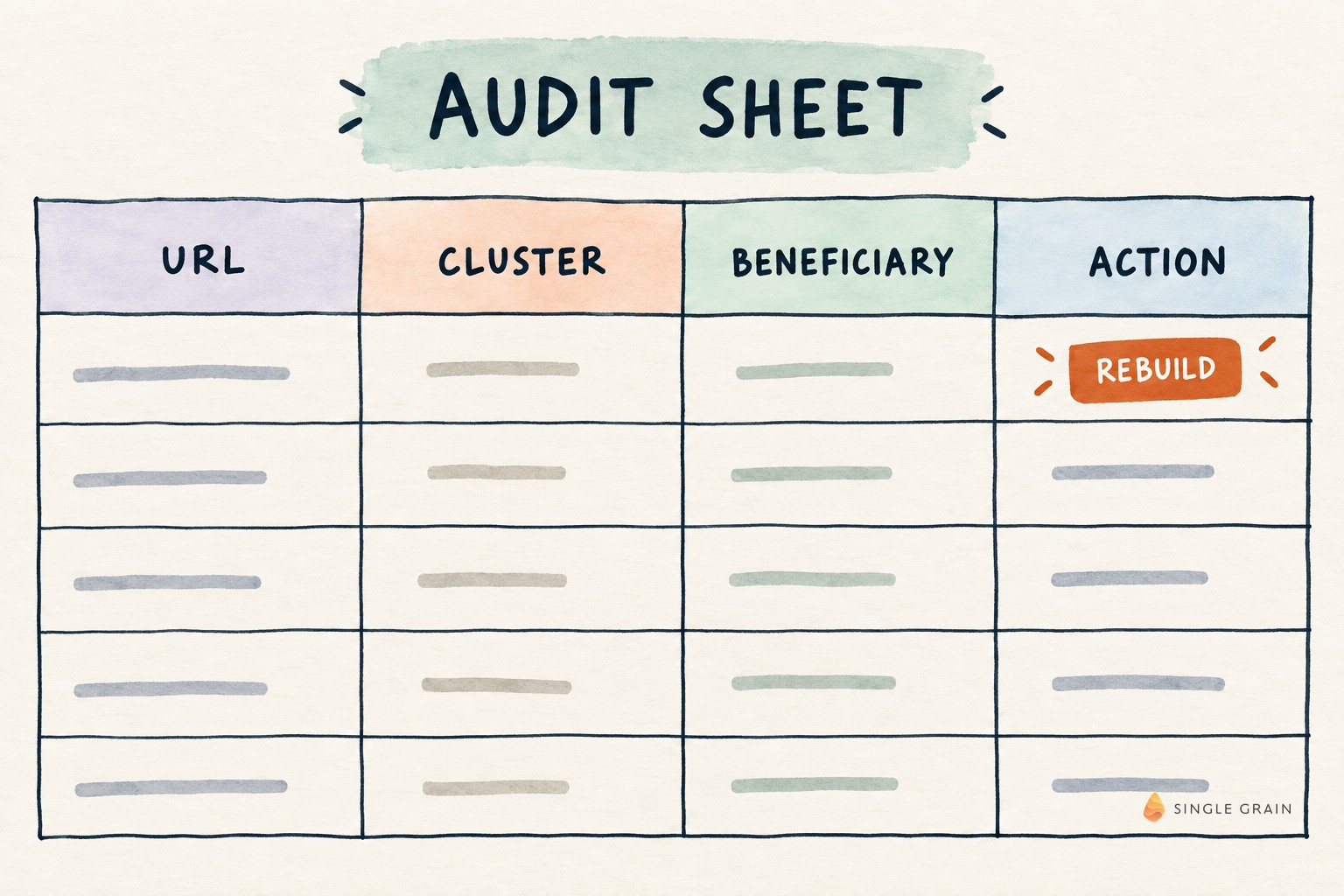
The second illustrative finding is a legacy comparison at /compare/workflow-tools outranking /product/workflow-platform for “workflow platform for audit logs.” The comparison declares Rival A the winner using a retired product limitation. The SEO lead pairs the query-level Search Console evidence with a dated search capture, then checks whether both pages genuinely target the same buying job.
The action depends on that check. If the comparison contains useful evaluation material that belongs on the product page, consolidate that material first. Redirect the legacy URL only after confirming that the destination satisfies the old page’s intent. If buyers still need a standalone comparison, rebuild it with current evidence and clearer internal links. Kill a page only when it has no useful purpose and no appropriate replacement; do not route every retired URL to the homepage.
Eric’s Jev middle-layer discussion changes where automation belongs. Put inexpensive classification and routing between the crawl and the writer. That layer can label query overlap, stale claims, and missing sources. Reserve expensive drafting for rows with a justified action.
Eric’s warning that a better model still needs a better workflow rules out a tempting purchase. If the system cannot distinguish an obsolete claim from an accurate competitor advantage, fix the schema and evaluation examples before upgrading the model.
AEO+SEO cannibalization audit sheet (URL, query cluster, who benefits, action, owner)
The Cannibalization Audit Sheet below contains illustrative values, not Single Grain client results. Relative due dates are planning assignments, not service guarantees. Preserve the captures and source passages in an evidence record linked to each URL.
| URL | Query cluster | Who benefits (us/competitor) | Citation surface | Action (consolidate/redirect/rebuild/kill) | Owner | Due |
|---|---|---|---|---|---|---|
| /blog/best-workflow-tools | Best workflow tools with audit logs | Competitor: Rival A | Captured AI Overview cites outdated roundup | Rebuild using current buyer criteria | Maya, content lead (example) | Audit week 2 |
| /compare/workflow-tools | Workflow platform for audit logs | Competitor: Rival A | Organic result above intended product page | Consolidate unique evaluation material; redirect after intent check | Jordan, SEO lead (example) | Audit week 3 |
Eric’s recommendation to build reusable workflows and hand them to the team changes the deliverable. Package the audit as a repeatable job card: inputs, classification rules, evidence requirements, permitted actions, exception handling, and completion checks. A polished spreadsheet without those instructions becomes another one-off consulting artifact.
Measurement needs the same discipline. The September 2026 Open Future Forum report reports that 81% of 230 marketing and growth leaders are past exploring agentic AI. Attribution was the top named challenge, appearing in 20 of 96 open answers. Those are different measures with different denominators.
That attribution gap changes the success definition. Check whether the intended URL serves the query, whether obsolete claims were removed, and whether later captures show current recommendations. Track organic performance and qualified buyer actions separately. Do not convert a changed citation into claimed pipeline recovery.
Single Brain installs the system; Single Grain runs it when you need the team
Single Brain is the AI implementation OS for job-specific agents, evaluation, and kill switches. For this job, its control surface should expose the source URL, evidence, proposed action, and exception reason. Evaluation should test whether the classifier correctly separates accurate comparisons from stale recommendations. A missing source or contradictory evidence should stop the action and route the row for review.
Name the ship gate once: the designated SEO lead approves redirects and removals, and the content lead approves revised claims. Agents do not autonomously publish these changes. Single Grain’s reliable marketing-bot workflow provides the operating frame for scoped jobs and explicit controls.
Walk away from automation when the backlog is small, access is restricted, or intent remains disputed. A manual audit can establish the schema faster. Buy orchestration when repeated classification consumes the team’s time, not when a stronger model promises to compensate for missing rules.
Hire Single Grain to install and run the audit when you need the search, content, and implementation team without staffing the workflow yourself. Bring your legacy URL inventory, priority buying queries, and approved buyer evidence. Talk to Single Grain about an AEO+SEO cannibalization audit before funding the next rewrite spree.