

AI Overview Query Capture: Which Prompts Deserve an Owned Citation Brief


Which AI Overview prompts deserve an owned citation brief?
An owned citation brief assigns a buyer question, an evidence gap, and an accountable editor to a content decision. A competitor citation supplies a research lead, not an automatic mandate to publish. Customer calls can strengthen that lead when their evidence is relevant and permitted for use. The objective is a defensible page worth citing, without promising that Google or an LLM will cite it.
- Capture the cited passage and source URL, not just a competitor’s name.
- Prioritize buyer decisions supported by company evidence.
- Classify and route prompts before commissioning drafts.
- Skip opportunities that lack evidence, ownership, or meaningful commercial relevance.
At the start of a weekly search review, an AEO operator enters a category query and finds a competitor cited in the AI Overview. In this worked example, the artifact is a saved result with the query, cited URLs, and capture date. The failure would be turning that screenshot directly into a writing assignment.
During the same review, the content lead opens a sanitized customer-call excerpt about evaluating an agency’s AI-search work. The buyer’s question is specific, but the content queue contains a broad glossary proposal. These two inputs belong in one triage process: decide whether the question deserves an owned citation brief before paying to draft it.
Job delta: Closest live page is the LLM SEO guide (discipline overview). This dens owns the triage job only: which captured AI Overview prompt gets an owned citation brief, which updates an existing page, and which is skipped before anyone drafts.
Kill rule: no captured prompt + cited URL + evidence gap → no owned citation brief commissioned.
Operator artifact : AI Overview prompt-capture brief (illustrative ACME triage; not a client result). Editorial ops blocks draft commission until every required row is filled:
| Field | Example value |
|---|---|
| Query | How to evaluate an AI search optimization agency |
| Intent class | Commercial evaluation: selecting an agency |
| Current cited domains | Not verified in this example. Operator must attach observed domains and cited URLs. |
| Evidence gap | A sourced evaluation checklist separating citation visibility, traffic, and business outcomes |
| Brief owner | Single Grain AEO content lead; named assignee required in the production ticket |
| Ship / skip rule | Proceed after capture verification, permitted evidence, and existing-page review; skip if only competitor presence supports the request |
Because Open Future Forum CMO AI Leverage Report (2026-09-06) finds 81% of 230 marketing/growth leaders already past exploring agentic AI, the triage decision is to commission an owned citation brief only when the captured prompt shows a cited competitor plus a fillable evidence gap. Forrester (2026-09-08) reports 83% of B2C marketing decision-makers implementing agentic AI (and 85% agree it delivers meaningful value), so volume without a ship/skip rule is the failure mode this dens kills.

Eric’s Jev for work: classify, test criteria, route uncertain cases; early tests, human review changes where control sits before the next expensive write. The same review applies Jev as the fast cheap middle layer: classify, apply criteria, route between models and ops, so uncertain rows route to a human instead of auto-publishing. Together with the embedded scene above, that is three on-angle Eric tape inputs for this job, not a link dump.
TABLE OF CONTENTS:
- Why a GEO glossary is not a prompt triage
- Worked scene: the AI Overview that cites a competitor for your category query
- Worked scene: prompt→brief scoring fields that decide ownership
- AI Overview prompt-capture brief (query, intent, evidence gap, owner, ship rule)
- Single Brain installs the system; Single Grain runs it when you need the team
Why a GEO glossary is not a prompt triage
Single Grain’s LLM SEO guide addresses the broader optimization discipline. This workflow starts with a narrower decision: does this observed query deserve a new brief, an existing-page update, or no work? It does not rank brands by mentions or produce an AEO share-of-voice report. Its unit of work is the evidence-backed brief.
Google’s documentation for AI features in Search points publishers toward established SEO fundamentals and helpful, accessible content. That changes the purchase decision: inspect crawlability, existing pages, and available evidence before buying a separate GEO-only stack. Single Grain’s explanation of why AI search optimization is SEO provides the foundation.
The operational pressure is real, but adoption statistics cannot validate an individual prompt. Open Future Forum’s September 2026 report says 81% of 230 marketing and growth leaders are past exploring agentic AI. Attribution was the most frequently named challenge, appearing in 20 of 96 open answers. Keep the brief’s delivery outcome separate from downstream revenue attribution.
Forrester’s September 8 report separately reports 83% of B2C marketing decision-makers implementing agentic AI across seven categories and 52 use cases. These different populations should not be averaged. The recommendation is to scope one decision workflow, rather than treat widespread adoption as permission to automate the entire content queue.
Worked scene: the AI Overview that cites a competitor for your category query
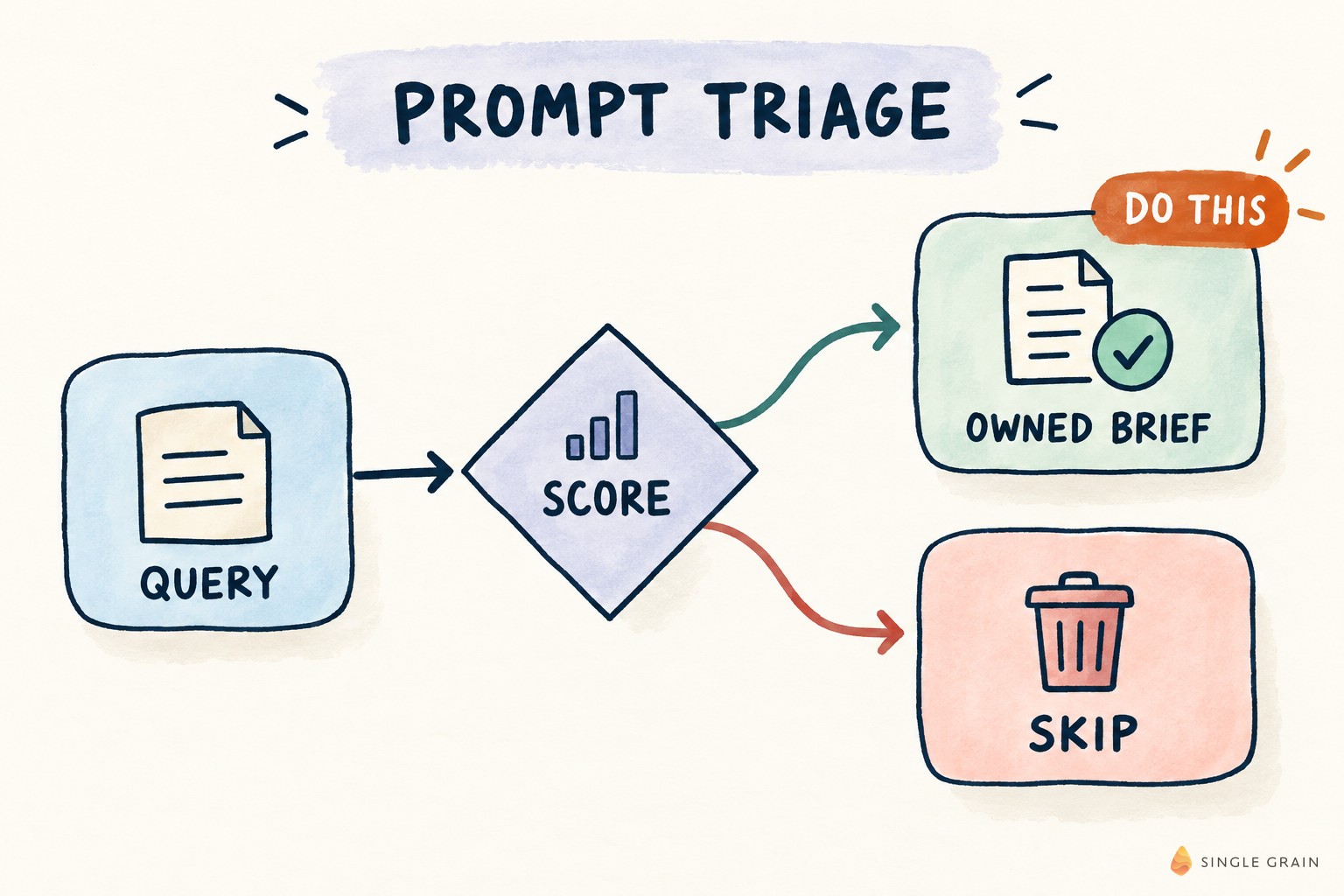
Take the illustrative query “how to evaluate an AI search optimization agency.” The operator records the actual cited domains from the live result, opens the competitor’s cited page, and identifies the passage answering the evaluation question. No domain or citation result is asserted here as a measured observation.
The first test is commercial relevance. An agency-evaluation question can support a buying decision. The next test is the missing evidence: does the cited material omit how an agency distinguishes citation visibility from organic traffic, or how it documents a useful content recommendation? The operator checks Single Grain’s existing page on pages that drive AI visibility without organic traffic before requesting another URL.
If that page can answer the question with a focused addition, update it. If a distinct evaluation resource requires evidence the team actually owns, commission a brief. If the only argument is “the competitor appears,” skip. Save the reason so the same screenshot does not repeatedly reopen the assignment.
Worked scene: prompt→brief scoring fields that decide ownership
In Eric’s company-brain discussion on Leveling Up, customer calls and internal conversations become inputs for finding content topics. The sequence matters: conversations supply questions, agents surface candidates, and the team chooses what deserves development. The practical change is to treat company context as governed evidence, with source permissions and traceable excerpts, rather than an unlimited transcript dump.
Apply that sequence to the second input: a sanitized buyer question about evaluating an agency’s AI-search work. Keep the account anonymous. Attach the permitted excerpt, classify it as commercial evaluation, and compare it with the category-query capture. The call establishes buyer relevance; it does not establish market-wide demand or prove any agency’s results.
Use ordinal fields such as strong, partial, and missing for intent fit, evidence readiness, and existing-page fit. Eric’s recommendation to choose better content before creating it changes queue order: a documented buying question with usable evidence outranks an unsupported glossary idea. Do not turn those labels into a fabricated probability of citation.
Eric’s Jev middle-layer discussion changes the architecture. Put classification, criteria checks, and routing ahead of expensive drafting. The middle layer should return a disposition and its supporting sources. Missing evidence returns a research task, not a longer article.
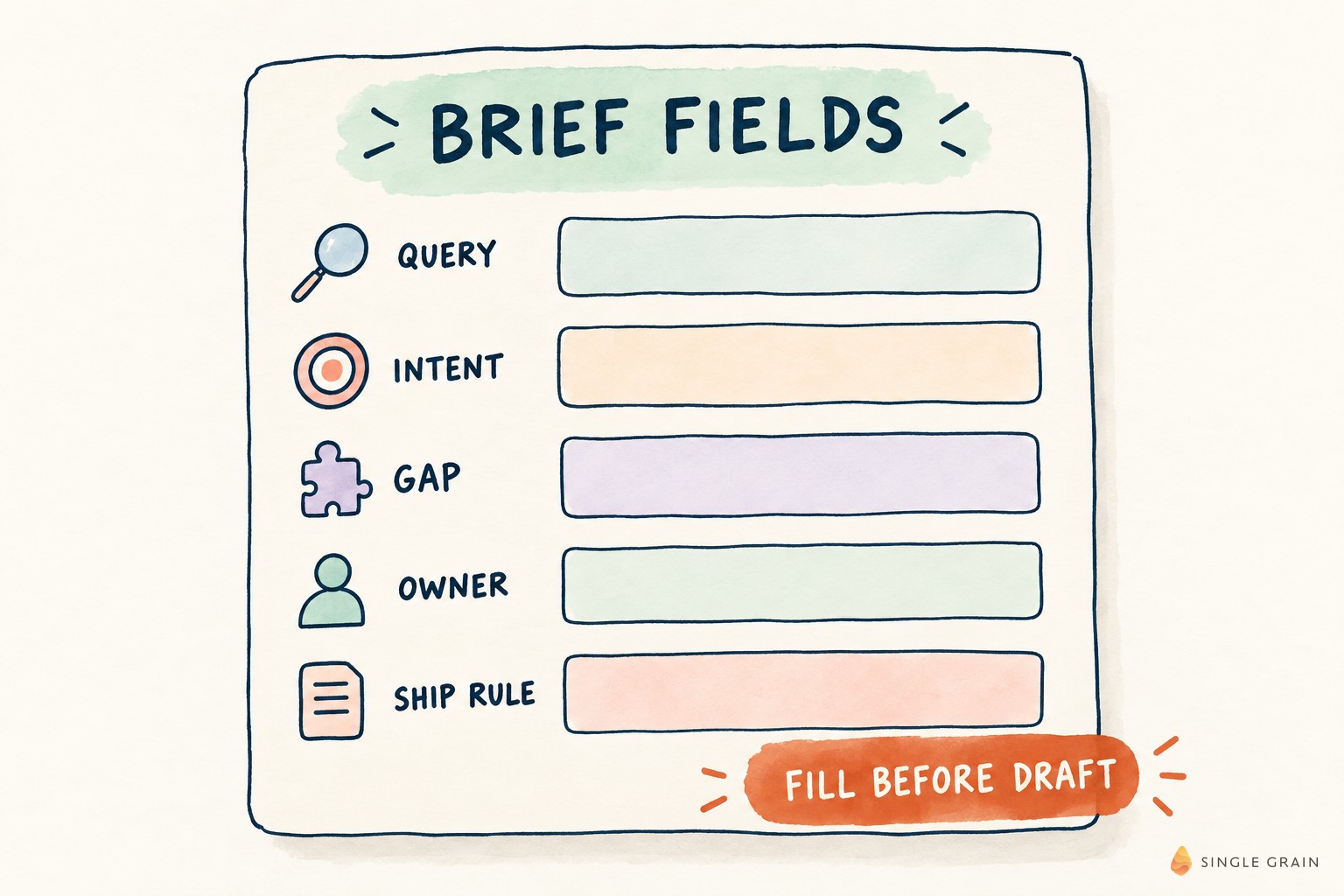
AI Overview prompt-capture brief (query, intent, evidence gap, owner, ship rule)
The AI Overview Prompt Capture Brief below continues the illustrative agency-evaluation example. Its unresolved citation field is deliberate: an unverified capture cannot become a factual competitor claim.
| Field | Example value |
|---|---|
| Query | How to evaluate an AI search optimization agency |
| Intent class | Commercial evaluation: selecting an agency |
| Current cited domains | Not verified in this example. Operator must attach observed domains and cited URLs. |
| Evidence gap | A sourced evaluation checklist separating citation visibility, traffic, and business outcomes |
| Brief owner | Single Grain AEO content lead; named assignee required in the production ticket |
| Ship / skip rule | Proceed after capture verification, permitted evidence, and existing-page review; skip if only competitor presence supports the request |
Eric’s early Jev work tests support an explicit exception path: uncertain classifications go to human review. The production ticket must name the responsible editor as the approval gate for the brief and final page; do not autopublish. Success means the question is answered with inspectable evidence and a clear disposition, not a promised citation.
Single Brain installs the system; Single Grain runs it when you need the team
The operator interface needs a source drawer, intent label, evidence status, existing-page candidate, owner, and disposition. Use Google’s published guidance as the eligibility reference. Preserve captures with dates because a saved result documents that observation, not a permanent ranking.
Single Brain is the AI implementation OS for job-specific agents, evaluation, and kill switches. For this job, evaluate whether classifications preserve source boundaries and whether routing respects missing evidence. Stop the workflow when sources are unavailable or restricted material enters the queue. Single Grain’s reliable marketing-bot framework supplies the implementation context.
Eric’s point that a better model still needs a better workflow defines the walk-away fork. Keep triage manual when volume is low or evidence rules remain unsettled. Do not buy a stronger model to conceal a missing schema. If you need the system installed and operated without staffing it internally, hire Single Grain to run capture, routing, briefing, and editorial delivery.