

Google Drew the Line: Optimizing for AI Search Is SEO, Not a New Discipline



You have spent this year getting pitched a new discipline. AEO, then GEO, a fresh acronym every quarter, each one sold as the thing you have to buy or fall behind in AI search. Google just settled the argument. Its guidance on AI features says that showing up in AI Overviews and AI Mode is the work you already know, the same helpful content, crawlable pages, and clean structured data that rank a page in normal search.
There is no separate switch to flip and no second channel to buy your way into. For anyone holding a search budget, this lands in the middle of a year spent deciding whether to fund a parallel AEO stack on top of the SEO one you already run.
By the end of this you will know what changed for AI search, what did not, and where I would put your next quarter of search budget so it pays off in Google and in the AI answers at the same time.
TL;DR
- Google’s guidance on AI features says appearing in AI Overviews and AI Mode runs on the same helpful content, crawlable pages, and structured data as normal search, so AI search is part of SEO rather than a separate discipline.
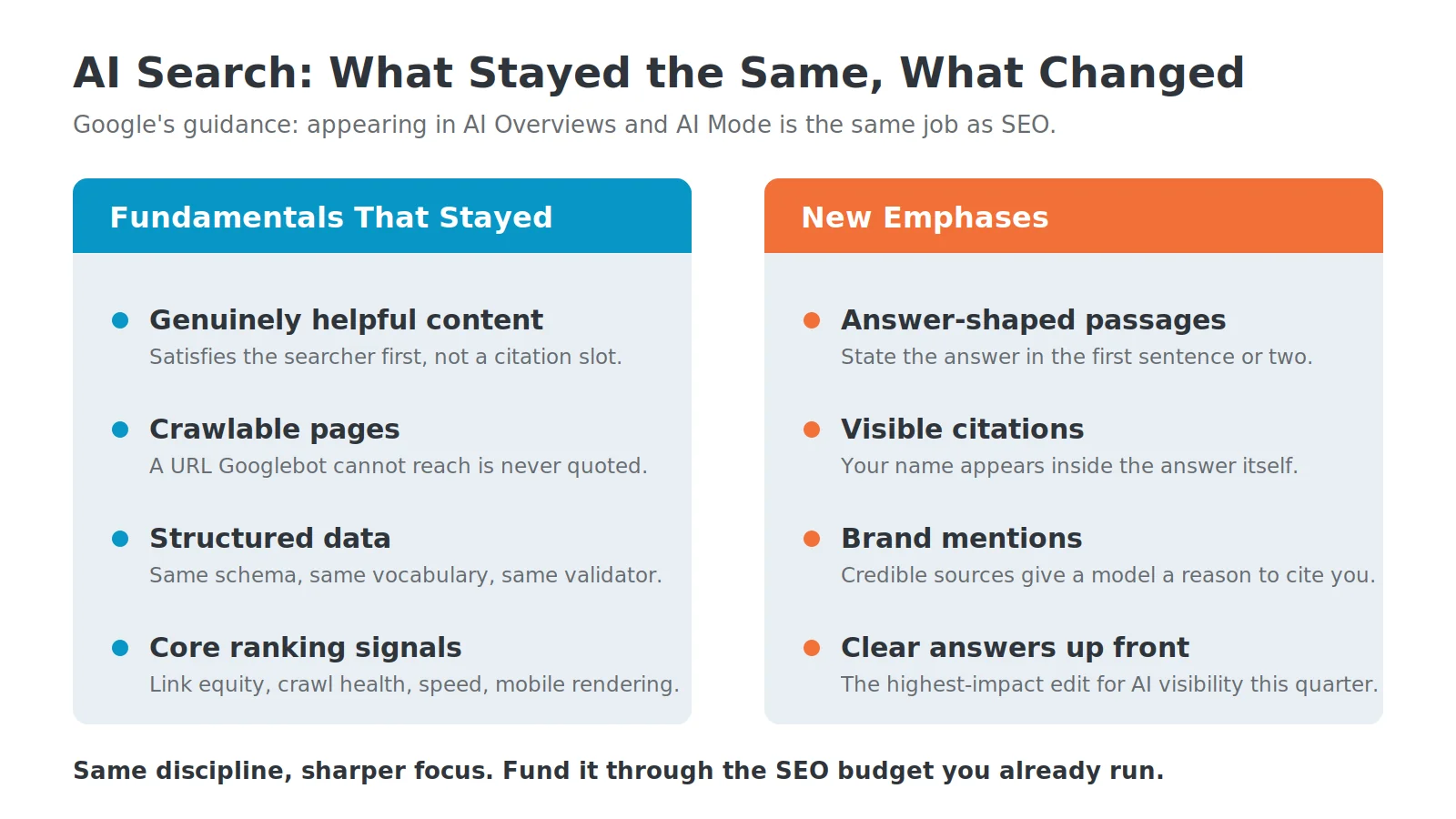
- The emphasis shifted, not the fundamentals: answer-shaped passages, visible citations, and brand mentions carry more weight now, while the core ranking signals stayed put.
- Fund AI search through your existing SEO budget by doing the SEO work well, measuring AI citations in Search Console, and dropping the separate AEO stack that checks what you already own.
What Google Actually Said
Google published guidance on how to appear in its AI features, and the instruction is plain. The way into AI Overviews and AI Mode is the same helpful content, technical SEO, and structured data that ranks pages in normal search. No new markup, no separate submission, no hidden API.
Its AI experiences pull from the same index and weigh the same quality signals that have driven organic rankings for years. If a page is crawlable, well structured, and useful, Google’s own documentation already treats it as a candidate for AI answers. The developer page reads like an SEO checklist you could have written in 2022, with a few new emphases bolted on.
I will call it what it is. AEO is your SEO team doing its job in front of an answer engine. When Google spelled this out, much of the search community read it as the end of the argument, and the response from the tooling side lined up with the same conclusion, that the path to AI visibility runs straight through existing SEO practice.

Why the “New Discipline” Pitch Took Off
Fresh acronyms sell software. The moment ChatGPT and Gemini started answering questions inside search, vendors needed a way to package urgency, and AEO and GEO gave them the wrapper.
The pitch felt true on the surface. AI answers look nothing like ten blue links. They summarize instead of rank, and they cite sources in the body of the answer. If the output changed that much, the input must have changed too. It did not. What moved is how Google assembles and displays the result, while the work that earns a spot in it held steady.
“Do the same work, but better” is hard to charge a premium for. “Buy our new AEO platform” is an easy sale. Most teams I talk to are paying for a second tool to solve a problem the first one already covers, an AI suite that flags the same crawl errors and schema gaps their existing stack flags. The land grab is real. The job did not split into two.
What Optimizing for AI Search Really Requires
Optimizing for AI search is part of SEO. Google says the fundamentals for appearing in its AI experiences are the same helpful content, crawlability, and structured data that rank pages in normal search, with a few new emphases like clear answers and brand mentions.
Strip the acronym away and the requirements read as ordinary. The work still comes down to four things you already staff for.
- Genuinely helpful content that answers the searcher’s question before it does anything else.
- Entities and structured data, so a model can connect your page to the right query.
- Crawlable pages, because a URL Googlebot cannot reach will never be quoted in an answer.
- Brand mentions across the web, so credible sources give the model a reason to cite you.
None of that is new to a competent SEO team. Quality raters still judge whether a page satisfies the person who searched, and AI Overviews pull from pages that clear the same bar. Clean schema still tells Google what a page is about. Brand mentions still read like digital PR, because they are digital PR.

What Actually Changed, and What Did Not
A few things do deserve attention this quarter. Answer-shaped passages carry more weight now, because a model prefers content that states a clear answer in the first sentence or two of a section and then supports it. Bury the answer under four paragraphs of throat-clearing and a cleaner competitor gets quoted instead.
Citations are visible to the reader, which makes each one worth more than a standard impression. When an AI answer quotes your page, your name sits inside the answer. I would rather earn one citation in an AI answer than chase ten vanity keywords. Brand mentions feed the same trust read, and teams already running integrated SEO and answer-engine work have a head start there.
What Did Not Move
The core signals held. Link equity, crawl health, page speed, and mobile rendering all count the same way they did last year. The relationship between GEO, SEO, and AEO is additive, not a swap, so you do not trade one for another.
Schema did not change either. Article, FAQ, Organization, the same vocabulary, the same validator, the same deploy. The teams showing up in AI answers right now are the ones that were already doing disciplined technical SEO and publishing pages worth reading. No new stack required.
Where to Put Your Next Quarter of Search Work
Here is the operator’s version of the question. You have a finite budget and a team that can hold only so many priorities. Where does the money go? Into the SEO work you already know how to do, done with more care and measured against a wider set of outputs.
Do the SEO Work Well
Audit crawl health. Fix broken schema. Rewrite your top 20 pages so the first two sentences of every section answer the query outright. Putting the answer up front is the highest-impact edit you can make for AI visibility this quarter, and it lifts the classic results too.
Measure AI Citations
Google added a generative AI report in Search Console. Use it. Track which pages earn citations, compare their structure against the pages that do not, and fold the finding into your normal SEO reporting. If your current tool cannot pull Search Console data, you have a tool problem, not an AI search problem.
Stop Buying a Separate AEO Stack
When a vendor charges you for an AEO platform that checks schema, monitors crawl status, and suggests edits, compare it feature by feature against what you already pay for. Most teams find heavy overlap. Single Grain’s AEO services run on that principle, treating the work as SEO with sharper focus on answer formatting and brand signals rather than a separate operation with its own org chart.
Digital PR, guest contributions, and community participation always helped SEO. Now they also shape whether a model trusts your brand enough to cite it. If you have money sitting in a link-building line item, move part of it toward earned mentions on sites people already trust.

The industry wants this to look complicated, because complexity sells contracts. It is not complicated. Do the work, measure the new output, and stop paying twice for the same thing. If you want a partner that treats AI search as an evolution of SEO instead of a reinvention, put your next quarter of effort where it compounds across both surfaces with Single Grain’s AI SEO services.