

Slop Grenades: What AI Slop Costs Your Team (and How to Stop It)


Let’s face it, we’ve all created AI slop, myself included. What’s worse is I’m guilty of actually PUBLISHING this slop. Not good! That’s why I built a gate to catch it. Once the gate went up, the difference in how people positively responded to my content showed up right away.
A few weeks ago, Shopify cofounder and chief executive Tobi Lütke gave this habit a name on a podcast: a slop grenade. Unchecked AI output moves work from the sender to the reader, which has negative impacts on both your team and your clients.
Below, I’ll define what AI slop is and what it looks like. Then, I’ll show you what slop grenades cost my team and steps my company takes to keep slop grenades out of client work.
TL;DR
- A slop grenade is unread AI work handed to someone else. The sender saves a few minutes, and the reader inherits the fact checks and the cleanup.
- AI slop is the output, and the grenade is the hand-off. Low-effort AI content becomes a team problem the moment someone forwards it without reading it.
- Put a price on the throw. My rule gives the sender a warning and a ten-business-day wait for the next review, so reading first becomes the faster option.
- Score drafts before a person sees them. My expert panel kills anything under 75, and my humanizer rubric sends drafts under 90 back for a rewrite.
What Is a Slop Grenade?
A slop grenade is AI-generated work, like an email or a code change, that someone passes to a coworker without reading it or adding any judgment of their own. The sender saves time and looks productive. The person who receives it has to find the mistakes, cut the padding and dig out the actual point.
Tobi used the phrase while talking with Shane Parrish, the host of The Knowledge Project and founder of Farnam Street. Shane asked what AI had made worse at Shopify, and Tobi answered, “We call those ‘slop grenades’ that people toss at each other.”
His example will feel familiar. Someone has one point to make and asks a model to stretch it into a long AI-written email, then the person on the other end asks another model to shrink it back down. “Why did we invent decompression and recompression?” Tobi asked.
Shane summed up the idea in a post on X, which I quoted when I shared my rule.
“Lazy work used to mean too little output. Now, with AI, it often means too much and more work for everyone else.”
This second sentence is the whole problem in one line. Every grenade needs a payload, though, and here the payload is AI slop.
What Is AI Slop?
AI slop is content made with generative AI that feels low in effort, quality or meaning, and it usually gets pumped out in volume. The word has the same sting as spam. Most of the public talk about slop centers on social feeds full of fake images and spammy videos. Inside a business, the problem looks quieter and costs more.
AI Slop Meaning Inside a Business
At work, AI slop is the deck nobody fact-checked or the blog draft with an invented stat and clear AI-written patterns that have not been removed by a human editor. It’s also the client report padded to look thorough. Each one looks finished on the surface and falls apart once someone reads closely.
AI agent adoption is growing around the world, which is a great when it is used properly! But, when everything is moving faster, it is rarely a recipe for excellence and the presence of AI slop also increases.
Humans can be lazy. Shipping slop is easy in the moment, but it can lead to bottlenecks for your business down the line. Marketing teams like mine feel this every day, because AI makes it easy to ship ten drafts where one good one would win.
My Team’s AI Slop Definition
A reviewer needs a definition they can apply in seconds, so mine is short. AI slop is any AI output a person hasn’t read and improved before it reaches someone else. It helps to keep the two terms apart.
- AI slop is the output. It’s the draft itself, with its filler and invented facts.
- A slop grenade is the hand-off. It’s the moment someone forwards slop to a coworker, a client or a prospect without reading it.
The split tells you what to fix. Better prompts and briefs reduce slop, while a review habit is the only way to stop the grenade. When a draft needs a voice pass, my guide to making content authentically human covers the editing side, and my team’s framework for AI content quality covers rankings.
So why does a forwarded draft deserve a rule of its own? Because the bill lands on the wrong person.
What Unread AI Drafts Cost Your Team
A slop grenade feels free to the person who throws it. The cost shows up later, on somebody else’s calendar, and it grows the further the draft travels.
The Cost Moves to the Reader
Tobi’s core point is about responsibility. When you send AI work you haven’t read, your coworker becomes its first real reviewer, and their time pays for your shortcut. The sender looks fast while the team gets slower.
In marketing, review is already the bottleneck for AI content, so every unread draft makes the line longer. Fixes can backfire too, as when an AI content agent’s rewrite creates a bigger problem than the thin claim it replaced.
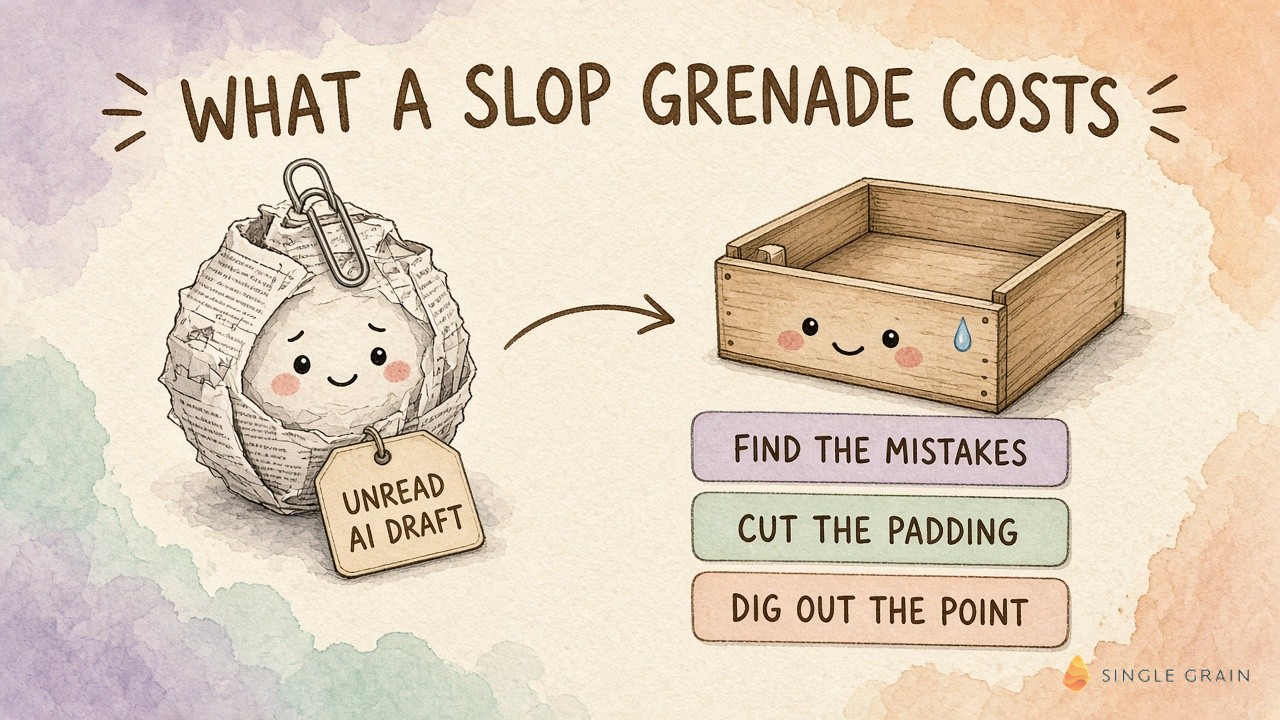
These three chores are the hidden price of every unread hand-off. Point the same grenade outward, and the damage gets bigger.
The Cost Moves to Your Audience
Inside a company, a slop grenade wastes a coworker’s hour. Aimed at your audience, it costs trust, and I learned this on my own feed. Here’s how I described it in my X article on making the open-source agent OpenClaw stronger.
“I was posting AI slop for the first 2 weeks before building this gate. The difference in engagement was immediate.”
Search engine optimization (SEO) feels it too. Google’s guidance treats mass AI text with no human oversight as low effort, which is a big part of my answer on whether AI content is bad for SEO. Older pages carry the same risk, and an AI-optimized content audit is how I’d find slop already sitting on a site.
The Cost Moves to Your Business
Agencies face a bigger version of this risk. I made the point in my X article on services-as-software.
“If all you do is take the same agency model and bolt AI onto it, you get faster decks, cheaper reports, more blog posts, more ad variants, and the same fragile business underneath. Congrats. You built a blender for agency slop.”
Volume without judgment is easy to sell for a quarter and hard to keep for a year. Clients stay for qualified leads and rankings, and slop works against both.
Knowing the cost is half the job. The other half is making the throw expensive, which is where my rule comes in.
My 10-Business-Day Review Rule
This is the exact rule I posted on X.
“To prevent slop grenades from exploding everywhere in your org, add a rule that says if a leader receives a slop grenade, they won’t review your work for another 10 business days + you’ll receive a warning.”
The rule flips the math. Reading your own draft takes minutes, while waiting two weeks for feedback hurts far more. Once the penalty is clear, checking your work before you hit send becomes the obvious move.
It also protects your best reviewers. Leaders and editors catch most grenades, so their time is the time you most want to defend.
How to Roll Out the Rule in 4 Steps
Here’s how I’d introduce it in four steps, so nobody gets blindsided.
- Write down what counts. Share the slop grenade definition above with two or three real examples from your own team, with names removed.
- Set the bar for a hand-off. Anything AI helped write should arrive read, fact-checked and trimmed, with a line on what the sender verified.
- Give one warning first. The first grenade earns a warning, and a repeat earns the ten-business-day wait on reviews from that leader.
- Apply it to leaders too. If a manager forwards unread AI output, the rule covers them, or nobody will take it seriously.
Keep the tone light when you announce it. The goal is a team that reads its own work, and the warning gives everyone a fair first chance.
| Pro-Tip |
|---|
| Ask everyone to add one line at the top of any AI-assisted hand-off saying what they checked and what they changed. If they can’t write the line, they haven’t read the draft. |
A rule catches grenades after someone throws them. A scoring gate stops most of them before they leave the building.
How to Avoid AI Slop With a Scoring Gate
The fastest way to avoid AI slop is to make the agent grade its own work before a person sees it. I run two layers, and each one catches a different kind of slop.
My Expert Panel Gate
In the same OpenClaw article, I described the gate I built after those two weeks of slop. Every piece runs past a panel of five simulated industry experts, and each expert scores it from 0 to 100 on relevance, originality, data quality and voice match.
“Score below 75? Killed. Never posted. Rewrite or move on.”
The bar is high on purpose. In one batch, the panel killed six of seven video clips, and only one crossed the threshold. I called it “the right ratio,” because each of those six clips would have been a slop grenade aimed at my audience.
My Humanizer Rubric
The second layer checks how human the writing sounds. My open-source humanizer scores every AI draft out of 100 against twenty-four AI writing patterns from Wikipedia’s Signs of AI writing guide. My prompt for it tells the agent, “Under 90, rewrite the parts that lost points and score it again.”
It flags banned words like “delve,” vague credit to unnamed experts and stock closing lines. It also catches my least favorite habit, a sentence that tells you what something isn’t before it says what it is.
How My Team Runs This at Single Grain
At Single Grain, the same idea sits in front of my editors. My list of Grok Bot use cases includes a content gate that scores each draft for duplicate pages, invented stats, weak evidence and AI tells before it moves. A separate Copy Humanizer rewrites drafts so they sound like a person wrote them and shows every change.
Once the bots handle word-level cleanup, my editors spend review time on facts and the offer. Those decide whether a post earns rankings and consult requests.
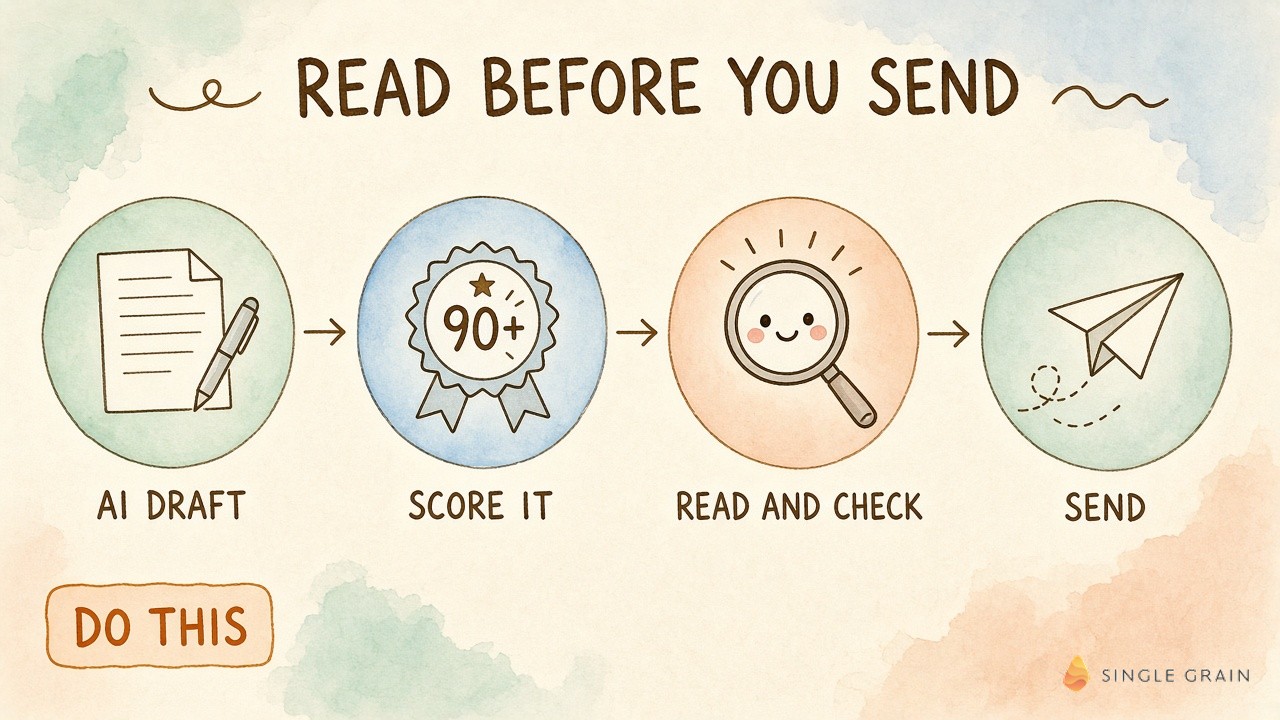
Score first and read second, then send. Save a pre-send prompt with your other reusable AI prompts so the check runs every time.
| Starter prompt for a pre-send check |
|---|
| Before I send this, list every factual claim with its source and flag any claim you can’t verify. Cut the draft to the shortest version that still makes my point, put the main point in the first sentence and show me every line you changed. |
A prompt like this one shrinks the draft before a human opens it. You still read it yourself, and now the read takes a few minutes.
Make Read-Before-Send Your Team’s Default
AI made output cheap, so judgment is what your team sells now. Give slop grenades a name, put a price on throwing one and score every draft before a person reads it.
Want help building a content engine with quality checks baked in? My team runs AI-powered content marketing and SEO services, and a forward deployed marketer can set up this kind of review loop inside your workflow. Talk to Single Grain about your content program.
Frequently Asked Questions About Slop Grenades and AI Slop
-
What is a slop grenade?
A slop grenade is AI-generated work, like an email, report or code change, that someone hands to a coworker without reading or checking it. The sender saves time, and the person who receives it has to find the mistakes, cut the padding and figure out the point.
-
Who came up with the term slop grenade?
Shopify cofounder and chief executive Tobi Lütke made it popular on The Knowledge Project podcast with Shane Parrish, released September 15, 2026. He said it’s what people at Shopify call AI output that gets tossed at colleagues without being reviewed.
-
What is AI slop?
AI slop is content made with generative AI that feels low in effort, quality or meaning, usually produced in high volume. “Slop” was the 2025 Word of the Year for both Merriam-Webster and the American Dialect Society.
-
What is the AI slop meaning at work?
At work, AI slop is any AI output a person hasn’t read, checked and improved before it reaches someone else, such as an unchecked deck, a blog draft with an invented stat or a padded client report.
-
How do you avoid AI slop on a marketing team?
Make the agent score its own drafts before a person sees them, then have a person read and fact-check before anything is sent. I use an expert panel that kills drafts under 75 and an open-source humanizer that scores every AI draft out of 100, with a rewrite for anything under 90.
-
Does AI slop hurt SEO?
Mass AI text published without human oversight works against you, because Google treats it as low effort. I go deeper in my answer on whether AI content is bad for SEO.