

What If Your Content Agent Could Only Cite Sources You Already Trust?


At the content desk, an SEO editor opens an agent’s draft and follows its strongest citation. The link leads to an affiliate blog the brand would never endorse. This illustrative failure starts before the first sentence: the retrieval job accepted a source that should never have entered the evidence packet. Pair allowlists with the citation playbook in how to earn ChatGPT citations with digital PR. Harden fetch surfaces with technical SEO for LLM scrapers.
In Eric Siu’s September Leveling Up discussion, the starting material is closer to the business: company content and internal conversations, including customer calls. A bot pulls from that material to surface content ideas. The operational question is which parts of that company context may support a public claim, and which must remain internal.
TABLE OF CONTENTS:
- Quick Overview
- Why an eval harness is not a source allowlist
- Worked scene: the draft that cited a random blog your brand would never endorse
- Worked scene: allowlist tiers (must-cite, may-cite, never-cite)
- Source-allowlist checklist (tiers, owners, refresh, block)
- Single Brain installs the system; Single Grain runs it when you need the team
Quick Overview
A retrieval source allowlist defines the evidence a content agent may use. It needs rules for domains, documents, permissions, freshness, and individual claims. An eval harness can test the resulting work, but it cannot substitute for those admission rules. Start with a narrow content job and an accountable source owner before expanding retrieval.
- Require approved evidence for product, pricing, and customer claims.
- Separate sources that inspire an idea from sources that can support publication.
- Block disallowed material before it reaches the drafting context.
- Preserve uncertainty when the admissible evidence is thin.
Why an eval harness is not a source allowlist
The distinction is scope. Single Grain’s marketing-agent eval harness covers broader quality tests: whether a job meets its criteria and whether its output is fit for the next step. This page governs an earlier boundary: which evidence is admissible in the first place.
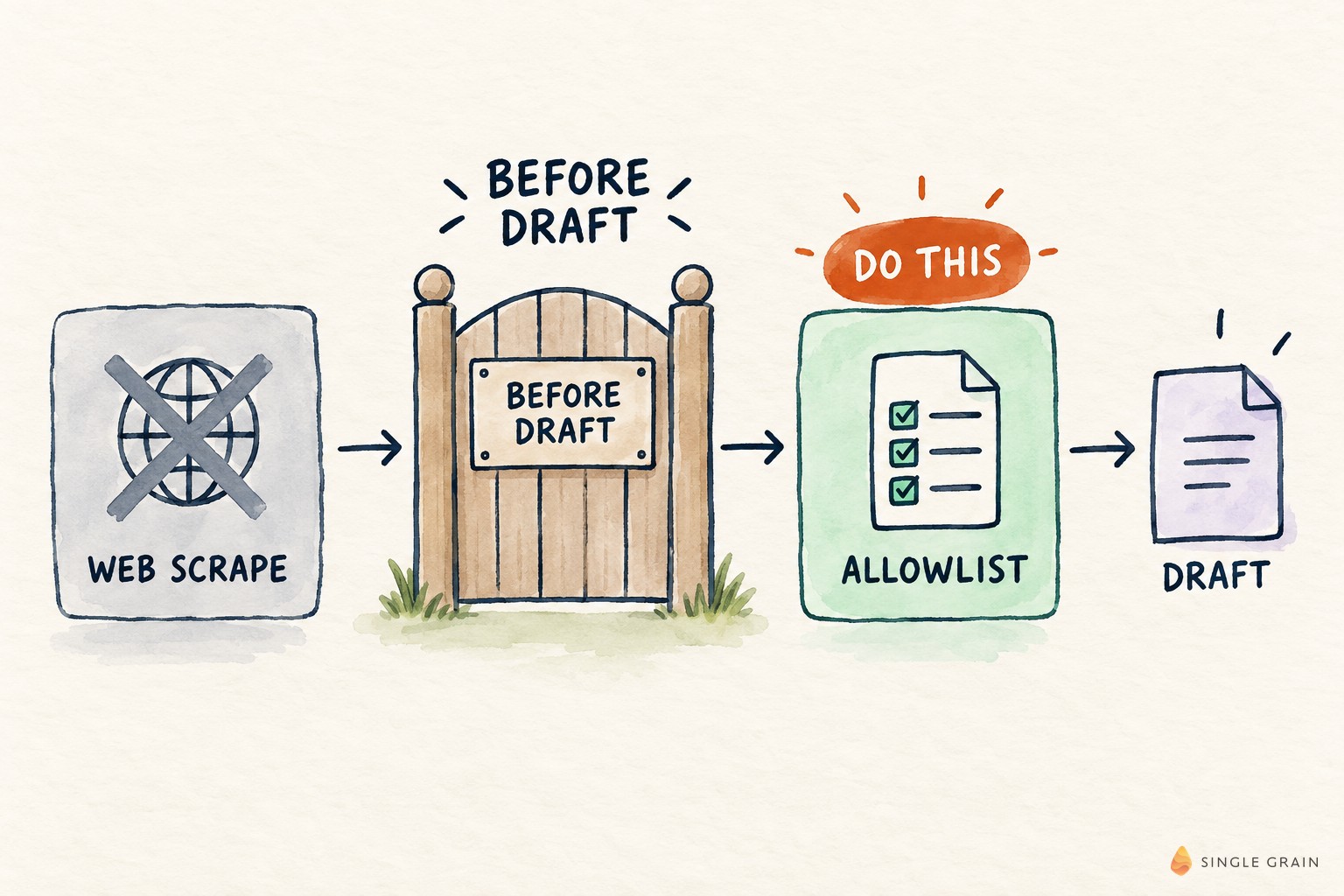
A draft can be readable, relevant, and correctly formatted while citing a prohibited source. Conversely, an approved document can be outdated or irrelevant to the claim. Source admission and output evaluation therefore need separate controls. Run the allowlist at retrieval, then check whether each material claim actually follows from the admitted evidence.
In Eric’s discussion of better models and better workflows, the recommendation is practical: model capability does not repair a missing workflow. Do not buy a stronger model to compensate for absent source IDs, permissions, or expiration fields. Build that schema first.
The Open Future Forum September 2026 report says 81% of 230 marketing and growth leaders are past exploring agentic AI. It also identifies attribution as the most-named challenge, appearing in 20 of 96 open answers. Those findings support investing in traceability, not assuming that wider adoption proves content agents are reliable.
Worked scene: the draft that cited a random blog your brand would never endorse
Return to the illustrative SEO draft. Its job is to explain a product capability using an owned product document and approved research. The retriever also finds an affiliate article repeating an unsupported comparison. Because the article shares the target keywords, it enters the context and becomes the draft’s strongest-looking citation.
Deleting the hyperlink leaves the contaminated claim behind. The useful repair happens upstream: reject the affiliate source, remove the dependent assertion, and rebuild the evidence packet from admissible documents. If no approved source supports the comparison, omit it or mark the evidence gap in the internal brief.
Eric’s company-brain content discussion supplies the better starting point. The bot pulls from company content and internal conversations; customer calls can reveal the next useful content idea. What this gives the team is business context. It does not automatically make every call transcript publishable evidence.
Translate that distinction into two permissions: “usable for ideation” and “citable externally.” A customer question may shape the brief while the approved product document supports the answer. Single Grain’s company-brain approach becomes more useful when that context carries source rules and freshness metadata rather than becoming an infinite dump.
Worked scene: allowlist tiers (must-cite, may-cite, never-cite)
For the second worked scene, give a brand-content agent an owned product brief, approved research domains, and a legal exclusion list. Its assignment is an SEO article explaining where the product fits. The tiers determine which evidence can support each part of the draft.
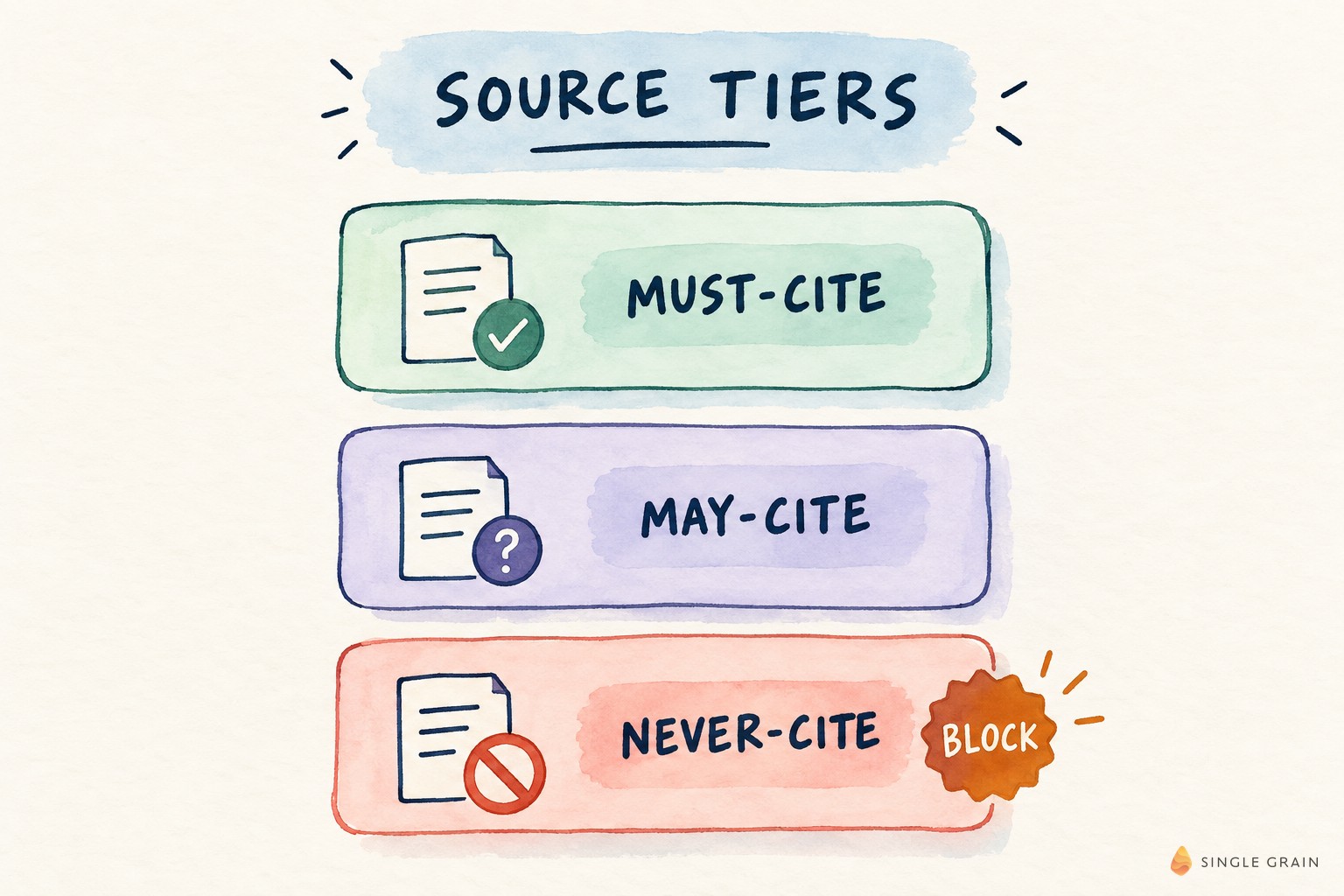
“Must-cite” means a claim requires a designated authority. A product capability needs the current approved product brief. A customer outcome needs a released case study with permission for that use. Requiring these sources prevents the agent from replacing authoritative records with convenient summaries.
“May-cite” includes approved research when it directly supports the claim. Approving a domain does not approve every page, methodology, or date on it. “Never-cite” covers competitor rumor blogs, unvetted affiliate posts, revoked documents, and confidential material prohibited from external use. Apply exclusions to retrieved chunks as well as visible citations.
The agent finds the Open Future Forum adoption figure. It may use that evidence to explain why operational controls deserve attention. It may not turn the figure into a claim about citation accuracy or brand safety. The chart below keeps the reported measure and denominator explicit.
Eric’s decision-layer discussion reinforces the next rule: evidence can be thin, and checks should improve through feedback. Keep a missing-evidence label attached to unsupported claims. Record why a source was rejected so the policy improves without silently widening access.
Source-allowlist checklist (tiers, owners, refresh, block)
Make the policy executable. A domain list in a prompt is too easy to bypass through cached snippets, redirects, or copied passages. Store the policy alongside the retrieval configuration and return source metadata with every accepted passage.
- Define the job: article type, intended audience, permitted claims, and required evidence.
- Register each source: canonical URL or document ID, tier, owner, version, access scope, and permitted use.
- Set refresh rules: review when products, permissions, research, or policies change. Expired records leave the eligible set.
- Enforce blocks: check document-level exclusions after domain matching and prevent rejected content from entering drafting context.
- Preserve provenance: connect each material claim to the supporting passage and source version.
The OWASP Top 10 for LLM Applications identifies sensitive-information disclosure and unbounded consumption as risks. Treat retrieval restrictions as security controls too: enforce access permissions, limit fetch depth and volume, and treat retrieved text as data rather than executable instructions. An allowlist alone does not solve prompt injection.
Keep one explicit human ship gate. Eric’s Jev discussion supports classification, criteria testing, and routing uncertain cases; his people-and-workflows discussion preserves taste and review. Name the accountable content editor in the job configuration. That person chooses ideas for drafting, resolves uncertain evidence, and authorizes publication, irreversible writes, and teardown. Do not give the drafting agent those permissions.
Success means material claims have admissible support and prohibited sources stay outside the evidence packet. Use Single Grain’s claim-consistency guidance to keep those supported claims aligned across downstream assets, and apply brand equity citation hygiene for LLMs when attribution drifts.
Single Brain installs the system; Single Grain runs it when you need the team
Single Brain is the AI implementation OS for job-specific agents, eval, and kill switches. For this job, the installation connects the source registry, retrieval filters, evidence records, and revocation controls. The broader eval harness tests output quality; the allowlist owns evidence admission.
Walk away from automation when the team cannot identify an authoritative source, assign an owner, or establish usage rights. Fix those inputs first. A stronger model is the wrong purchase when the missing component is a source schema.
Hire Single Grain to install and run the workflow when you need the operating team without staffing it yourself. Bring one content job, its approved documents, and its exclusion list. Contact Single Grain to scope the system around that boundary.