

How to Find the Best Instagram Hooks With Jev and Meta Muse Before You Spend


Instagram hooks are the first line or first second that stops a scroll, and I used to lose the best ones in my saves folder. Dozens of bookmarks, zero system. So I started using Jev to scan the people I bookmark on Instagram and use it to scrape their hooks, offers, and creatives with Meta Muse, and I’m honestly hooked on it.
The way I organized the scrape was a hooks ledger, one shared sheet where every saved hook gets a row and a score. Below, I’ll show you how to find the best Instagram hooks with a five-step route that fills that ledger, how to score them against your own winners, and how to keep the loop running every week.
TL;DR
- Instagram hooks are the opening line or moment that earns the next second of attention. The best ones usually sit unused in your saves folder until someone turns them into a row you can score.
- Jev routes your bookmarks into keep, merge, or drop. Meta Muse then extracts the hook, offer, and format from each kept post so you study patterns instead of copying words.
- Every hook becomes a scored row before any spend. You compare it with your past winners and only brief the ones that pass.
- Start with ten saves this week. Run them through the route and brief only the rows that clear the score step.
TABLE OF CONTENTS:
- What Is an Instagram Hooks Ledger?
- Why Your Best Instagram Hooks Die in the Saves Folder
- How Jev and Meta Muse Split the Work
- How to Find the Best Instagram Hooks in 5 Steps
- Test Jev Against Your Past Content Decisions First
- Steal the Offer Behind the Hook Too
- A Weekly Rhythm That Keeps Hooks Fresh
- 4 Mistakes That Break the Hook Ledger
- Turn Instagram Hooks Into a Testing Engine
What Is an Instagram Hooks Ledger?
Instagram hooks are the first line, visual, or sound that makes someone stop scrolling. An Instagram hooks ledger is used to collect those hooks in one place, with the offer, format, and source next to each one, plus a pass or fail score against what already worked for you.
That score is what makes it useful. A saves folder tells you what felt good, while a ledger tells you which angles are worth paying to test.
Two tools keep my ledger full. Jev sorts my saved posts first, keeping fresh hooks, merging near-duplicates, and dropping anything off-topic. Meta Muse, Meta’s AI creative assistant, then pulls the hook, offer, and format out of each kept post so the row writes itself.
If you’re a creative or performance lead who bookmarks strong posts all week and loses them by Monday, this gives you angles you can fail on paper before you buy media.
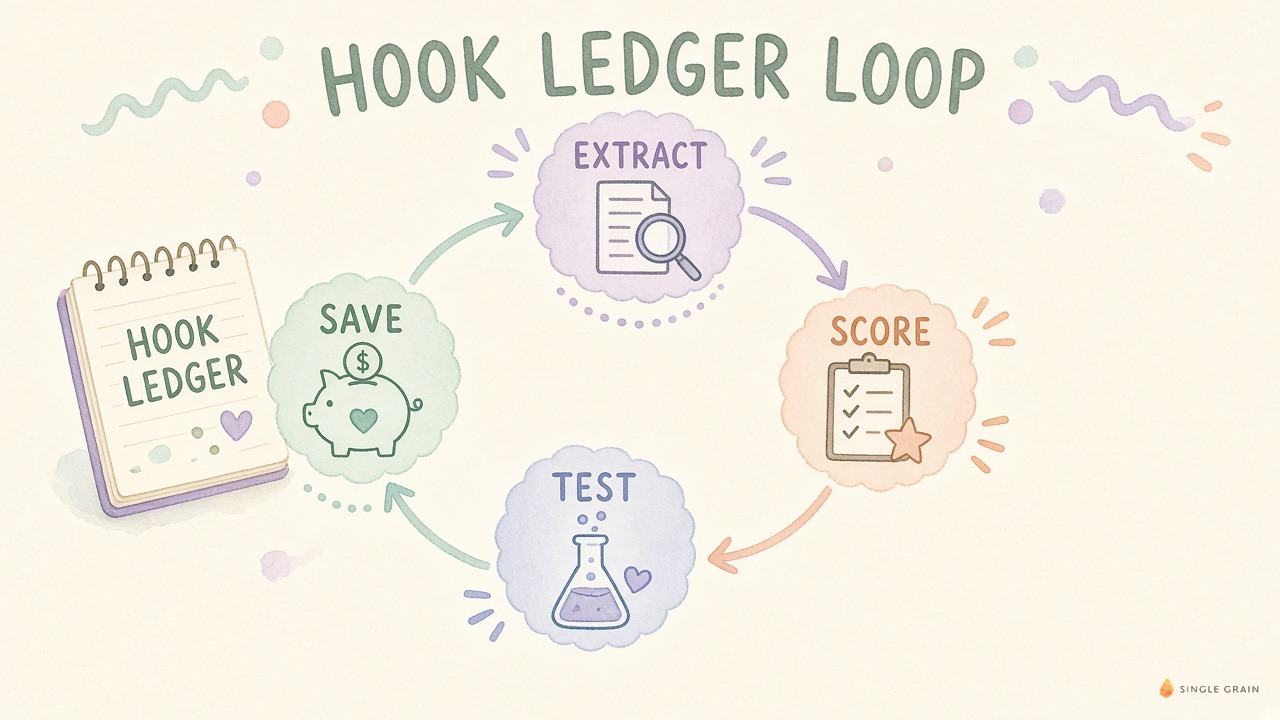
Each step in the hook ledger loop hands a cleaner row to the next one, so nothing reaches your media plan without a score.
Why Your Best Instagram Hooks Die in the Saves Folder
Saving a post feels like research. Without a ledger, it’s delayed forgetting. A hook that made you tap save rarely survives into a brief unless someone types it into a row with a score and a next test.
When you copy a hook as a vibe, it doesn’t work either. “This felt punchy” fails as a field anyone can test. A useful row holds five things.
- Hook line. The first-line claim or tension, copied cleanly.
- Offer shape. Discount, demo, free tool, proof, urgency, or something else.
- Format. Static, carousel, short video, or UGC style.
- Source. The bookmarked account and the save date.
- Score. Pass, fail, or needs a human taste call.
Format matters more than most teams think. Meta reports that more than 50% of time spent on Instagram is on Reels, and that a hook using both visual and sound is 1.5 times more likely to rank in the top 20% for purchase intent. Logging format next to the hook lets you see which ones carry.
| Pro-Tip |
|---|
| Add a format column before you add anything else. A strong line in a static post and the same line in a Reel are two different tests. |
How Jev and Meta Muse Split the Work
Think of Jev as the bouncer and Meta Muse as the analyst. Jev filters junk, duplicates, and off-category saves before anything costs money. Meta Muse then breaks each kept post into hooks, offers, and creative patterns.
On a Marketing School episode with Neil Patel, co-founder of NP Digital, I showed Meta Muse doing exactly that with short-form formats. I asked it to study Ryan Deiss’s videos and rebuild the patterns as a table.

It came back with each format on the left, Ryan’s version in the middle, and my topics plugged into his patterns on the right. You can see Degree in N, Bad/Better/Best, Tier List, and “If I wanted…” laid out row by row.
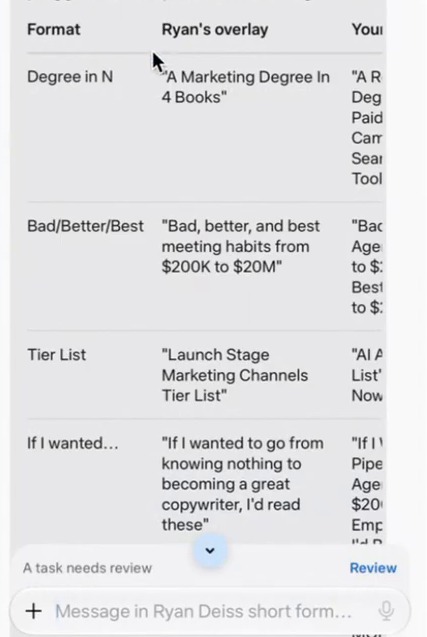
That table is the shape every saved hook should end up in. Once a hook sits in a row next to its format, you can reuse the pattern instead of copying the words.
How to Find the Best Instagram Hooks in 5 Steps
Here’s the route my team runs. Each step hands a cleaner set of rows to the next one, so nothing expensive happens until the junk is gone.
1. Collect Your Bookmarks Into One Queue
Export or sync your Instagram saves into a queue Jev can see. Keep three fields at first: the hook text, the offer family, and the source post URL.
2. Let Jev Keep, Merge, or Drop Each Save
Jev labels every row. Keep means the hook is distinct from your ledger. Merge means it’s a near-duplicate of an existing row. Drop means it’s off-ICP or unclear, and uncertain rows go to a human pile.
A few saves should never get routed at all.
- Aesthetic posts with no clear hook line.
- Offers your business can’t fulfill.
- Creatives that depend on a face or trademark you don’t own.
- Angles you already killed last month.
Nothing goes to Meta Muse until the keep set is locked.
3. Extract Hooks, Offers, and Formats With Meta Muse
Meta Muse pulls each kept post into structured rows. Ask for the hook line, the offer shape, and the format, then have it map the pattern onto your own topics like the Ryan Deiss table above.
4. Score Each Hook Against Your Past Winners
Compare every row with hooks that already worked or flopped for you. Score hook clarity, offer match, and brand safety. Skip this step, and you’ve just built a prettier mood board.
5. Send Only Passing Rows to a Creative Brief
Pick one recommended row as the weekly test candidate. Crossed-out rows stay in the ledger, so nobody re-saves the same idea next week.
| Starter prompt for an Instagram hook ledger |
|---|
| From these saved Instagram posts, extract the hook line, offer shape, and format for each one. Label each row keep, merge, or drop against my existing ledger, and flag anything uncertain for a human. Then map each kept hook pattern onto my topics: [list topics]. |
Once the rows exist, the next job is proving the scores mean something.
Test Jev Against Your Past Content Decisions First
I don’t trust a new scoring agent with fresh calls until it matches old ones. That’s why I test the Jev work in Meta Muse against my past content decisions before letting it judge new hooks.
- Gather previously reviewed ideas.
- Keep the original briefs and decisions.
- Set aside a group you won’t use to shape the questions.
- Have the agent judge that group.
- Inspect disagreements with your reviewer.
One warning I always give my team: Matching past decisions tells you the agent picks ideas worth developing. It doesn’t predict audience results, so you still need live tests.
| What You Should Do |
|---|
| Pull twenty hooks you already shipped, hide ten, and see whether Jev scores those ten the way your team did. Fix the criteria where it disagrees. |
Steal the Offer Behind the Hook Too
A great hook attached to a weak offer still loses. When I used Meta Muse to study competitor offers that have stayed live, a simple framework kept showing up.
- Promise a measurable result.
- Put a deadline on it.
- Reduce the buyer’s risk.
- Own a combination competitors haven’t claimed.
For my company, the gap was an AI-native marketing offer tied to a specific result and backed by a 90-day guarantee for enterprise buyers. Now my team has to pick a result I’m confident enough to guarantee.
Add an offer column that tags which of the four moves each saved post uses. Patterns jump out fast once twenty rows sit side by side.
A Weekly Rhythm That Keeps Hooks Fresh
A ledger only helps if it keeps moving. This cadence keeps my team honest without eating the week.
Picture the ledger as a notebook your whole team writes in, with a score next to every hook.
Keep that ledger in one shared place next to your prompt, then follow this rhythm.
- Daily. Bookmarks land in the queue automatically where possible.
- Twice a week. Run the Jev route and Meta Muse extract into new rows.
- Same day. Score each row pass or fail against your winners sheet.
- Creative standup. Only passing rows get briefs.
- Friday. Archive fails with a one-line reason, so the scoring improves.
Measure the system by angles tested per week and by how often a hot save dies at scoring. A high fail rate at scoring is healthy because it saves spend. Frequent extraction failures mean your bookmark diet needs work.
4 Mistakes That Break the Hook Ledger
Most failures I see come from skipping a gate rather than from the tools.
- Scraping before routing. Meta Muse spends effort on junk Jev should have dropped.
- No score column. Hooks get debated on taste instead of history.
- Rewriting every rule on Friday. Change one rule a week so you can tell what helped.
- Letting the agent make taste calls. Keep a person on the final yes.
If you’re weighing which model should sit behind jobs like this, start with specialized marketing LLMs for pipeline jobs. Pair the ledger with SLAs and kill switches for marketing agents so a noisy scrape can be paused in one step.
| Action Step |
|---|
| Pick your five worst hook tests from last month and check which gate would have caught them. Add that gate first. |
Turn Instagram Hooks Into a Testing Engine
Instagram hooks are cheap to save and expensive to waste. Route them with Jev, extract them with Meta Muse, and score them before money moves, and your saves folder starts feeding your media plan.
Want help testing hooks at scale? My team at Single Grain runs paid social creative testing for brands. Let’s talk about your next round of ads.
P.S. This guide started from my post on what I use Jev to scan. Instagram bookmarks were the first item on the list for a reason!
Frequently Asked Questions About Instagram Hooks
-
What are Instagram hooks?
Instagram hooks are the opening line, visual, or sound that stops someone from scrolling. A strong hook earns the next few seconds of attention so the rest of the post gets seen.
-
How do you find the best Instagram hooks?
Collect the posts you save, filter out duplicates and off-topic saves, then extract each hook with its offer and format. Score every hook against your own past winners before you test it with ad spend.
-
What do Jev and Meta Muse do in this workflow?
Jev routes your saved posts into keep, merge, or drop and flags uncertain ones for a person. Meta Muse extracts hooks, offers, and formats from the kept posts and maps the patterns onto your topics.
-
How do you know if an AI hook score is trustworthy?
Test it against decisions your team already made. Hide a group of past ideas, let the agent judge them, and review every disagreement. Matching past decisions doesn’t predict audience results, so keep running live tests.
-
How often should you update a hook ledger?
Run the route and extraction twice a week, score new rows the same day, and review wins and misses every Friday. Change one rule per week so you can see what improved results.