

How to Stop Your Content Agent From Quietly Killing the Posts That Already Rank


Should this brief open a blank draft, or touch a page that already ranks?
Put a cannibalization gate between brief intake and draft creation. Require the agent to compare the proposed reader task with existing URLs, then return merge, update, or net-new with first-pass reasons. Those reasons support a content decision; they do not establish that the overlap detector is accurate or predict a ranking outcome. Keep missing evidence visible rather than letting an empty search result become permission to write.
- Map query clusters to existing URLs before assigning a draft.
- Require URL-specific reasons, including differences that justify a separate page.
- Hold incomplete or conflicting decisions outside the draft queue.
- Reuse the same decision schema across briefs and writing models.
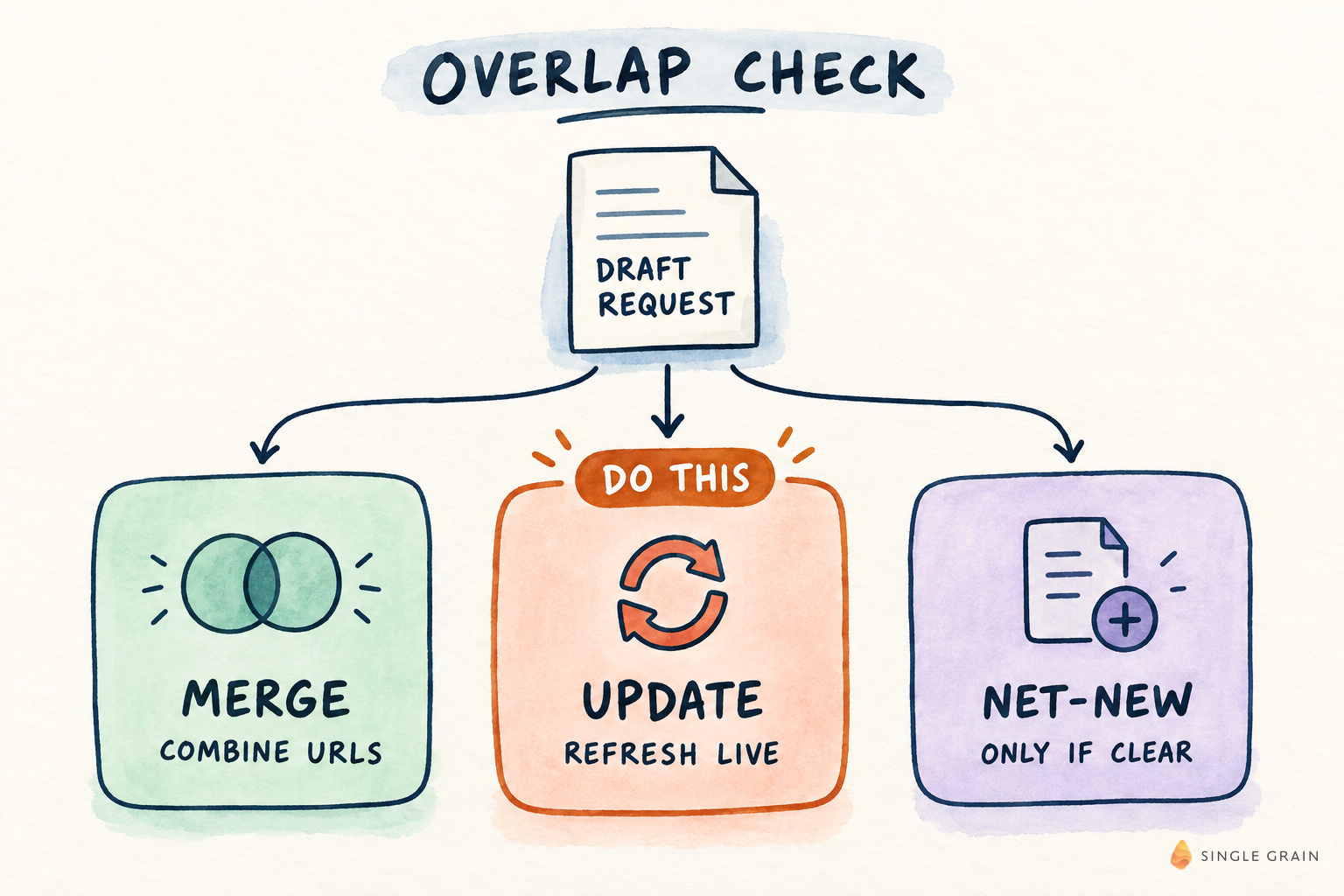
At the pre-draft queue, the SEO lead has a proposed brief, a query cluster, and an existing URL answering the same question. In the SEO/Jev short, Eric puts overlap checking ahead of drafting and frames the useful result as first-pass reasons. The failure to prevent is concrete: a content agent opens a blank document while a relevant, ranking post sits outside its context. Translate that instruction into an overlap card. Attach the proposed query cluster and reader task, retrieve candidate pages, and record each existing URL alongside its purpose. Compare the actual answer, audience, scope, and next step. A matching title alone is insufficient. The card should state the evidence directly: “This existing URL addresses the same reader task; the brief adds a missing implementation section.” That supports an update recommendation. “Both pages contain the keyword” does not. If the inventory is incomplete or a candidate page cannot be read, leave the disposition unresolved. Do not equate retrieval failure with an uncovered topic. Store editorial ownership and URL purpose alongside audience knowledge in the company brain.
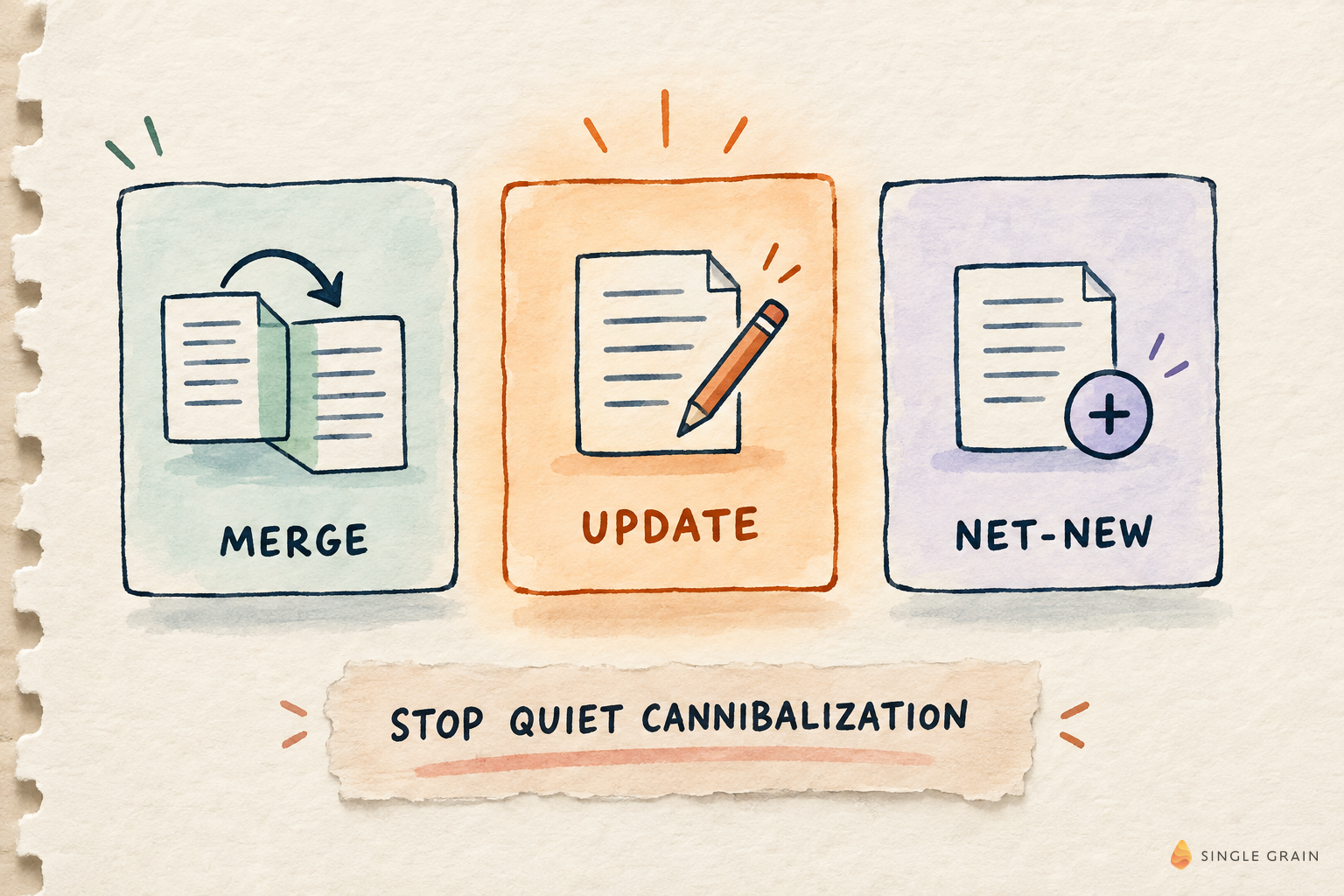
At the CMS handoff, content operations needs a different artifact from another polished draft. It needs a decision card identifying the existing URL, the intent match, and whether the assignment belongs in a merge, an update, or a net-new page. For an update, the card names the existing destination and the missing material; the agent receives the existing page as its starting artifact. For a merge, the card names the proposed destination and every source URL, with reasons for preserving particular material; do not let the writer independently retire URLs or execute redirects. For net-new, require a positive explanation of distinct intent and define boundaries that prevent the new brief from reproducing core answers already live. Eric’s discussion of Jev across inbox, CRM, outbound, and SEO/AEO makes stopping duplicate content an explicit job outcome. Define success as a resolved assignment with a justified destination, not a larger draft queue. This fits Single Grain’s multi-agent orchestration approach: retrieval and routing should constrain the writer’s job. Watch the evidence boundary when building the card. Google documents different row limits for Search Console’s interface and Search Analytics API. These are extraction limits, not cannibalization statistics:
| Evidence surface | Documented row limit | Workflow implication |
|---|---|---|
| Search Console performance report table | 1,000 rows | Do not treat the visible table as a complete URL inventory. |
| Search Analytics API request | 25,000 rows maximum per request | Account for pagination and the API’s stated data limitations. |
Use the CMS or crawl inventory alongside performance data. Even a larger query response does not establish that every relevant page has been considered.
Cannibalization checklist (query cluster, URL map, decision, human stamp)
Keep one named human ship gate: the SEO lead assigned to the brief. Eric’s Jev-for-work discussion emphasizes classification, test criteria, early testing, and routing uncertain cases. Apply that recommendation by sending ambiguous overlap cards to that owner for review. Record their name, decision, and date before drafting or CMS write access is released; the overlap result never authorizes automatic publication.
- Query cluster: State the reader task, audience, and intended next step.
- URL map: List candidates, their current purpose, retrieval coverage, and missing evidence.
- Decision: Record merge, update, or net-new with reasons for each relevant URL.
- Work boundary: Specify the destination, permitted changes, and excluded material.
- Human stamp: Retain the named owner’s disposition on the same card as the evidence.
Do not automate the decision when nobody can explain page ownership, the inventory is stale, or migrations make URL relationships unreliable. Start with manual mapping. Do not purchase a stronger writer to compensate for a missing overlap schema. First make the existing system retrieve candidate URLs and explain the proposed destination.
Single Brain installs the system; Single Grain runs it when you need the team
Single Brain is the AI implementation OS for agents, eval, and kill switches. For this job, the installation connects brief intake to URL retrieval, stores the decision schema, and blocks draft creation when required evidence or a resolved disposition is missing. Eval checks whether the workflow follows those requirements. It does not turn first-pass overlap reasons into proof of search impact. Hire Single Grain to install and run that workflow when you need the operating team without staffing it yourself. Talk to Single Grain about connecting your content queue, URL inventory, and editorial ownership before agents create more pages.