

Programmatic SEO + AI Search Visibility Playbook for B2B SaaS


TABLE OF CONTENTS:
- Quick Overview
- Why programmatic SEO fails AI visibility when evidence is optional
- Playbook step 1: inventory entities and reusable proof
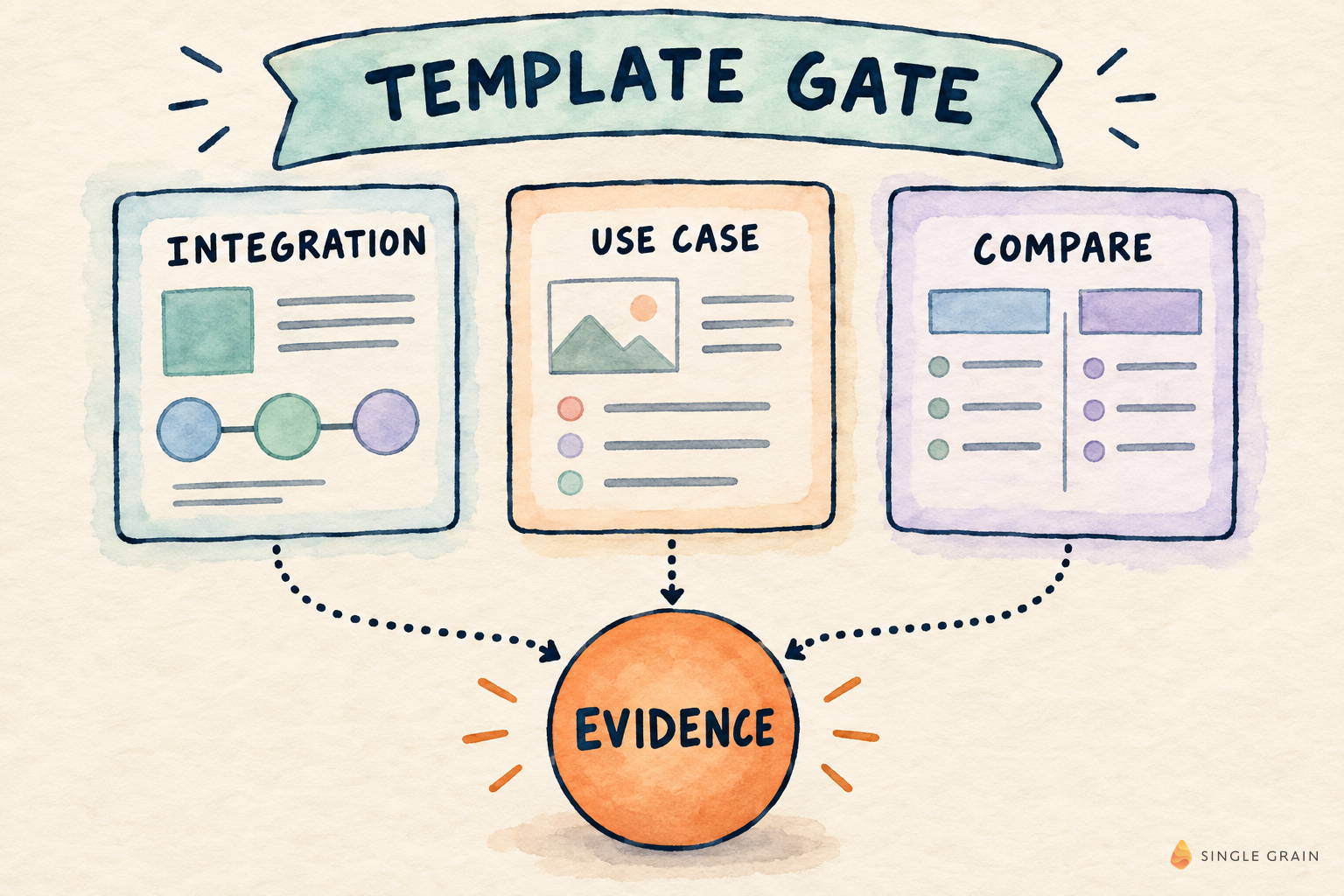
- Playbook step 2: design templates with mandatory evidence slots
- Playbook step 3: gate publish on uniqueness, not volume
- Playbook step 4: route AI Overview captures into owned briefs
- Playbook step 5: measure citations and assisted conversions separately
- A weekly operating cadence
- Failure modes to log every Friday
- Operator notes for SaaS teams already mid-rollout
- Want programmatic pages that still earn citations?
Quick Overview
This playbook is for B2B SaaS growth and SEO leads who want programmatic pages that still earn AI search citations. The job is not more URLs. The job is a template system with mandatory evidence slots, a uniqueness gate before publish, and a triage path that routes AI Overview captures into owned briefs. The mechanism is entity inventory, template design, publish gates, and separate measurement for citations versus rankings. The outcome is a smaller set of citable pages instead of a thin catalog that answer engines skip.
One recent number: when a Google AI summary was on the page, users clicked a traditional result in 8% of visits. With no summary, they clicked in 15% of visits. They clicked a link inside the summary in 1% of those visits. About 18% of the Google searches in the March 2025 sample produced an AI summary. Source: Pew Research Center, July 22, 2025.
- Inventory entities and proof you can legally reuse before you scale templates.
- Design integration, use-case, and comparison templates with required evidence slots.
- Gate publish on uniqueness checks, not row count.
- Route AI Overview captures through an owned-brief triage, not a dump into the CMS.
- Measure citations and assisted conversions separately from classic rankings.
A SaaS SEO lead opened Monday’s “integrations to ship” sheet and felt the trap. One hundred forty stubs sat ready. Partner logos were already in the brand kit. The CMS could spit out pages before lunch. The quieter truth sat in column G: most stubs reused the same three sentences with a product name swapped in. Answer engines were already skipping thin pages that could not show unique evidence, and the team was about to manufacture more of them.
Closest live work at Single Grain owns prompt triage in the AI Overview query capture playbook. This playbook owns the programmatic template system that feeds those briefs at SaaS scale. Volume without evidence creates pages that look busy in Screaming Frog and empty in ChatGPT citations.
Watch the AI search gap scene here: Eric on solid SEO missing an AI search layer.
Eric has been running the same uniqueness problem on X. Jev could help catch duplicate SEO and AEO ideas before we waste time drafting them. Ideas plus published pages go into a classifier so near-duplicates die before dens. Pair that with his note that connecting your analytics account only gives you the inputs for SEO and AEO traffic. The workflow still needs entity inventory, brief quality, and a human publish gate. For source ideas that already sound like buyers, use the same discipline as turning customer calls into SEO and AEO content ideas: pull themes, then force each programmatic template to carry proof slots before it scales.
Why programmatic SEO fails AI visibility when evidence is optional
On a Tuesday SEO standup, the same lead scrolled an AI Overview for their category and saw a competitor named with a limit table they had never published. Their own integration stubs still said “seamless sync” in three fonts. Classic programmatic SEO rewarded coverage. AI search rewarded the page that could be cited. Eric has been blunt about the same pattern in Marketing School when reviewing AI-generated growth options: solid SEO can still miss AI search unless the work is built for citations, not only blue links.
So the rule for this playbook is boring on purpose. Each template type must force unique proof into the page before a human can approve publish. If the evidence slot is empty, the page stays draft. The publish queue counts ready pages, not spreadsheet rows.
What “unique evidence” means on a SaaS page
Unique evidence is not a synonym swap. It is something a competitor cannot copy from your homepage in thirty seconds: an auth flow detail, a limit that changes buyer decisions, a workflow screenshot with your product UI, a metric definition your team actually uses, or a sourced contrast against another tool. If the only differentiator is a logo and a generic benefit list, the template failed before the LLM ever saw it.
Playbook step 1: inventory entities and reusable proof
Start with what you can legally and operationally reuse.
- List product entities: modules, plans, integrations, ICP use cases, competitor pairs you are willing to compare honestly.
- List proof assets: docs snippets, limit tables, auth notes, customer-approved quotes, workflow clips, support macros that describe real constraints.
- Mark each asset with an owner and a reuse rule. Marketing cannot invent a limit that Support will contradict next week.
- Kill entities that have no proof path. A programmatic row without evidence is a future soft 404 in AI answers.
This inventory is boring on purpose. Teams that skip it ship volume, then spend a quarter cleaning thin pages after AI Overviews ignore them.
Playbook step 2: design templates with mandatory evidence slots
Every template needs slots that block publish when empty. Use the same three families most B2B SaaS programs need.
| Template type | Must include | Skip if missing |
|---|---|---|
| Integration page | Auth flow, limits, proof snippet | Only partner logo |
| Use-case page | ICP, workflow, metric definition | Generic benefits list |
| Comparison stub | Criteria and sourced contrasts | Unverified versus claims |
Wire the CMS so those fields are required in the editorial checklist, not optional in a Notion doc nobody opens. If your stack cannot enforce required fields, keep a human gate that rejects drafts with empty slots. The gate is the product.

In that Marketing School segment, Eric looks at creative and messaging options that praise solid SEO while still calling out a missing AI search angle. Treat that as the operator warning for programmatic programs: rankings without citation design leave a gap buyers already feel in answer engines.
How managed agents fit the template loop
Once templates and evidence slots are frozen, a managed agent can draft stubs, pull approved proof, and flag empty slots. A human still owns publish. That is the same ownership pattern as managed marketing agents: the agent owns the job steps, not the brand decision. Pair the agent with your SEO services and GEO services so classic crawl health and answer-engine visibility stay on the same roadmap.
Playbook step 3: gate publish on uniqueness, not volume
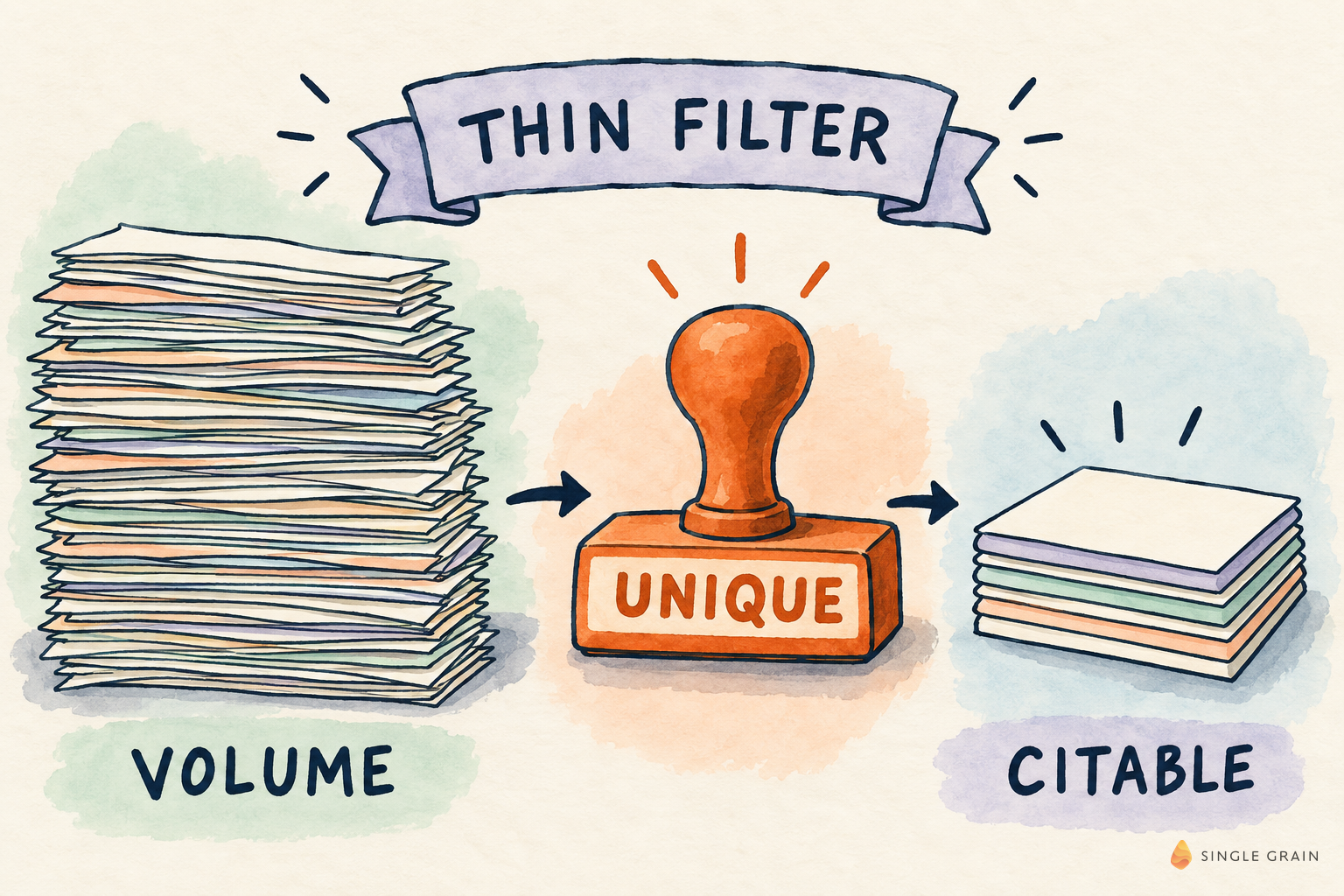
Before any batch goes live, run a uniqueness pass.
- Compare new pages against nearest prior templates for near-duplicate body blocks.
- Reject pages whose only unique token is the entity name.
- Require at least one evidence field that is not shared across the batch.
- Keep a refuse outcome. Not every spreadsheet row deserves a URL.
Thin pages do not get fixed by a clever title tag. They get fixed by refusing to publish until the evidence slot is honest. If your team needs a case study narrative later, write it as a separate owned brief, not as fluff padded into every stub.
Playbook step 4: route AI Overview captures into owned briefs
Programmatic pages feed discovery. They should not be the only place you answer high-intent prompts. When you capture an AI Overview query that your stubs cannot satisfy with unique proof, route it into the owned-brief triage from the query capture playbook. That keeps the catalog honest and the deep answers deep.
- Tag the capture: catalog fit, owned brief, or refuse.
- If catalog fit, fill the evidence slots and publish through the uniqueness gate.
- If owned brief, assign a writer and a source pack. Do not auto-expand a stub into a longform by stuffing synonyms.
- If refuse, log why. Refuse is a healthy outcome.
What not to automate yet
- Publishing comparison claims without sourced contrasts.
- Inventing auth or limit details the product team has not approved.
- Letting an agent rewrite evidence fields to “sound more unique” without a human check.
Playbook step 5: measure citations and assisted conversions separately
Rankings can rise while AI citations stay flat. Track both.
- Classic: indexation, query clusters, non-brand clicks on template families.
- AI visibility: citation mentions, share of answers on tracked prompts, assisted demo or trial paths from those pages.
- Quality: uniqueness reject rate, empty evidence-slot rate, pages later consolidated.
If uniqueness reject rate is near zero, your gate is asleep. If citation mentions stay empty while rankings look fine, you are still optimizing for a SERP that buyers are leaving for answers.
A weekly operating cadence
- Monday: freeze entity list and proof inventory for the week.
- Tuesday: generate stubs into draft only; fill evidence slots.
- Wednesday: uniqueness gate and human publish decisions.
- Thursday: route AI Overview captures into catalog, owned brief, or refuse.
- Friday: review five wins and five misses; change one template rule only.
Keep the Friday note next to the template definitions. If the note lives in a random Slack thread, next week starts from folklore again.
Failure modes to log every Friday
Pick five published pages and five refused rows. For each miss, name whether inventory, template design, uniqueness gate, or triage failed. Update one rule. Broad rewrites of the whole programmatic system every Friday are how institutional memory dies.
When an answer engine cites a competitor on a prompt your catalog should own, do not panic-publish twenty stubs. Open the evidence inventory. If you cannot point to unique proof, you do not have a page problem. You have a product proof problem.
Owners should be able to pause the generator in one step. If pause requires an engineering ticket, you do not have a kill switch yet. New teammates should shadow one full cycle before they edit template prompts. Prompt edits without cycle context recreate silent thin pages.
Store template versions next to proof versions. Mixing versions mid-batch creates pages nobody can defend later. Celebrate a shrinking empty-slot rate. That usually means better inventory, not a smarter model.
Operator notes for SaaS teams already mid-rollout
If you already published a thin catalog, do not delete everything on day one. Freeze new publishes first. Tag live stubs as keep, enrich, or consolidate. Enrich only when evidence exists. Consolidate when multiple stubs repeat the same proof with different entity names. Keep a public redirect plan so you do not trade thin pages for crawl debt.
Engineering partners often want to automate the whole generator before marketing freezes evidence slots. Resist that order. Freeze the slots, then automate. The opposite order creates a faster thin-page machine that is harder to shut down because someone will cite “velocity” as a reason to keep shipping bad URLs.
Legal and partner teams should review comparison stubs before marketing scales them. Unverified versus claims are not a content problem only. They are a trust and liability problem. Put partner-approved language in the proof inventory with an expiry date so stale claims do not linger after a pricing change.
When leadership asks for a volume target, translate it into a citable-page target. “Ship 200 pages” is a trap metric. “Ship 40 pages that pass uniqueness and earn tracked citations on named prompts” is an operating metric. Put both numbers on the same slide so the tradeoff is visible.
If your team uses agents to draft stubs, store the prompt version next to the template version and the proof pack version. When a page later looks wrong, you need to know which trio created it. Folklore about “the bot wrote it last month” is not an audit trail.
Want programmatic pages that still earn citations?
Single Grain builds SEO and GEO systems that refuse thin volume. If your SaaS catalog is growing faster than your evidence inventory, talk to Single Grain about a template gate your answer-engine visibility can trust. Start from SEO agency context or pair it with AEO services when AI citations are the board metric.


