How Can Twitter Follower Analysis Help You Find Buyers and Deals?


My own Twitter follower analysis turned up 580+ possible decision makers, and when I saw CMOs in the results, it got my attention fast.
Twitter follower analysis is the process of checking public follower profiles to find people whose role and company match what you sell. I use it to answer this question: which followers deserve a sales conversation, and which only look good on paper? If you’d rather build pipeline from the audience you already have, check before anyone reaches the CRM!
In this quick guide, I’ll share my scan results, the checks I require before a CRM handoff, and the mistakes a separate recruiting test exposed.
TL;DR
- Start with a written buyer definition. Ask the agent to explain each match using public evidence and your actual customer criteria.
- My scan produced candidates for review. Five hundred eighty-one decision makers appeared in the report; the report doesn’t establish qualified pipeline or revenue.
- Check relationship history before outreach. A HubSpot match can give the account owner useful context about an earlier conversation.
- Keep a person in charge of the next action. Verify the profile, assign an owner, and review the reason for contact before sending a message.
TABLE OF CONTENTS:
- What Twitter Follower Analysis Should Answer
- Inside My Follower Scan at Single Grain
- Write a Buyer Research Brief the Agent Can Follow in 3 Steps
- Check HubSpot Before a Sales Handoff
- Research Another Account’s Followers With Care
- Keep Buyer, Recruit, and Deal Research Separate
- Measure the Quality of the Buyer Queue
- Give Sales a Reviewed Starting Point
What Twitter Follower Analysis Should Answer
Twitter follower analysis should help you decide whose profile merits closer research. For this workflow, I care about the person’s current responsibility and whether the company could use the service you sell. After all, a follower count alone can’t answer either question.
The first step in this analysis is to write your buyer intent signals separately from your customer-fit criteria. A marketing title may support a role match. Keep in mind that following an account shows a connection on the platform, but it doesn’t establish an active project, budget, or purchase timeline.
My scan also produced recruiting and acquisition candidates. For a marketing leader building pipeline, the better move is to keep these outside the buyer queue so sales can review a coherent set of records. You can send the other categories to their respective owners after verification.
Tools enter after the research question is clear. X’s follows documentation describes endpoints for retrieving follower and following lists. Your implementation still needs an appropriate access method and usable profile evidence; an agent can’t infer missing records into existence.
With the scope written down, my own report offers a concrete place to see how the classification works.
Inside My Follower Scan at Single Grain
At Single Grain, we ran my followers through Grok Bot with Jev as the classifier, looking for possible customers, recruits, and agencies of acquisition interest. The output was a categorized report with names and role groupings.

The buyer portion showed five hundred eighty-one decision makers, led by CMOs. Recruiting results appeared in separate role categories, including SEO and paid media. This was a classification result from my account, so I wouldn’t use the count to forecast the yield of your list.
Here’s the useful part of the scene: I could inspect named matches instead of staring at a total audience size. A reviewer could then open the source profile and question the classification. A report becomes much easier to challenge when it preserves the evidence behind each row.
To reproduce the useful part of this exercise, begin with instructions a reviewer can audit.
Write a Buyer Research Brief the Agent Can Follow in 3 Steps
Your brief needs enough detail to reject a plausible-looking profile. For example, you should name the customer characteristics your business actually uses, define the acceptable evidence, and tell the agent how to handle uncertainty. Otherwise, an impressive title can dominate the whole classification.
Let me break this down a little more thoroughly.
1. Define Fit Before Scanning
Use your approved customer criteria as the input document. Include the relevant marketing responsibilities, the company characteristics you can verify publicly, and any exclusions. If company size matters but the source doesn’t establish it, leave the field unresolved.
Keep the brief specific to this sales research job. An agent reviewing acquisition candidates needs different information from an agent reviewing possible service buyers. Mixing both tasks in a single judgment makes the reason for a match harder to interpret.
2. A Prompt for Reviewable Output
The following is a proposed starter prompt for your run. It translates the checks in this guide into instructions; it isn’t a record of my original prompt.
Review the public follower profiles supplied with this request against the attached customer criteria. For each possible buyer, return the account handle, profile URL, stated role, company, supporting evidence, evidence date, and reason for the match. Separate observed facts from inference. Mark missing or ambiguous information as needs review. Keep recruiting and acquisition candidates outside the buyer output. Produce research only and wait for human approval before any contact or CRM change.
Add a rejection reason to profiles you set aside. It will help you distinguish an irrelevant account from a profile with insufficient evidence. Save the criteria alongside the output so a later reviewer knows which version guided the run.
3. Check the First Results Before Expanding
Review an initial batch manually before processing the rest of the list. Open the linked profiles and compare the agent’s reason with the written criteria. If a recurring mistake appears, revise the brief and rerun the affected records.
Pay particular attention to ambiguous titles and employers. A consultant writing about a company could be mistaken for an employee, and a former role could appear in an old bio. These are reasons to inspect the evidence rather than accept a confident explanation.
Once the labels survive a manual review, relationship history becomes the next useful input.
Check HubSpot Before a Sales Handoff
A strong profile match still needs a CRM check. When we cross-referenced my follower report with HubSpot, an earlier lead involving 6sense came up, and a growth marketing contact looked like a relevant way to reconnect.
This creates a different decision from the initial classification. A profile can fit your customer criteria while the account already belongs to a salesperson, an active client relationship, or an earlier conversation. The next action depends on this history.
Build the handoff as a research view with a profile URL, verified role, matching company record, relationship note, review status, and account owner.
Matching When Names Overlap
Pay attention to this: Match carefully when names overlap. A handle alone may be insufficient to associate a person with a CRM record. Keep uncertain matches pending until a reviewer confirms the employer and identity.
A useful handoff note explains why the person fits and what the existing relationship allows you to do next. If an account owner already has an open conversation, give the research to this owner. If the context is unclear, further research is a reasonable outcome.
My Grok Bot templates article covers related routines. Keep this run’s permissions scoped to its research job as you connect it to other systems.
Your own audience is a sensible starting point, but the same research question can apply to another public account.
Research Another Account’s Followers With Care
Scanning someone else’s audience raises its own cost questions. On a second follower scan, the agent estimated the cost of analyzing another account’s audience and proposed cutting it from twenty-five dollars to fifteen by excluding accounts with fewer than one hundred followers. This was a conditional estimate from a specific run, rather than a published price for the workflow.
The recruiting outreach from this test brought interest, along with questions about how I got people’s information. It’s a clear warning about the gap between finding a profile and having a reason to contact its owner.
Data Sources and Building Trust
I highly recommend you explain the data source honestly if you contact someone. Avoid implying a prior relationship based on a follow, especially when the person follows another account. Review X’s developer policy for the proposed use, including its privacy and automation requirements.
Next, choose the source account because its subject matter overlaps with your buyer’s work. A large audience can contain casual readers and vendors alongside possible customers. Compare the evidence quality of the resulting matches before committing to a broader scan.
The second test also shows why each category needs its own review process.
Keep Buyer, Recruit, and Deal Research Separate
Social connections serve different purposes, and I sort mine into separate customer, recruiting, and acquisition uses. You can preserve this distinction while keeping your main job focused on buyer research. A matching profile should reach someone who understands the relevant decision.
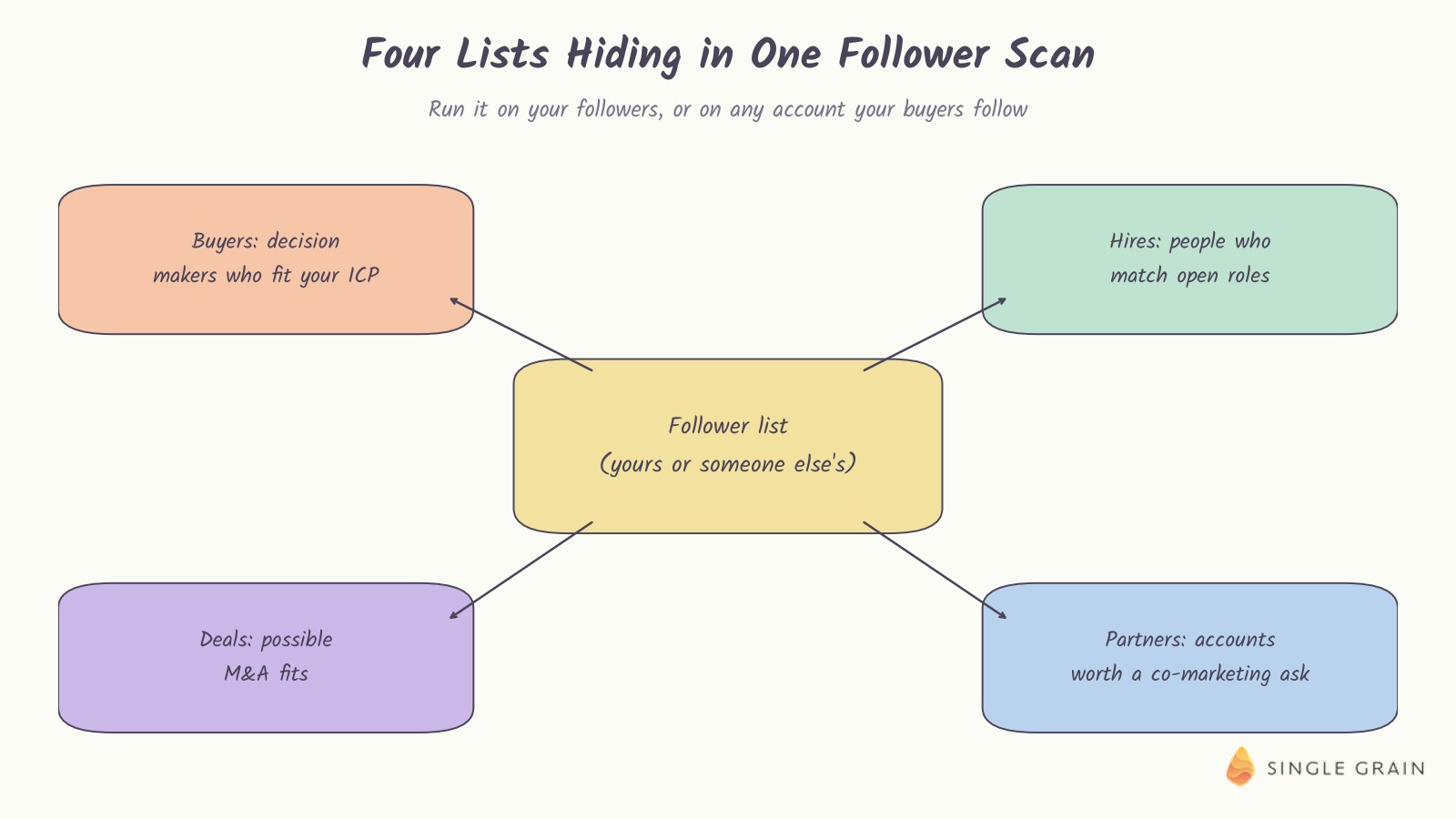
For recruiting, use the actual open role and its requirements. A topical bio doesn’t establish whether someone wants a job or can do the work. My team’s questions for AI-native hiring address a later evaluation stage once a person enters the hiring process.
For acquisition research, a founder or agency profile offers a place to begin investigation. It doesn’t establish financial fit, ownership, or willingness to sell. The corporate development owner needs separate evidence before advancing a possible deal.
For partnerships, record the audience overlap and the specific reason a joint project could help both parties. Avoid adding someone to a sales sequence simply because no separate partnership queue exists. A webinar idea and a service inquiry deserve different conversations.
I discuss related agency routines in my Grok Bot use cases. For this exercise, finish the buyer review process before adding more destinations for the output.
After the handoff, measure whether the research survives contact with real account context.
Measure the Quality of the Buyer Queue
Track how many proposed buyer matches a reviewer accepts, rejects, or leaves unresolved. Save the reason for rejection beside the original classification. This lets you distinguish a weak brief from stale source data or a mistaken identity match.
Keep accepted research records separate from qualified opportunities in your reporting. A current marketing role supports a fit judgment. A sales conversation must establish the business need before an opportunity enters your normal qualification process.
For repeat runs, preserve the source account, collection date, criteria version, and reviewed outcome. Compare newly reviewed matches with existing records before handing them to sales. Otherwise, a familiar name can look like a fresh lead each time the scan runs.
What to Do with Review Findings
Let the review findings guide content choices carefully, too. A cluster of verified marketing leaders may suggest topics to test, but the follower report doesn’t tell you which posts each person read. Check content performance separately before changing your editorial plan.
If rejected matches repeatedly share the same problem, fix the criterion responsible and review another batch. Expand the workflow when you can explain why the accepted records deserve attention. This gives the final handoff a defensible basis.
Give Sales a Reviewed Starting Point
You now know a follower scan is only a report worth investigating. The useful deliverable is a buyer queue with source evidence, relationship context, and a named owner. Start with your customer criteria and carry the uncertainty through to the review.
If you’d like help designing this workflow, explore Single Grain’s AI transformation services. For broader audience acquisition, Single Grain also offers paid social services.
Frequently Asked Questions About X Follower Analysis
-
What is X follower analysis?
X follower analysis is the process of reviewing the accounts that follow you, or another account, to find patterns such as job titles, companies, and buying power.
-
How many decision makers did the scan find?
My scan of my own X followers found 581 decision makers, led by CMOs.
-
Can I analyze someone else's X followers?
Yes. If your own following is small, scan the followers of an account your buyers already trust. One large list cost me about $15 to analyze.
-
What lists can one follower scan produce?
The same pass can flag buyers, possible hires, M&A fits, and partners.
-
Should I message everyone on the list automatically?
No. Treat the output as research to prioritize outreach and content, and keep every message to a real person in human hands.