

Astra got worse before it got better, and the fix was in your skills, not the model.



GPT-6 Astra users flooded social media with complaints the moment the model went live. Outputs felt off. Skills that ran perfectly last week started producing bloated, meandering responses.
Then OpenAI’s Thomas Sottiaux posted a reset that hit 6.4 million views, 7.9 times his usual: “Working with some of you, we have found and fixed the following issues: some skills written for previous models were triggering too often or stopping the model from checking its work.” That’s the line worth reading twice. The model wasn’t broken. Your saved instructions were misfiring against a different engine.
For anyone who built a library of saved prompts and custom skills, that distinction changes the fix entirely. You don’t need a new model. You need to re-test the prompts you already have.
This guide walks through why GPT-6 Astra broke your existing prompts, how to diagnose which skills are misfiring, and the re-test process that restores output quality without switching models.
TABLE OF CONTENTS:
What is GPT-6 Astra?
GPT-6 Astra is OpenAI’s latest model release, launched in September with dramatically improved instruction-following and built-in verification loops.
The upgrade changed how the model interprets saved skills and custom instructions.
A skill that told the old model “always structure your answer as a numbered list” might now trigger on every single response, even when a paragraph would be better. A constraint like “never speculate” might stop Astra from running its built-in verification pass, the one OpenAI specifically designed to reduce hallucinations.

Why a model update breaks old prompts
GPT-6 Astra processes instructions differently than its predecessor.
The over-trigger problem
Astra’s instruction-following is more literal.
A skill with five rules written loosely for GPT-4o might now fire all five rules on every turn, even when only one applies.
The output balloons. You get 800 words when you needed 200.
The self-check suppression problem
Astra has a stronger internal verification loop.
But some legacy instructions accidentally override it. If your skill says “respond immediately without caveats,” Astra interprets that as “skip your own quality check.”
The output arrives faster and worse.
That is exactly what Sottiaux described: skills written for a previous model were the thing misfiring, not Astra. Treat every model upgrade as a prompt-migration event. Test, repair, version, then go live.
How to re-test a skill
The quality drop came from old skills colliding with new model behavior. The fix is a structured re-test of every saved prompt before you trust it again.
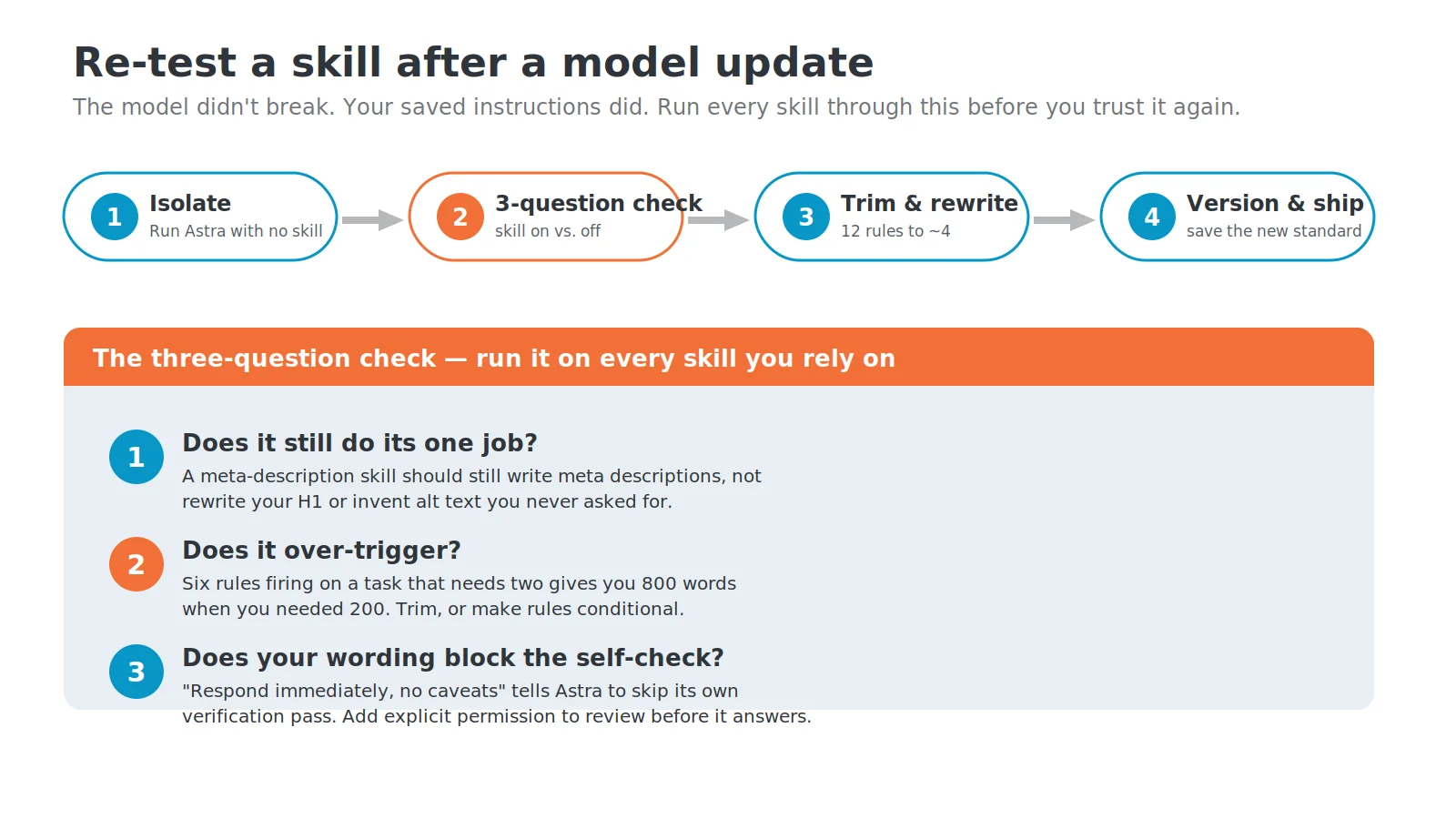
Step 1: isolate the skill
Run Astra with zero custom instructions first.
Give it the same task your skill handles. Save the raw output as your baseline.
Now turn the skill back on and run the same task. Compare the two outputs side by side.
If the skill-on version is worse than naked Astra, the skill is the problem.
Step 2: check the three failure modes
Every re-test should answer three questions:
- Does it still do the one job you wrote it for? If you built a skill to write meta descriptions, it should still produce meta descriptions without rewriting your H1 or suggesting alt text you didn’t ask for.
- Does it over-trigger or add steps you didn’t request? Count the instructions in your skill. If you have six rules but Astra applies all six to a task that only needs two, trim the skill or add conditional logic (for example, apply rule 3 only when the input is longer than 500 words).
- Ask Astra to critique its own output after the skill runs, and if your skill’s wording blocks that self-review, rewrite the constraint.
Pair every prompt update with a verification step. When a skill stops suppressing the model’s self-check, the regressions that usually surface during an upgrade get caught before they reach a page.
What operators are actually shipping with Astra
On the same day as the quality reset post, Sottiaux listed the week’s Astra-powered launches: Images 2.5, GPT-Live-1, Agents API, Data Agent, and ChatGPT for Financial Services, “and yet it is not yet DevDay.”
Ethan Mollick tested Astra’s ceiling by having it one-shot an Ultima-style RPG with agent feedback.
Strong on complex interlocking systems, weak in places. That’s a fair summary of where Astra sits: the ceiling is dramatically higher, but only if your instructions don’t drag it back down.
Eric Siu runs Astra skills every day: a shortform format scanner, a lead-leak audit, a drafting loop. Every one was written against a specific version of the model. When the model underneath a skill changes, the skill is what needs re-testing, not the model.
Eric walks seven of these Astra jobs, and the feedback he gives to fix each one, here:
A prompt regression checklist for any AI model update
This checklist works for GPT-6 Astra and for the next model after it.
Every AI model update will break some percentage of your saved instructions. Build the habit now.
Before you trust the output
- List every saved prompt and custom instruction you use in production, and if you can’t list them, you can’t test them.
- Test each skill on and off with the same input and keep the outputs.
- Determine if the skill improved the output or made Astra worse than its default, and if it’s not clearly better, disable it until you rewrite.
After you rewrite
Trim instructions to the minimum.
Astra follows directions more precisely than older models, so you need fewer guardrails. A skill that was 12 rules for GPT-4o might need 4 for Astra.
Add explicit permission for self-review. Something like: “After completing the task, review your output for accuracy before presenting it.”
This one line restores the verification loop that overly restrictive skills suppress.
If you’re stacking AI tools across your marketing, this matters even more. Astra’s self-check is what catches a hallucinated fact before it reaches your published page.

Treat every model upgrade as a prompt-migration event
The pattern repeats with every upgrade.
New model ships. Old prompts misfire. Users blame the model.
The actual fix sits in the instructions they wrote six months ago for a different engine. We’ve seen it with AI marketing workflows across multiple model generations now.
Build a skills practice. Every time a model updates, block 90 minutes to run your top 10 skills through the three-question check.
Trim what’s bloated. Rewrite what’s suppressing self-review. Delete what no longer helps.
If you’d rather not audit every skill yourself, Single Grain’s AI SEO team runs the kind of prompt-level and content-level checks described above, so your Astra-powered workflows produce output worth publishing.


