Speed-to-Lead Agents: Call Every Inbound Lead in 60 Seconds


At the moment a website form lands in the CRM, the revenue operations owner has a timestamp, a phone number, and a routing decision. The first-minute clock is running. If the record sits in an unowned queue, a polished voice agent cannot rescue the missing assignment.
The artifact to inspect is the lead record: consent evidence, account owner, call eligibility, and a destination for the outcome. A sales rep opening that record needs to see what happened and what to do next, without replaying an entire conversation.
TABLE OF CONTENTS:
- Quick Overview
- Why the first-minute response is a workflow, not a voice demo
- Worked scene: form fill to call to human handoff
- Worked scene: turn conversation into the next step
- Consent, routing, and measurement checklist: the human approval gate
- Single Brain installs the system; Single Grain runs it when you need the team
Quick Overview
This page is for revenue operations and sales leaders who want inbound leads called in the first minute without buying a voice demo first. The job is a timed call workflow: detect the form, check consent and eligibility, resolve the owner, place an allowed call, and write a next-step record. The mechanism is a bounded webhook-to-call path with duplicate suppression, eligibility gates, and a structured handoff schema. The outcome is an operable first-minute response system measured by eligible attempts and accepted handoffs, not connection promises or invented close rates.
- Build the timed call job and ownership before buying a convincing voice agent.
- Treat 60 seconds as a design target for eligible first attempts, not an SLA or close-rate claim.
- Require consent evidence, routing, and a dispositioned next step on every run.
- Score structured handoff completion alongside call attempts.
- Keep live calling disabled until RevOps, compliance, and sales accept the gate.
Why the first-minute response is a workflow, not a voice demo
In Eric’s Marketing School discussion, the concrete example is straightforward: every lead gets a call within 60 seconds, and a bot can make that call and sound good. The same beat lands again on the full episode at 37:59 (“Haggle bot and speed-to-lead in 60 seconds”). The operational consequence is to build a timed call job with a handoff. Buying a convincing voice before fixing eligibility and ownership reverses the work.
Treat 60 seconds as the design target for an eligible inbound lead’s first call attempt. It is not a promise of connection, a claim about close rates, or a Single Grain service-level agreement. Any contractual response commitment needs its own scope, exclusions, and measurement definition.
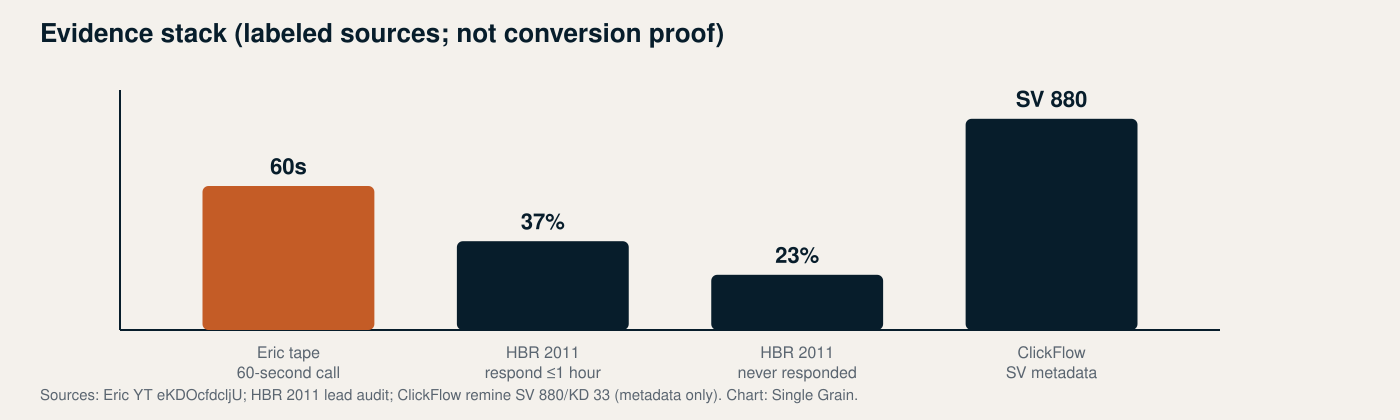
There is older, separate evidence for taking response delays seriously. HBR’s 2011 audit of 2,241 U.S. companies found that 37% responded to a web lead within an hour and 23% never responded. That study does not establish a 60-second threshold or validate today’s voice agents. It establishes that receiving a lead and responding to it are different operational achievements.
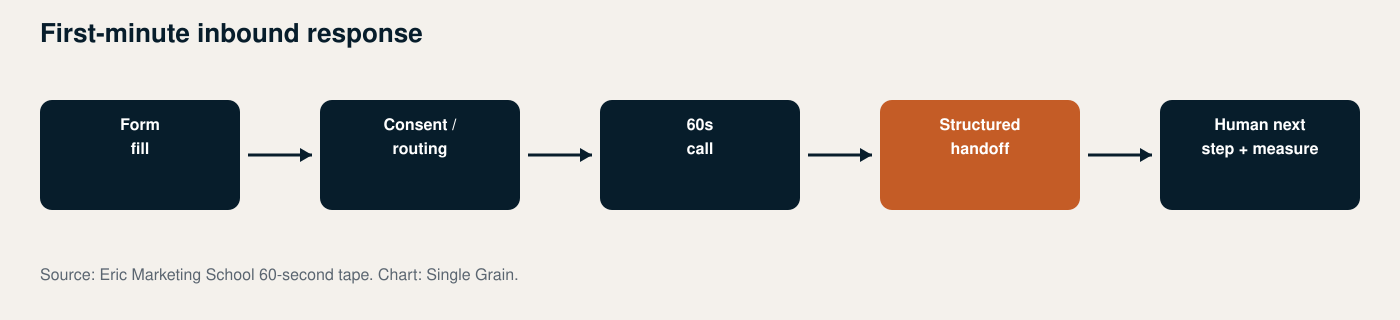
Scope the agent accordingly: detect the submission, check eligibility, resolve the owner, place an allowed call, and produce a next-step record. Anthropic’s guidance on building effective agents supports simple, composable workflows before unnecessary autonomy. Start with a bounded path that your team can inspect.
Worked scene: form fill to call to human handoff
Eric’s tape gives us the sequence’s starting point: an inbound lead arrives, a bot calls within the first minute, and the voice can sound good. The implementation below translates that example into an operating design. It is not a report of a measured Single Grain deployment.
A prospect submits a consultation form. The webhook creates a job keyed to the submission ID, carrying the server receipt timestamp, submitted phone number, form version, and consent evidence. A duplicate webhook resolves to the same job so it cannot generate a second call.
Before dialing, the workflow checks whether the available consent and applicable calling rules permit this automated call. A phone field alone is insufficient evidence. Missing evidence sends the record to a review queue or an independently permitted follow-up channel. An existing account routes to its owner; a new account follows the territory rule.
The call job receives a narrow brief: identify the business, explain the inquiry being answered, establish the prospect’s need, and offer the allowed next step. It does not negotiate pricing or make delivery promises. Start the response clock at submission receipt and stop it at call initiation, not when the CRM task was created.
The output is a disposition, an assigned owner, and either a supported next action or an explicit exception. Use Single Grain’s pipeline-agent RACI framework to assign the revenue operations owner responsibility for queue health and the sales manager responsibility for follow-through. “The agent handled it” is not an owner.
Worked scene: turn conversation into the next step
The second scene begins after the prospect answers. In this proposed continuation, the prospect asks about paid media support and wants to speak with a specialist. The call succeeds operationally only if that request becomes a usable action for the right person.
Eric’s separate discussion of handoffs makes the useful unit explicit: a conversation needs to become a clear next step. That changes the scorecard. Measure structured handoff completion alongside call attempts, rather than rewarding a dialer for producing activity.
The agent records the prospect’s stated need, requested follow-up, relevant qualification answers, and unresolved questions. It separates statements from inferences. “Asked about paid media support” belongs in the record; an invented budget or buying timeline does not. A meeting is marked booked only when the calendar integration returns a confirmed event.
The paid media lead then receives the record with the agreed action and supporting notes. If the calendar write failed, the task says to arrange the meeting. If the prospect declined further contact, the workflow records that preference and suppresses additional automated outreach according to policy. These are different outcomes, not interchangeable “completed” calls.
The historical response gap above explains why an unattended queue deserves attention. It does not supply an expected lift for this workflow. Establish your own baseline for eligible attempts, exceptions, and handoff completion before estimating business impact.
Consent, routing, and measurement checklist: the human approval gate
Appoint the revenue operations lead as the named launch approver, with legal or compliance review of calling eligibility and the sales manager’s acceptance of the handoff format. Keep live calling and CRM write access disabled until that gate is complete.
- Consent: retain the disclosure version, source, timestamp, and relevant permissions. Define jurisdiction, calling-hour, recording, identification, and opt-out rules with qualified counsel.
- Routing: resolve existing owners before territory assignment. Specify an exception owner for conflicts, unavailable reps, and missing account data.
- Permissions: allow only necessary record fields and calendar actions. Keep pricing, opportunity-stage changes, and bulk outreach outside the initial job.
- Reliability: test duplicate submissions, invalid numbers, unavailable calendars, API timeouts, and opt-outs. Cap retries and document the stop conditions.
- Measurement: report eligible leads attempted within 60 seconds, latency distribution, exclusions by reason, confirmed next steps, and accepted handoffs. Keep attempts separate from connections.
Define each denominator before launch. Handoff completion should require an owner, a disposition, and an actionable next step or valid closure reason. Pair Single Grain’s reliable marketing bot framework with explicit service boundaries and kill switches so a broken integration stops safely.
Walk away from automation when consent is unresolved, routing has no accountable owner, or lead volume cannot justify maintenance. Do not grant write access to compensate for an undefined process. A staffed queue can be the better purchase.
Single Brain installs the system; Single Grain runs it when you need the team
Single Brain is the AI implementation OS for agents, eval, and kill switches. For speed-to-lead, the installation should include the submission trigger, eligibility contract, routing rules, call brief, handoff schema, evaluation cases, and shutdown controls.
Eric’s recommendation to build reusable workflows and hand them to the team changes the buying decision: purchase an operable system, not recurring custom craftsmanship around every form. On a separate live build session, he shows the revenue stack on screen, including the haggle bot and the speed-to-lead bot he actually runs. Require documented ownership and configuration your operators can maintain.
The same tape identifies speed to learning as a bottleneck. Once the first-minute path works, carry its validated handoff schema and exception handling into other inbound teams and channels. Recheck channel-specific consent and routing before reuse. Transfer the learning, not unchecked dialing permissions.
Use Single Grain’s hire-or-build framework for pipeline agents to decide who maintains the system. If you want it installed and operated without staffing that function internally, hire Single Grain to scope and run the workflow. Bring your forms, consent language, CRM fields, routing rules, and response logs. Those inputs determine what can safely happen in the first minute.