

6 Questions We Send Every AI-Native Hire (and Why X Hours Matter)


I now ask every recruit how many hours a week they spend on X (formerly Twitter). When I posted this rule, the replies poured in, so two days later I shared the full list of six questions my team uses to hire AI-native marketers at Single Grain. It turned into my most saved post of the past two weeks, with hundreds of bookmarks!
Why did a list of questions hit that hard? Most hiring loops still test what someone did three years ago. These six questions test how someone works right now, this week, with the tools that exist today.
Below, I’ll walk you through each question, what a strong answer looks like, and how my team runs the screen with bots, so you can hire AI-native marketers without losing weeks to interviews.
TL;DR
- Screen for how people work with AI today. My six questions cover hours spent learning on X, the share of tactical work done by AI, daily tools, personal spend, their best build, and what they’ve dropped.
- Time on X is my first filter. Anything under three hours a week doesn’t make the cut on my team.
- A build beats a résumé line. Something a candidate can actually show you proves how they think and ship.
- Put the questions to work this week. Paste all six into your next job post, then score every answer on the proof behind it.
Before the questions themselves, here’s the profile I’m actually screening for.
TABLE OF CONTENTS:
- What I Look for in an AI-Native Hire
- The 6 Questions I Send Every Applicant
- 1. How Many Hours Are You Spending Per Week on X?
- 2. What Percent of Your Tactical Work Is Done by AI Right Now?
- 3. What Is Your Daily AI Driver, and How Are You Using It Specifically?
- 4. How Much Are You Spending Out of Pocket on AI?
- 5. What Is the Most Impactful Build You've Made, and Can You Share It?
- 6. What Workflows or Products Have You Stopped Using in the Last Six Months?
- How My Team Runs the Screen Without Slowing Hiring Down
- Mistakes That Let the Wrong Hires Through
- Put the Six Questions in Your Next Job Post
What I Look for in an AI-Native Hire
An AI native marketer hands repeatable work to AI by default, so their hours go to judgment, taste and strategy.
I have a catchphrase for this: robots do robot work, and humans do human work. When you interview, you’re checking whether a candidate already splits their week this way.
- Robot work is anything repeatable with a clear right answer. On my team that means mining topic ideas, scoring drafts for invented stats, building the weekly paid media report, scheduling interview loops and posting videos on a schedule.
- Human work is the judgment a bot can’t own. Picking which 20 of 40 topic ideas to pursue, adding taste to a thumbnail, deciding whether a campaign should spend more, and making the final hiring call all stay with a person.
The expectation on my team is that AI-native people are constantly building bots and managing them. A strong hire can tell you which parts of their job they’ve already handed to a bot and which parts they’ve kept.
Of course, experience still matters. But picture two marketers with the same ten years of experience, where one adds AI on top of this judgment every single day. How does the other one compete?
The 6 Questions I Send Every Applicant
Here’s the exact list I send before any interview. Candidates answer in writing, and only the strongest answers earn a call.
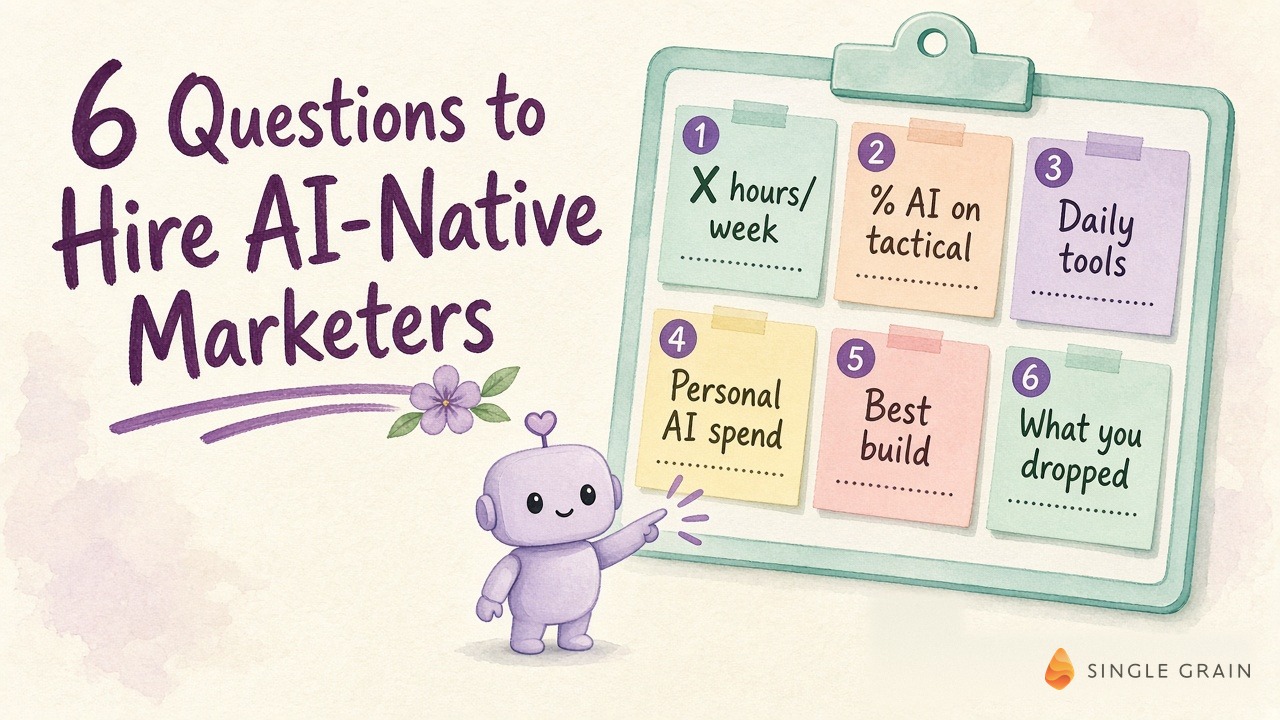
Each question targets a different signal. Below is what each one tells you as the person hiring, and what a strong answer looks like.
1. How Many Hours Are You Spending Per Week on X?
X is where the AI action is happening right now. The hours a candidate spends there show whether they’re obsessed with learning this stuff.
My bar is three hours a week. Anything less is unacceptable if someone wants to stay on top of AI, and many people are already spending 15 to 20+ hours a week there.
Pushback to the X Hours Standard
This was the question that drew the most pushback on X. Some people argued X is mostly people reacting to other people’s work, while the original work lives elsewhere, on GitHub, Hugging Face’s daily papers feed, niche blogs and conference talks. Another said anyone spending that much time on X probably isn’t employee material.
I hear both, and the hours still matter to me. Three hours is only the floor, and a candidate who also reads papers and repos is a great answer. What I want to hear is they show up where builders share what they’re shipping, then do something with it.
2. What Percent of Your Tactical Work Is Done by AI Right Now?
This one shows whether robots are doing the robot work so the candidate can do the human work. Tactical work means the hands-on, repeatable tasks:
- Drafting
- Reporting
- Research
- Editing
- Scheduling
At my agency, Single Grain, if the majority of someone’s tactical work isn’t running through AI yet, it probably won’t work out. Your bar may differ by company, but it’s where my team is headed.
A strong answer gives a rough percentage and backs it up with tasks, such as “AI drafts my weekly report and I edit it.” A weak answer stays vague, like “I use AI for a lot of things.”
3. What Is Your Daily AI Driver, and How Are You Using It Specifically?
The word that matters here is “specifically.” Naming a tool is easy, while describing a workflow shows how deep someone’s day-to-day use actually goes.
For reference, my team runs Grok Bot for SEO and AEO routines, OpenAI Dots for product and website work, and Meta Muse for Instagram creative. I split work across OpenAI Dots, Grok Bot and Meta Muse so each one handles what it does best. Expect the same level of detail from a candidate: the tool, the task, and the result.
4. How Much Are You Spending Out of Pocket on AI?
This question shows whether a candidate puts their own dollars behind learning and invests in themselves.
I pay for OpenAI, Claude, and plenty of other tools myself. If a candidate won’t spend a dollar on the tools they claim to use every day, this tells me something.
5. What Is the Most Impactful Build You’ve Made, and Can You Share It?
Here’s where the rubber meets the road. The candidate shows what they’ve built and explains how they built it.
A bot, a skill, a prompt chain (a series of prompts where each output feeds the next) or a small app all count. What matters is it works and they can walk you through it.
| What You Should Do |
|---|
| Ask for a link or a short screen recording with question five. A build someone can show you in two minutes tells you more than a polished cover letter. |
6. What Workflows or Products Have You Stopped Using in the Last Six Months?
AI moves so fast that a good marketer keeps eliminating as they add. Someone who hasn’t dropped anything in six months probably hasn’t tested much either.
Good answers name the old tool, the replacement, and why the switch was worth it.
How My Team Runs the Screen Without Slowing Hiring Down
Nobody on my team reads every answer cold. Our Talent Bot, one of the 21 Grok Bot jobs I shared on X, screens applicants on how much of their work runs on AI and what they’ve built.
A second bot, our Recruiting Coordinator, schedules interview loops, preps interviewers and chases whatever has stalled. The bots gather and sort the material, and a person on my team makes the hiring call.
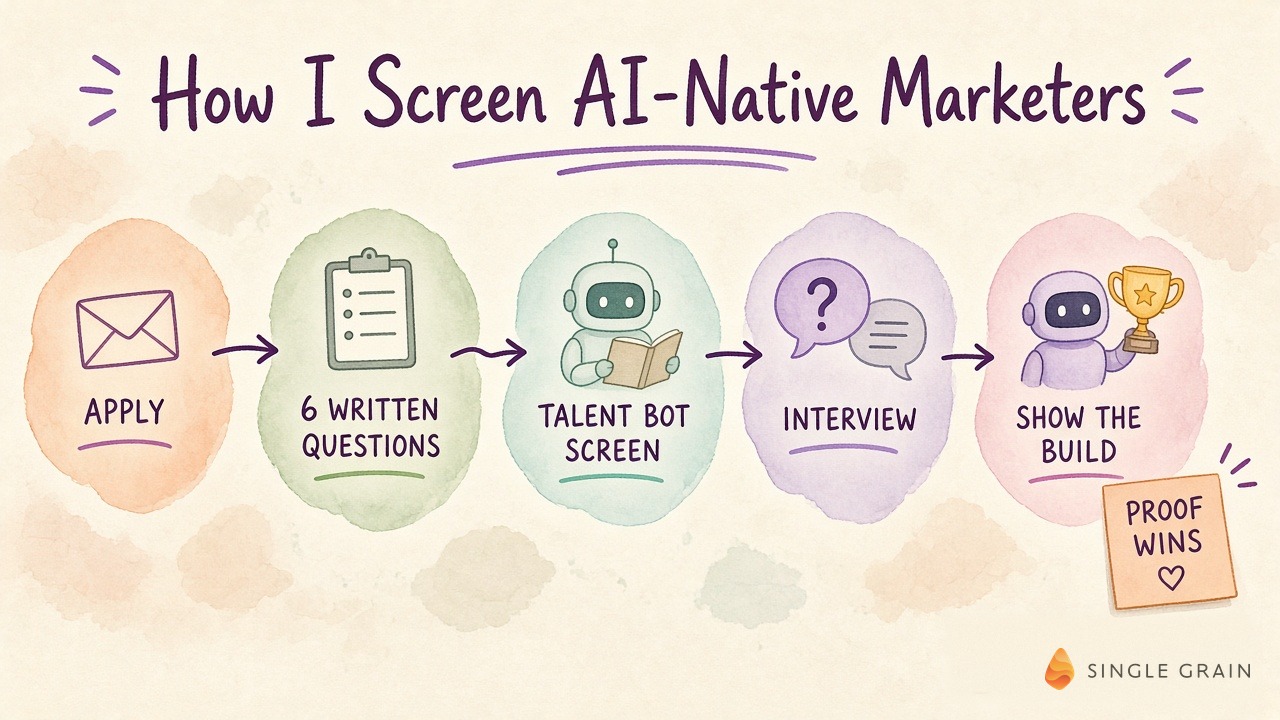
The flow runs left to right. Applicants answer the six questions, the Talent Bot sorts answers by proof, the top candidates get an interview, and the final step is always a live walkthrough of something they built.
Sourcing AI-Native Candidates With an X Hiring Scout
If you’d rather go find candidates than wait for them, this is the sourcing routine I’d add next. It looks for people who show their work on X.
| Starter prompt for an X hiring scout |
|---|
| “Every Friday at 10am CT, search X for people who posted in the last 7 days about a marketing workflow they built with AI agents. Keep only posts that show the work: a screenshot, a prompt, a repo or a before-and-after. Skip recruiters, course sellers and accounts that only repost. For each person, give the handle, a link to the post, what they built in one line, and which of [open roles] it fits. Skip anyone already in [ATS export]. Send the list to me in Slack. Never DM, follow, like or reply to anyone. If fewer than 3 qualify, send what you found and say so.” |
Before you post the role, decide which seats to fill first with an AI hiring plan for marketing team leaders, so the six questions go to the right openings.
Mistakes That Let the Wrong Hires Through
Even with good questions, a few habits can sink the screen.
- Grading polish over proof. A beautifully written answer with no numbers, tools or builds is a weak answer.
- Accepting a list of tool names. Ask how they use each one, on which task, and what changed.
- Treating hours on X as optional. If a candidate isn’t learning where the action is, they’ll fall behind fast.
- Skipping question six. What someone stopped using tells you whether they actually test new tools or just collect them.
Fix those four habits first, and the six questions will do most of the sorting for you.
Put the Six Questions in Your Next Job Post
Steal the list. Paste the six questions into your next job post, score every answer on the proof behind it, and finish with a live walkthrough of the candidate’s best build.
Do that, and you’ll hire AI-native marketers who make the whole team faster. I use the same screen for my own open roles at Single Grain.
Hiring AI-native marketers takes months. My team at Single Grain already works this way, running AI-powered SEO, AEO and paid media for growth brands. Let’s talk about plugging us in.
Frequently Asked Questions About Hiring AI-Native Marketers
-
What is an AI-native marketer?
An AI-native marketer hands repeatable, tactical work to AI by default and spends their own time on judgment, taste and strategy. At Single Grain, that also means building and managing bots as part of the job.
-
What questions should you ask to hire AI-native marketers?
Single Grain asks six: hours per week on X, percent of tactical work done by AI, daily AI driver and how it’s used, out-of-pocket AI spend, most impactful build, and workflows or products dropped in the last six months.
-
Why does Single Grain ask candidates how many hours they spend on X?
X is where much of the AI action happens right now, so time there signals how seriously someone keeps up. Single Grain treats anything under three hours a week as a miss for AI-focused roles.
-
How do you verify an AI-native candidate's skills?
Ask them to share their most impactful build and walk you through how they made it. A working bot, skill or prompt chain is stronger proof than a résumé line.
-
Can AI help screen job applicants?
Yes. Single Grain’s Talent Bot screens applicants on how much of their work runs on AI and what they’ve built, and a recruiting bot schedules interviews. A person still makes the hiring decision.