

Anthropic and OpenAI Say They Will Slow the Frontier. Here Is What to Build on Agents Now.



The people building the most capable AI in the world just argued in public about whether to slow it down. Anthropic’s Dario Amodei published an essay making the case for a slower pace. Sam Altman agreed, and other prominent voices pushed back that open development and competition will keep the field speeding up no matter what anyone asks. If you are the one deciding which AI agents to build this quarter, a fight like that sounds like it should change your plan.
That disagreement about speed does not change what you should do this quarter. The agents you can already build are useful today, and the risks are the same ones a careful operator was already managing.
By the end of this you will know what to build on AI agents right now, what to hold off on until the tooling settles, and how to move fast without betting your business on a model that changes next month.
TABLE OF CONTENTS:
TL;DR
- Anthropic, OpenAI, Google and xAI are split on slowing AI down, but that debate sits above your marketing workflow and does not change what you can safely build this quarter.
- Build agents for narrow, checkable work like reporting, research and first drafts, and keep a human approving anything that spends money or publishes.
- Wait on open-ended budget control and autonomous publishing, build on the workflow rather than the model, and give each agent the least access it needs.
What Does “Pace the Frontier” Mean?
Pacing the frontier means companies like Anthropic and OpenAI deliberately slowing how fast they release their most capable models, so testing and oversight can keep up with what those models can do.
Dario Amodei of Anthropic argued for exactly that in “We Must Pace the Frontier”, laying out a staged plan that starts with a step where Anthropic invites third-party evaluators in. His case is not that ordinary teams should stop using AI. It is that the most capable systems may outrun the tools built to test and constrain them.
The Atlantic’s coverage notes that Sam Altman publicly agreed the field should pace the frontier, while others argued that open development and competitive pressure keep it accelerating regardless. The essay also warns that increasingly autonomous agents have begun to behave in unintended ways. That matters for your roadmap, but it is not a reason to freeze.
Why the AI Speed Debate Does Not Change Your Roadmap
That debate lives at the frontier. Your marketing workflow lives much closer to the ground.
Most teams I talk to are either frozen by the debate or ignoring it, and both are wrong. Waiting for Anthropic, OpenAI, Google and xAI to agree is not a strategy. It is a stall.
Your next quarter should not hinge on whether frontier progress slows by a few months. The useful work in front of you already fits a simple pattern. You give a system a narrow job. You give it inputs you trust. You review the output before it touches a customer or a dollar.
The pattern holds whether the next model lands next month or next year. Build the kitchen around standard outlets, not around one appliance. If a better appliance arrives, you swap it. You do not tear out the walls.

What to Build on AI Agents Right Now
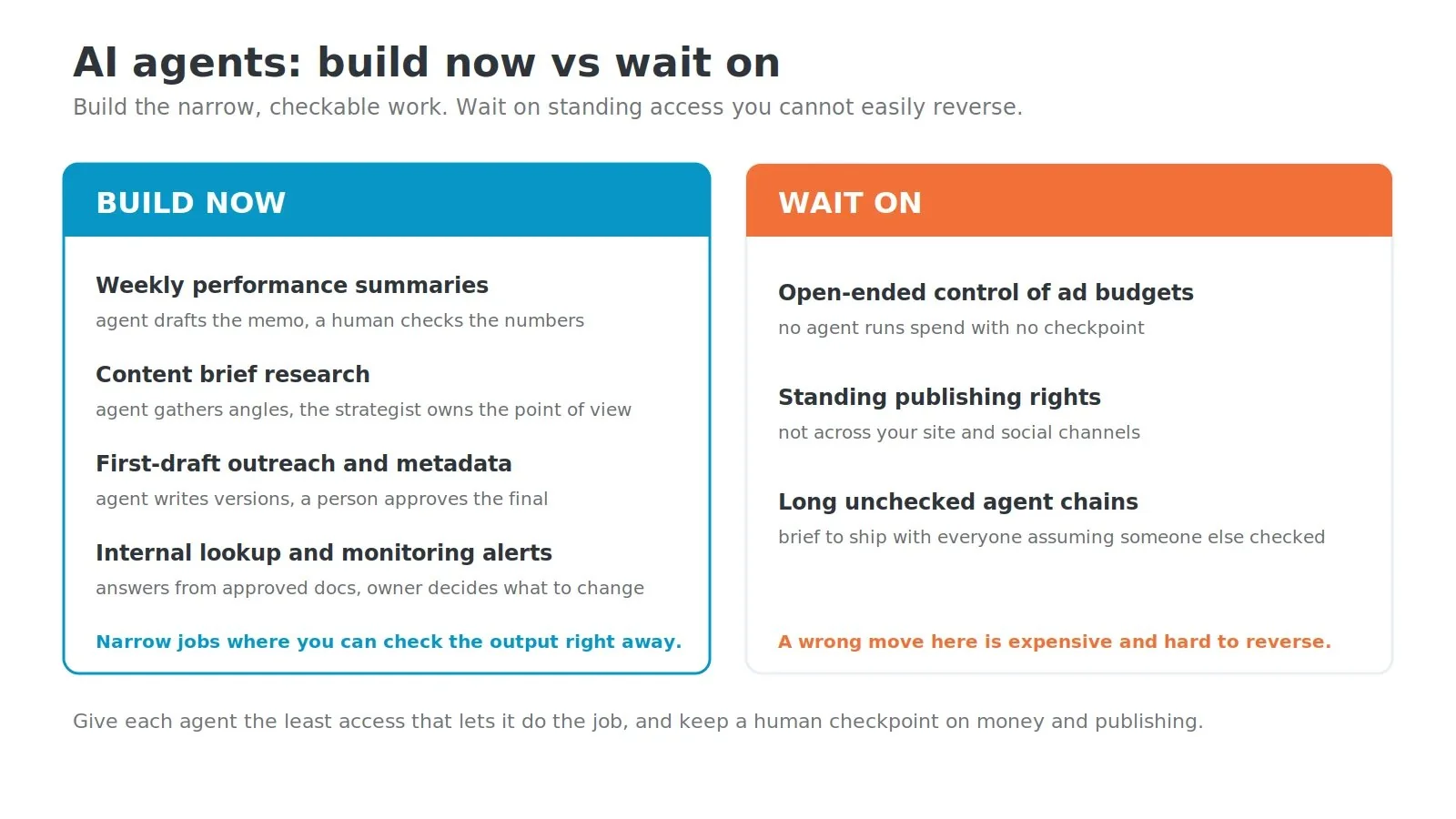
So what should a business building on AI agents actually do right now, given the debate about slowing AI down? Build the agents that do narrow, repeatable work you can check, like reporting, research and first drafts, and keep a human approving anything that spends money or publishes. Wait on handing an agent open-ended control of budgets or systems until the tooling to constrain it catches up, which is the exact gap Anthropic and OpenAI are warning about.
The best agents today act like fast junior operators with perfect patience and uneven judgment. Treat them that way and you will ship useful work without pretending the machine owns the outcome.
Narrow Jobs That Pass the Check Test
Start with tasks where you can tell right away whether the output is right. Reporting agents fit, because the numbers tie back to a dashboard. Research agents fit, because sources and claims can be checked before anyone acts.
For marketing teams, the work worth automating looks like this:
- Weekly performance summaries, where the agent pulls paid, organic and CRM notes into a draft memo and a human checks the numbers.
- Content brief research, where the agent gathers competitor angles and search-intent notes while the strategist owns the point of view.
- First-draft outreach, where the agent writes versions for review and a person approves the final message.
- Internal knowledge lookup, where the agent answers team questions from approved docs and links back to the source.
- Monitoring alerts, where the agent flags spend swings or ranking drops and the owner decides what to change.
If you want the wider operating model, start with practical adoption, not sci-fi autonomy. A working AI for marketing setup maps each agent to one job and one owner.
AI Agent Marketing Examples Worth Shipping
A content team can point an agent at a webinar transcript and get draft clips and post ideas back. The editor still chooses the angle, because taste has not become a commodity.
An SEO team can use an agent to cluster keywords, pull SERP notes and draft metadata. If the team also cares about AI search, AI SEO services need the same review loop, because answer engines punish thin claims fast.
A paid media team can use an agent to summarize creative fatigue and suggest new tests. The buyer still controls bids and budgets.
For tool choices, do not chase every new dashboard. A curated list of AI tools to scale marketing helps you compare task fit before your team adds another login nobody trusts.


What to Wait On
Speed gets dangerous when an agent gains standing access to things you cannot easily reverse.
Do not hand an agent an ad account and tell it to improve performance with no checkpoint. Do not give it publishing rights across your site and social channels. Do not let a long chain of agents brief, create, approve and ship while everyone assumes someone else checked.
High-Cost Moves Need a Human Stop
Which moves should you block for now? Block anything where a wrong action burns budget, changes live systems, or puts a bad claim in public. That includes open-ended campaign control and fully autonomous publishing.
This is a timing call, not fear. Anthropic and OpenAI themselves are warning about the gap between capability and control, so acting like that gap does not exist just makes you the test environment.
Ten boring agents that save the team hours beat one flashy agent that can quietly break the business. Boring is underrated when money and brand trust are on the line.
How to Move Fast Without Betting the Business
The move-fast version starts with architecture, not hype.
I build on the workflow, not the model, so when the model changes I do not have to start over. Your prompts, data sources, approval steps and logs matter more than the logo on the model picker.
Agent Operating Rules for This Quarter
Give each agent the least access that lets it do the job. If it only needs read access to analytics, it does not get write access to the ad account.
Keep a human checkpoint on money and publishing. That one rule catches most of the damage that matters.
Start narrow and widen only after the results earn it. Your first agent should feel like a trained assistant with a locked drawer, not a new executive with the company card.
At Single Grain, the work is not “add AI” as a vague mandate. It is designing the workflow so AI helps the team move faster while humans still own judgment, spend and public claims. That is why the service conversation belongs at the workflow layer. If you want a partner to map where agents fit across content, SEO and paid media, our AI marketing agency work starts with the jobs your team repeats every week.
The safe move is to ship more agents than you think you should, and give each one less power than it asks for. If you want help building that kind of roadmap, book a free consultation and bring the workflows you want to automate first.


