
Google Is Testing Ads in AI Mode for Personal Intelligence Users


It’s finally here! Google AI Mode ads now connects to your Gmail, Calendar, and Photos. If you run marketing, the part worth your attention is this: Google is now testing whether insights from a person’s connected apps can help decide which ad they see.
You might be wondering, “Do I need a brand-new campaign for this?” Nope, and I’ll explain why this is good news for your budget.
Keep reading to discover how these ads work, what Google keeps off-limits, what it means for your search strategy, and the readiness checklist I’d run on campaigns this quarter.
TL;DR
- Google is testing ads for Personal Intelligence users. People who connect their apps to AI Mode had an ad-free experience until now, and Google confirmed the test to Search Engine Land.
- Connected-app insights can shape the ad. Summaries, excerpts, and inferences from connected apps may personalize ads, alongside the query, the response, and the person’s interests.
- Some data stays off-limits. Ads won’t be based directly on someone’s Gmail inbox or Photos library, advertisers can’t access connected apps, and sensitive categories aren’t used.
- There’s no AI Mode campaign type. Eligibility runs through Performance Max, Shopping, and Search campaigns with broad match, including AI Max, so readiness starts with what you already run.
What Are Google AI Mode Ads?
Google AI Mode ads are paid placements showing inside or below answers in AI Mode, Google’s conversational search experience. When Google started testing them, it said ads may appear “below and integrated into AI Mode responses” where relevant, according to Google’s Ads and Commerce blog.
AI Mode itself keeps changing fast. My team has already covered how Google AI Mode links got bigger and how Gemini 4 Argon split AI Mode in two. Both shape who gets the click.
Personal Intelligence is the layer on top. It lets AI Mode reference past searches and, if someone chooses to connect them, apps like Gmail, Google Calendar, and Google Photos to tailor answers. People need a personal Google Account with Personalized Recommendations turned on, and the rollout is gradual by country and language.
You probably know that ads in AI Mode aren’t new. But ads in AI Mode for people with Personal Intelligence connected are.
What Just Changed With Ads in AI Mode?
Back in March 2026, Google told Search Engine Land contributor Anu Adegbola there were no ads for people who connect their apps to AI Mode, adding, “That isn’t changing right now.” Google also said it expected ads to work similarly for those users in the future.
This future arrived this month! Adegbola reported in Search Engine Land that Google is starting to test ads in AI Mode for users who connect their apps through Personal Intelligence, reversing the earlier ad-free approach.
Barry Schwartz, founder of Search Engine Roundtable, then spotted new language in Google’s updated help document. It now answers whether connected Gmail or Photos data will be used to serve ads.
One thing is missing, though. Google hasn’t announced new advertiser controls, targeting options, or a wider rollout for this test.
What Shapes an AI Mode Ad, and What Stays Private
Google has drawn a fairly clear line between the signals allowed to shape an ad and the data it keeps out. Here’s how the two sides compare.
- Signals that can shape the ad. The person’s query, the context of the AI response, their interests, and now summaries, excerpts, and inferences from connected apps.
- Data kept out of ad targeting. Ads won’t be based directly on someone’s Gmail inbox or Photos library, and Google says it doesn’t personalize ads based on sensitive categories such as race, religion, sexual orientation, or health.
- What advertisers never see. Advertisers won’t get access to anyone’s connected apps, and people can disconnect those apps at any time.
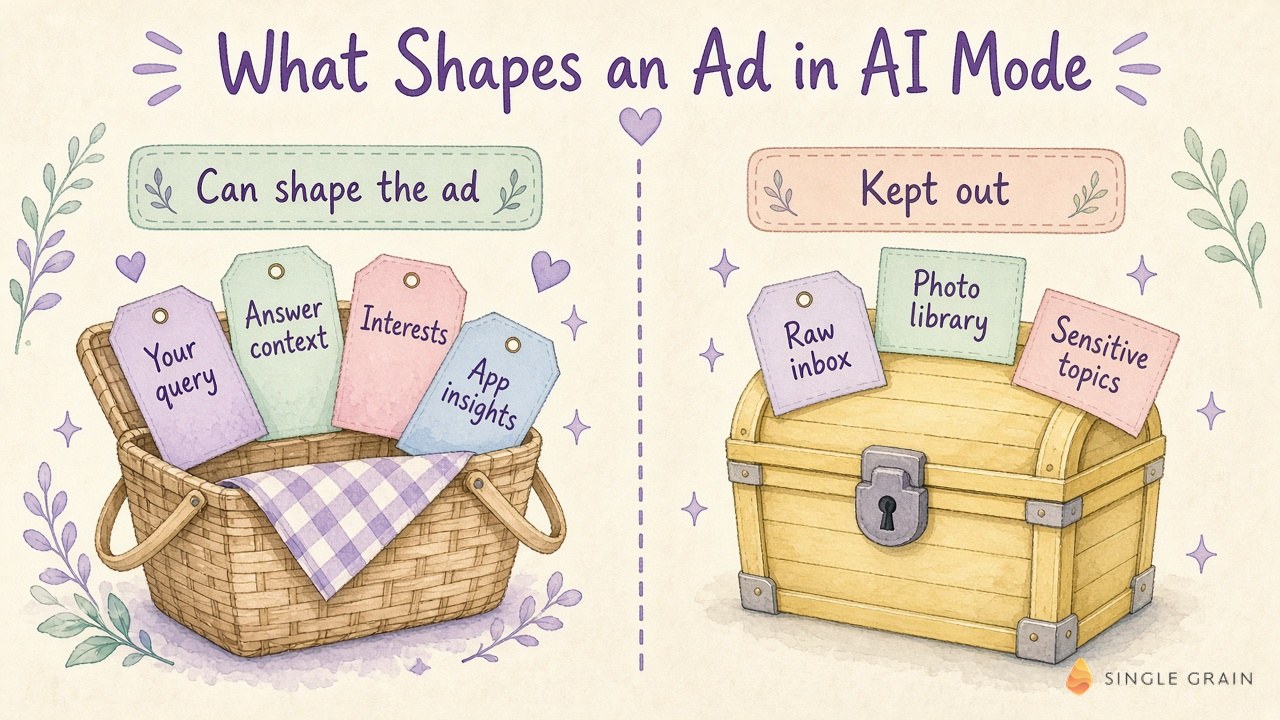
The basket side matters most for your campaigns. A person’s context can now make your ad more or less relevant, even though you never touch their data.
| Pay Attention |
|---|
| “Not based directly on your Gmail inbox” still leaves room for summaries, excerpts, and inferences from those apps. Expect ad relevance to lean more on what Google infers about a person, and less on the exact words they type. |
Before you rework anything, it helps to know how much is still unknown.
What Google Hasn’t Said Yet About This Test
Google confirmed the test, yet the details advertisers care about most are still missing. Here’s what’s open right now.
- No new controls. Google hasn’t announced any advertiser setting to opt in or out of Personal Intelligence placements, per Search Engine Land.
- No new targeting. Nothing suggests you can target people based on connected-app insights, and advertisers can’t see that data.
- No rollout timeline. Google hasn’t said how large the test is or when it might expand, and Personal Intelligence itself is still rolling out by country and language.
- No public results. There’s no published data yet on how these ads perform compared with standard AI Mode ads.
My read is this test is about relevance inside Google’s system. You won’t get a new lever, so the work is making your existing campaigns good candidates when the system goes looking for an ad.
With the unknowns in view, the practical question is whether your campaigns can show up at all.
Are Your Campaigns Ready for Google AI Mode Ads?
You can’t buy AI Mode as its own campaign type. Readiness comes down to the campaigns you already run and how well they fit longer, more personal questions.
Check Eligibility First
Google said advertisers using Performance Max, Shopping, and Search campaigns with broad match, including AI Max for Search campaigns, are eligible to appear in AI Mode. If your account runs only exact and phrase match Search campaigns, you’re likely sitting out most of this inventory.
P.S. My Performance Max playbook covers the controls you keep when you open targeting up.
Write for Longer, Messier Questions
People ask AI Mode complex questions and follow up several times. Your ad and landing page need to answer the next question too, which is a big shift from matching a three-word keyword.
Interactive AI answers are already changing how people click, so it’s worth building landing pages where comparisons are quick.
Feed Bidding With Clean Conversion Data
You can’t see a person’s connected apps, so your best lever is the data you control. Accurate conversion tracking helps Smart Bidding value the right clicks in a more personalized auction.
Keep Paid and Organic Telling One Story
AI Mode blends answers, links, and ads on the same screen. If your organic content and ads say different things, the answer may cite one version and the ad may show another.
| Pro-Tip |
|---|
| Pick five long, real customer questions from sales calls or support tickets. Run them in AI Mode, note which brands show up in answers and ads, and use the gaps to brief both your paid and content teams. For more help, my AI Overview query capture playbook shows how to map the questions where your brand should appear. |
This one exercise can tell you more than a week of dashboards.
Why AI Mode Ads Matter Beyond Google
Google isn’t alone in putting ads next to AI answers. OpenAI just said ChatGPT Ads now run in eighty-nine countries, and more than one hundred thousand advertisers have run campaigns there since launch.
The pattern is clear. AI assistants are becoming a place where people compare options, and ads are following. The open question is whether paid ads lose value in AI search, and my answer is value moves toward ads built to fit the conversation.
For now, Google’s test is limited, and nobody has public performance data on it. Treat it as a signal of where search is heading, then make sure your campaigns are eligible when it scales.
Get Your Campaigns Ready for AI Mode
Google AI Mode ads for Personal Intelligence users are still a test, yet the direction is obvious. More of search will happen in conversational answers, and the ads that win will be relevant, eligible, and backed by clean data.
If you’d like help preparing, my team at Single Grain runs Google Ads management and Search Everywhere Optimization so your paid and organic presence show up together in AI search. Talk to my team about AI Mode readiness and my team will map where your campaigns stand today.
Frequently Asked Questions About Google AI Mode Ads
-
What are Google AI Mode ads?
Google AI Mode ads are paid placements that can appear below and integrated into AI Mode responses where relevant. Google began testing ads in AI Mode in 2025.
-
What is new about ads in AI Mode for Personal Intelligence users?
People who connect apps like Gmail, Calendar, and Photos to AI Mode had an ad-free experience. Google is now testing ads for them, and insights from connected apps may help personalize those ads.
-
Will Google use my Gmail inbox to target ads in AI Mode?
Google says ads will not be based directly on your Gmail inbox or Google Photos library. Summaries, excerpts, and inferences from connected apps may be used to personalize ads, and sensitive categories are excluded.
-
Can advertisers see data from connected apps?
No. Google says advertisers will not have access to anyone’s connected apps, and people can disconnect those apps at any time.
-
How do I get my ads into Google AI Mode?
There is no AI Mode campaign type. Google says advertisers using Performance Max, Shopping, and Search campaigns with broad match, including AI Max for Search, are eligible. Google Ads management can help you check eligibility.