

AI Agent Adoption Statistics 2026: OpenAI’s EU Data for B2B


AI agent adoption is moving faster than most business owners planned for, and Europe just produced the clearest proof yet. New OpenAI research shows small European firms are now handing whole tasks to agents at a pace few people expected. Among OpenAI’s business customers, North American companies still lead on how deeply they put those agents to work, but the EU is jumping on the bandwagon.
I care about this for a selfish reason. When buyers hand research and purchasing work to AI agents, those agents decide which brands get a look. This is where answer engine optimization (AEO), the work of becoming the source AI assistants cite and act on, starts to matter as much as classic SEO.
So what does the influx of AI agent adoption mean for how I run my business, and for how buyers will find me? Keep reading to see the numbers worth knowing, how Europe compares with the US, and the SEO and AEO moves I’d make once agents do the shopping.
TL;DR
- Agent use is surging at small firms. Weekly agent users at European small businesses grew more than 8x in five months, and agentic tools already produce most AI output at larger EU firms.
- Breadth is close between Europe and the US. About one in five EU firms and nearly one in four US firms report using AI, though the surveys measure it differently.
- North America leads on depth. North American companies dominate the group of firms using AI most intensively, and this depth gap matters more than headline adoption.
- Agent-led buying changes SEO and AEO. When agents research vendors for their humans, proof, trusted citations, and machine-readable facts decide who gets recommended.
What Fast AI Agent Adoption Means for Business Owners
An AI agent is software you hand a task to. It plans the steps and carries them out, from pulling data to drafting the finished deliverable. OpenAI’s report separates two kinds of AI use, counting output from Codex and ChatGPT Work as agentic, and the difference shapes everything in this post.
- Chat. You ask ChatGPT a question, read the answer, and do the rest of the work yourself.
- Agentic use. You hand an agent a task, such as writing code with Codex or running a multistep project in ChatGPT Work, and it carries the job from planning through completion.
For an owner, this shift rewrites the job description. You spend less time on research and first drafts, and more time setting goals, checking output, and approving decisions.
How Fast European Small Businesses Moved
Among EU small and medium businesses, defined as firms with 200 or fewer associated users, weekly active users of Codex or ChatGPT Work grew 8.1x between the first week of May and early October 2026. This comes from OpenAI’s October 2026 report, Europe’s Agentic Opportunity, which says a major part of the jump followed the July launch of ChatGPT Work.
Larger firms moved too. By the end of September, agents generated more than half of all output tokens, a rough measure of how much text the AI produces, across ChatGPT Enterprise and Business accounts in OpenAI’s EU sample.
Why I Read These Numbers With One Eyebrow Raised
This is vendor data about vendor products, so I treat it as a strong usage signal and nothing more. Tokens and weekly users show activity. Quality, revenue, and whether a task deserved automation all sit outside what they measure.
Still, the direction matches what I described on X this fall. A year before that post, most agent work in marketing was demos, and by then agents were touching ad accounts, CRMs, Search Console, GA4, and sales follow-up, faster than almost anyone planned for. Small firms have fewer approval layers, so one person who saves an afternoon with an agent can change how the whole company works by Friday.
Growth like this sounds impressive on its own. To judge it properly, you need a benchmark, and the obvious one sits across the Atlantic.
AI Agents Statistics: How Europe Compares With the US
I went looking for a clean, apples-to-apples comparison of agent use in Europe and the US. Here is what I found.
Broad AI Use Is Close on Both Sides
In the US, the Census Bureau’s Business Trends and Outlook Survey asks employer businesses every two weeks whether they used AI in any business function. The share rose from 19.8% in the survey round collected through May 3, 2026, to 23.8% in the round collected through October 4, 2026, almost the same window as OpenAI’s EU data. The smallest US firms, with one to four employees, climbed from 19.0% to 23.9%.
In Europe, the closest official figure comes from Eurostat, which found 20.0% of EU enterprises with ten or more employees used AI technologies in 2025, up from 13.5% in 2024.
Different questions, different firm sizes, different years. Even so, the two surveys land close together, at about one in five EU firms and nearly one in four US firms, so the US holds only a modest lead on simple adoption.
Depth Is Where North America Pulls Ahead
OpenAI’s report is the better guide to depth, because it compares regions inside one customer base. It defines frontier firms as the top 10% of companies by output tokens per active user. In September, North America accounted for roughly 65% of these frontier firms, against about 10% for the EU.
Inside Europe, frontier firms generated more than four times the output per active user of typical EU firms. Frontier firms outside the EU generated more than twice the output per active user of those EU frontier firms.
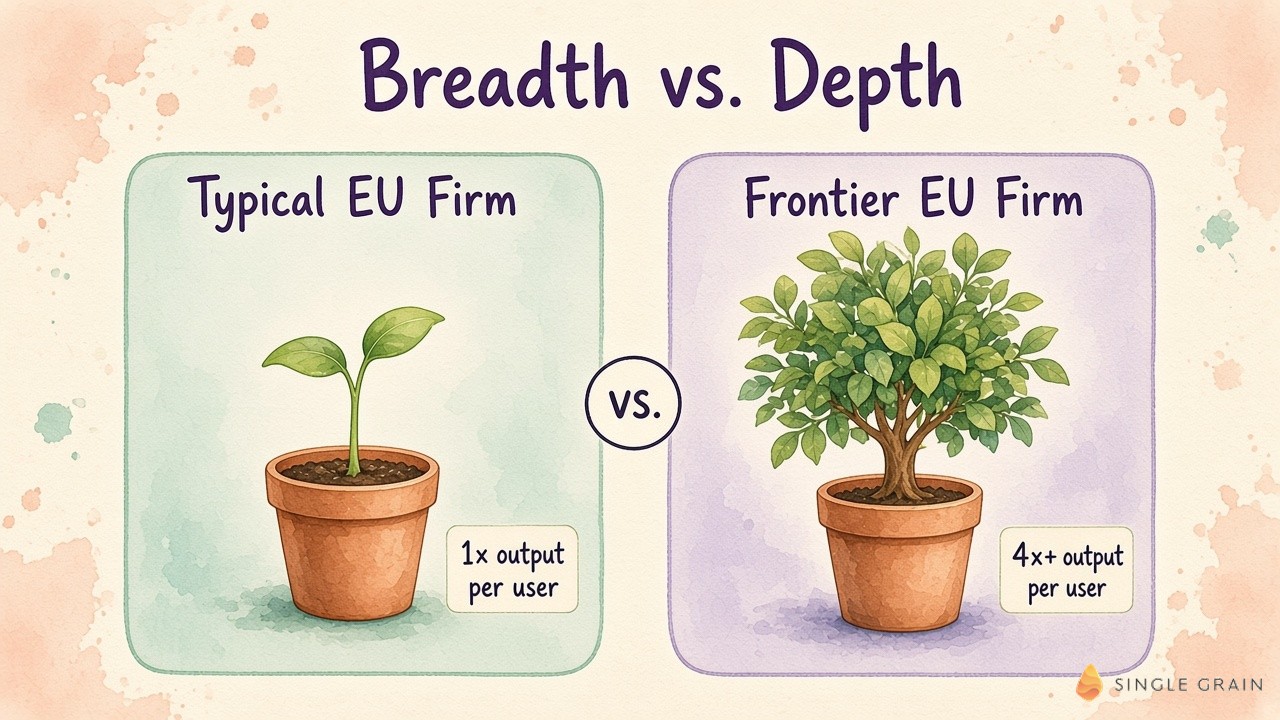
In simple terms, plenty of European teams have the tools, and fewer of them push the tools hard. Among OpenAI’s business customers at least, North American companies are further along in turning seats into delegated work.
What OpenAI’s Small Business Data Adds
OpenAI’s September 2026 report, Small Businesses, Bigger Capabilities, covers its small-business users worldwide at firms with up to 499 employees. It found agentic output made up two-thirds of all small-business output tokens in August, up from one-third in April 2026.
On the US side, OpenAI Economic Research estimated in May 2026 at least four million Americans who were starting, running, or planning a business in March 2026 did so with help from ChatGPT. For people already running a business, the September report notes OpenAI’s May analysis found marketing and copywriting took the largest share of activity.
Put together, American owners already run a big slice of daily work through AI, and small firms everywhere are shifting from chat to agents. Europe’s surge fits the same global wave.
| Pay Attention |
|---|
| No public source measures agent use by US and EU small businesses with one shared method yet. The Census Bureau and Eurostat track any AI use with different questions, and OpenAI tracks its own products. Treat every cross-border gap as directional. |
With a benchmark in place, the more useful question is what all this means if your company, or your customers, sit in Europe.
What AI Agent Adoption Means for European Businesses
For European owners, the takeaway has two sides. Your own team can close the depth gap, and your buyers’ teams are already changing how they research vendors.
Your Buyers’ Teams Already Delegate Research
If you sell to European companies, assume some of their staff already hand vendor research to AI. In OpenAI’s Q3 2026 sample of messages from Free, Go, Plus, and Pro users, developing business or marketing plans stood out as the most distinctive work task in the Netherlands. Denmark and France stood out for explaining financial information.
For a marketer, this means the first reader of your pricing page or case study may be software acting for a buyer. When the agent can’t find a clear answer, it moves on to a brand whose answer is easy to find.
Expect Big Differences Country by Country
Agent depth varies a lot by market. Among larger firms on ChatGPT Enterprise and Business, the agentic share of output tokens in September ranged from 85% in Lithuania to 22% in Slovenia, with Germany at 51% and France at 55%.
A pan-European plan built on one market’s habits can easily misfire. I’d check how buyers in each priority country actually research before deciding how much to invest in agent-readable content there.
Close the Depth Gap Inside Your Own Company
OpenAI’s own conclusion is the EU’s opportunity lies in turning broad adoption into deeper use. I’d say the same to any European owner who bought AI seats for the whole team and stopped there.
Pick one recurring workflow per team, simplify it before you automate it, and count finished tasks alongside logins. The habits of top marketers who run AI agents daily show what depth looks like in practice.
Inside the company, agents change how work gets done. Outside it, they change how customers find you, and this is where SEO and AEO come in.
Why AI Agent Adoption Rewrites SEO and AEO
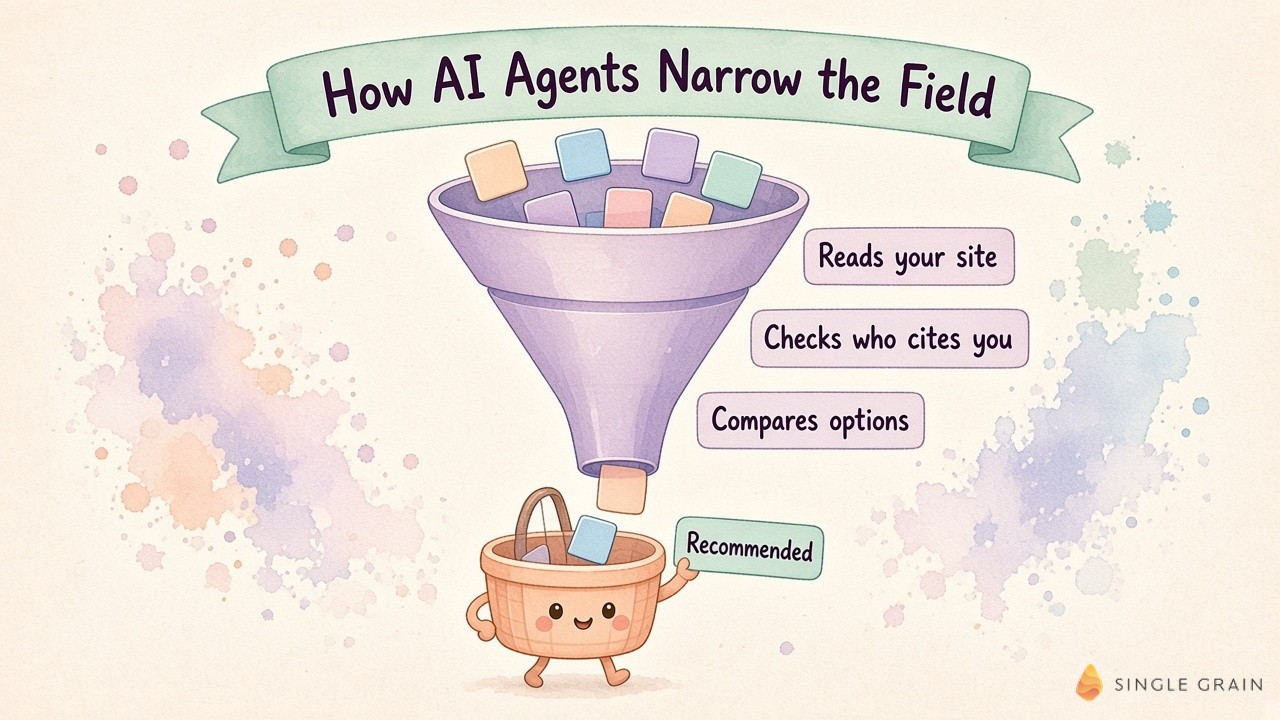
My prediction is simple. The next buyer your marketing has to convince will be an agent, and it works through your brand in a predictable order.
- It reads your site. Pricing, specs, and proof need to be easy to find as plain text.
- It checks who cites you. Outside sources confirm or undercut what your own pages claim.
- It compares you with competitors. Your claims get lined up against a few alternatives.
- It hands its human a few recommended options. Only the brands left standing ever reach a person.
Each step filters out brands whose claims can’t be checked. This is the heart of marketing to AI agents, and a clever tagline does little for software hunting for proof.
Those filters point to three specific jobs for your SEO and AEO work.
Citations Become the New Backlinks
I also argue citations are like the new backlinks. A mention from a source an agent trusts, such as a review, a partner page, or an industry roundup you didn’t write, carries more weight than one more post on your own blog. One practical way to build them is earning ChatGPT citations with digital PR.
Invented stats get punished too. An agent catching one made-up number will trust the rest of your site less, which is why my team runs every draft through a quality gate before it ships.
Make Your Business Easy for Machines to Use
The new SEO game is AI search. Agents need to access, understand, and actually use your website, so MCPs, APIs, markdown, pricing, and technical docs matter more every month.
I call the bigger version of this idea Agent-Led Growth. Product-led growth removed friction for humans, and the next challenge is removing friction for the agents acting on their behalf, so products become discoverable, understandable, callable, and verifiable by machines.
For the technical groundwork, start with crawl and citation readiness for LLM scrapers. If agents will book or buy on your site, keep an eye on the Personal Agent Protocol and agentic commerce too.
SEO Still Feeds the Answers
Classic SEO keeps its value. Gemini and AI Overviews can draw on Google Search for their answers, so teams who kept doing SEO well get a head start.
Measurement gets messier, though. As I wrote on X, people ask ChatGPT or Gemini, get the answer, then go directly to your site or search your brand later, so the conversion is AI-assisted and attribution gets murky. Share of voice in AI answers is a fine starting point, and revenue remains the real scoreboard.
| Pro-Tip |
|---|
| Once a week, ask ChatGPT, Gemini, and Perplexity the questions your buyers ask before they buy. Note which brands get named, flag anything wrong about yours, and fix the source page first. |
Once you know what agents want, half the job is done. The other half is running your own business so agents handle the busywork and people keep the judgment.
How I Run My Business With Agents on Both Sides
My team at Single Grain uses agents for much of its own marketing, and my AEO and SEO work mostly runs without me now. Grok Bot drafts from Search Console and GA4, Muse runs the research, and Jev grades every draft before it ships. A batch of twenty articles used to take hours, and it now runs in about thirty minutes. My editors run a quick human pass on the content, then hit publish!
Agents own execution in this setup, and people own judgment, approvals, and accountability. This is the line I keep coming back to in my five levels of an AI-native company, and these Grok Bot use cases I run every week show how it plays out day to day.
For an owner reading these numbers, here are the four moves I’d make first, in order.
- Rebuild one workflow around agents. Start with recurring work like reporting or content research. If your pipeline lives in a CRM, an agentic CRM built for AI agents is a natural place to begin.
- Give each agent a clear job. Define the outcome, the trigger, the data it may read, and who approves its work before it touches anything live.
- Publish proof agents can check. Put pricing, specs, case results, and third-party mentions on crawlable pages.
- Audit what agents say about you every week. Fix errors at the source page, then check again the following week.
A small team can run all four with one owner and a weekly rhythm. Agents may do the shopping now, but somebody still has to stock the shelves.
Be the Brand AI Agents Recommend
Agent adoption is moving from experiment to habit on both sides of the Atlantic, and your next buyer may send software to do the first round of research. Brands with clear facts, real proof, and trusted citations are the ones agents will bring back to their humans.
My team at Single Grain helps B2B brands get found and chosen across search engines and AI answers. If you want help becoming the source AI assistants cite and act on, explore my team’s AEO services and SEO services.
Frequently Asked Questions About AI Agent Adoption
-
What does fast AI agent adoption mean for small business owners?
It means more of the daily work, from research to first drafts, gets handed to software, while owners spend more time setting goals and approving output. It also means your buyers may send an agent to research vendors before a person ever visits your site.
-
How does AI agent adoption in Europe compare with the US?
Broad AI use is close. About one in five EU firms used AI in Eurostat’s 2025 data, and nearly one in four US firms did in the Census Bureau’s Business Trends and Outlook Survey, though the surveys measure it differently. The bigger gap is depth. In OpenAI’s business data, North American companies make up far more of the most intensive AI-using firms than EU companies do.
-
How do AI agents change SEO and AEO?
Agents read your site, check who cites you, and compare you with competitors before recommending a few options. This rewards clear facts, real proof, and trusted third-party mentions, which is why marketing to AI agents now sits alongside classic SEO.
-
What is answer engine optimization (AEO)?
AEO is the work of becoming the source AI assistants such as ChatGPT, Gemini, and Perplexity cite and act on when they answer a question. This AEO framework explains the basics.
-
What should European businesses do first about AI agents?
Start with one recurring workflow per team and measure finished tasks, then make pricing, specs, and proof easy for agents to read in every market you sell to. Check what AI assistants say about your brand each week and fix errors at the source page.
-
Where do these AI agents statistics come from?
The European agent figures come from OpenAI Economic Research’s October 2026 report on Europe’s agentic opportunity. US comparison figures come from the Census Bureau’s Business Trends and Outlook Survey and OpenAI’s 2026 small business research, and the EU baseline comes from Eurostat.