

21 Grok Bot Use Cases I Run Every Week at My Agency


My agency now runs over twenty Grok Bot use cases, from SEO audits to sales prep to hiring screens. Not one of them can send an email, publish a post or spend a dollar without a human yes.
I shared the full list on X this week. I’m all in on Grok Bot. I’ve tried a lot of agents, and for setting up routines and getting things done, it has been the most reliable one I’ve used.
So which jobs can you safely hand to a bot, and where should it stop? Discover all 21 Grok Bot use cases, team by team, plus exactly where each one hands off to a person and four routines you can copy today.
TL;DR
- Each Grok Bot use case is one recurring job. Topic research, content gating, ad spend alerts and lead routing all get handed to an agent scoped to a single task.
- My team runs 21 of them. They span SEO and AEO, content, paid media, sales, hiring and ops.
- Bots draft, score and flag. Sending, publishing and spending still wait for a person to approve.
- Start with one manual report. Pick a report your team still builds by hand and turn it into your first scheduled routine this week.
Here’s the whole lineup first, then I’ll break down where each bot hands off to a person.
All 21 Grok Bot Use Cases at a Glance
Here’s the full lineup of bots on one page, grouped by the team that owns it.
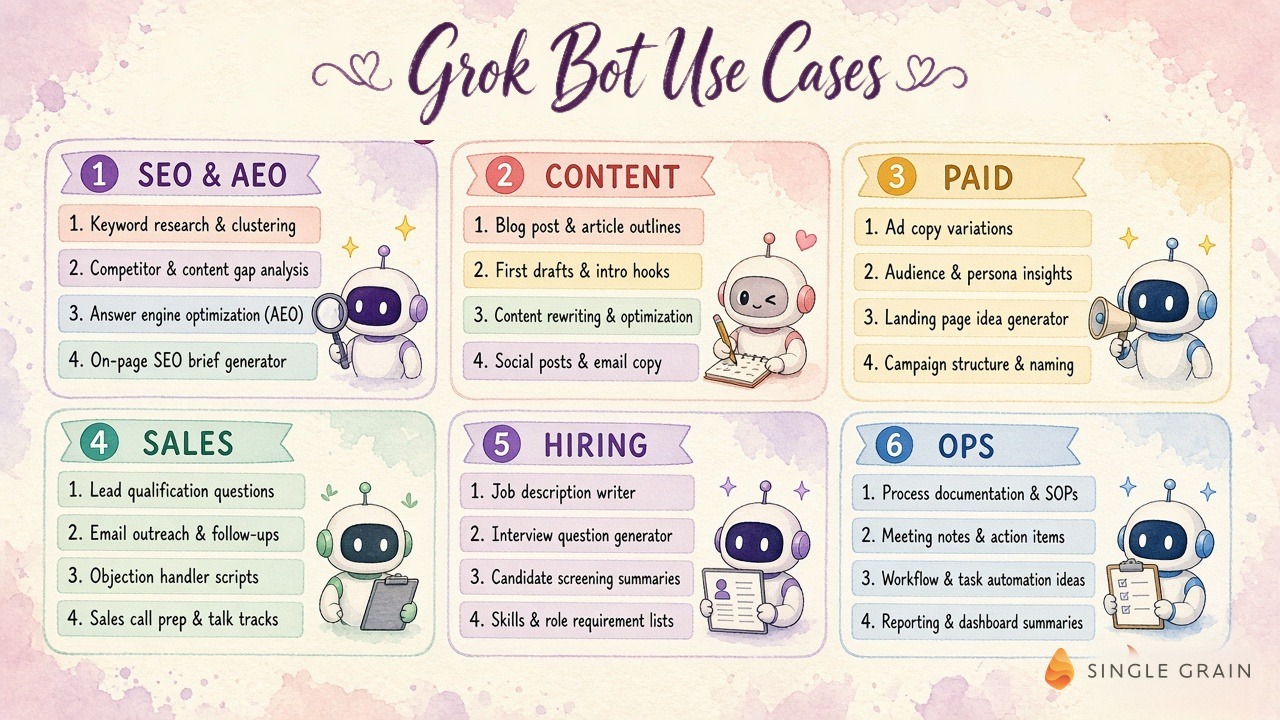
Notice every group is small. I keep each bot narrow, with a single job, and the sections below explain what each one does and where a person steps in. Now, let’s take a closer look at each of these use cases.
SEO and AEO: Use Cases 1 to 6
This is where my team started, and it’s still the busiest part of the lineup. SEO targets Google rankings, while AEO (answer engine optimization) targets the answers AI assistants like ChatGPT and Gemini give.
- AEO/SEO Bot: mines 40 topic candidates from search and our own content, my team picks 20, and drafts wait for approval. The bot does the digging, and a person decides what’s worth writing.
- Content gate: Jev, our content classifier, scores each draft for duplicate pages, invented stats, weak evidence and AI tell before it moves.
- Topic triage: decides whether to draft, update, delete or consolidate before anyone writes. Content consolidation means merging overlapping pages into one stronger page instead of publishing another. In other words, 301 redirects.
- GEO audit and measurement: GEO (generative engine optimization) is the work of getting cited in AI answers, and this bot shows where my team is missing citations and steers what the content bot works on next.
- AI Search Visibility: checks whether AI assistants recommend you and who they name instead.
- Site Audit: ranks SEO, page speed, CRO (conversion rate optimization) and schema markup issues by priority, P0 for fix now through P2 for fix later, with evidence URLs for each.
The content gate is the one I’d copy first, because one invented number can cost you a reader’s trust. Jev also works outside the gate: my team uses it to turn one sales call into a timestamped article brief.
Content: Use Cases 7 to 11
These bots keep the content calendar full without anyone scrolling for ideas.
- YouTube demand radar: scans channels in my space for topics worth making and flags the ones that have cooled.
- X Brief: finds posts getting traction in your industry and turns them into a daily brief.
- Shortform Scaler: aims for at least 4 clip candidates a day from webinars and podcasts. A person picks the winners, because taste is human work.
- Trial Reels: pulls Reel candidates from one YouTube video (9 from one of ours) and tests variants on non-followers.
- Copy Humanizer: rewrites drafts so they read like a person wrote them and shows every change.
Ideas for these bots often start with something I spot on X myself.
| Pro-Tip |
|---|
| When you see a post on X worth reacting to, hit share and send it straight to your Grok Bot with a quick “should we do this?” It’s the fastest way to turn a hunch into a scored idea. |
Paid Media: Use Cases 12 and 13
Paid is where a bot mistake costs money, so these two only watch and report. Neither one can change a budget or a bid.
- Ad Spend Watch: flags what’s breaking before it burns budget and never pauses a campaign without you.
- Paid Media Report Desk: turns Google, Meta and LinkedIn exports into one weekly report with commentary.
Sales is where I let bots touch the pipeline directly, starting with how fast we reach new leads.
Sales: Use Cases 14 to 17
These bots work the pipeline so reps spend their time on conversations.
- Speed-to-lead: a voice bot calls new demo leads in under 60 seconds, re-qualifies them and routes the good ones to sales.
- Pre-Call Intelligence: reads past conversations and briefs the team on what the other side cares about.
- Outreach Agent: checks prospects against my team’s criteria and recent news, and won’t lower the bar to fill a daily cap.
- Lead Pipeline Desk: scores inbound leads, merges duplicates and assigns an owner.
Sales bots also help keep the clients you already have, like an agent that spots churn signals across HubSpot, Slack and Stripe before an account goes quiet.
Hiring and Ops: Use Cases 18 to 21
The last four keep recruiting and events moving without a coordinator chasing every thread.
- Talent Bot: screens applicants on how much of their work runs on AI and what they’ve built.
- Recruiting Coordinator: schedules interview loops, preps interviewers and chases what’s stalled.
- Sponsorship Deal Desk: answers sponsor inquiries within 60 seconds using locked minimum pricing.
- Luma Pages: builds and updates event pages, registration and waitlists for field marketing.
All of these grok bot use cases share one rule about where the bot’s job ends, and this rule matters more than any single use case. Let me explain.
Where Grok Bot Stops: The Approval Gate
Every one of these Grok Bot use cases follows the same rule. The bot does its one job, then waits.
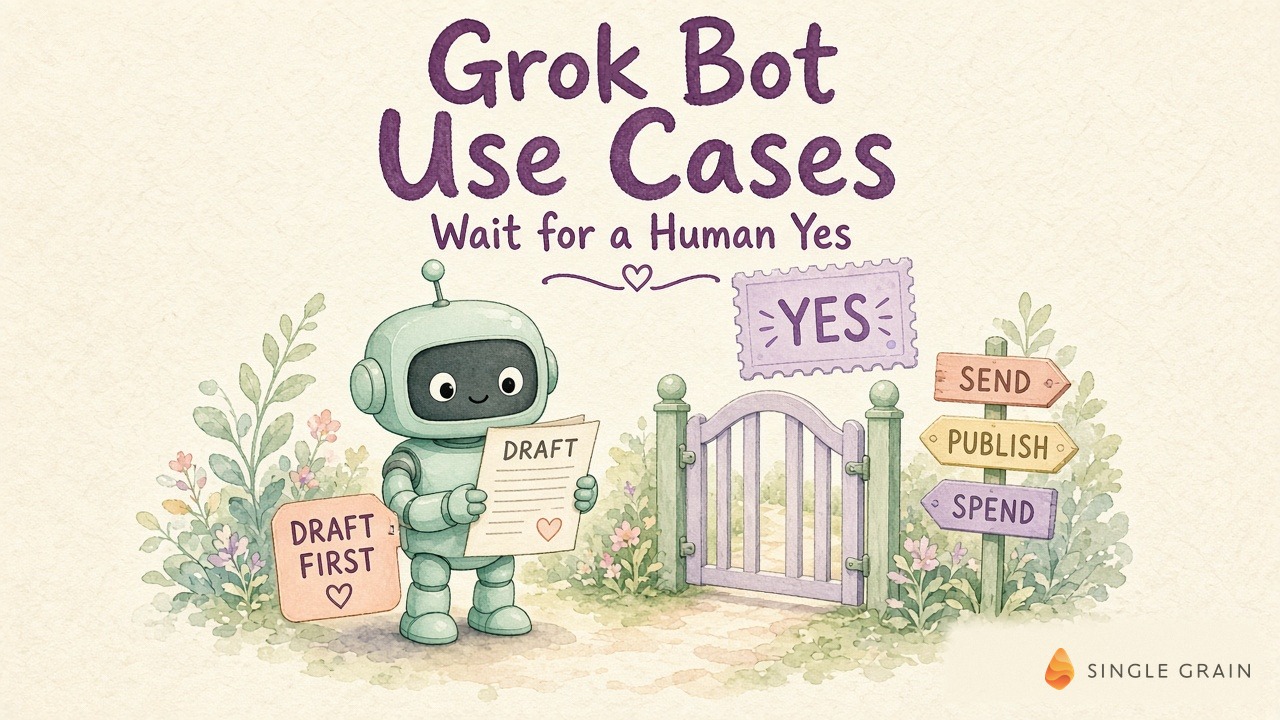
For instance, the bot finishes its task and drafts the result. But before anything goes out, gets published, or spends money, a person on the team says yes. Only then does the last step happen.
How the Approval Gate Keeps 21 Bots Manageable
This is what keeps my bots from turning into chaos. One reply on X put the doubt plainly: “21 bots is a lot to feed. How many actually get used weekly?” Another asked which bot I’d shut off first if the review queue ever got longer than the scoreboard.
Both are fair worries. My answer is the one-job rule plus the habit of retiring bots: if a bot has no owner, no measured result or a growing pile of unreviewed drafts, it gets fixed or shut off. Choosing which agent should own which job across OpenAI Dots, Grok Bot and Meta Muse also keeps any one queue from overflowing.
4 Grok Bot Routines You Can Copy Today
I also shared four routines I’d give any marketing team. Each one runs on a schedule and lands in Slack as a draft.
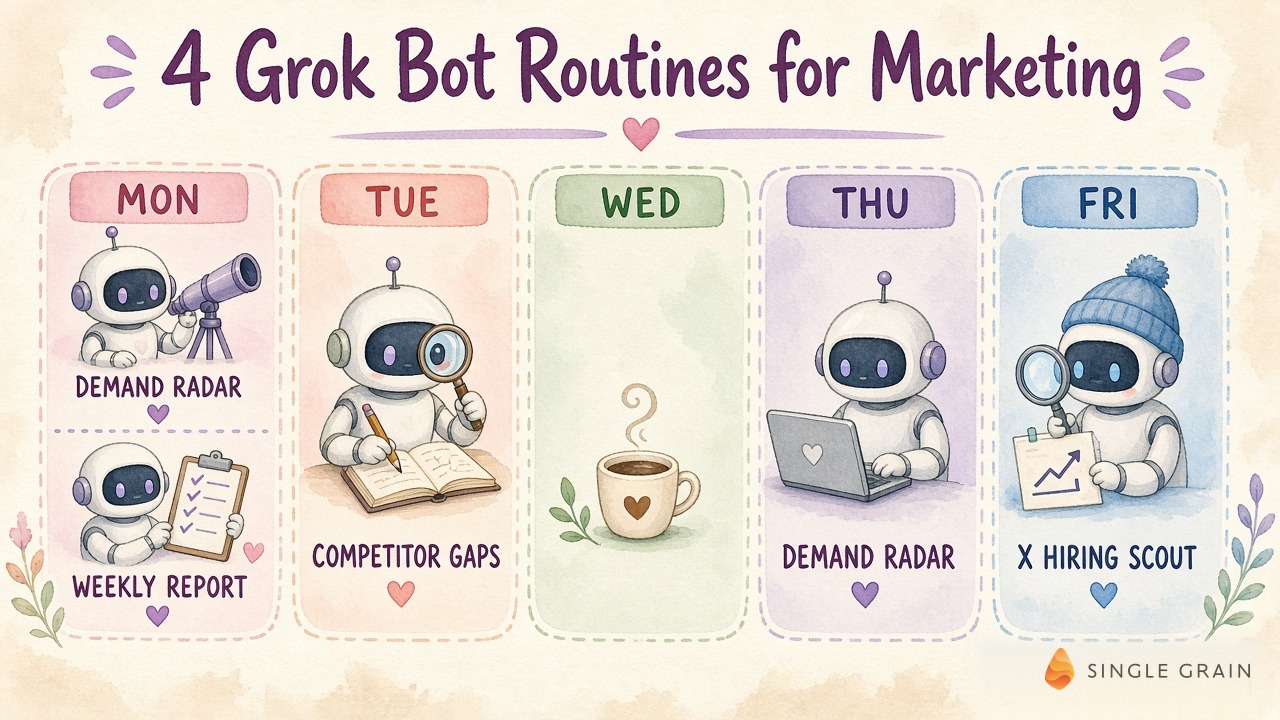
Times are in Central, and the approval rule at the bottom applies to all four. Here are the prompts, so you can paste them in and swap the brackets.
Routine 1: YouTube and X Demand Radar
| Starter prompt for a YouTube and X demand radar |
|---|
| “Every Monday and Thursday at 7:30am CT, check the YouTube channels and X accounts in [your list] for posts about [your category] from the last 7 days. Rank the 5 topics where attention is growing fastest, and link the video or post behind each one. Flag any topic from your last list that has cooled off. For each topic, tell me whether we’ve already published on it and suggest one angle that fits [your offer] for [your buyer]. Send it to me in Slack as a draft. Do not post, reply, like or follow on X. If a source fails, name it and run the rest.” |
Routine 2: Monday Marketing Report
| Starter prompt for a Monday marketing report |
|---|
| “Every Monday at 8am CT, read our scoreboard Google Sheet, last week’s Google Analytics, and Search Console clicks by page. Tell me what moved against the week before, which three pages lost the most clicks, and where we should focus first. Keep it under 150 words and DM it to me in Slack. Do not edit the sheet, the site or any campaign. If a data source is missing, say which one before you write anything.” |
Routine 3: Competitor Gap Check
| Starter prompt for a competitor gap check |
|---|
| “Every Tuesday at 9am CT, pull the last 7 days of posts from these competitor X accounts [handles] and new pages on their blogs [URLs]. List the topics that show up at 2 or more competitors. For each one, check who ranks on page one of Google and search our sitemap for a page that already covers it. Label it create, update, consolidate or skip, with one sentence of evidence. Post the table in [Slack channel] for review. Do not draft or publish anything until I pick.” |
Routine 4: X Hiring Scout
| Starter prompt for an X hiring scout |
|---|
| “Every Friday at 10am CT, search X for people who posted in the last 7 days about a marketing workflow they built with AI agents. Keep only posts that show the work: a screenshot, a prompt, a repo or a before-and-after. Skip recruiters, course sellers and accounts that only repost. For each person, give the handle, a link to the post, what they built in one line, and which of [open roles] it fits. Skip anyone already in [ATS export]. Send the list to me in Slack. Never DM, follow, like or reply to anyone. If fewer than 3 qualify, send what you found and say so.” |
All four draft and wait. Nothing gets posted, sent, paused or messaged until someone on the team says yes.
How to Pick Your First Grok Bot Use Case
Start small, with the report or check your team rebuilds by hand every week, because this is where a routine pays off first.
Give it one job, write down exactly what it may and may not touch, and keep the send, publish and spend steps behind a person. Once it runs cleanly for a few weeks, add the next bot, and you’ll have your own lineup of Grok Bot use cases before you know it.
When you want more organic growth while your own routines come online, my team at Single Grain offers SEO services for brands ready to compete in search.
Frequently Asked Questions About Grok Bot Use Cases
-
What are the best Grok Bot use cases for marketing teams?
Single Grain runs 21, including an AEO/SEO topic bot, a content gate, a YouTube demand radar, ad spend alerts, a speed-to-lead voice bot and a Talent Bot for screening applicants.
-
Can Grok Bot publish, send or spend without approval?
In Single Grain’s setup, no. Each bot has one job, and sending, publishing and spending stay behind a human yes.
-
How do you set up a recurring Grok Bot routine?
Write a prompt with a schedule, the sources to read, the output you want, where to send it, and what the bot must not do. The demand radar, Monday report, competitor gap check and X hiring scout prompts above are good starting points.
-
What is a Grok Bot content gate?
It’s a bot that scores each draft before it moves forward. Single Grain’s uses a Jev classifier to check for duplicate pages, invented stats, weak evidence and AI tell.
-
Should one Grok Bot handle many jobs?
Single Grain gives each bot one job. Narrow bots are easier to check, fix and trust than one bot that tries to do everything.