

What Is AEO (Answer Engine Optimization)?


In the rapidly evolving landscape of digital search, a new paradigm is emerging: Answer Engine Optimization (AEO). Moving beyond the traditional focus of Search Engine Optimization (SEO), AEO is the strategic practice of optimizing content to be directly understood, trusted, and surfaced by AI-powered answer engines and large language models (LLMs). As users increasingly seek immediate, concise answers to their queries, the ability for brands to appear as the authoritative source in these AI-driven responses becomes paramount. This shift signifies a move from simply being found to being the definitive answer, directly influencing user perception and decision-making in the digital realm.
Understanding Answer Engine Optimization (AEO)
AEO represents a significant shift from merely ranking high in search results to becoming the direct answer provider. While SEO aims to drive traffic to a website through organic search rankings, AEO focuses on structuring content in a way that AI systems can readily extract and present as a direct answer. This involves a deep understanding of how AI processes information, identifies relevance, and synthesizes responses. It’s about creating content that is not only comprehensive but also highly digestible for machines, ensuring that your brand’s message is accurately represented in AI-generated summaries, featured snippets, and voice search results. Consider, for instance, how Google’s AI Overviews now directly answer complex queries, often bypassing traditional search result pages. For businesses, this means that the content needs to be crafted with an AI audience in mind, anticipating the questions users might ask and providing clear, authoritative answers.
AEO vs. SEO: Key Differences and Synergies
While AEO and SEO share the overarching goal of improving online visibility, their methodologies and immediate objectives diverge. SEO primarily targets traditional search engine algorithms, focusing on keywords, backlinks, and technical aspects to improve page rankings. AEO, conversely, is geared towards the algorithms of AI-powered answer engines, emphasizing clarity, conciseness, and direct answers to common questions. For example, an SEO strategy might focus on ranking for a broad keyword like “digital marketing strategies,” while an AEO strategy would optimize for a specific question such as “What are the best digital marketing strategies for small businesses?” However, these two strategies are not mutually exclusive; rather, they are synergistic. A strong SEO foundation, built on high-quality, relevant content, provides the essential groundwork for effective AEO. Optimizing for AEO often involves refining existing SEO practices to cater to the nuances of AI interpretation, such as using structured data and providing definitive answers to specific questions. In essence, AEO builds upon SEO, adapting content for the next generation of search.
Why AEO Matters in the Age of AI
The rise of AI-powered search, exemplified by platforms like Google AI Overviews, ChatGPT, Perplexity, and Bing Copilot, has fundamentally altered user behavior. Users now expect instant, direct answers without navigating through multiple links. For businesses, this means that appearing in these AI-generated answers is crucial for maintaining visibility and authority. AEO ensures that your brand is not just found, but also cited as a credible source, directly influencing user perception and decision-making. It’s about future-proofing your digital strategy and adapting to the evolving ways consumers interact with information. Consider the growing prevalence of voice search, where users ask direct questions and expect immediate, spoken answers. AEO is vital for ensuring your content is optimized for these conversational interfaces, making your brand a go-to source for information. This proactive approach to content optimization can significantly enhance brand trust and establish thought leadership in your industry.
Strategies for Effective Answer Engine Optimization
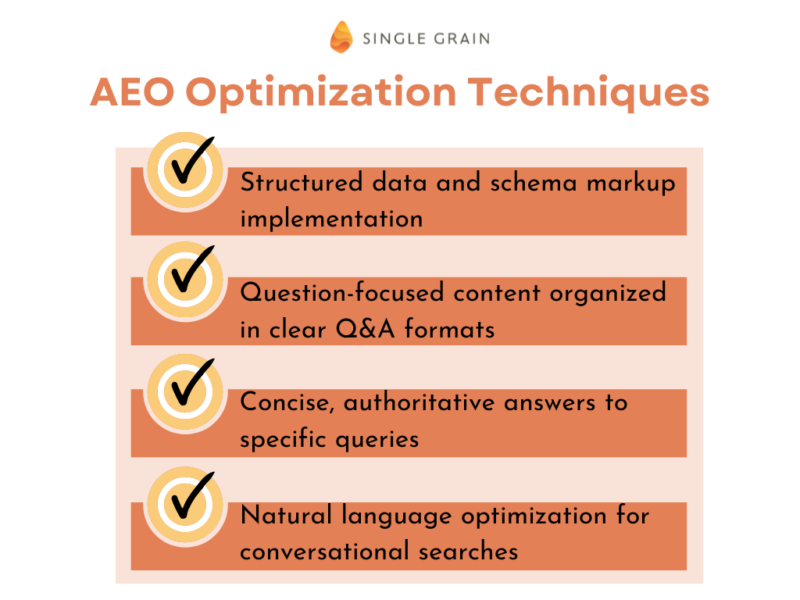
To excel in AEO, a multi-faceted approach is required:
- Content Clarity and Conciseness: AI models prioritize clear, direct answers. Structure your content with definitive statements and avoid ambiguity. Think about how an AI might summarize your text. This means getting straight to the point and providing the most relevant information upfront. For example, when defining a term, start with a clear, one-sentence definition before elaborating.
- Structured Data Implementation: Utilize schema markup to provide explicit clues to search engines and AI about the meaning of your content. This helps AI understand the context and relationships within your data. Implementing FAQ schema, How-To schema, or Product schema can significantly improve the chances of your content being featured in rich snippets and AI answers. More information on schema markup can be found on Schema.org.
- Comprehensive FAQ Sections: Incorporate dedicated FAQ sections that directly answer common questions related to your topic. This provides AI with readily available question-and-answer pairs. Each question should be a clear, concise query, and each answer should be direct and informative. For instance, an article on AEO might include questions like “How does AEO impact voice search?” or “What are the best tools for AEO?”
- Conversational Language: Optimize for natural language queries and voice search by using conversational tones and phrasing that mirrors how users ask questions. This involves using full sentences and addressing the user directly. Think about how a person would naturally ask a question, and structure your content to answer it in a similar, natural way. This approach also improves readability for human users.
- Authority and Trust Signals: Ensure your content is backed by credible sources and demonstrates expertise. AI models are designed to prioritize trustworthy information. Building strong internal links to related content on your site can also boost authority and provide users with more in-depth information. For external validation, consider referencing reputable industry studies, academic papers, or well-known publications 1. Establishing your website as a hub of reliable information is key.
- Optimizing for Featured Snippets: While not exclusively AEO, optimizing for featured snippets (e.g., paragraphs, lists, tables) is a strong indicator of content that is well-suited for direct answers. Crafting concise, answer-focused paragraphs that directly address potential queries can increase your chances of appearing in these prominent search results. This often involves front-loading the answer in a paragraph.
The Future of AEO and AI Search
The trajectory of digital search is undeniably towards more intelligent, conversational, and personalized experiences. AEO is not a fleeting trend but a fundamental shift in how content will be discovered and consumed. As AI technologies continue to advance, answer engines will become even more sophisticated in their ability to understand context, synthesize information, and provide nuanced responses. Brands that proactively embrace AEO will be better positioned to dominate future search landscapes, establishing themselves as indispensable sources of information and solutions. The integration of AI into every facet of online interaction means that AEO will become an increasingly critical component of any successful digital marketing strategy. Further insights into AI’s impact on marketing can be found on Forbes. The evolution of search will continue to prioritize direct answers and intelligent content delivery, making AEO an essential practice for long-term digital success. Understanding the nuances of AI content generation will also be crucial.
Frequently Asked Questions About What is AEO (Answer Engine Optimization)
Q: How does AEO differ from traditional SEO? A: While SEO focuses on ranking web pages in search results, AEO aims to optimize content so that AI-powered answer engines can directly extract and present it as a concise answer to a user’s query. AEO prioritizes direct answers and machine readability, whereas SEO focuses on broader visibility and traffic generation. Think of SEO as getting your book on the shelf, and AEO as getting a specific passage quoted directly by a librarian.
Q: Why is AEO becoming so important now? A: AEO’s importance is growing due to the proliferation of AI-powered search tools and large language models. Users increasingly expect immediate, direct answers, and AEO ensures that your content is positioned to provide those answers, maintaining brand visibility and authority in the evolving digital landscape. The shift in user behavior towards conversational queries and instant gratification makes AEO a critical strategy for relevance.
Q: What are some key elements of an effective AEO strategy? A: Key elements include creating clear and concise content, implementing structured data, developing comprehensive FAQ sections, using conversational language, and building authority through credible information and external references. Another crucial aspect is optimizing for voice search. These elements collectively enhance the machine-readability and trustworthiness of your content.
Q: Can AEO replace SEO? A: No, AEO is not a replacement for SEO but rather a complementary strategy. A strong SEO foundation is essential for AEO, as well-optimized content for traditional search engines often provides the basis for AI systems to extract answers. They work in tandem to enhance overall digital visibility, with SEO laying the groundwork and AEO refining content for advanced AI interactions.
Ready to elevate your digital presence?
Unlock the full potential of your online strategy with Single Grain. Our experts specialize in cutting-edge digital marketing techniques, including advanced AEO strategies, to ensure your brand stands out in the age of AI. Contact Single Grain today to learn more!


