

When a General LLM Is the Wrong Hire for Pipeline Jobs


When a General LLM Is the Wrong Hire for Pipeline Jobs
A new demo request lands in your form inbox. A general chatbot can summarize it, infer company fit, and suggest an owner. Give that conversation permission to update your CRM, and an unsupported inference can become a routing decision. Hire a specialized enrich-and-route bot with a bounded output instead. The same specialization lens applies when you buy digital PR aimed at ChatGPT citations rather than another generic SEO page. Keep account ownership, qualification policy, and record permissions outside its discretion.
Eric Siu’s one-job-per-bot guidance gives Single Grain a practical operating rule: define the job, success condition, and safety bar before choosing the model. “Help marketing” is too broad. “Return an evidence-backed fit score and proposed queue for this submission” is a job you can test and price.
Why general chat fails pipeline jobs
Pipeline work depends on state. A submission has a timestamp, source, required fields, and possibly an existing account relationship. A conversational answer can sound reasonable while overlooking those constraints. The damage appears downstream: duplicate records, conflicting owners, or a sales queue full of companies that never met your ICP.
Start with Eric’s numbers before buying the organizational pitch. In his discussion of marketing-agent adoption, he cites 17 of 100 companies using AI agents in marketing, with those agents covering 3.5% of marketing staff. These figures have different denominators. Neither establishes a productivity gain or supports replacing a department. The buying implication is narrower: ship one owned workflow and measure staff hours saved after review and rework.
Eric’s walkthrough of a live revenue-bot stack supplies the useful story. He moves through concrete jobs, including haggling and speed-to-lead. What emerges is a division of labor, with separate bots handling separate revenue tasks. Take that pattern into procurement: ask for a demonstration of one job against your records, then evaluate the next job separately. Refuse a super-agent package whose responsibilities cannot be isolated.
A specialized marketing LLM need not be a proprietary model. Specialization often lives in restricted inputs, versioned rules, structured outputs, limited tools, and an evaluation set. A general model can power that system. An open-ended chat session should not define its operating contract. Single Grain’s guide to AI tools for SEO workflows applies the same task-first logic to choosing tools.
Worked scene: specialized enrich/route bot
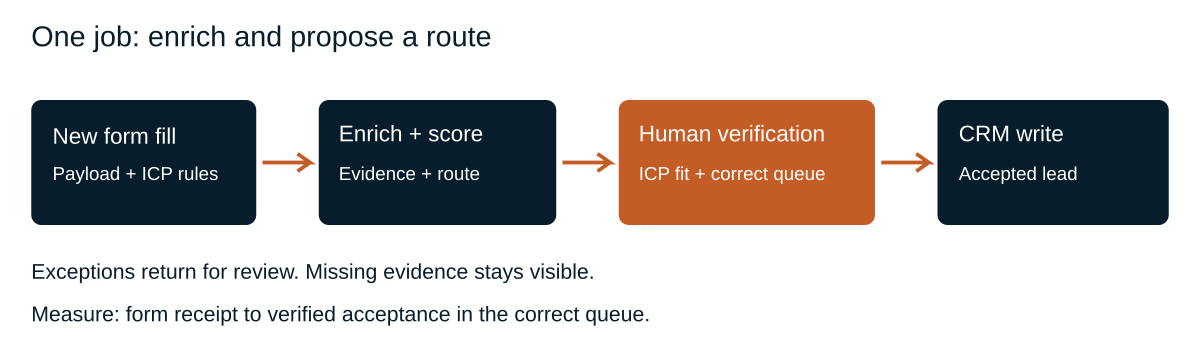
Use this as an implementation specification, not a claimed client result. The trigger is a new form fill. The inputs are the form payload and current ICP rules. The entire job is enrichment plus a route score. The bot does not send email, negotiate pricing, or change account ownership.
The payload contains a work email, company URL, country, and submitted request. The ICP rules define eligible regions, company characteristics, exclusions, and queue thresholds. Approved enrichment lookups can add evidence, but every added field needs a source and retrieval time. An unavailable company-size estimate stays unknown rather than becoming a plausible number.
The output contains enriched fields, evidence references, fit score, proposed queue, and an exception reason. Deterministic rules handle exact exclusions and existing-account matches. The model interprets ambiguous company descriptions. When those components disagree, the submission enters an exception queue. It cannot silently select whichever answer produces a completed record.
Eric’s one-job guidance therefore changes the scope: buy enrichment and routing recommendations, not unrestricted CRM access. His research, draft, and repeat guidance changes the permissions: producing a proposed record and executing an outbound action remain separate capabilities. This bot gets the former. Its execution checkpoint is defined below.
Measure the accepted-lead SLA from form receipt to verified acceptance in the correct queue. Sales operations sets the threshold. Track incorrect routes, missing evidence, reviewer minutes, and exceptions alongside elapsed time. A quick suggestion that sales must repair has not satisfied the job.
The operational urgency has supporting evidence, although it is historical. Harvard Business Review’s 2011 audit of 2,241 U.S. companies found that 37% responded to a web lead within an hour, while 23% never responded. Those figures justify auditing your response gaps, not importing an old benchmark into a new contract. Establish your own baseline before attributing improvement to a bot.
Worked scene: observe → recommend → approve refresh
For a content-refresh bot, start with a URL inventory, Search Console exports, analytics conversions, and previous update dates. Its initial job is observation: flag sustained performance declines and record affected queries, comparison windows, and possible tracking issues. A seasonal dip alone should not trigger a rewrite.
Eric’s observe, recommend, then act-with-approval progression changes the rollout. First compare the bot’s decay flags with an SEO lead’s assessment of historical pages, including healthy pages it should leave alone. Only after those flags prove useful should the bot produce refresh briefs. Draft creation comes later, through the gate below.
A useful brief identifies the URL, evidence of decay, likely intent mismatch, sections to revisit, and measurement window. It also states what remains uncertain. A page losing clicks while holding its ranking needs a different diagnosis from a page losing relevance across its core queries.
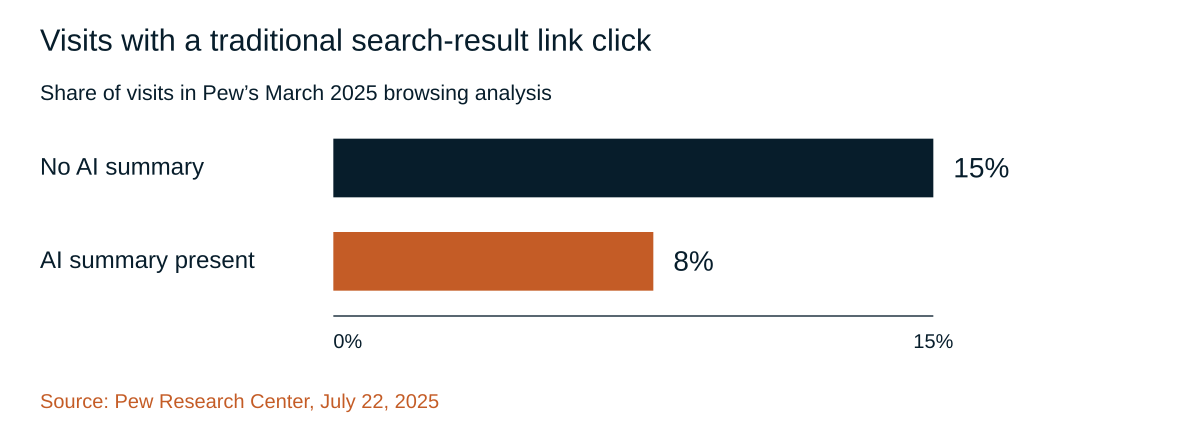
Pew Research Center’s July 2025 analysis supports that distinction. Users clicked traditional results on 15% of visits without an AI summary, compared with 8% with one. About 1% of visits with a summary produced a click on an in-summary source. These are observed behaviors, not a forecast for your site. For prompt selection, use the AI Overview query capture playbook.
| Search visit condition | Observed click rate | Diagnostic implication |
|---|---|---|
| No AI summary: traditional-result click | 15% | Keep search-result context in the comparison. |
| AI summary present: traditional-result click | 8% | Investigate distribution changes before rewriting. |
| AI summary present: in-summary source click | About 1% | Do not equate citation visibility with referral traffic. |
For Single Grain’s AI SEO work, the recommendation is to separate content decay from changes in search-result behavior. Connect the brief to an integrated AEO and SEO strategy where answer visibility matters. Track qualified visits and downstream conversions alongside rankings. Otherwise, the bot may keep rewriting a sound page to solve a distribution problem.
What you do not hand to any model
Keep consequential execution behind a named human ship gate. Before launch, enter the actual owner’s name in the runbook. For the form bot, the sales-operations lead verifies ICP fit and the proposed route before any CRM write. For the refresh bot, the managing editor approves opening a draft and owns the publication decision. Never auto-publish. Unsupervised sends and spending are outside both jobs.
Reserve ICP changes, pricing commitments, suppression policies, and access grants for accountable people. Treat form text and retrieved pages as untrusted data, not instructions. Use narrowly scoped credentials and preserve the input, rule version, evidence, proposed change, and final decision in an audit trail.
Define failure behavior before deployment. Missing evidence should produce an explicit exception. An unavailable integration should leave the item queued rather than marked complete. Retried events should not create duplicate records or drafts. These requirements belong in the operating contract and acceptance test, not in a vague promise that the model is accurate.
How to buy specialized marketing LLMs / next step + CTA
Buy a workflow when its native integrations, evidence capture, permissions, and exception handling fit your operating rules. Build a thin orchestration layer when your ICP logic or content governance is distinctive. Test simpler rules-based automation first. If exact rules solve the job reliably, adding model inference creates another dependency to maintain.
Run the purchasing test on historical inputs, including malformed forms, duplicate accounts, ambiguous descriptions, and URLs with measurement gaps. Require proposed outputs without production changes. Compare them with accepted answers and inspect disagreements. Aggregate accuracy can conceal expensive mistakes in the small subset of leads or pages that matter most.
- Define the trigger, required inputs, allowed output, and explicit refusals.
- Set success measures that include reviewer time, rework, and exception volume.
- Price integration, enrichment, model usage, ongoing review, and maintenance.
- Require exportable logs and independent controls for each capability.
Return to Eric’s adoption figures when judging the pilot. An “AI-first organization” label is not a deliverable. A shorter accepted-lead cycle or a better-supported refresh queue can be. Expand only when measured staff hours and output quality justify the added operating burden.
For Single Grain, start with one pipeline bottleneck that connects acquisition to a measurable business outcome. Bring a form-routing backlog or content-decay queue (start with a legacy content helping competitors audit), governing rules, and examples of correct decisions. Contact Single Grain to scope that workflow, decide what to buy or build, and define the evidence required before expanding it.


