

Agency 2×2: What Work to Productize, Deprioritize, or Stop


At the quarterly service review, the agency managing partner puts the service catalog beside the delivery ledger. The workshop starts with a practical failure: a premium engagement keeps requiring a new brief, a new reporting format, and another senior specialist. Its price looks attractive. Its delivery pattern deserves scrutiny.
The operations lead brings a blank SKU one-pager to the same review. Before approving another delivery hire, the team needs to decide which service deserves fixed inputs, a repeatable workflow, and a defined price. These two worked scenes show how to make that decision. They are operating examples, not claims about Single Grain client results.
TABLE OF CONTENTS:
- Quick Overview
- Why hire/build agents is not a stop/productize matrix
- Worked scene: quarterly 2×2 workshop on utilization × strategic fit
- Worked scene: productized SKU one-pager before hiring more delivery
- 2×2 checklist (axes, Stop / Deprioritize / Productize / Keep custom)
- Single Brain installs the system; Single Grain runs it when you need the team
Quick Overview
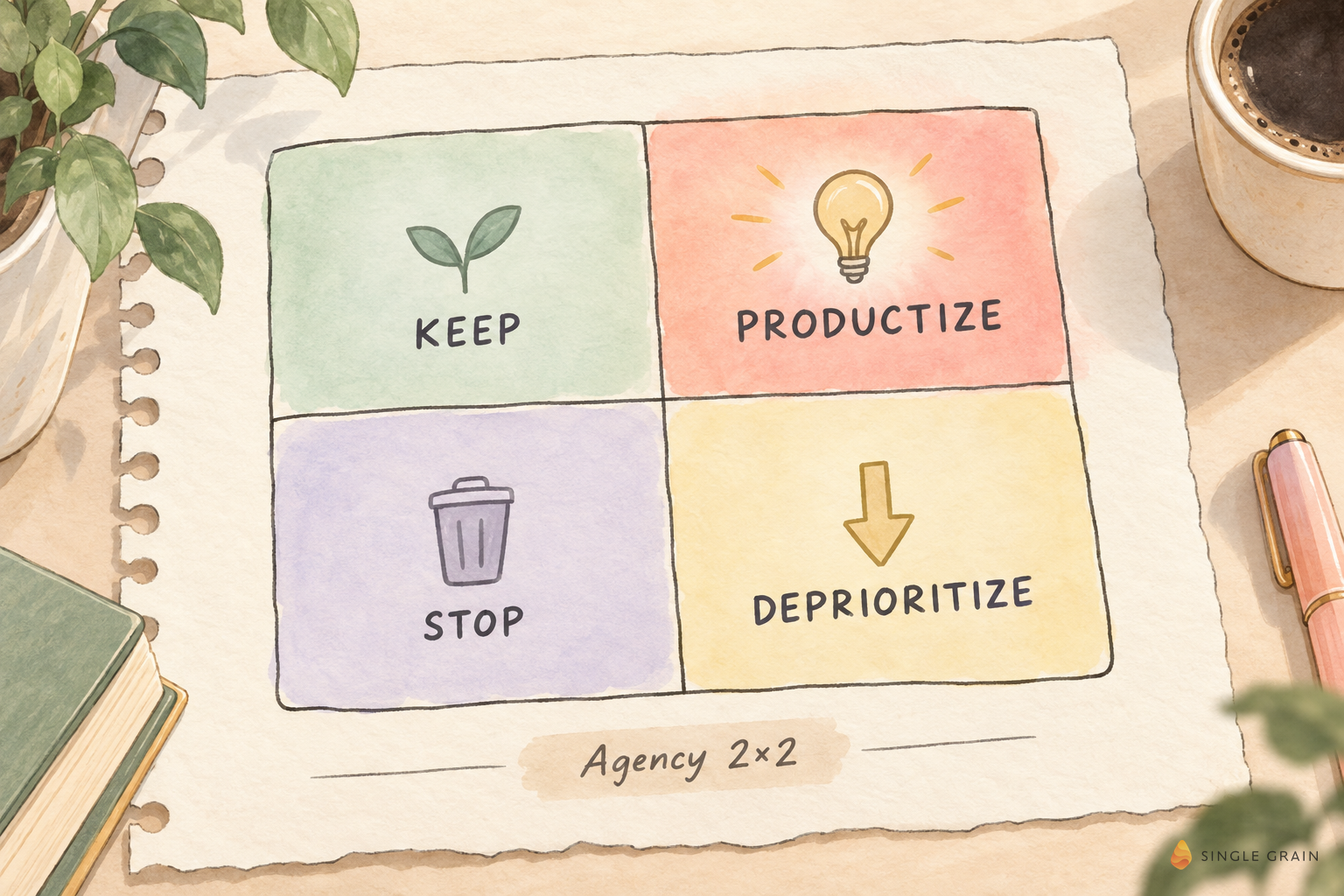
Use the agency 2×2 to decide what you will continue selling before deciding what to automate. Score services on utilization contribution and strategic fit, then test repeatability and project margin before assigning an action. Productize strong, repeatable services; preserve justified custom work; deprioritize distracting exceptions; stop structurally weak offers. The output is a revised service catalog with accountable owners.
- Bring actual delivery hours, scope changes, and project economics to the review.
- Require a fixed-scope SKU before adding delivery capacity to a productizable service.
- Give every Stop decision a commercial exit plan.
- Buy automation only after the surviving service has a usable workflow schema.
Why hire/build agents is not a stop/productize matrix
The Single Grain hire/build agents guide addresses how to resource an agent job. This matrix comes earlier: should the agency sell the underlying service? A well-built agent can accelerate an offer that still consumes scarce specialists, attracts poor-fit buyers, or produces weak economics.
In the Marketing School discussion of reusable workflows, Neil discusses buying agencies that stopped growing. Eric brings the conversation to a 2×2 and reusable AI workflows rather than continuing to sell custom premium work. The sequence matters: examine the agency model, build reusable workflows, then hand them to the team. That changes the first purchase from delivery capacity to service design.
Eric’s point that a better model still needs a better workflow supplies the walk-away rule. Do not buy agents for an offer already headed for the Stop list. For a viable offer without defined inputs, outputs, and exceptions, write the schema before buying a stronger model.
Worked scene: quarterly 2×2 workshop on utilization × strategic fit
The managing partner opens the workshop with service-level records: contracted scope, realized revenue, delivery hours by role, rework, and scope changes. Finance owns the economics. The delivery lead explains exceptions. Account leads identify services that support the agency’s chosen market rather than merely satisfying a vocal customer.
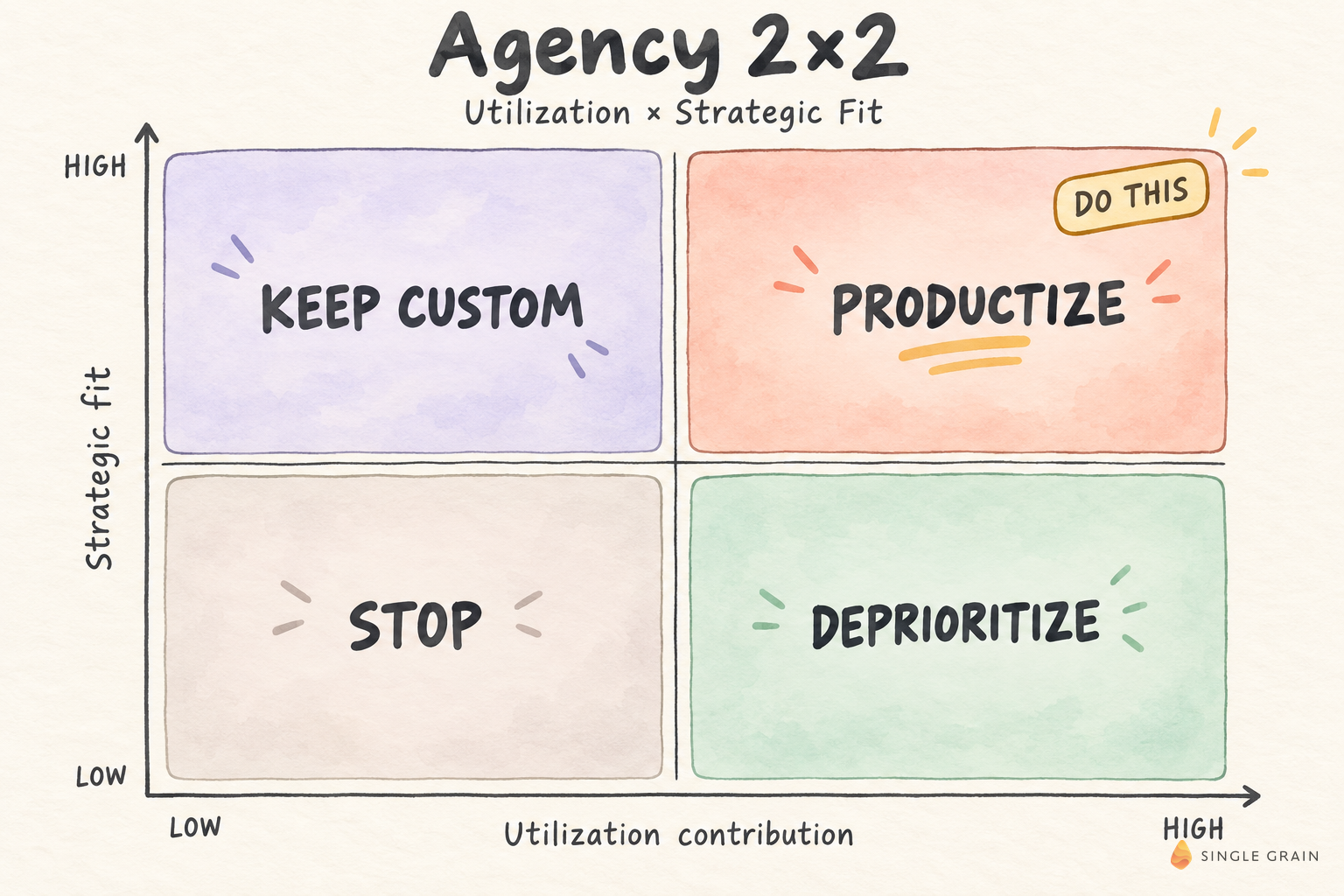
Plot utilization contribution horizontally and strategic fit vertically. Utilization contribution means the service’s effect on deploying available delivery capacity into paid work. Include coordination and revision time in the diagnosis. Strategic fit means the service supports a defined buyer, outcome, and agency capability.
Then apply Eric’s repeatability and margin test as an overlay. A top-right service becomes a Productize candidate only when its inputs and delivery steps recur and its economics survive full labor costs. High-fit work with genuinely variable requirements can remain Keep custom. High utilization alone cannot rescue an unprofitable offer.
The premium engagement from the opening has strategic appeal, but its recurring specialist interruptions make utilization contribution weak. The partner deprioritizes new sales pending a scope redesign. Eric’s recommendation to build reusable workflows and ad machines, then hand them to the team changes the decision: “premium” does not earn an exemption for bespoke one-offs.
The same discussion warns about agencies still running the 2021 playbook. Translate that warning into a mandatory quarterly Stop list, not an automatic price increase for every flat custom service. Record the owner, renewal treatment, contractual obligations, and replacement offer. Stopping new sales need not mean abandoning existing commitments.
The benchmark context reinforces this discipline. Deltek’s summary of SPI’s 2026 benchmark reports 2025 billable utilization of 66.4%, the lowest in the study’s 19-year history, against an approximately 75% optimal level. Project margins were 37.7%; revenue growth was 5.2%. These are professional-services benchmarks, not Single Grain results or targets for every service.
Worked scene: productized SKU one-pager before hiring more delivery
The operations lead takes a repeatable paid-media creative testing service from the workshop’s top-right cell. Before requesting another delivery hire, she writes its SKU: required campaign exports, approved brand assets, a creative brief, a fixed batch of concepts, a review cycle, and a reporting deliverable. Batch size and turnaround are set from demonstrated capacity, not copied from a competitor.
This follows Eric’s recommendation to build reusable workflows and hand them to the team. The changed decision is specific: finish the fixed-scope, fixed-price offer before expanding delivery headcount. Otherwise, the next hire inherits an undefined service and its exceptions.
The one-pager names exclusions, revision limits, access requirements, and change-order triggers. Price must cover delivery labor, tools, quality review, and expected exception handling. Use Single Grain’s managed-agent pricing framework to structure that calculation without assuming automation savings.
The paid-media director is the named human ship gate: approve creative and campaign changes before release; do not autopublish. Success means accepted deliverables within the contracted scope, with actual hours and rework visible. It does not mean the workflow produced more drafts.
The SPI benchmark announcement also reports generative AI use in 27.1% of professional-services projects in 2025, up 40% year over year, with 40% of firms selling AI-related services. Adoption alone therefore provides little differentiation. Sell a bounded deliverable with accountable economics, then use measured capacity constraints to decide when another human hire is warranted.
2×2 checklist (axes, Stop / Deprioritize / Productize / Keep custom)
Keep the plotted axes consistent between reviews. Use repeatability and margin to determine the action rather than pretending every quadrant mechanically produces one answer.
- Productize: Strong utilization contribution and strategic fit, supported by recurring inputs, reusable steps, and viable project margin. Assign a SKU owner.
- Keep custom: Strong strategic value with requirements that genuinely resist standardization. Require pricing and capacity allocation that justify specialist involvement.
- Deprioritize: Weak fit despite acceptable economics, or strong fit with delivery friction that may be repairable. Limit new commitments while testing a bounded redesign.
- Stop: Weak fit and weak utilization contribution, with no credible economic or repeatability case. Remove from new proposals and plan the contractual exit.
Before automating a surviving service, apply Forrester’s priority, people, process, and technology readiness lens. Missing access, ownership, or evaluation criteria means implementation is premature. A stronger model cannot supply an absent service definition.
Single Brain installs the system; Single Grain runs it when you need the team
Single Brain is the AI implementation OS for job-specific agents, eval, and kill switches. Install it around the services that survive the matrix: defined inputs, scoped outputs, evaluation criteria, and clear conditions for pausing a workflow when its requirements fail.
Hire Single Grain to install and run that system when you need the team without staffing the implementation and delivery roles yourself. Bring your service catalog, delivery ledger, and candidate SKU to a conversation with Single Grain. Start by deciding what deserves capacity. Then build the operating system around that decision.


