

If You Explain the Same Task to AI Every Monday, That Is a Skill, Not a Prompt



It’s Monday morning. You open a new AI chat and type out the same instructions you typed last Monday. You spell out the brand rules and the tone, set the format, and paste the two examples of what good looks like. Next Monday you’ll type most of them again. Every marketing team I talk to is quietly doing a version of this. They rebuild the same context by hand, from scratch, every single week.
The repetition is the tell. If you retype roughly the same directions on a schedule, or you keep pasting the same block of brand context into a fresh window, you’re doing the model’s setup work for it by hand. This block deserves a name and a permanent home, not a new chat every time.
By the end of this you’ll know which of your prompts are worth saving, what to put inside one, and how to ship your first marketing skill before Friday.
TL;DR
- Saving a repeated prompt as a skill turns a throwaway instruction into a reusable file the AI loads on its own, with your standing rules, brand context, and examples built in.
- The trigger to convert one is repetition. Any task you re-explain on a schedule, or any context block you keep re-pasting, is already a skill you haven’t saved yet.
- Start with the prompt you repeat most, break it into standing instructions, brand context, guardrails, and variable input, then refine it every run so the quality compounds instead of resetting.
What Is an AI Skill?
A prompt is a single instruction you give in the moment, and the model forgets it once the chat closes. A skill is a saved package of instructions, examples, and rules the model reloads automatically whenever that kind of task comes up.
Think of it like a recipe. A prompt is reading the recipe out loud every time someone cooks. A skill is handing them the card instead. The ingredients, the steps, and the notes stay put, so they get consistent results without you standing over the stove.
This is exactly what happens when you save a prompt as a skill. Anthropic describes a skill as folders of instructions, scripts, and resources the model loads dynamically. You write it once, and the model reads it every time.
The Monday Test: When a Repeated Prompt Becomes a Skill
So what actually makes a prompt worth saving? Repetition. If I explain the same task to AI every Monday, that is not a prompt anymore; it is a skill I just haven’t written down yet.
The second signal is re-pasted context: brand guidelines, reporting templates, tone examples, audience definitions. Every time you paste that block, you are doing the model’s job for it.
Here are four marketing tasks that almost every team repeats on a schedule:
- The weekly performance check. You pull numbers from Meta, Google Ads, and GA4, paste them in, and ask for anomalies and a summary, in the same format with the same thresholds every week.
- The brand-voice rewrite. Someone pastes draft copy and re-explains your tone rules, your banned words, and your audience, then asks for a rewrite. Same context block, different draft.
- The monthly SEO content brief. You describe the funnel stage, the keyword cluster, the internal-linking rules, and the format. Next month, same instructions, new keyword.
- The ad creative variation. You feed a winning headline and ask for ten variations inside your character limits and brand rules. Same constraints, new seed copy.
A prompt is not infrastructure, and most teams still run their best work like it is. If any of these feel familiar, you already have skills. You just haven’t saved them yet.

What a Marketing Skill Actually Contains
A bare prompt carries none of its own context, so you supply it fresh every time and any missing detail turns into drift. Package it as a skill and everything the model needs is already waiting before you hand over the day’s input.
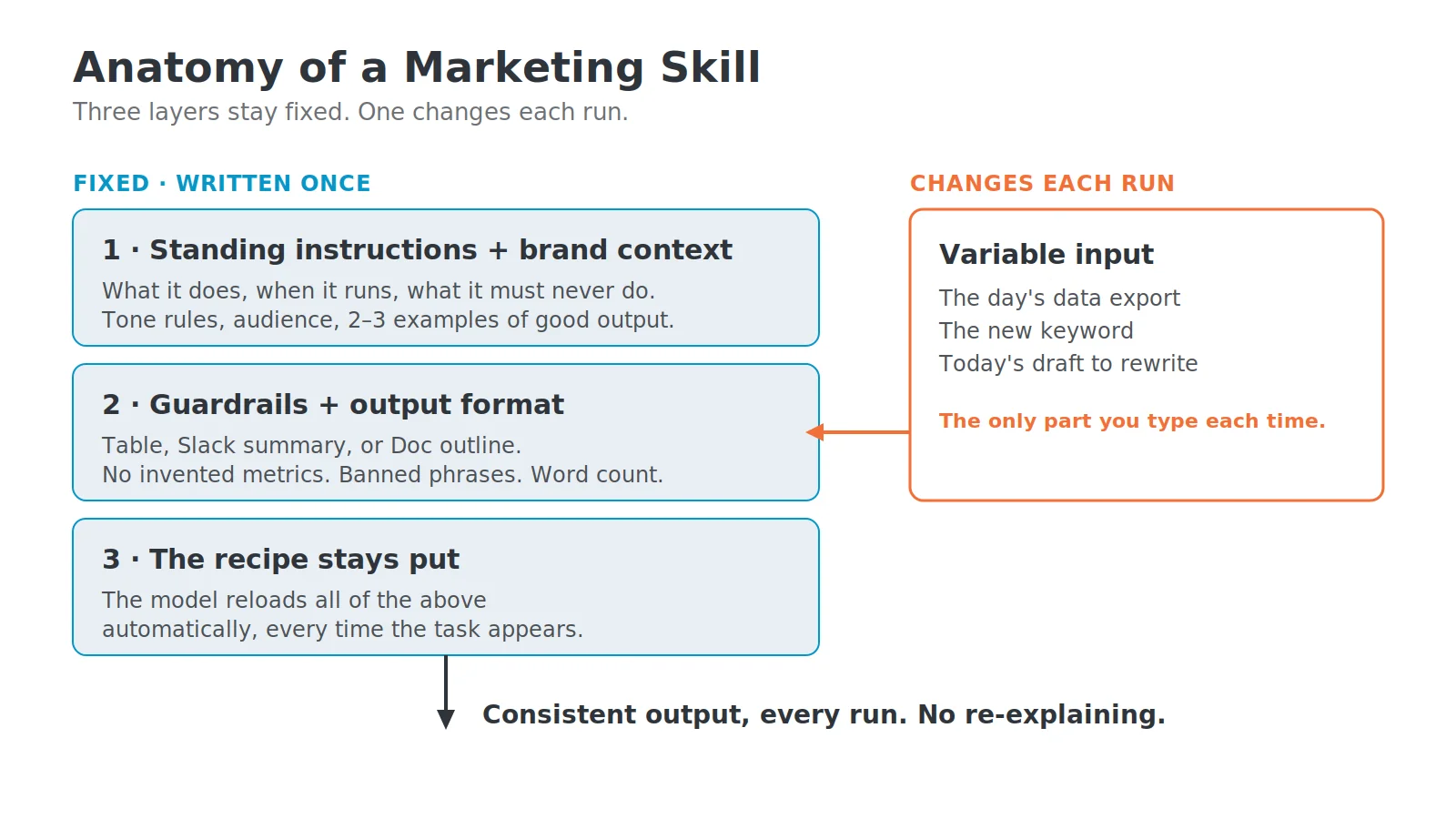
One pattern shows up across marketing teams. The drift is almost never a model problem; it is the context they forget to paste. A skill fixes that by making the context permanent. Three layers stay fixed, and one changes each run.
Standing Instructions and Brand Context
The first layer is the standing instructions: what the skill does, when it runs, and what it must never do. For a brand-voice rewrite, that means your tone rules, your audience, and two or three examples of what good looks like. The model reads these before it ever sees your new draft.
Guardrails and Output Format
The second layer is guardrails and format. Specify the shape of the output, whether that is a table, a Slack-ready summary, or a Google Doc outline. Then set the lines it cannot cross. No invented metrics, no banned phrases, a fixed word count.
The Variable Input
The third layer is the only part that changes. The variable input is the day’s data export for the performance check, or the new keyword for the content brief. Everything else stays locked.
Turn Your Best Prompts into AI Skills This Week
Here is what to do before Friday.
Audit your last 30 days. Open your AI chat history and find the prompts you sent more than twice. Look for the pasted context blocks. Those are your skill candidates.
Pick the one you repeat most. Not the most complex task, the most frequent one. Frequency is where the compounding shows up first.
Then take that repeated prompt and break it into its parts:
- Standing instructions and brand context, with examples of good output
- Guardrails and output format
- The variable input it expects each run
Save it, run it, and compare the result to your old bare prompt. Then refine. I’d rather save a task the second time I explain it than retype it a tenth time, because every edit makes the skill sharper and that improvement carries into every future run. A prompt you typed ten times taught you nothing after the first. A skill you refined ten times is ten versions better.

Where Marketing AI Skills Already Live
You don’t have to build from zero. Skill managers already exist for the major coding agents, and marketing skills are starting to arrive as connectors inside the big AI assistants. Teams are publishing them too. One shared a set of skills that check Meta, Google Ads, and Search Console on a schedule and suggest what to change. The pattern is the same everywhere. Save the instructions once, and let the model load them on demand.
Single Grain’s open-source AI marketing skills give you a starting library for common tasks, built to be forked and edited. If you’re already running AI for marketing workflows, the distance between what you do now and a saved skill is probably one afternoon of documentation, and there are more AI skills resources to pull from as you expand.

Nobody sets out to rebuild the same instructions every week; I’ve yet to meet a team that planned it that way. Your best prompts shouldn’t die in a chat window as disposable messages. They are reusable operational assets, and the teams pulling ahead are the ones treating them that way. If you’re sitting on dozens of repeated prompts and want help turning them into a system that compounds, talk to Single Grain’s AI marketing team.


