Blogging Frequency for Business: How Often to Post and Why


How often should you blog when your team is already stretched thin? Oftentimes, businesses will publish a chunk of blogs in bursts after a planning meeting, then go quiet for two months. Does frequency and consistency of your website’s blog really matter for SEO and AEO?
Your blogging frequency should match three objectives: your goal, your industry, and how many good posts your team can produce without cutting corners. A steady, sustainable rhythm is the best way to maintain your company blog.
The good news? AI writing has changed how easy it is to create content and maintain your blog. Of course, you need to make sure you don’t publish AI slop grenades, and I’ll show you how my team produces high-quality AI content (with minor human edits) later in this guide.
Below, you’ll find beginner-friendly blogging advice B2C, B2B, and SaaS companies, five tips for picking your pace, and the quality checks that keep a higher volume of blog production from hurting your brand (and site health!).
TL;DR
- Consistency matters more than any magic number. For most businesses, four quality posts a month is a strong starting point, and growth-focused teams can push to weekly or more.
- Your industry changes the answer. B2C brands often publish more often to catch seasonal and trend searches, while B2B and SaaS teams can win with fewer, deeper posts aimed at buyers.
- Pick your pace from your capacity. Count how many posts your team can research, write, edit, and promote well, then commit to that rhythm for at least a quarter.
- AI raises the ceiling only with guardrails. My team published more than twenty posts in one week by checking every draft against written editorial rules and grading each post after it went live.
What Blogging Frequency Means for a Business
Your blogging frequency is how often you publish new posts on your company blog, usually counted per week or per month. For a business, it’s less about staying busy and more about giving search engines and buyers a reliable stream of useful answers.
A business blog accomplishes three jobs.
- It brings in search traffic
- It answers questions buyers ask before they talk to sales
- It gives your other channels something to share.
Each new post is another page that can rank, another link your email and social teams can send, and another answer an AI assistant might cite.
So the right frequency is the one that keeps these jobs running. If you’re new to this, my team’s breakdown of whether blogs are still relevant covers why a blog still earns its place in a modern marketing plan.
How Often Should I Blog?
For most small and mid-sized businesses, two to four posts a month is a smart floor. It’s enough to build momentum in search without burning out your team. Of course, we’re talking about traditional copywriting here. This number is easy to scale if you have AI tools in your pocket (and know how to use them PROPERLY). Companies chasing aggressive organic growth often publish weekly, and some publish several times a week.
So how often should I blog if I’m just starting out? Start with one or two posts a month you’re proud of, then add volume once you have a repeatable process. A blog with eight excellent posts usually outperforms a blog with forty thin ones.
Google’s own guidance on creating helpful, reliable, people-first content makes the same point from the other side. Search rewards pages that genuinely help the reader, regardless of how often they’re published.
Those ranges are a starting point. Your industry and goals push the number up or down, which is where most of the real decisions happen.
Blogging Frequency by Industry
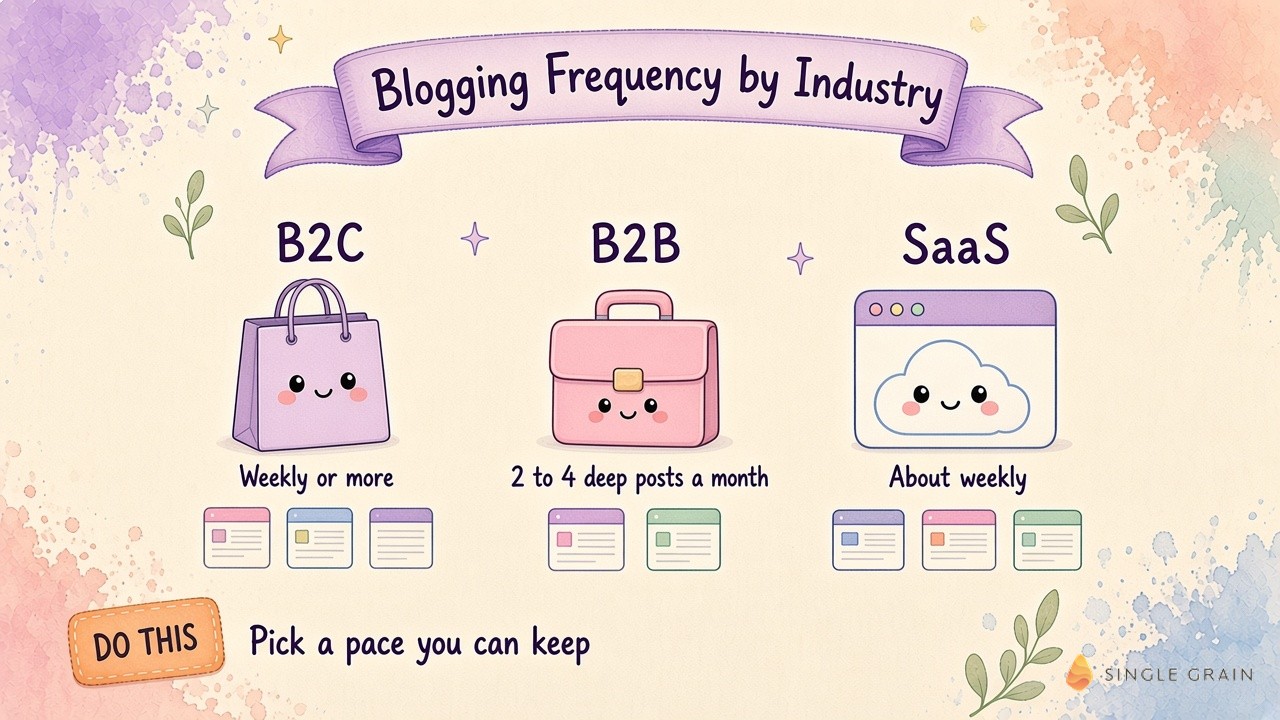
Different businesses blog for different reasons, so the right rhythm shifts by model. Here’s how I’d think about the three most common ones.
B2C Brands
Consumer brands often benefit from a higher cadence. Shoppers search for gift ideas, how-to tips, seasonal trends, and product comparisons all year, and many of those searches spike around specific dates. Weekly posting, or more during peak seasons, helps you catch those moments.
B2C posts can also be shorter and more varied. A quick styling guide, a recipe, or a buying checklist can each drive traffic on its own, so volume tends to pay off faster here.
B2B Companies
B2B buyers move slower and research harder. A purchasing committee might read a dozen pages before anyone fills out a form, so depth often matters more than raw volume. Four in-depth posts a month, each aimed at a real buyer question, is a strong rhythm for many B2B teams.
Quality is the lever here. One post that answers a pricing question better than anyone else can generate pipeline for years, especially when it feeds a content marketing program built around buyer questions.
SaaS Companies
Software-as-a-service (SaaS) companies usually sit in the middle. They need educational posts to attract new users, comparison and alternative pages to catch buyers, and product-led tutorials to help customers succeed. Weekly publishing is common for SaaS teams with a real growth target.
SaaS blogs also lean heavily on topic clusters, where a group of related posts supports one core page. If that’s your plan, my team’s guide on how to build topical authority shows how to sequence the posts.
Whatever your model, the five tips below help you land on a number your team can actually keep.
5 Tips to Choose Your Blogging Frequency
These tips work for any business, from a two-person marketing team to an enterprise content department. Work through them in order before you lock in a calendar.
1. Start With Your Goal
Decide what the blog is for. If you want search traffic, you’ll need more posts over time. For sales enablement, a smaller set of deep buyer guides may do more. Your goal sets the minimum.
2. Count Your Real Capacity
Add up the hours it takes to research, write, edit, design, and publish one good post. Then compare that to the hours your team actually has. The honest answer is your sustainable frequency, even if it’s lower than you hoped.
3. Pick a Rhythm You Can Keep for a Quarter
Commit to one cadence for at least three months. Search results take time to respond, so changing your pace every few weeks makes it impossible to tell what’s working.
4. Plan Updates Alongside New Posts
New posts aren’t the only way to grow. An update to an older post that’s slipping in rankings is often faster than writing a new one, and my team’s guide to how often you should update your blog covers that side. A healthy calendar mixes both.
5. Check for Overlap Before You Publish
More posts can mean more posts competing for the same keyword. Before anything new goes live, run a quick keyword cannibalization check so you don’t split your own traffic.
| Pro-Tip |
|---|
| Write your publishing cadence into a one-line team rule, such as “two buyer guides and one refresh every month.” A rule everyone can repeat is far easier to keep than a color-coded calendar nobody opens. |
Those five tips give you a number. The next question is whether AI can help you raise it without lowering the bar.
Can AI Raise Your Content Velocity?
Yes, with a BIG condition. AI can draft faster than any writer, so it removes the biggest limit on content velocity. Content velocity is simply how fast your team can move a post from idea to published page, and AI shortens the drafting step dramatically.
The RISK is volume without quality. Google’s spam policies call out scaled content abuse, meaning many pages made mainly to rank rather than to help people. More posts only help when every post still earns its place.
My team learned this firsthand. Recently, we published more than twenty SEO posts in one week, while most companies I talk to publish two to eight a month. And yes, these blogs are high-quality and are showing real results in Google Search Console! I broke down how we did it in a post on X, and the short version is that every post had to clear the same bar a human editor would set.

That speed only held up because of the checks we put around it. Those checks are worth copying even if you never use AI at all.
How My Team Keeps Quality High at Higher Volume
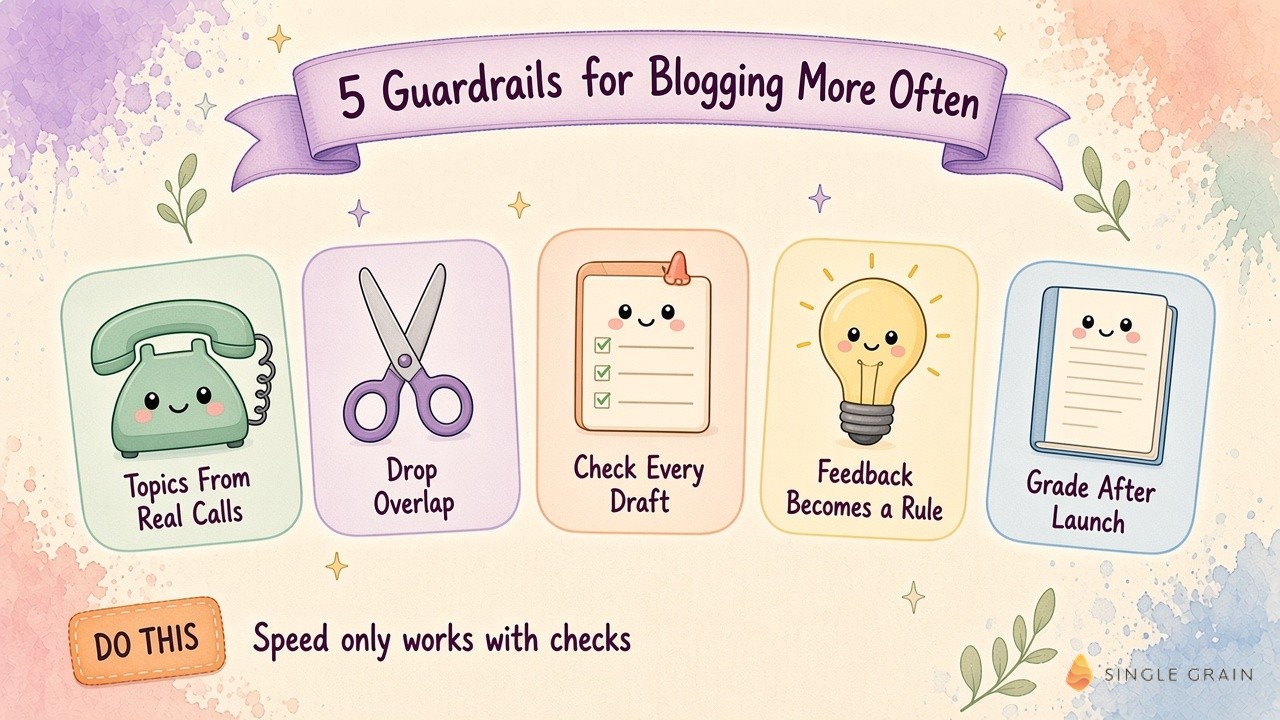
Here’s the system behind our faster publishing pace. Every piece runs through the same five checks.
- Topics come from real conversations. Some of our best ideas come from internal calls, where clients and teammates ask questions in their own words.
- Overlap gets dropped. If a live post already covers a topic, the new idea gets cut or turned into an update.
- Written rules check every draft. We keep one hundred thirty-six editorial rules, plus checks for the title, meta description, and FAQ, and every draft has to pass them.
- Feedback becomes a rule. Each time an editor corrects something, the correction becomes a new rule, so the same mistake doesn’t come back.
- Every post gets graded after launch. We review each post at fourteen, twenty-eight, and sixty days on impressions, clicks, position, and leads.
You can see the first-pass checklist we use in my SEO content checklist. The grading step matters just as much, and my post on how to build and grade an SEO plan explains how we score posts once they’re live.
If AI drafts are part of your plan, my team also covered whether AI content is bad for SEO. The answer depends far more on your review process than on the tool.
Signs Your Blogging Frequency Is Working
You’ll know your rhythm is right when a few signals move together. Watch them monthly so you can adjust without overreacting to one bad week.
- Impressions climb steadily. New posts start appearing in search, and older posts hold their ground.
- Clicks follow impressions. Your titles and meta descriptions earn the visit once a post ranks.
- Leads show up in your CRM. Readers move from posts to demos, quotes, or sign-ups.
- Your team isn’t burning out. The calendar feels steady instead of frantic.
If impressions grow while leads stay flat, the issue is usually topic choice rather than frequency. Shift a few posts toward buyer questions before you add more volume.
Set a Blogging Frequency You Can Keep
So, how often should you blog? Pick the highest pace your team can sustain with quality, usually two to four posts a month to start, then grow from there with clear guardrails. B2C brands can push volume, B2B teams can win with depth, and SaaS companies often land on weekly.
Want to really scale your blog, improve your brand position, and pull in quality traffic that actually converts? My AI-native team can help!
If you’d like help building a blog that publishes consistently and drives leads, my team at Single Grain offers content marketing services and SEO services. Contact Single Grain and we’ll help you find the right pace for your business.
Frequently Asked Questions About How Often You Should Blog
-
How often should a small business blog?
Most small businesses do well with two to four quality posts a month. Start with what your team can sustain, then add volume once you have a repeatable process.
-
Is posting one blog a week enough?
Weekly posting is enough for many businesses and is a common rhythm for SaaS and B2C brands. Consistency and quality matter more than hitting a specific number.
-
Does blogging frequency affect SEO?
Frequency helps when each post is useful, because more quality pages give you more chances to rank. Thin posts published only for volume can hurt, so read whether AI content is bad for SEO before scaling.
-
Should I update old posts or write new ones?
Do both. Refreshing a slipping post is often faster than writing a new one, so plan updates into your calendar alongside new content.
-
Can AI help me blog more often?
Yes, AI can speed up drafting, but every post still needs editing, fact-checking, and a quality check before it goes live.