How to Build and Grade Your SEO Plan Before You Fund It


An SEO plan can look polished in a slide deck and still waste six figures once the budget lands. Most plans fail for boring reasons. They give vague advice, never tie back to revenue, and say nothing about AI search. Nobody catches it until the quarter is gone.
So my team open-sourced a fix. I shared an SEO expert panel on X, a file with 10 AI experts who grade any SEO plan out of 100 before you fund it. I love how it turns the sign-off meeting from a gut call into a scorecard. It even rewrites the weak parts before a human reads them.
Keep reading to see what goes into a fundable SEO plan, the full SEO audit checklist the panel uses, and how to run it yourself in Claude Code or any AI agent.
TL;DR
- A good SEO plan ties every action to revenue. It names target queries, owners, timelines, and an expected return, and it accounts for AI Overviews, ChatGPT, and Perplexity.
- The panel scores plans out of 100. Ten AI experts, from a technical SEO specialist to an ROI expert, grade the plan and dock points for vague advice.
- Under 90 means a rewrite. The agent fixes the weak parts and rescores, up to three rounds, then shows the final score and every change.
- You can run it today. The file is free on GitHub, and one prompt in Claude Code or ChatGPT gets the panel working on your plan.
TABLE OF CONTENTS:
What Is an SEO Plan?
An SEO plan is the written roadmap for how your site will earn search traffic and revenue over a set period. It lists the queries you’ll target, the pages you’ll create or fix, the technical work, who owns each piece, and what return you expect.
A strong plan reads like an investment memo, since someone is about to fund it. Google’s own SEO Starter Guide covers the basics every plan should respect, from crawlable pages to helpful content.
SEO Plan vs SEO Strategy
These two terms sound similar, but they refer to different things. An SEO strategy is the bigger picture, meaning where search fits in your growth and which markets you want to own. Meanwhile, the SEO plan is the operating version of that strategy, with dates and dollars attached.
Where I see problems arise is when teams blur the two. They end up with a strategy deck full of ideas but no plan anyone can execute.
Plans also go wrong in predictable ways. My team covered the most common ones in 12 reasons your SEO strategy is failing. This post picks up one step earlier, at the moment before you approve the budget.
Now that we’ve settled this debate, let’s take a closer look at SEO planning.
How to Build an SEO Plan Worth Funding
Before you grade anything, the plan has to exist in a form someone can check. Most SEO plan templates cover the same core parts, and the panel scores each of them. If you’re starting from a blank page, build your plan in this order:
- Set the business goal. Name the revenue, pipeline, or lead target search should move, and the time frame.
- Pick the target queries. List the keywords and questions you’ll go after, grouped by topic and buying stage, including the ones that trigger AI answers.
- Audit what you have. Note the technical issues, thin pages, and existing posts that already rank, so new work doesn’t compete with them.
- Map the work. Assign each page to create or fix, plus the technical tasks, with an owner and a due date for each.
- Estimate the return. Write down the expected traffic, conversions, and revenue for every major line item, along with your assumptions.
- Name the risks. List what could go wrong and how you’ll know early.
A plan with those six parts is ready for the panel. One missing piece usually becomes the lowest score.
Meet the 10-Expert SEO Panel
The panel lives in a single markdown file in my AI marketing skills repo on GitHub. Each expert has one job and one question it asks of every plan.
Here’s the lineup and what each one checks:
- Technical SEO Specialist. Site architecture, crawlability, Core Web Vitals, and structured data.
- Content Strategist. Topic clusters, content gaps, and search intent alignment.
- Conversion Rate Optimizer. Whether the plan connects to revenue or only to traffic.
- Revenue Attribution Expert. Whether each recommendation ties to dollar outcomes.
- Competitive Analyst. What competitors are doing and where the gaps are.
- AI/AEO Specialist. Whether the plan accounts for AI Overviews, ChatGPT citations, and Perplexity.
- Data Scientist. Whether the analysis is statistically sound and the trends are real.
- Growth Hacker. The fastest path to measurable results.
- Operations Expert. Whether the plan is feasible with current resources and timelines.
- ROI Calculator. Whether the plan clears a 4:1 return bar and what return to expect.
The AI search specialist is the one I’d never skip now. A plan written two years ago could ignore AI answers, but today a big share of buying research starts in one, and optimizing for AI search is part of SEO.
With the experts in place, the next question is what they actually score.
The SEO Audit Checklist the Panel Uses
Think of this as an SEO audit checklist for the plan itself, separate from a site audit. A full site audit, like the one in my team’s guide on how to perform an SEO audit, finds problems on your website. This checklist finds problems in the plan meant to fix them.
Data Backing
Every claim should rest on real data, such as Search Console queries, rankings, or competitor gaps. Projections are fine as long as the assumptions are written down. A plan that says “traffic will double” with no source loses points fast.
Actionable Specificity
This is my favorite check. The panel docks points for vague advice like “optimize your content.” A specific plan names the page, the query, the change, and the owner.
ROI Estimate Quality
The ROI expert holds the plan to a 4:1 return bar. Every major line item needs a realistic estimate with its assumptions stated, which forces the team to prioritize the work with the biggest payoff.
Risk Assessment
A good plan is honest about what could go wrong, like a migration that dips traffic or a cluster that cannibalizes existing pages. My team’s keyword cannibalization guide is a useful companion for this check.
Feasibility and Alignment
The last two checks ask whether your team can actually ship the plan with current resources, and whether it serves the business goals leadership cares about this year.
Those criteria are what turn a pretty deck into something you can fund. Now let’s run it.
How to Grade Your SEO Plan With AI
The setup takes about five minutes. Download the file from GitHub, drop it into Claude Code, Cursor, ChatGPT, or whichever agent your team uses, then paste the prompt below. It’s the same wording I shared in the original post.
| Starter prompt for grading an SEO plan |
|---|
| Read this file. Before you show me any SEO plan, have all 10 experts score it out of 100. Under 90, rewrite the weak parts and score it again, up to 3 rounds. Show me the final score and every change. |
The agent will score the plan with each expert, combine the results, and flag the weakest sections. If the total lands under 90, it rewrites those sections and runs the panel again.
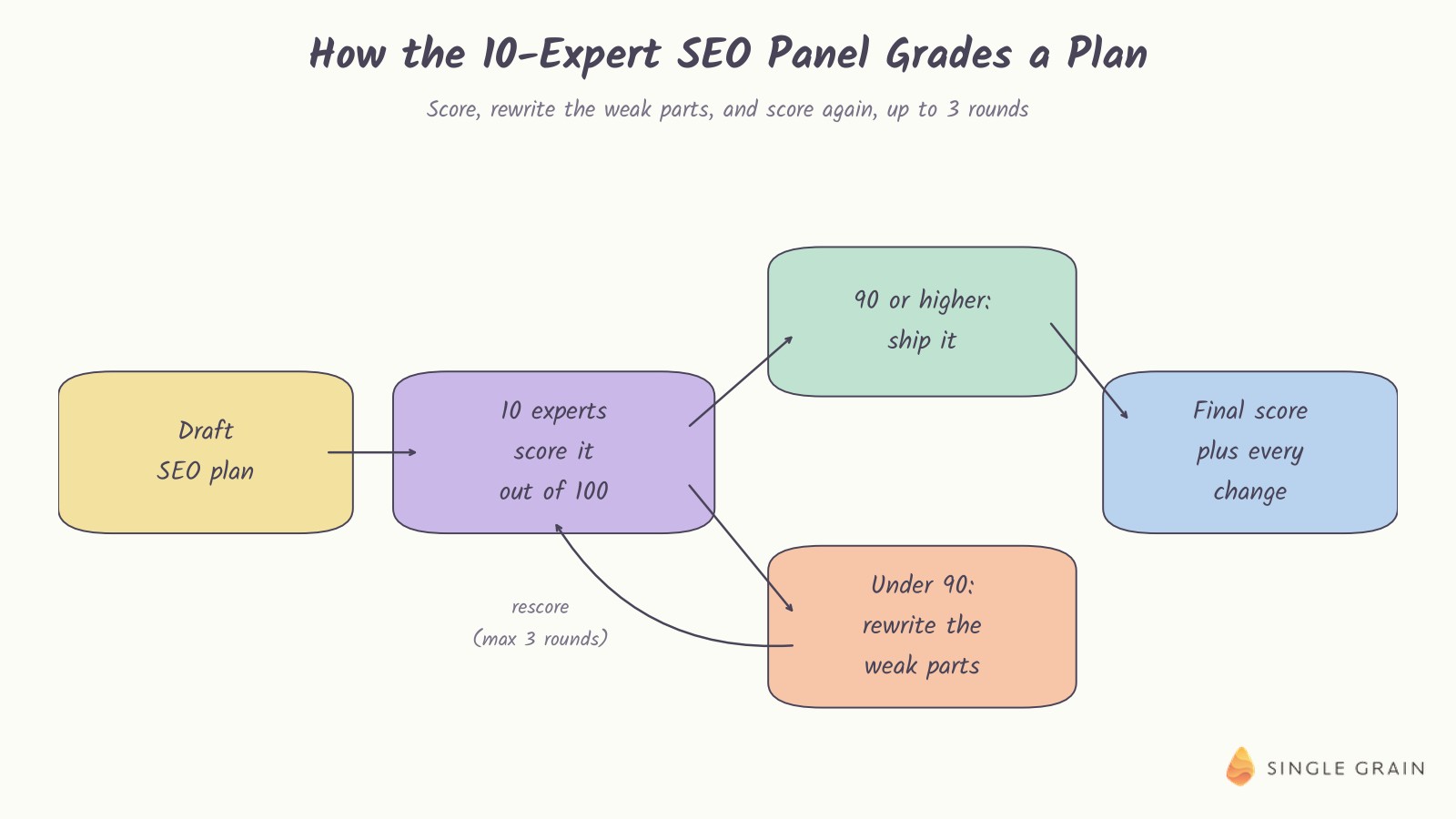
The three-round cap matters. Without it, an agent can keep polishing forever, and you’d rather see a solid plan at 91 than wait for a perfect one.
Once you have a score, here’s how I’d use it in a real budget conversation.
What to Do With the Score
A score above 90 means the plan is ready for a human review. It’s still no guarantee of results. I still want a senior SEO to read the final version and sanity-check the priorities, especially the ROI estimates.
A score in the 70s or 80s usually points to the same few gaps. The plan is light on AI search, it lacks revenue estimates, or it’s full of generic advice. Read the change log the agent produces, since that list shows you exactly what your team or agency left out.
| Pay Attention |
|---|
| If an agency hands you a plan, run it through the panel before your next call. The weak spots it flags make a great agenda for that meeting. |
It’s a fast way to raise the bar on every plan you see, whether it comes from your team or a vendor.
Scoring also works best when it’s part of a bigger loop.
Where the Panel Fits in Your SEO Strategy
The panel is one piece of a larger system my team runs, where everything we publish gets measured and the results shape the next draft. I walked through that loop in my AI operating system video.

The same idea applies to plans. Score the plan before you fund it, measure the results after you ship, and feed what you learn into the next plan. Over a few quarters, your plans get sharper, and the panel’s job gets easier.
If you’re also scoring drafts, my humanizer skill post shows how my team grades AI writing before anyone reviews it.
When to Run the SEO Plan Panel
The obvious moment is right before a budget decision. Run the panel when a new plan lands on your desk, whether it came from your team, a new hire, or an agency pitch.
It also pays to rerun it on a schedule. A plan written in January can look dated by summer, especially as AI Overviews and AI answers change which queries still send clicks. A quarterly rescore shows you which parts of the plan still hold up and which ones need a refresh.
Finally, run it after a big miss. If traffic or pipeline from search drops, score the plan that’s currently running. The lowest category usually points to the cause faster than a long post-mortem meeting.
Fund SEO Plans That Earn Their Budget
A strong SEO plan names the work, ties it to revenue, and accounts for AI search. The expert panel gives you a fast, repeatable way to check all three before a dollar goes out the door. Download the file, run your current plan through it, and see where it lands.
If you’d like a team to build and run a plan that clears the bar, my team at Single Grain offers SEO services and AEO services tied to pipeline. Get in touch with Single Grain and we’ll score your plan together.
Frequently Asked Questions About Grading an SEO Plan
-
What should a good SEO plan include?
A good SEO plan names target queries, owners, timelines, and an expected return for each action. It should also account for AI Overviews, ChatGPT, and Perplexity.
-
How does the 10-expert AI panel grade an SEO plan?
Ten AI experts, from a technical SEO specialist to an ROI expert, score the plan out of 100 and dock points for vague advice, missing data, and weak return estimates.
-
What score should an SEO plan hit before I fund it?
Aim for 90 or higher. Under 90, the agent rewrites the weak parts and rescores, for up to three rounds, then shows the final score and every change.
-
Where can I get the SEO panel file?
It’s free on GitHub. Load it into Claude Code or ChatGPT with your plan and one prompt to run the panel.
-
Can the panel replace an SEO audit checklist?
It works as one. The panel scores data backing, actionable specificity, ROI estimate quality, risk, and feasibility, which covers what most audit checklists ask before a plan gets funded.