

Meta Ad Prices Are Up 14%. How Do I Keep Facebook Ads Cost Down?


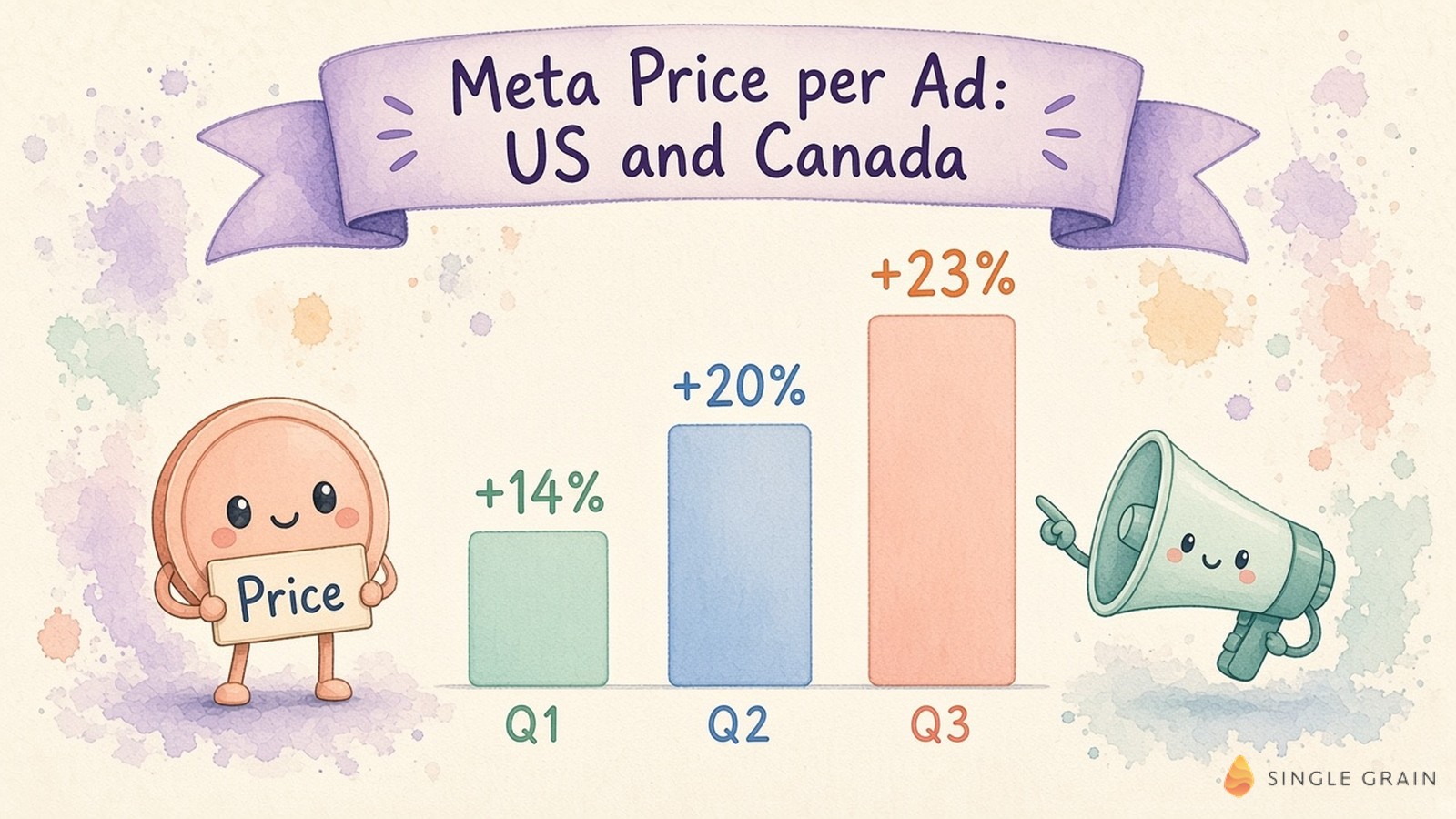
If your Facebook ads cost more this quarter than they did a year ago, you’re not imagining it. Meta’s own Q3 2026 results show the average price per ad up 14% worldwide and 23% in the US and Canada. For a growth team with a fixed budget, the same spend now buys fewer impressions.
The good news? You still have more control than you think. Your bill comes out of an auction where creative, conversion data, and campaign setup count alongside your bid, so two advertisers in the same industry can pay very different prices.
Below, you’ll find current CPM, CPC, CPL, and CPA benchmarks from named sources, what pushed prices up, how much budget you really need, and the levers I’d pull first to keep spend efficient. My Facebook advertising team runs this playbook every day, so I’m excited to share it with you!
TL;DR
- Benchmarks depend on the sample. Triple Whale’s ecommerce data puts the median Meta CPM at $15.06 and CPA at $38.99, while WordStream’s 2026 report shows a $0.60 traffic CPC and a $27.39 cost per lead.
- Prices are rising faster than supply. Meta’s average price per ad grew 14% year over year in Q3 2026 while impressions grew 10%, and the US and Canada saw a 23% jump.
- The auction rewards relevance. Meta picks winners by bid, estimated action rate, and ad quality, so stronger creative and cleaner conversion data can lower what you pay.
- Judge cost by outcomes. A higher CPM is fine when your cost per qualified lead or customer holds steady, so set targets on CPA and pipeline before you cut spend.
TABLE OF CONTENTS:
- How Much Do Facebook Ads Cost in 2026?
- Why Meta Ad Prices Rose 14% This Year
- Facebook Ads Cost by Campaign Objective
- What Drives Your Meta Ads Cost?
- How Much Should You Spend on Facebook Ads per Month?
- How to Lower Facebook Ads Cost Without Losing Volume
- When Higher CPMs Are Still Worth Paying
- Keep Your Meta Budget Working Harder
How Much Do Facebook Ads Cost in 2026?
Fair warning: This next section is going to be data heavy. Ready? Let’s take a look at the numbers.
Recent medians run from about $7 to $22 for every thousand impressions, under a dollar per click on traffic campaigns, and about $27 to $39 per lead or purchase. These ranges come from three large, recent datasets, each measuring a different slice of advertisers.
| Metric | Median benchmark | Source and sample |
|---|---|---|
| CPM | $15.06 | Triple Whale, 40,000+ ecommerce brands, Aug 2025 to Jul 2026 |
| CPM | $7.26 | Databox, 2,800+ companies, updated Oct 22, 2026 |
| CPC (traffic objective) | $0.60 | WordStream 2026, 1,892 US campaigns, Apr 2025 to Jun 2026 |
| CPC (leads objective) | $1.80 | WordStream 2026 |
| CPC (all clicks) | $0.40 | Databox |
| Cost per lead | $27.39 | WordStream 2026 |
| Cost per purchase (CPA) | $38.99 | Triple Whale |
Why such a spread? Triple Whale’s Meta benchmarks cover ecommerce brands buying conversions, Databox’s Facebook Ads benchmarks pool companies across industries, and WordStream’s 2026 Facebook ads benchmarks report tracks US traffic and lead campaigns.
Treat the medians as a sanity check, and use your own trailing results as the real baseline.
Facebook Ads CPM Benchmarks
Triple Whale’s median CPM of $15.06 is up 13.24% from $13.30 a year earlier, and sixteen of its seventeen industries got more expensive. The range runs from $11.50 in baby products to $21.80 in health and wellness, so your vertical sets the starting line.
Databox’s cross-industry median sits lower at $7.26, which reflects a broader mix of objectives and markets. If your CPM lands between the two, you’re in normal territory. For more context on reach and usage, see these Facebook ads statistics.
Facebook Ads Cost per Click Benchmarks
WordStream puts the median cost per click for traffic campaigns at $0.60, down from $0.70 the year before. Arts and entertainment advertisers paid the least at $0.34, while finance and insurance paid the most at $0.86.
Leads campaigns cost more per click, with a $1.80 median, because Meta hunts for people likely to fill out a form. Their median cost per lead was $27.39, ranging from $12.30 in career and employment to $61.56 for dentists.
Those numbers set the baseline. The bigger question for your budget is why the baseline keeps moving up.
Why Meta Ad Prices Rose 14% This Year
Meta reported its Q3 2026 results on October 21, and the line advertisers care about most sits in the operational highlights.
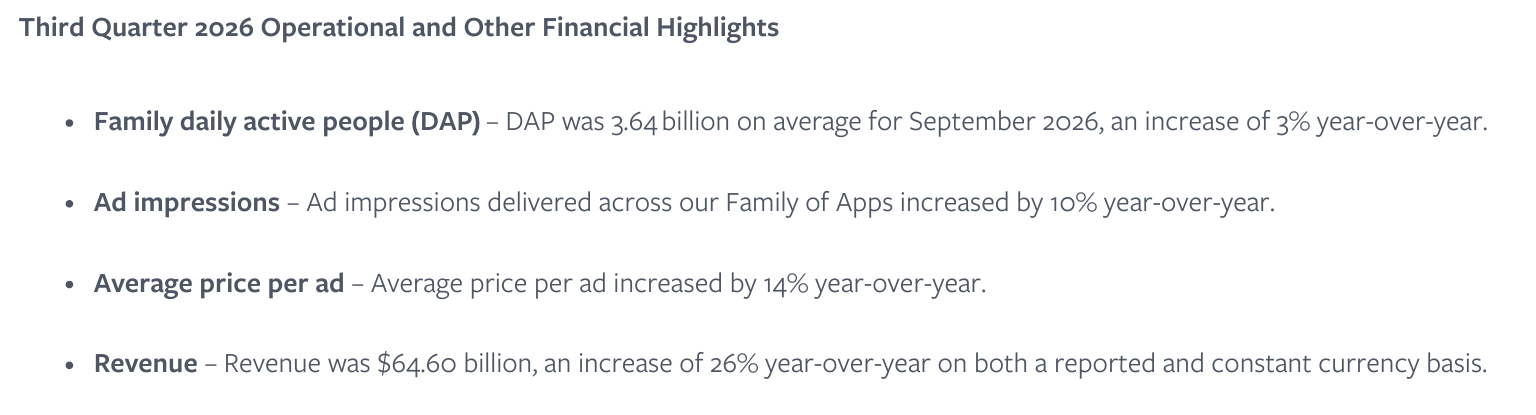
Ad impressions grew 10% while average price per ad grew 14%, according to Meta’s Q3 2026 earnings release. Revenue reached $64.60 billion, up 26%, which means most of Meta’s growth came from charging more per ad.
The regional picture is sharper. PPC Land’s breakdown of the earnings presentation shows price per ad up 23% in the US and Canada on just 8% more impressions. That regional rate has climbed every quarter this year, from 14% in Q1 to 20% in Q2 to 23% in Q3.
On the earnings call, Susan Li, Meta’s chief financial officer, credited the rise to ad performance gains and better macro conditions than a year earlier, per PPC Land’s write-up of the call. Put simply, Meta’s position is that you pay more because ads convert better.
Keep in mind what this number measures. Average price per ad blends formats, placements, and regions, so it won’t map one to one onto your invoice. Triple Whale’s independent CPM data still points the same way, and the next question is how your campaign objective changes the price you see.
Facebook Ads Cost by Campaign Objective
Your objective tells Meta what to bid on. Meta’s guide to performance goals notes a conversion may cost more than a landing page view, and each objective comes with its own headline cost metric.
- Awareness (CPM). You pay to reach people, so cost per thousand impressions is your main number. Expect it near the Triple Whale and Databox medians, higher in crowded verticals.
- Traffic (CPC). Clicks are cheap when Meta optimizes for them, which is why WordStream’s traffic median sits at $0.60.
- Leads (CPL). Clicks cost more ($1.80 median), but you judge the campaign on cost per lead, which WordStream puts at $27.39.
- Sales (CPA). Purchase-optimized campaigns carry the highest cost per result, with Triple Whale’s ecommerce median at $38.99.
Cheaper results higher in the funnel aren’t automatically better. A $0.60 click is only a bargain when enough of those visitors buy, so I’d pick the objective closest to revenue that you can feed with enough data. Whatever you choose, the same auction sets the price.
What Drives Your Meta Ads Cost?
The Meta ad auction is the quick contest that runs every time an ad slot opens for someone on Facebook or Instagram. Each eligible ad gets a score that blends what the advertiser is willing to pay with how useful Meta expects the ad to be for that person. That score is what ultimately shapes your Facebook ads cost, which is why relevance can save you real money.
Per Meta’s ad auction documentation, the winning ad has the highest total value, a mix of your bid, the estimated action rate, and ad quality. Because relevance is part of the math, a more relevant ad can beat a higher bid. Meta also says its adjustments will never charge you more than your bid.
Audience and Competition
When more advertisers chase the same people, prices climb. Health and wellness brands pay nearly double the CPM of baby product brands in Triple Whale’s data, and narrow audiences shrink the inventory you can bid on.
Creative Quality
Meta scores ad quality from feedback such as people hiding an ad, plus signals like sensationalized language and engagement bait. Tired creative also loses clicks over time, which drags down the estimated action rate and raises your price.
Learning Phase and Edits
Meta’s learning phase guide says ad sets usually stabilize after about fifty results in the week after their last significant edit. During learning, cost per result usually runs higher, and editing mid-flight resets the clock.
Placements and Seasonality
If you limit delivery to one placement, you shrink the inventory you can buy. Busy retail seasons also bring more bidders into the same auctions, so plan tests for quieter weeks when you can.
Once you know what moves the price, you can size a budget around it.
How Much Should You Spend on Facebook Ads per Month?
Meta gives a simple floor. Its performance goals guide says your daily budget should be at least ten times the average cost of your performance goal, so a $5 click goal needs at least $50 a day.
Pair this rule with the learning phase. At WordStream’s $27.39 median CPL, about fifty leads a week works out to roughly $1,370 a week, or close to $5,900 a month for one ad set, by my math. A purchase goal at Triple Whale’s $38.99 median lands near $1,950 a week.
Testing Budget vs Scaling Budget
Your first month buys learning, so fund enough results to tell a winner from noise. Once a campaign holds a stable cost per result, raise spend in measured steps, since Meta warns frequent budget changes can push an ad set back into learning.
Using a Facebook Ads Cost Calculator
Online calculators run the same math: target results multiplied by expected cost per result. Plug in your own trailing ninety-day numbers whenever you have them, because industry medians can be far off for your offer.
Budget sets the ceiling, but most savings come from how you run the account day to day.
How to Lower Facebook Ads Cost Without Losing Volume
These are the moves I’d check first in any account, in this order. Each one targets an input Meta’s auction actually scores.
1. Ship More Creative, More Often
Creative is your biggest lever on estimated action rates and ad quality. Back in May, I posted about why most marketing teams are stuck on creative volume.

In my post on X, I pointed out how the top ad accounts ship around 200 creative assets a month while the average team ships four. More variations give Meta more chances to find an ad people respond to, and fresh ads delay fatigue.
My team’s creative testing framework and this look at why top startups test thousands of ads show how to keep the volume organized, and AI video tools like Seedance 2.0 make it cheaper to produce.
2. Send Meta Better Conversion Signals
Estimated action rates depend on what Meta can see. When browser tracking drops events, delivery optimizes on partial data. Meta’s Conversions API sends events from your server to fill those gaps, and this breakdown of server-side tracking explains when the setup pays off.
3. Consolidate Ad Sets and Stop Resetting Learning
Meta’s learning phase guide warns that many ads and ad sets spread learning thin, and it recommends combining similar ad sets. So the creative volume from the first move belongs inside fewer ad sets, introduced in batches, with edits saved for when you have a reason.
4. Optimize for the Event You Actually Value
Cheap form fills are easy to buy and hard to close. Meta’s leads objective includes a goal to maximize qualified leads, and sales campaigns can optimize for purchase value, so aim delivery at the outcome your sales team counts. For more ideas on structure, see these Facebook advertising strategies.
5. Give Delivery Room to Work
Broad audiences and automatic placements give the auction more inventory to choose from, which can lower your average price. Meta keeps adding automation here, and my rundown of the newest Meta Advantage+ AI tools covers what’s live and where to keep control.
| Pro-Tip |
|---|
| Before you cut budget, sort your ads by cost per result over the last fourteen days and pause the bottom fifth. Move the savings behind your two best ads, plus one fresh variation of each. |
Lower costs are the goal most of the time, but some price increases are worth paying.
When Higher CPMs Are Still Worth Paying
CPM tells you what attention costs. It says nothing about what the attention earns you.
Triple Whale’s data shows this clearly. Median CPM rose 13.24% year over year, yet median click-through rate rose 15.97% and median ROAS held at 1.88, up 0.57%. For the typical brand in that dataset, prices rose and returns held.
My team saw a similar pattern with Schumacher Homes, a home builder that viewed Meta as an awareness channel. A prospecting campaign aimed at high-intent audiences, run under Meta’s housing ad restrictions, produced 30+ quality leads at a cost per lead comparable to search and a 5.62% click-to-lead conversion rate.
So set your guardrail on cost per qualified lead or CPA, and let CPM float. Then ask yourself, Is this spend creating customers I wouldn’t have won anyway? A holdout built with incrementality testing answers this, and the benefits of Facebook ads help you make the case internally.
Keep Your Meta Budget Working Harder
Meta’s prices may keep climbing while impression growth slows, so efficiency has to come from your side of the auction. More creative, cleaner signals, steadier campaigns, and targets tied to revenue will do more for your Facebook ads cost than any bid trick.
If you want experts to audit your account and run this playbook with you, talk to Single Grain’s Facebook ads specialists or explore my team’s paid social media agency services.
Frequently Asked Questions About Facebook Ads Cost
-
What is the average cost of Facebook ads?
It depends on the dataset and objective. Triple Whale’s 2026 benchmarks put the median Meta CPM at $15.06 and cost per purchase at $38.99 for ecommerce brands, while WordStream’s 2026 report shows a $0.60 median cost per click for traffic campaigns and a $27.39 median cost per lead.
-
Why are Facebook ads getting more expensive?
Meta’s Q3 2026 results show the average price per ad up 14% worldwide while ad impressions grew 10%, and PPC Land’s read of the earnings presentation puts the US and Canada increase at 23%. Meta credits better ad performance and improved macro conditions.
-
How much should I spend on Facebook ads per month?
Meta recommends a daily budget of at least ten times the average cost of your performance goal. If you also want an ad set to reach about fifty results a week to exit the learning phase, multiply fifty by your expected cost per result to get a weekly floor.
-
What is a good CPM for Facebook ads?
Recent medians range from $7.26 across industries (Databox) to $15.06 for ecommerce brands (Triple Whale), with health and wellness near $21.80. A good CPM is one that still produces your target cost per lead or customer.
-
Is paying for Facebook ads worth it?
It is worth it when your cost per qualified lead or customer fits your margins. Test against a holdout to confirm the spend is adding sales, and see the benefits of Facebook ads for where the channel fits.