

How to Build Topical Authority Without Cannibalizing Your Posts


We’ve heard it time and time again: Google rewards those who post well-written, valuable content. Along with quality, topical authority on the subject absolutely factors into the equation. If you’re wondering why a seemingly smaller competitor can outrank you on a subject your team has covered for years, it often boils down to topical authority (and other SEO factors, like search intent, but we’ll stick to topical authority here).
Most of the time, the problem is coverage. Your site answers some of a buyer’s questions in depth, skips others, and has three posts quietly competing for the same query. This last issue, keyword cannibalization, is the part most topical authority advice skips, and it can undo months of publishing.
In this article, you’ll learn how to map a topic, turn the map into clusters, consolidate overlapping posts, and measure query coverage so you know the work is paying off.
TL;DR
- Topical authority is earned coverage. Search engines and AI assistants favor sites answering a subject’s related questions in depth and connect those answers with internal links.
- AI search rewards breadth within a topic. Google says AI Overviews and AI Mode can run several related searches across subtopics to build one answer.
- Overlap undoes authority. Two posts targeting the same intent split your signals, so decide whether to draft, update or consolidate before anyone writes.
- Measure coverage by cluster. Track how many of a cluster’s queries earn impressions, clicks and AI citations at fixed checkpoints after you publish.
TABLE OF CONTENTS:
What Is Topical Authority?
Topical authority describes how thoroughly and credibly your site covers a subject, judged across many pages instead of one. A site with topical authority on paid search, for example, answers the beginner, budget, bidding, measurement and troubleshooting questions a buyer asks on the way to a decision.
Google has written publicly about a related idea. Its topic authority system for news looks at how notable a source is for a topic, how often its original reporting gets cited, and its reputation. Google’s advice to publishers was simple: keep covering the areas you know well, in line with its guidance on helpful, people-first content.
Topical Authority vs. Domain Authority
It is important to know the difference between these two terms.
- Domain authority is a third-party estimate of link strength. SEO tools calculate it from backlinks, and it says little about which subjects you know.
- Topical authority is subject-specific. It grows when your pages cover a topic’s related questions, connect to each other and earn citations on the topic.
This is why topical work pairs well with entity SEO, which helps search engines and language models understand the people, products and concepts your pages are about.
Why Topical Authority Decides Who Gets Cited in AI Search
AI answers pull from more than one query. Google’s documentation on AI features and your website says AI Overviews and AI Mode may use a “query fan-out” technique, issuing multiple related searches across subtopics to build a response.
Think about what this means for your content plan. If your site covers one subtopic well and ignores the rest, you show up for one branch of the fan-out while a competitor with full coverage shows up across several.
Google also says there’s no special optimization required for AI features. Pages need to be indexed, eligible for a snippet and easy to find through internal links, which is the same groundwork topical authority depends on. The deeper argument for content depth in AI search follows from this.
Our Topical Authority Example: Case Study
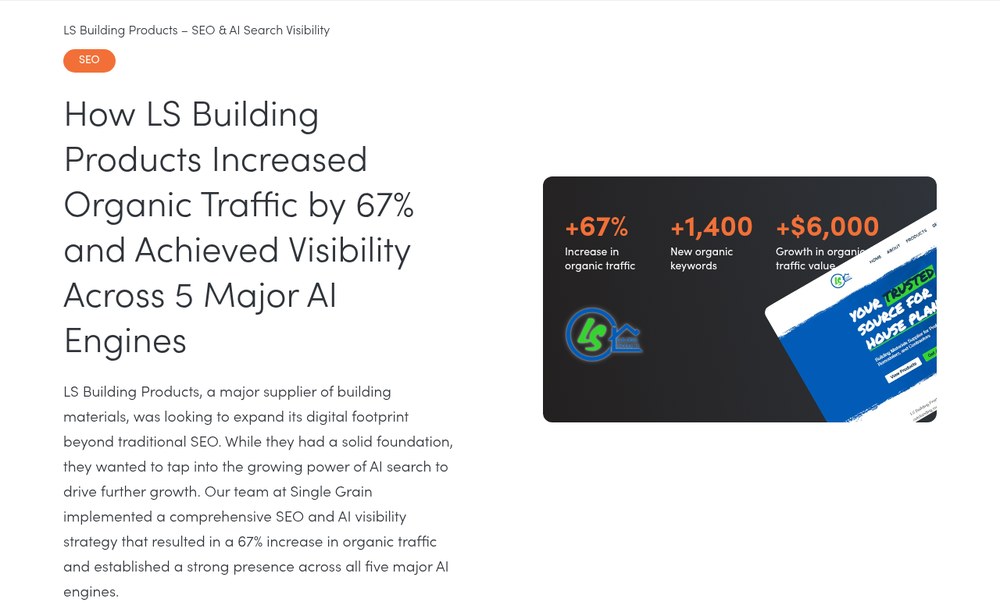
Single Grain saw this play out with LS Building Products, a building materials supplier. Building topical authority around siding, windows, roofing and decking was one of the stated goals, and the team built content pillars around those categories plus calculators.
Source: Single Grain case study, LS Building Products
After the six-month engagement, the LS Building Products case study reports a 67% increase in organic traffic and a 540% increase in Google AI Overview mentions. Your results will depend on your starting point, but the pattern is worth noting, since depth within a category gives AI systems more of your pages to cite.
How to Build a Topical Map
A topical map is the list of every question your buyers ask about a subject, grouped by intent and linked to the page answering it. It keeps your team from publishing whatever topic feels urgent this week.
Start From the Topics Tied to Revenue
Pick the three to five subjects where winning search would move pipeline, usually the categories your sales team sells into. For each, list the questions buyers ask at every stage, from definitions to pricing, comparisons, implementation and troubleshooting.
“Where do I find those questions without guessing?” Great question. Pull them from your Search Console queries, sales call notes, support tickets and the subreddits or forums your buyers use. You can easily automate this with an AI agent like Grok Bot.
Mine Your Own Content and Calls
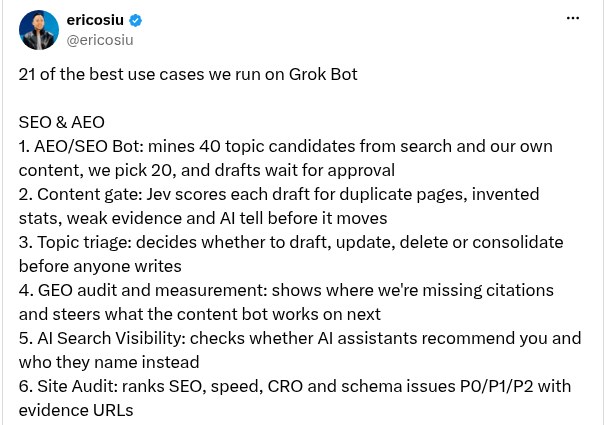
Your best topics often already exist inside your company. I posted about the system my team runs on X, where an AEO/SEO bot mines topic candidates from search data and our own content, and a separate triage step decides what happens to each idea.
Source: Eric Siu on X, October 11, 2026
You don’t need the same tooling to borrow the logic. Every idea on your map should come with a decision attached before writing starts.
Decide to Draft, Update, Delete or Consolidate
Next, here’s what I recommend:
- Draft when no page on your site answers the question yet.
- Update when a page exists but is thin, dated or missing a subtopic.
- Consolidate when two or more pages answer the same intent.
- Delete or redirect when a page serves no buyer and has no traffic or links worth keeping.
These four calls are what keep a topical map from turning into a list of near-duplicate posts. Once every idea has a decision, you can shape the map into clusters.
How to Turn Your Map Into Topic Clusters
A topic cluster is one pillar page that covers a subject broadly, surrounded by supporting pages that each go deep on one question. A lot of people call this a hub-and-spoke model. The pillar links to every supporting page, and each supporting page links back to the pillar and to its closest siblings.
Keep each supporting page focused on one search intent. If two questions would satisfy the same searcher with the same answer, they belong on one page.
Internal links are the wiring. Google lists internal links among the fundamentals for AI features, and they tell crawlers which page is your main answer for a subject. Use descriptive anchors matching the target page’s topic, and link on the first mention of a term.
| Pro-Tip |
|---|
| Before you approve a new cluster, write the one-sentence answer each supporting page will give. If two sentences sound alike, merge those pages now, before they compete in search. |
Clusters also give your content marketing team a clear brief. Writers know which page owns which question, which cuts duplicate drafts.
How to Grow Topical Authority Without Cannibalizing Your Posts
Cannibalization happens when several of your pages target the same intent, so search engines rotate between them and none ranks as well as one strong page would. Publishing more posts on a topic can make this worse if no one checks what already exists.
Signs Your Posts Compete With Each Other
Start in the Search Console Performance report. Filter by one of your target queries and open the Pages tab, and if several URLs earn impressions for it, you likely have overlap.
Watch for rankings swapping between pages, with one URL ranking this week and a sibling ranking the next. Another tell is a topic where new posts stall while older ones slip, so total traffic stays flat even as you publish more.
My team’s AEO and SEO cannibalization audit walks through a full review of legacy content.
Block Duplicates Before They Ship
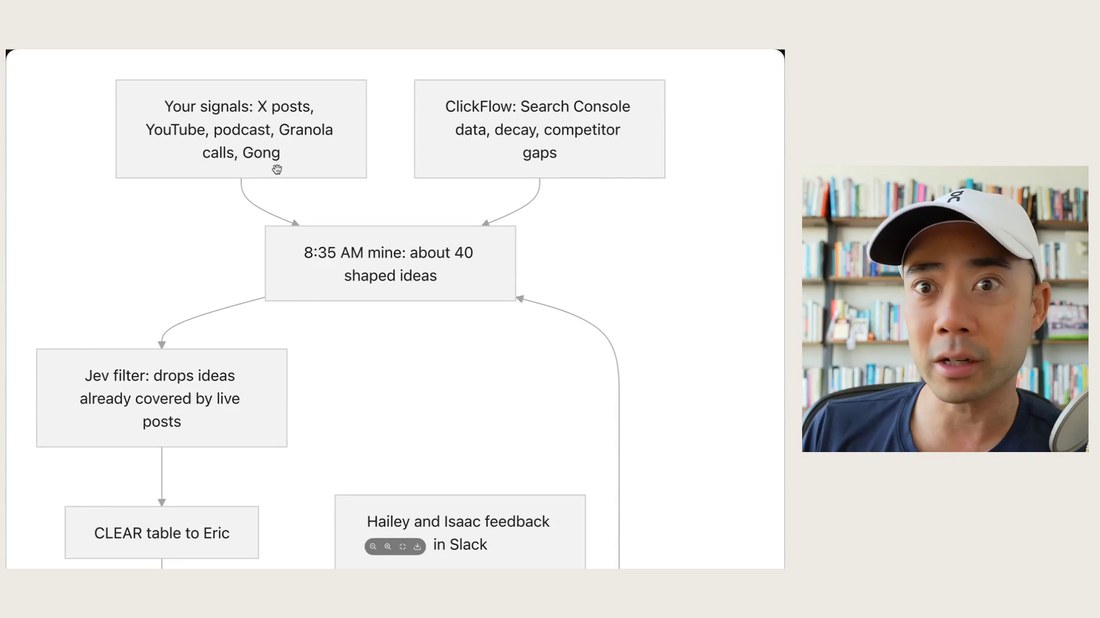
The cheapest fix is a check before anything gets written. In my own workflow, a classifier drops ideas already covered by live posts before a draft is ever started.
Source: Eric Siu’s AEO/SEO workflow video on X
You can run the same check by hand. Search your site and your Search Console data for the target query before you approve a brief, and send overlapping ideas to the update pile.
Consolidate Pages That Already Overlap
When two live pages compete, pick the stronger one by traffic, links and conversions, then merge the useful sections from the weaker page into it. Redirect the weaker URL with a 301, update internal links to point at the winner, and use canonical tags where duplicates must stay live, following Google’s guidance on consolidating duplicate URLs.
If you use AI agents to publish, guard against them overwriting pages that already rank. The guide on stopping a content agent from killing posts that already rank covers the guardrails.
How to Measure Topical Authority and Query Coverage
No tool hands you a single topical authority score you can trust, so measure the outcome by cluster. Query coverage is the share of a cluster’s target queries where your site earns impressions, and it’s the clearest early signal.
Set fixed checkpoints instead of watching daily. My team cohorts new posts and reviews results at fourteen and twenty-eight days, then flags position or click-through drops for a refresh.
What You Should Track
Track these numbers for each cluster in your monthly report.
- Query coverage. The share of target queries with impressions in the Search Console Performance report.
- Clicks and average position. Measured for the cluster as a group, so one page swap doesn’t hide progress.
- AI citations. How often AI Overviews, ChatGPT and other assistants cite your pages for the cluster’s questions.
- Pipeline influence. Leads and opportunities from cluster pages, which is the number your leadership will ask about.
Google says AI Overview and AI Mode traffic is included in Search Console’s Performance report under the Web search type, so clicks from AI features already show up there. For citation tracking across assistants, a search everywhere optimization program covers the platforms Search Console doesn’t, and an early warning system for topic saturation tells you when a cluster needs fresh angles.
Make Your Next Ten Posts Count
Topical authority comes from covering a subject completely, wiring the pages together and refusing to publish two posts answering the same question. Map your revenue topics, build clusters, consolidate overlap and measure coverage at fixed checkpoints, and each new post adds to your authority.
If you want help building topical maps and clusters to earn rankings and AI citations, Single Grain’s SEO services and search everywhere optimization team can plan, write and measure the work with you.
Frequently Asked Questions About Topical Authority
-
What is topical authority in SEO?
Topical authority is how thoroughly and credibly your site covers a subject across many pages. Sites that answer a topic’s related questions in depth, link those pages together and earn citations on the topic tend to rank and get cited more often.
-
How long does it take to build topical authority?
It depends on your starting coverage, competition and publishing pace. Measure progress by cluster at fixed checkpoints, such as fourteen and twenty-eight days after publishing, and look for rising query coverage before expecting top rankings.
-
How is topical authority different from domain authority?
Domain authority is a third-party score based mostly on backlinks. Topical authority is subject-specific and grows as your pages cover a topic’s questions and earn citations on that topic.
-
Does topical authority help with AI Overviews and ChatGPT?
Yes, coverage helps. Google says AI Overviews and AI Mode may run several related searches across subtopics to build one answer, so a site covering more of those subtopics has more chances to be cited. Single Grain’s search everywhere optimization work tracks citations across assistants.
-
How do I fix keyword cannibalization while building topical authority?
Find queries where several of your URLs rank, pick the strongest page, merge useful sections from the weaker page into it, then redirect the weaker URL with a 301 and update internal links. Check new ideas against live posts before writing so overlap doesn’t return.