

SLAs and Kill Switches for Managed Marketing Agents


SLAs and Kill Switches for Managed Marketing Agents
A managed marketing agent can stay available all day and still send the wrong prospect a bad offer. Buy a delivery commitment, a stop mechanism, and a recovery process together. An uptime promise leaves expensive decisions undefined: who can stop execution, what happens to queued work, and who pays to investigate.
Eric Siu’s $15K sponsorship never-negotiate framing makes the boundary concrete. A pricing bot may prepare a reply, but it cannot bargain below the stated commercial floor. The figure belongs to that taped sponsorship context, not every Single Grain engagement. The buying lesson travels: write commercial constraints into execution controls, rather than leaving them in a prompt.
Start with Eric’s one-job operating rule: one job, a success definition, a safety bar, and a human verifier. Contract separately for outbound drafts, AEO content preparation, and paid-media recommendations. Each needs its own acceptance criteria, permissions, and stop conditions.
Uptime SLAs are not ship-gate SLAs
Uptime measures service availability. A delivery SLA measures whether an agreed output arrives on time. A ship-gate SLA defines who reviews it, which action they authorize, and how unresolved work gets escalated. Put separate clocks and exclusions against each commitment.
For revive or outbound work, use this contractual pattern: “The vendor delivers review-ready drafts within X business hours after receiving a complete, validated input package.” Negotiate X against staffing and volume. Required inputs include the approved audience, suppression list, offer, account context, and permitted claims. Missing inputs pause the clock only when the vendor records the deficiency.
Eric’s checkpoint-before-ship guidance and rule for agents that can send, publish, delete, or spend set the acceptance condition: external work stays in draft until the named Accountable human approves the exact version, destination, and action. PR pitches and citation assets belong inside this boundary. Changed copy, targeting, or budget invalidates the earlier authorization. Silence never becomes consent.
Eric’s reliability discussion supplies the expansion sequence: create roughly four candidates, approve the winners, then measure at 7, 14, 30, and 60 days before widening autonomy. Candidate selection comes before observation; broader permissions come after evidence. Buy a capped starting scope and scheduled readbacks, not a calendar-based promise that the agent automatically graduates.
Worked scene: kill switch before send
In Eric’s revive/outbound bot discussion, the job is drafting outreach. The bot prepares messages, leaving the buyer with drafts to inspect rather than unrestricted mailbox ownership. Keep that preparation job when buying the service. The following contract test applies that boundary; it is not a reported Single Grain incident.
The bot receives a dormant-lead export, account notes, a suppression list, and an approved offer. It returns drafts with recipient records and reasons for inclusion. The reviewer finds accounts outside the ideal customer profile while another batch is being prepared. An unacceptable ICP miss rate, a complaint, or an approval backlog that prevents reliable inspection should each trigger containment. Define measurable thresholds during contracting rather than borrowing an unsupported industry benchmark.
Name the client’s lifecycle marketing lead as Accountable and the vendor’s on-call operator as technical responder. Either can freeze the affected send path without waiting for the other. The freeze must disable dispatch in the email connector and quarantine queued messages. A dashboard that says “paused” while scheduled sends continue has failed the test.
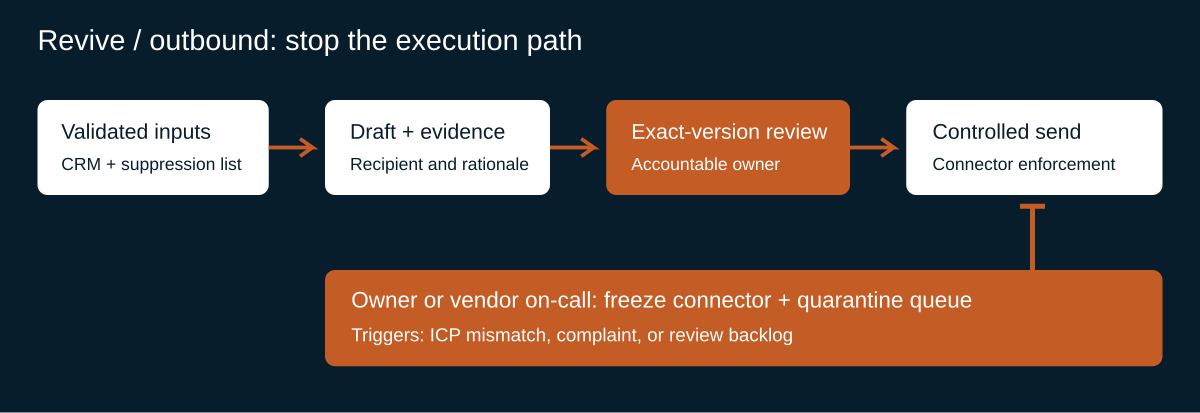
Require a stop receipt showing the connector, freeze time, queued items, and sends already in flight. Test retries and scheduled jobs alongside new requests. Successful containment accounts for outstanding actions and blocks further dispatch; it does not pretend already-sent email can be recalled.
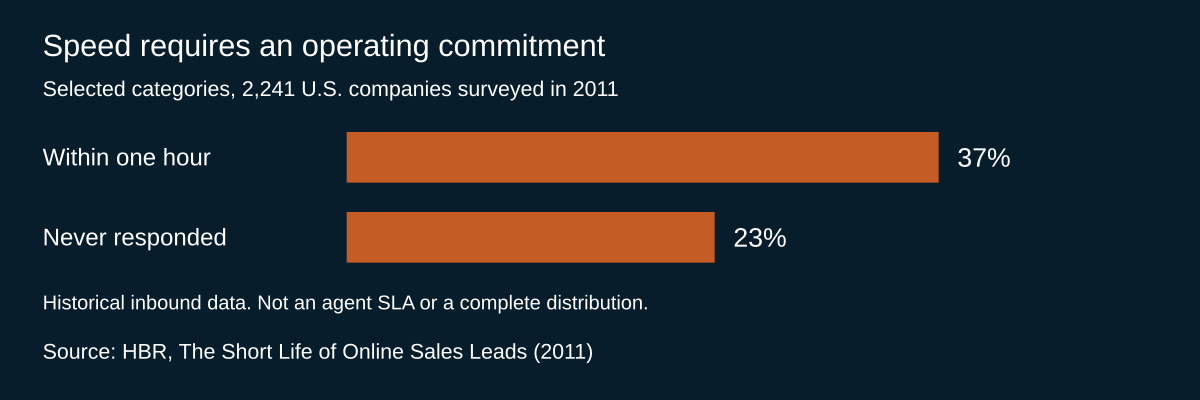
Speed still matters. An HBR audit of 2,241 U.S. companies reported that 37% responded to a web-generated test lead within an hour, while 23% never responded. These are historical 2011 inbound-response findings, not outbound-agent benchmarks. Use them to justify staffed queues and escalation coverage. Resume with corrected audience evidence and a limited batch, not the entire accumulated backlog.
Worked scene: kill switch before publish/spend
For a Single Grain AEO engagement, retain research and drafting while separating CMS execution credentials. A brief enters with source material, target questions, existing URLs, and approved product claims. The agent returns an unpublished article, citation assets, and proposed internal links. That is a bounded production job within AEO services, with inspectable inputs and outputs.
During revision, a product limitation disappears and an unsupported performance claim enters the article. The version mismatch blocks the publish request under the gate already defined. The team freezes the affected CMS path and any queued distribution assets derived from that version. Connecting AEO and SEO planning does not require sharing every execution permission. A drafting agent has no reason to delete redirects or change campaign budgets.
If distribution includes sponsorship negotiation, the stated commercial floor remains a hard constraint. Apply the taped $15K example only where that is the actual sponsorship floor; record the buyer’s real terms elsewhere. A price or skill bot can draft replies, but bargaining below the floor is outside its job. Separately specify paid-media spending limits. A sponsorship price floor is not an ad-budget ceiling.
Eric’s observe/recommend fallback changes the abort behavior: remove the affected execution capability while preserving diagnosis and recommendations. The agent can flag the unsupported claim or propose compliant distribution terms. It cannot bypass the block through another connector. This is why SEO tool selection should follow the workflow: connector permissions and recoverability belong in the buying decision alongside drafting quality.
Contract checklist (owner, abort, resume, margin)
Attach an operating schedule to the commercial agreement. Have the vendor demonstrate the controls in a test environment before receiving production access. Specify these obligations:
- Owner: name the Accountable client role, backup, vendor on-call role, and coverage hours. Separate authority to stop from authority to restart.
- Delivery: define complete inputs, review-ready outputs, business-hour calculations, volume caps, and rejection reasons. Count defective work separately from late work.
- Abort: list triggers, covered connectors, queue behavior, and the negotiated time to enforce a freeze. Include retries, scheduled jobs, and alternate execution paths.
- Evidence: retain input and output versions, authorization records, connector responses, costs, and incident timestamps. Specify retention periods and client access.
- Resume: require cause analysis, corrected inputs or permissions, a replay test without external effects, and a named release decision. Clear stale work deliberately.
- Margin: price routine review, exception handling, model usage, and on-call coverage. Assign vendor-caused rework costs and define qualifying service credits.
Use the 7/14/30/60-day readbacks as the expansion clause’s review schedule, not as proof of reliability by themselves. At each checkpoint, examine accepted outputs, exceptions, attempted actions, review effort, and recovery results. Maintain the cap when evidence is insufficient. Wider volume, connector access, or spending authority requires a recorded scope change.
Measure cost per accepted output, including review and remediation. Cheap drafts can consume expensive operator hours. Require enough visibility to decide whether the vendor should improve the workflow, narrow the job, or stop offering it. Service credits help allocate costs; they cannot restore sender reputation or undo an unsupported public claim.
How to buy + CTA
Buy a managed service when the vendor can own connector controls, staffed response, and evidence collection. Build when your team already owns those systems and can maintain them. Reject either proposal if its kill switch is a chat instruction that downstream tools can ignore.
Anthropic’s guidance on building effective agents recommends simple, composable patterns and adding complexity only when needed. Apply that to procurement: require the smallest workflow that can complete the scoped job, demonstrate containment, and produce a usable recovery record. A broader orchestration layer needs an operational justification.
For Single Grain, connect that decision to the actual acquisition job: revive drafts, AEO assets, or paid recommendations. Ask for the input package, acceptance criteria, accountable owner, freeze demonstration, and fully loaded operating cost before comparing retainers. A compelling demo without those artifacts is insufficient evidence to buy.
Talk with Single Grain about scoping a managed marketing-agent engagement around delivery SLAs, enforceable kill switches, and evidence-based expansion. Bring the workflow you want to delegate and the commercial boundary you cannot afford to cross.