

The 5-Step Framework for Reliable Marketing Bots


The 5-Step Framework for Reliable Marketing Bots
A marketing bot can write a convincing follow-up while targeting the wrong buyer, reviving a closed deal, or promising something your sales team cannot deliver. Before connecting it to Single Grain’s acquisition or content workflows, give it one narrow job, a defined audience, and a hard output limit. For ops queues, start with an inbox triage agent that routes, labels, and escalates before you grant broader write access.
Eric Siu’s recommendation for reliable automation starts with roughly four candidates, followed by review and outcome checks at 7, 14, 30, and 60 days. Those numbers define the operating sequence: keep the initial batch small enough to inspect, then require timed evidence before widening autonomy.
The buying decision follows from that sequence. Pay for a bounded job you can evaluate, not a promise that an agent will run marketing. A useful pilot should expose bad inputs and expensive corrections before it multiplies them.
Why “it can draft” is not a ship decision
A fluent draft proves generation capability. It does not establish that the bot retrieved the correct deal history, respected exclusions, or used a supported claim. Reliability requires those conditions to hold when records are incomplete and requests are ambiguous.
Eric’s one-job-per-bot guidance changes the scope: specify one pipeline job, its success definition, its safety bar, and its human verifier. Refuse the super-agent proposal that bundles prospecting, negotiation, content, and spending into one vague deliverable. Those jobs have different evidence requirements and different consequences when they fail.
Write the trigger, permitted inputs, expected output, exclusions, and owner before selecting software. “Improve outreach” is too broad. “Produce four reactivation candidates for eligible stalled opportunities using approved CRM fields” is testable. Missing opportunity history should return a flagged record, not an improvised explanation.
Anthropic’s guidance on building effective agents supports starting with simple solutions and adding complexity when it improves outcomes. For a known sequence of retrieval, drafting, and checking, buy or build a fixed workflow first. Agentic tool selection needs a specific justification, such as genuinely variable retrieval paths.
Measure the existing failure before pricing the fix. Count missed records, factual corrections, and time spent repairing outputs. If the bottleneck is unreliable CRM ownership, a faster writing model leaves the underlying problem intact.
The 5-step reliability loop (ICP → caps → approve → readbacks → earn autonomy)
Eric’s observation-to-action progression sets the deployment order: observe, recommend, then act with approval. Combine that progression with his four-candidate, 7/14/30/60-day loop. The first deployment should reveal how the workflow behaves before it receives consequential permissions.
- Lock the ICP and safety limits. Define eligible companies, buyer roles, lifecycle stages, and exclusions. Specify approved evidence, prohibited claims, and the fallback for missing information. Encode exclusions in the workflow rather than relying on the model to remember them.
- Cap output. Start with roughly four candidates per eligible input. Also set limits on records processed, retries, and spending. Enforce caps in application logic so repeated errors cannot create an expanding queue.
- Approve winners. Enter the actual person’s name in the job specification: the account owner for outreach or managing editor for content. Record decisions and rejection reasons. Sending and spending require approval; content drafts never auto-publish. Leave unsupervised execution outside the initial scope.
- Read back at 7, 14, 30, and 60 days. Check defects alongside business measures already available in your CRM and analytics. Keep operational quality separate from slower outcomes such as opportunity movement or qualified conversions.
- Earn autonomy. Expand one dimension only when the readbacks justify it. A larger batch, another segment, and another data source are separate changes. Document the decision and retain the previous configuration for rollback.
These are operating checkpoints, not claimed performance lifts. Save the input snapshot, workflow version, candidate set, decision, and downstream record identifier. Without that trail, the team cannot distinguish a retrieval failure from a drafting failure.
Set stop conditions before the pilot. A suppressed-contact violation or unsupported commercial promise should halt the affected workflow. Acceptance rate and editing time need targets based on your baseline. A clean early check does not cancel the later readbacks or authorize automatic expansion.
Worked scene: outreach/revive bot
Eric’s stalled-deal discussion starts with an opportunity that has stopped moving. The useful observation is that a prior conversation supplies context a cold prospect list cannot: the buyer, the objection, and the last interaction. Paired with his reliability discussion, that leads to a narrower recommendation: revive eligible existing opportunities with a small candidate set. The tape supplies the use case, not a verified reply-rate improvement.
For a proposed Single Grain pilot, the CRM supplies deal stage, buyer role, last meaningful interaction, documented objection, and account owner. The workflow checks ICP fit and exclusions first. Opt-outs, active negotiations, and records without enough history remain outside the drafting batch.
The bot then produces four candidates. Where the CRM records a timing objection, the message can reference that objection. It cannot invent a budget change, offer an unauthorized discount, or claim Single Grain discovered a website problem without evidence. If it selects proof from Single Grain’s case studies, the result must match the buyer’s problem and preserve the source’s context.
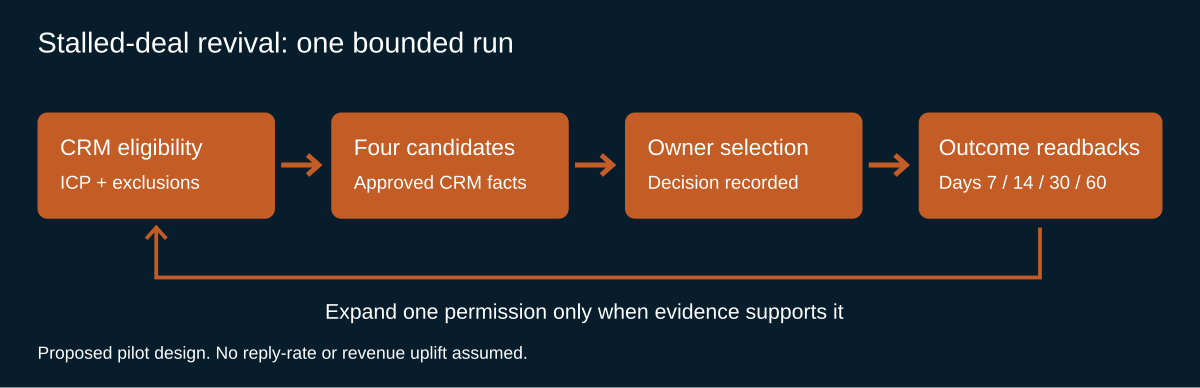
At day 7, inspect candidate acceptance, factual corrections, and delivery failures. At day 14, classify replies using the team’s existing categories. At days 30 and 60, inspect meetings and opportunity movement. Put sent-message counts beside outcomes so a small batch does not masauerade as a trend. Persistent context errors mean fixing retrieval, not increasing volume.
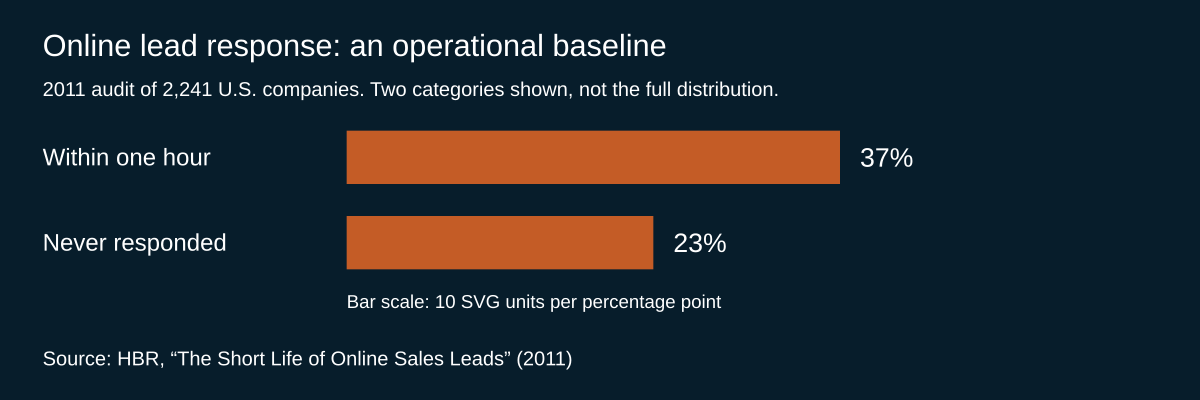
Historical research helps diagnose adjacent workflow problems. HBR’s 2011 audit of 2,241 U.S. companies found that 37% responded to a web lead within an hour and 23% never responded. Those inbound findings support checking your own response backlog. They do not forecast stalled-deal replies. If records never reach an owner, repair routing before buying more message generation.
Worked scene: content draft bot with publish gate
Eric’s content-bot discussion puts a cap on draft production. That changes the first build: invest in a bounded queue, evidence references, and clear status fields before adding more generation capacity. Apply the permissions policy above rather than treating a finished-looking article as a completed workflow.
For a proposed Single Grain search-content pilot, the inputs are an approved brief, target audience, search intent, source packet, and permitted internal links. Use four draft candidates per batch as a pilot setting derived from the reliability loop, not as a claimed content optimum. Attach the brief identifier and source references to each candidate.
The brief determines the channel job. A page supporting Single Grain’s AI SEO services needs a clear buyer and conversion purpose. An educational article may answer a broader research question. Single Grain’s AEO and SEO integration guidance helps connect those search objectives, but it should not become boilerplate inserted into every draft.
The bot produces its bounded set and flags unsupported passages. A candidate that needs substantial factual reconstruction returns to the queue with a recorded reason. That reason becomes an input to the next workflow revision, instead of disappearing into an editor’s private rewrite.
At the early checkpoints, inspect source accuracy, duplication, brief adherence, and editing time. For published work, start performance windows from publication and use engagement, impressions, clicks, or qualified conversions only where tracking already exists. Keep unpublished candidates out of traffic comparisons. No traffic lift should be inferred from draft acceptance alone.
Evaluate the complete process, consistent with Single Grain’s focus on AI tools for workable SEO workflows. Lower generation cost can disappear inside research and repair work. Broaden the queue only when the readbacks show that quality and total production effort justify it.
What you do not automate yet + CTA
Keep pricing exceptions, contractual commitments, sensitive customer situations, and unsupported performance claims outside the bot’s authority. Defer any job with no dependable source of truth or accountable owner. Missing instrumentation is a reason to narrow the scope.
Buy existing software when it can enforce your eligibility rules, caps, logs, and readback requirements. Build when a necessary data boundary or workflow constraint cannot be handled reliably by the available product. Price one pipeline job, including integration and correction costs. Do not pay a premium for a super-agent whose responsibilities cannot be tested separately.
Bring Single Grain one bottleneck, its current inputs, its baseline, and the person accountable for the result. We can scope the smallest useful pilot and define what evidence would justify expansion. Contact Single Grain to map that job before committing to broader automation.


