

How to Price Managed Marketing Agents Without Guessing Margin


How to Price Managed Marketing Agents Without Guessing Margin
A managed marketing agent can look profitable until someone counts reviewer minutes, enrichment retries, and failed jobs. Price the bounded job from its full delivery cost, set a margin floor, and then offer a monthly volume cap. Do that before quoting a retainer.
Eric’s discussion of sponsorship replies gives this problem a concrete commercial boundary. He describes turning an annoying, valuable task into a skill, with a stated $15K sponsorship floor constraining negotiation. The task becomes repeatable, but the commercial limit stays fixed. Apply that distinction to the offer: a reply skill can prepare responses within agreed caps; it cannot bargain below the stated floor. That $15K figure is sponsorship context, not a managed-agent price.
For Single Grain, the same discipline belongs in pipeline development, SEO, and answer engine optimization. Quote the work the service can reliably deliver, including exceptions. “Access to our AI stack” leaves both the client’s entitlement and your delivery liability undefined.
Why retainer vibe pricing fails managed agents
A familiar monthly fee hides unfamiliar costs. Clients submitting similar request volumes can consume different amounts of enrichment, reasoning, revision, and exception handling. Without boundaries, the cleaner account subsidizes the messier account. More activity can make that problem worse rather than improve margin.
Eric’s one-job-per-bot framework supplies the starting unit: one job, a success definition, a safety bar, and a human verifier. Refuse the proposed super-agent that “runs growth.” Scope a pipeline research packet or a content brief, with separate acceptance criteria and prices. Bundling can come later, after each unit has a measurable cost.
Anthropic’s guidance on effective agents also recommends starting with the simplest suitable solution. That changes the build decision: use a predictable workflow when it solves the job. Extra orchestration introduces more calls and failure paths that your quote must cover.
Keep acquisition outcomes separate from production economics. Pew’s analysis of Google browsing behavior found traditional-result clicks in 15% of visits without an AI summary versus 8% with one. Users clicked a link within the summary in about 1% of visits containing a summary. These are observed behaviors, not a forecast for a particular client.
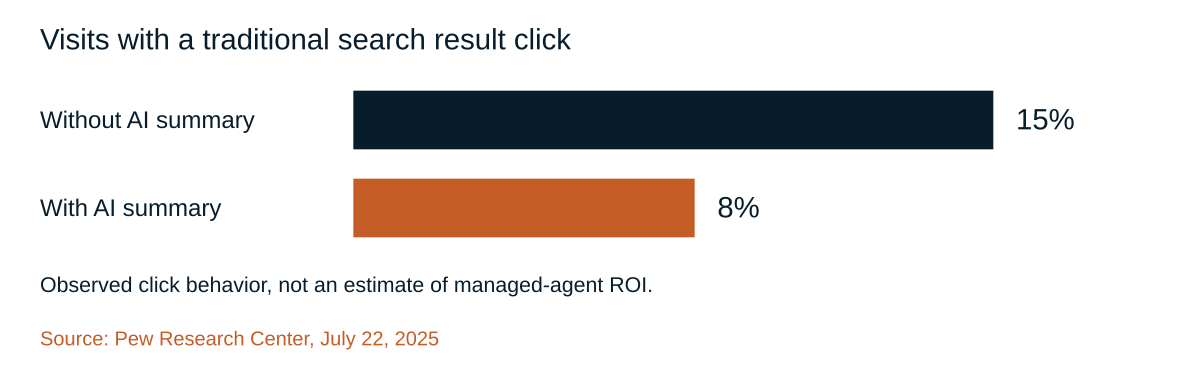
Those figures support refusing guaranteed traffic as the acceptance condition for a research or drafting job. In a Single Grain engagement combining AI SEO services and AEO services, the channel strategy must address changing discovery behavior. The agent’s unit price still needs to cover the deliverable. Our SEO and AEO integration approach informs distribution and measurement, not a promise that every accepted brief produces traffic.
Worked scene: unit-price a pipeline job + ship gate
Take a proposed pipeline research job. The client supplies an account domain, target-role criteria, approved data sources, and suppression rules. The bot returns a sourced account brief, a role match, and an outreach draft. Success means the packet meets agreed evidence and completeness requirements. A booked meeting sits outside this job’s acceptance criteria.
Run representative inputs through a paid scoping batch before fixing the recurring rate. The job ledger captures model calls, enrichment API charges, reviewer minutes, and SLA abort costs. When an enrichment request fails and requires another lookup, both attempts remain in the ledger. When a packet is rejected, its consumed resources do not disappear.
Calculate the batch’s delivery cost by adding those charges, converting reviewer minutes using the reviewer’s loaded hourly cost, and including the agreed abort allowance. Divide by accepted packets to get cost per accepted job. Keep onboarding separate, and avoid counting failed-attempt costs twice if they already sit inside the batch total.
Minimum unit price equals cost per accepted job divided by one minus the target gross-margin rate. Put that floor beside the proposed selling price before discussing discounts. A discount that crosses the floor requires a documented cost reduction, narrower scope, or rejection. Expected future efficiency does not pay the current delivery bill.
Quote per accepted packet, or a monthly fee covering a specified accepted-job cap. Also cap submitted requests, retries, and included revisions. Otherwise, a client can submit unlimited unusable inputs against a limited deliverable allowance. The contract should distinguish provider defects, which require remediation, from client input changes that create new work.
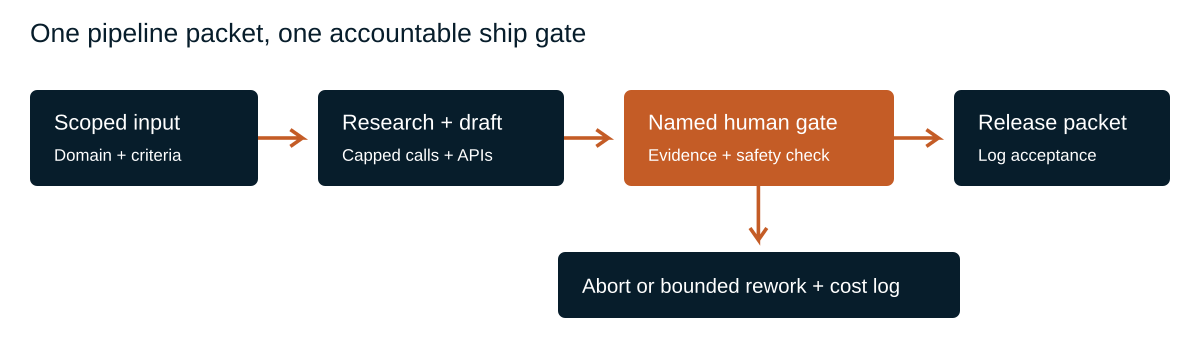
Eric’s human-checkpoint guidance assigns research, drafting, and repetitive work to bots while retaining a person before anything ships. Put the actual pipeline lead’s name in the statement of work as verifier, with a named backup and review window. That lead checks evidence, suppression compliance, and the draft before release. Nothing auto-sends or auto-publishes. The price includes this staffed checkpoint rather than hiding it inside account management.
Define the SLA abort here: required data is unavailable, a suppression conflict appears, or the retry allowance is exhausted. Stop processing, record the reason and incurred cost, and route the exception under the agreed response window. Provider failures consume the provider’s allowance; defective client inputs follow the resubmission policy.
Worked scene: price the earn-autonomy ladder
Now carry that pipeline job through its deployment stages. Eric’s guidance on agents earning autonomy begins with observation and recommendations before broader action. Translate that progression into a commercial ladder, rather than selling every permission in the first package. The months below are a proposed rollout structure, not a promise of automatic advancement.
Month 1 is observe/recommend only. The agent examines the permitted workflow and proposes account packets without changing operational records. Charge for setup, capped recommendation volume, evaluation, and readback sessions. Record missing evidence, incorrect role matches, suppression errors, and handling time. Price the labor actually required, with no assumed savings from future automation.
At the readback, compare what the agent intended to do with the evidence and the action it recommended. A packet that looks polished but selects the wrong role fails the job definition. That result keeps the service in the current stage and directs the next correction. It does not justify adding execution permissions to demonstrate progress.
Month 2 moves to act-with-approval only when readbacks meet the agreed advancement criteria. The service can prepare a permitted CRM update and queue the authorized next step. This tier adds execution logging, recovery procedures, and monitoring. Charge for that expanded operating scope rather than treating it as a free feature unlocked by elapsed time.
Later autonomy expands only within the proven job boundary. Review intended actions against actual records, exceptions, and recovery results. Specify advancement thresholds and rollback triggers before deployment. If reviewer effort falls but monitoring costs rise, recalculate the combined cost stack. Price tiers follow demonstrated autonomy stage, not the calendar or the number of tools connected.
Margin floors, aborts, and what you do not sell
Track margin by job type and autonomy stage. An account-level average can conceal an enrichment-heavy service losing money behind inexpensive drafting work. Define which delivery expenses enter gross margin, then separately check whether gross profit covers account overhead and the business’s required operating return.
- Cap model usage, enrichment lookups, retries, and revisions in the offer.
- Specify coverage hours, response windows, and the exception allowance behind the SLA.
- Charge onboarding and new integrations separately from recurring delivery.
- Reprice when input quality, permissions, volume mix, or coverage requirements change.
- Pause excess submissions when capacity or the contracted exception allowance is exhausted.
Keep commercial authority out of scope unless it is explicitly bounded. Eric’s sponsorship floor makes this concrete: drafting a reply does not confer authority to renegotiate the underlying deal. Apply similarly explicit exclusions to unrestricted CRM edits, unlimited research, and revenue guarantees attached to accepted research packets.
Buy standard capabilities where they satisfy the job, and build custom coordination only when the workflow requires it. Single Grain’s workflow-focused approach to AI SEO tools is the relevant buying frame. A custom agent adds maintenance obligations; include those obligations in delivery economics before choosing the build.
How to buy / next step + CTA
Ask a provider for a sample job specification, an itemized cost stack, its minimum sustainable unit price, and the autonomy-stage schedule. Request the abort policy and a readback example showing an exception. A successful demonstration reveals little about the cost of incomplete inputs or failed enrichment.
Bring representative inputs, expected monthly volume, current handling time, required systems, and coverage needs. Start with one bounded job. Use the scoping batch to establish delivery cost, set the margin floor, and agree on the monthly cap before widening the engagement.
Talk with Single Grain about scoping a managed marketing agent for pipeline, SEO, or AEO work. Define the deliverable, price its full cost, and make expanded permissions a separately evaluated decision. That gives the buyer a clear service boundary and the operator a margin they can defend.