

How to hire or build AI marketing agents that own pipeline jobs without a chatbot demo


How to hire or build AI marketing agents that own pipeline jobs without a chatbot demo
A lead-routing agent that cannot resolve account ownership leaves sales with the same cleanup queue. Start with one assignment: enrich an inbound submission from allowed systems, apply written territory rules, and get it to a named rep inside the hour. Evaluate that handoff before buying broader automation. Pair it with a clear map of which marketing jobs a founder can hand GPT-6 Astra for a full day before hiring, then lock autonomy behind an agent job card with a definition of done.
Eric Siu’s case for specialized agents sets the buying rule: one job per bot, a success definition, a safety bar, and a human verifier. Separate routing, outreach, monitoring, and briefing. At Single Grain, a search-refresh queue and a sales handoff need different inputs, expertise, and measures of success. Price the completed job, not access to a chat window.
What an AI marketing agent is (and isn’t)
An AI marketing agent is a scoped software worker that retrieves information, uses tools, completes an assignment, and records the result. Specify its trigger, permitted systems, output, exceptions, and accountable operator. A conversational interface alone establishes none of those capabilities.
In Eric’s discussion of marketing-agent adoption, he cites 17 of 100 companies using agents in marketing, with those agents covering 3.5% of marketing staff. Those figures describe limited deployment, not a mandate to replace a department. Start with one owned workflow and measure staff hours consumed, including correction time. Do not buy an “AI-first organization” transformation before the first job works.
Refuse the super-agent brief. A routing failure should be diagnosable without untangling an outreach sequence. A monitoring agent should flag a page without assuming every decline requires a rewrite. Separate jobs make failure rates and correction costs visible.
Shared context still matters. For Single Grain’s search and paid work, the necessary records include ICP definitions, approved offer language, commercial pages, and conversion definitions. Assign someone to maintain them. Keep deterministic steps deterministic: territory lookup and duplicate detection rarely need open-ended reasoning. Use a model to interpret inconsistent information, then validate its output against written rules.
Pipeline jobs agents can own
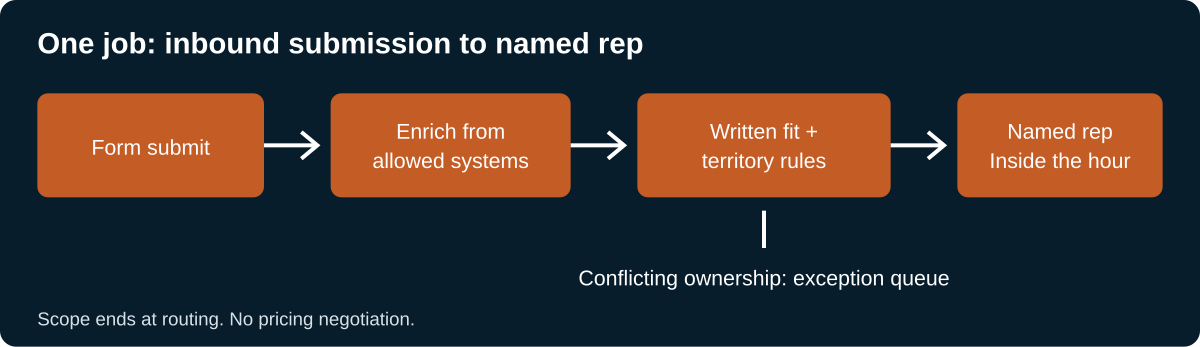
The first worked scene starts with an inbound form submission. The agent enriches the record from allowed systems, checks existing account ownership, applies written fit and territory rules, and prepares the handoff to a named rep inside the hour. Each added field retains its source. Conflicting ownership enters an exception queue. The assignment ends at routing; pricing negotiation remains outside its scope.
Measure submission-to-assignment time, assignment corrections, and unresolved exceptions. Track the rep’s first contact and qualified opportunities separately. A fast assignment cannot compensate for a seller who never follows up, and the agent should not receive credit for revenue it merely touched.
The operational reason to inspect that whole handoff predates agents. Harvard Business Review’s 2011 report described an audit of 2,241 U.S. companies: 37% responded to a web lead within an hour, while 23% never responded. This is historical evidence, not a current industry baseline. Use it to justify checking response coverage as well as routing speed. Establish your own baseline before claiming improvement.
The second worked scene is the Monday search queue. A weekly Search Console monitor flags commercial pages losing impressions. A separate briefing agent prepares refresh briefs with a definition up top and a comparison table where the buying question warrants one. In this workflow example, the strategist keeps five briefs, kills two, and routes the rest to a writer. A separate on-page job prepares internal-link changes for the refreshed pages.
The useful detail is the two killed briefs. Preserve that outcome in the evaluation rather than rewarding every flag with another article. Require comparable reporting periods, affected queries, current page content, and recent site changes. Search Console identifies a decline; it does not establish its cause.
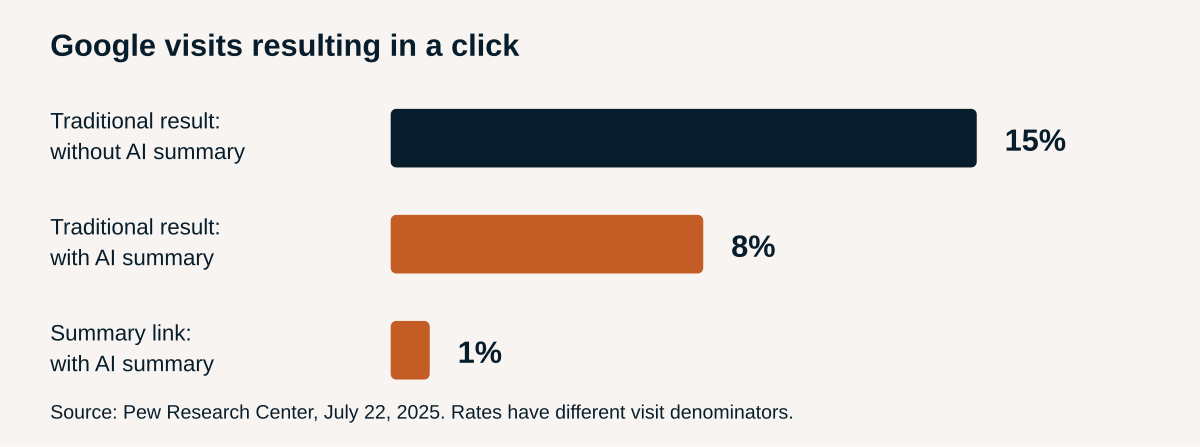
Pew Research Center’s July 2025 analysis found traditional-result clicks on 15% of Google visits without an AI summary versus 8% with one. Summary sources received clicks on about 1% of visits containing a summary. These observed rates do not forecast an agent’s results. They justify tracking answer visibility alongside rankings, clicks, and conversions.
For Single Grain’s queue, a comparison-table recommendation still needs page and query evidence. Our AEO and SEO integration framework connects those objectives, while our SEO workflow guidance helps separate monitoring from briefing and implementation. Keep those assignments distinct so a visibility problem does not automatically become a content-production bill.
Hire vs build
Eric’s recommendation to develop domain expertise before managing agents changes the hiring order. Secure a revenue-operations specialist for routing or a search strategist for refresh work before hiring a generalist agent manager. Someone must recognize a wrong territory assignment or a brief that misses the buying objection.
Buy a platform when the job is standard, the necessary integrations exist, and your operator can inspect the work. Demand a test on your records. A polished demonstration with clean sample data establishes little about conflicting account owners or ambiguous search declines.
Build internally when proprietary rules justify custom control and engineering can maintain the integrations. Budget for credentials, monitoring, recovery, model changes, and the person clearing exceptions. An inexpensive API call can still produce an expensive workflow.
Hire an agency when domain expertise and implementation capacity are both missing. Scope the engagement around a working job, an evaluation set, and transferable configuration and logs. For Single Grain, AI SEO work should connect the search diagnosis to the commercial page and its conversion objective. A generic agent installation does not supply that judgment.
Compare complete operating costs across all three routes. Include software, implementation, operator time, corrections, and integration maintenance. Eric’s one-job rule also makes procurement enforceable: define the accepted output and failure conditions before agreeing to a recurring fee.
Evaluation checklist (no chatbot demos)
Give every candidate the same historical records, source material, and permitted tools. Establish the current process’s baseline first. Test routine work, ambiguous inputs, and broken dependencies. A vendor that handles only the clean path has demonstrated a prototype.
- Job contract: Identify the trigger, inputs, deliverable, exceptions, and business owner.
- Quality: Score routing accuracy or brief usefulness against written criteria. Keep downstream revenue separate.
- Evidence: Trace enriched fields and recommendations to accessible sources and retrieval dates.
- Replay safety: Submit the same event twice. Require no duplicate assignments or briefs.
- Failure handling: Disconnect a source system. Inspect bounded retries, alerts, and recoverable state.
- Economics: Report cost per accepted job, correction minutes, staff hours saved, and unresolved queue age.
- Portability: Export logs, configuration, and work products before signing a long commitment.
Include duplicate submissions and conflicting account ownership in the routing test. Include tracking changes and declines without a clear content problem in the search test. Reward justified exceptions and no-change recommendations. Request the execution trace behind each result.
Use Single Grain’s case studies to assess relevant marketing experience, then request evidence for the proposed workflow. A strong marketing engagement does not automatically validate a production agent. The buying decision should turn on repeatable performance with your inputs.
Human ship gate and when to buy help
In Eric’s discussion of agents earning freedom, the sequence starts with observation, moves to recommendations, and reaches action with approval. The useful operating lesson is the order: the agent first exposes what it sees, then shows what it would change. Deploy read access and recommendations first, so the operator can inspect judgment before granting write permissions.
His human-checkpoint principle adds a contractual requirement: name the actual person authorized to release each class of work. Put the revenue-operations owner’s name on routing changes and the strategist’s and editor’s names on search releases. Agents do not independently send outreach, publish content, or authorize spend. Record approvals, supporting evidence, and a rollback path.
Expand permissions only after the evaluation shows reliable work and manageable exceptions. More completed tasks do not justify broader access if the correction queue grows with them. Recheck accepted-job cost and staff hours, the same measures that made a bounded deployment preferable to organizational theater.
If your team cannot write the job contract or judge the outputs, buy expertise before buying more automation. Talk to Single Grain about one pipeline assignment, its inputs, and its success definition. Start with a workflow worth owning, then decide who should build and operate it.


